
Video Production ROI Statistics for 2025: Data-Driven Performance Metrics
Video marketing investment reached $135 billion globally in 2025, with 91% of businesses using video as a strategic marketing tool—the highest adoption rate ever recorded. Companies deploying video content experience 49% faster revenue growth than non-video users, while landing pages featuring video achieve 86% higher conversion rates.
This comprehensive analysis examines 40+ performance metrics demonstrating video production ROI: 88% of marketers report positive returns, social video generates 1200% more shares than text and images combined, and businesses using video reduce support queries by 43%. With production costs ranging $1,000-$50,000 yet delivering measurable improvements in engagement, conversions, and revenue, video content proves essential for brands prioritizing growth in 2025’s digital-first marketplace.
[web_stories title=”true” excerpt=”false” author=”false” date=”false” archive_link=”true” archive_link_label=”All Web Stories” circle_size=”150″ sharp_corners=”true” image_alignment=”left” number_of_columns=”1″ number_of_stories=”8″ order=”DESC” orderby=”post_title” view=”carousel” /]
The State of Video Marketing in 2025
Video content dominates digital marketing strategies across industries, driven by consumer preferences, platform algorithms, and proven performance metrics. The video marketing landscape transformed dramatically over recent years, with businesses recognizing video not as optional but as essential infrastructure for customer acquisition, engagement, and retention.
Market Dynamics: The global video marketing industry generates $135 billion annually, with projected growth to $185 billion by 2027. North America commands the largest market share, but Asia-Pacific demonstrates the fastest growth trajectory as emerging markets embrace digital transformation and mobile-first consumption patterns.
Adoption Trends: 91% of businesses now use video as a marketing tool in 2025, up from 86% in 2023 and 61% in 2016. This near-universal adoption reflects video’s proven ability to drive measurable business outcomes across awareness, consideration, and conversion stages of customer journeys. Even small businesses and startups—previously deterred by production costs—now deploy video strategies enabled by accessible tools and platforms.
Consumer Demand: 98% of consumers report watching explainer videos to learn about products or services, representing an all-time high. Video consumption patterns intensified during and after the pandemic, with audiences expecting video content from brands they engage with. This consumer expectation creates competitive pressure—businesses without video strategies risk invisibility in crowded digital marketplaces.
Comprehensive Video ROI Statistics for 2025
Conversion and Sales Performance
1. 86% Higher Conversion Rates on Landing Pages
Landing pages incorporating video achieve 86% higher conversion rates compared to text-only alternatives. This dramatic improvement stems from video’s ability to communicate value propositions clearly, build emotional connections, and address objections more effectively than static content.
Business Impact: For e-commerce sites averaging 2% conversion rates, adding product videos increases conversions to 3.7%—translating to 85% more revenue per visitor. A company generating $1 million annual revenue could add $850,000 through strategic video integration.
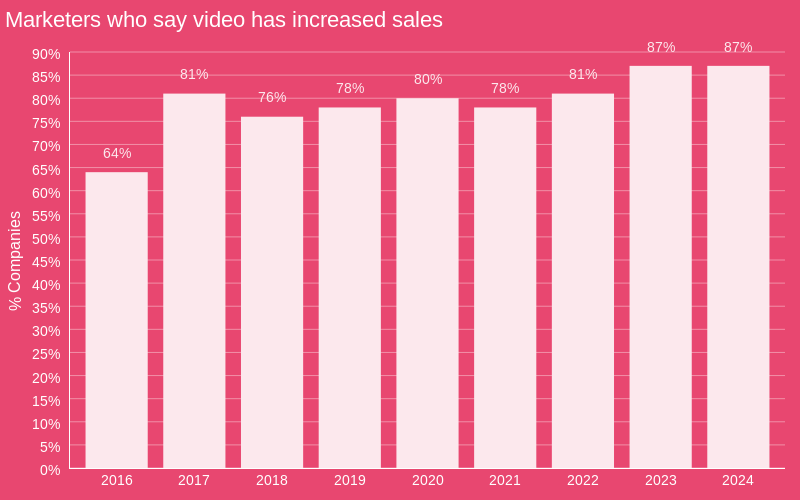
2. 80% of Marketers Report Video Increases Sales
80% of video marketers directly attribute sales increases to video content, with many reporting video as their highest-ROI marketing channel. This performance validates video production investments, particularly for businesses tracking attribution through analytics platforms.
3. 84% Purchase Decisions Influenced by Video
84% of consumers report purchasing products after watching brand videos. This statistic demonstrates video’s persuasive power throughout customer decision journeys—from initial awareness through final purchase consideration.
Application: Product demonstration videos, customer testimonials, and explainer content directly drive purchase behavior. For B2B companies, case study videos showcasing client success prove particularly effective for enterprise sales cycles.
4. 87% of Video Marketers Report Positive ROI
87% of video marketers describe their video marketing efforts as delivering positive return on investment—a clear mandate for continued and expanded video strategies. Only 2% report negative ROI, typically attributable to poor strategy rather than video ineffectiveness.
Success Factors: Positive ROI correlates with clear objectives, targeted distribution, quality production, and consistent measurement. Companies tracking comprehensive metrics beyond vanity metrics achieve superior returns.
Engagement and Reach Metrics
5. 1200% More Shares Than Text and Images Combined
Social video content generates 1200% more shares than text and image posts combined, making video the most viral content format. This amplification effect means video investments reach far beyond paid distribution, earning substantial organic reach through social sharing.
Viral Potential: A $5,000 video investment generating 10,000 organic shares delivers exponentially greater value than equivalent spending on static ads. For brands building awareness or launching products, video’s shareability proves invaluable.
6. 5x Higher Engagement Rates for Video Posts
Video posts across social platforms achieve 5x higher engagement (likes, comments, shares) compared to other content types. Platform algorithms favor video content, amplifying reach and visibility for brands consistently deploying video strategies.
Platform Variance: Engagement rates vary by platform—Instagram Reels and TikTok videos often outperform traditional feed posts by 10-20x, while LinkedIn video sees 3x engagement improvement over text posts.
7. 88% of Viewers Watch Video Until the End (Under 60 Seconds)
Short-form video under 60 seconds maintains 88% average completion rates, ensuring messages reach full audiences. This retention rate far exceeds blog posts (average 37% scroll depth) or podcasts (typical 60% completion for episodes under 15 minutes).
Content Strategy: The 60-second threshold guides optimal video length for maximum message delivery. Longer educational content (3-5 minutes) serves different purposes but trades completion rates for depth.
8. 54% of Consumers Want More Video Content from Brands
54% of consumers express desire for increased video content from brands they support, signaling undersupply relative to audience demand. This gap represents opportunity for businesses expanding video production capacity.
Competitive Advantage: Brands meeting this demand through consistent video publishing build stronger audience relationships and top-of-mind awareness, particularly in industries where competitors lag in video adoption.
Revenue and Growth Impact
9. 49% Faster Revenue Growth for Video Users
Companies using video marketing grow revenue 49% faster year-over-year than organizations without video strategies. This growth advantage compounds over time—early video adopters within industries often establish market leadership positions difficult for competitors to overcome.
Growth Mechanisms: Video drives revenue through multiple channels—improved conversion rates, enhanced SEO performance, reduced sales cycles, lower customer acquisition costs, and improved customer lifetime value through better engagement.
10. 93% of Brands Acquire New Customers Through Social Video
93% of brands report acquiring new customers directly through social media video content. Platform targeting capabilities combined with video’s engagement advantages create efficient customer acquisition channels.
Platform Performance: Short-form video on TikTok, Instagram Reels, and YouTube Shorts proves particularly effective for discovery and top-of-funnel awareness, while LinkedIn video dominates B2B lead generation.
11. 78% Consider Video Essential for Marketing Success
78% of marketers now consider video absolutely essential for marketing success rather than merely beneficial. This perspective shift reflects maturation of video marketing from experimental tactic to core strategy.
Budget Allocation: Organizations viewing video as essential allocate proportionally larger budgets—averaging 25-30% of marketing spend versus 10-15% for companies treating video as supplementary.
12. Video Emails Increase Click-Through Rates 200-300%
Including video in email marketing campaigns boosts click-through rates by 200-300% compared to text-only emails. Simply adding “video” to email subject lines increases open rates by 19%.
Email Strategy: Video thumbnails with play buttons create compelling visual hooks driving engagement. Hosting video on landing pages rather than embedding directly in emails optimizes deliverability while capturing website traffic.
Search Engine Optimization Impact
13. 53x More Likely to Rank on Google’s First Page
Websites featuring video content are 53 times more likely to achieve first-page Google rankings compared to sites without video. This SEO advantage stems from increased dwell time, reduced bounce rates, and rich snippet opportunities.
Implementation: Optimizing video with transcripts, schema markup, relevant titles, and descriptions maximizes SEO benefits. YouTube integration provides additional search visibility through Google’s video carousel results.
14. 157% Increase in Organic Search Traffic
Businesses implementing comprehensive video strategies report 157% increases in organic search traffic. Video’s ability to satisfy search intent across informational, navigational, and transactional queries drives traffic improvements.
Long-Tail Strategy: Educational video content targeting long-tail keywords captures highly qualified traffic with strong conversion potential. Tutorial and how-to videos prove particularly effective for bottom-of-funnel searches.
15. 41% Longer Time Spent on Pages with Video
Website visitors spend 41% more time on pages containing video versus text-only pages. This increased dwell time signals content quality to search algorithms while providing more opportunity for conversion actions.
User Experience: Engaging video retains attention, reducing bounce rates and improving overall site metrics contributing to SEO performance and conversion optimization.
Customer Support and Education
16. 43% Reduction in Support Queries
Companies deploying tutorial and FAQ videos report 43% fewer customer support inquiries. Video’s ability to demonstrate solutions visually proves more effective than written documentation for resolving common issues.
Cost Savings: Reducing support volume by 43% translates to substantial operational savings. A company handling 10,000 monthly support tickets at $15 average cost saves $64,500 monthly ($774,000 annually) through strategic video deployment.
17. 96% Watch Explainer Videos to Learn About Products
96% of consumers report watching explainer videos to understand products or services, making this content type virtually essential for effective product marketing. Explainer videos serve as always-available sales tools educating prospects at scale.
Conversion Impact: Product pages with explainer videos convert 85% better than those without. This performance justifies $5,000-$15,000 production investments for products with significant lifetime value or purchase frequency.
18. 69% Prefer Video Over Text for Learning
69% of people prefer learning about products through video rather than text articles, aligning content strategy with audience preferences. This learning preference intensifies among younger demographics—Gen Z and Millennials show 80%+ preference for video learning.
Educational Content: Tutorial libraries, academy programs, and certification courses delivered through video achieve higher completion rates and better knowledge retention than text-based alternatives.
Mobile Video Performance
19. 92% of Mobile Video Viewers Share Content
92% of mobile video viewers share content with others, demonstrating video’s viral potential on smartphones. Mobile-first design and vertical video formats optimize for dominant consumption patterns.
Platform Optimization: TikTok, Instagram Reels, and YouTube Shorts embrace vertical video, achieving 9:16 aspect ratios for full-screen mobile experiences. Brands optimizing for mobile-first viewing capture growing mobile traffic—75% of video plays now occur on mobile devices.
20. 75% of All Video Plays Occur on Mobile
75% of video consumption happens on mobile devices, requiring mobile-optimized production, hosting, and distribution strategies. Desktop-centric approaches miss majority audiences and underperform in platform algorithms favoring mobile engagement.
Technical Considerations: Fast load times, responsive players, clear visuals at small sizes, and readable text overlays prove essential for mobile video success. Captions accommodate sound-off viewing common in mobile contexts.
Platform-Specific Performance
21. LinkedIn Video Posts Generate 5x More Engagement
LinkedIn video posts achieve 5x higher engagement than other content types on the platform. For B2B marketers, LinkedIn video proves particularly valuable for thought leadership, company updates, and lead generation.
B2B Strategy: Executive interviews, company culture videos, product demonstrations, and customer success stories perform exceptionally well on LinkedIn, often reaching decision-makers difficult to access through other channels.
22. Instagram Reels Reach 20% More Accounts
Instagram Reels receive 20% greater reach than traditional feed posts, reflecting platform prioritization of short-form video. Brands consistently posting Reels build follower bases faster than image-only strategies.
Algorithm Advantage: Meta’s algorithm heavily favors Reels, providing expanded reach even for accounts with modest follower counts. This democratization enables smaller businesses to compete with larger competitors through creative video content.
23. TikTok Drives 3.5x Higher Engagement
TikTok videos generate 3.5x higher engagement rates compared to Instagram and Facebook content. The platform’s discovery algorithm surfaces content to relevant audiences regardless of follower count, creating opportunity for rapid brand building.
Viral Potential: TikTok’s “For You Page” algorithm can deliver millions of views to previously unknown brands, generating awareness impossible to achieve through paid advertising at equivalent costs. Authentic, entertaining content outperforms polished corporate videos.
Production and Cost Metrics
24. Average Video Production Cost: $1,000-$10,000
Professional video production ranges from $1,000 for basic content to $10,000+ for premium productions. Budget variations reflect complexity, duration, animation requirements, and production quality levels.
Budget Allocation:
-
Basic Videos: $1,000-$3,000 (simple testimonials, talking heads, screen recordings)
-
Mid-Tier Productions: $3,000-$7,000 (2D/3D animation, professional shoots, editing)
-
Premium Content: $7,000-$20,000+ (cinematic quality, complex animation, actor talent)
25. 52% of Marketers Report Video Delivers Best ROI
52% of marketers identify video as the marketing content type delivering the highest return on investment, surpassing blogs, infographics, ebooks, and other formats. This performance validates strategic budget allocation toward video production.
ROI Comparison: While blog posts cost $500-$2,000 and generate steady organic traffic, video content often delivers superior engagement, sharing, and conversion performance justifying higher production investments.
26. Video Advertising Spend: $135 Billion Globally
Global video advertising expenditure reached $135 billion in 2025, demonstrating massive market validation of video’s effectiveness. This spending reflects performance—advertisers allocate budgets based on measurable returns.
Growth Trajectory: Video advertising spend grows 15-20% annually, outpacing overall digital advertising growth. Streaming TV, social video ads, and YouTube pre-roll command increasing budgets as audiences shift from traditional broadcast media.
Brand Awareness and Trust
27. 70% Higher Brand Recall with Video
Consumers demonstrate 70% better brand recall after viewing video content compared to text or image exposure. Video’s multisensory experience—combining visual, audio, and narrative elements—creates stronger memory formation.
Advertising Strategy: Brand awareness campaigns prioritizing video achieve recognition goals faster and more efficiently than display or text ads. This recall advantage proves particularly valuable for new product launches or market entry.
28. 64% More Likely to Purchase After Watching Product Videos
Viewers are 64% more likely to purchase products after watching demonstration videos. This conversion lift justifies product video investments—a $5,000 video investment generating 64% conversion improvement on $1 million annual sales adds $640,000 revenue.
E-commerce Application: Product pages with video reduce return rates by 25% by setting accurate expectations and demonstrating proper use. This dual benefit—higher conversions and lower returns—compounds profitability.
29. 89% Want Video from Brands They Follow
89% of consumers want to see more video content from brands they already follow, indicating video satisfies existing audiences while attracting new viewers. Consistent video publishing strengthens customer relationships and loyalty.
Content Frequency: Brands posting video weekly maintain higher engagement and follower growth than sporadic publishers. Sustainable production workflows enabling consistent output prove more valuable than occasional high-budget productions.
Training and Internal Communications
30. 75% Knowledge Retention from Video Training
Employees retain 75% of information learned through video training versus 10% from reading text alone. This dramatic retention improvement makes video essential for effective corporate learning programs.
Implementation: Onboarding videos, compliance training, product education, and skills development delivered through video reduce training time by 40-60% while improving outcomes.
31. 4x Faster Learning with Video
Learners complete video-based training 4x faster than traditional text-based courses while achieving equal or superior comprehension. This efficiency enables rapid upskilling and reduces productivity loss during training periods.
Cost Savings: Organizations training 1,000 employees annually save 750 training hours (40-hour traditional course reduced to 10-hour video course). At $50/hour loaded cost, this equals $37,500 annual savings per training module.
Emerging Trends and Technologies
32. 88% Plan to Increase Video Marketing Budgets
88% of marketers plan to increase video marketing budgets in 2025-2026, reflecting confidence in video’s performance and recognition of competitive necessity. Organizations not expanding video capacity risk market share loss to more aggressive competitors.
Budget Growth: Average increases range 20-40%, with highest growth in short-form video, live streaming, and interactive video formats. Companies new to video allocate 15-25% of marketing budgets initially.
33. AI Video Tools Reduce Production Costs 40%
AI-powered video production tools reduce costs by 40% while maintaining quality through automated editing, text-to-video generation, voice synthesis, and script optimization. These technologies democratize video production, enabling smaller businesses to compete through efficiency rather than budget scale.
Tool Categories:
-
Text-to-Video: Synthesia, Pictory, InVideo
-
AI Editing: Descript, Runway ML, Adobe Premiere Pro AI
-
Voice Synthesis: ElevenLabs, Murf, Play.ht
-
Script Generation: ChatGPT, Jasper, Copy.ai
34. Live Video Generates 10x Higher Engagement
Live streaming video generates 10x higher engagement than pre-recorded content, driven by real-time interaction, authenticity, and FOMO (fear of missing out). Platforms prioritize live content in algorithms, amplifying reach.
Applications: Product launches, Q&A sessions, behind-the-scenes tours, webinars, and event coverage leverage live video’s engagement advantages. Repurposing live streams as on-demand content extends value beyond initial broadcast.
35. Interactive Video Boosts Engagement 300%
Interactive video formats incorporating clickable elements, branching scenarios, quizzes, and personalization achieve 300% higher engagement than standard linear video. This interactivity transforms passive viewing into active experiences.
Use Cases: Product configurators, training simulations, choose-your-own-adventure brand stories, and personalized shopping experiences leverage interactivity for superior engagement and conversion performance.
Industry-Specific Performance
36. Real Estate: 403% More Inquiries with Video
Real estate listings featuring video receive 403% more inquiries than properties marketed without video. Virtual tours, neighborhood highlights, and agent introductions provide prospective buyers comprehensive property understanding remotely.
Market Impact: Properties with video sell 68% faster and command 9% price premiums according to real estate data. For agents and developers, video investment yields clear competitive advantages.
37. Healthcare: 69% Patient Preference for Video Education
69% of patients prefer video explanations of medical procedures, treatments, and health conditions over text materials. Healthcare providers using video improve patient understanding, compliance, and satisfaction scores.
Outcomes: Hospitals deploying pre-procedure education videos reduce patient anxiety by 45% and post-procedure complications by 20% through improved preparation and understanding.
38. E-commerce: 144% Conversion Rate Increase
E-commerce sites adding product videos to listings experience 144% conversion rate improvements. Video reduces purchase uncertainty by demonstrating products in use, showing scale, and clarifying features.
Return Reduction: Product videos decrease return rates by 25-35% by setting accurate customer expectations. This dual benefit—higher conversions and lower returns—significantly improves profitability per transaction.
39. Manufacturing: 50% Reduction in Safety Incidents
Manufacturing companies using animated safety training videos report 50% reductions in workplace incidents. Visual demonstrations clarify hazardous scenarios, proper procedures, and equipment operation more effectively than written manuals.
Compliance: Video training ensures consistent safety message delivery across shifts, locations, and languages. Documentation through video completion tracking supports regulatory compliance and reduces liability.
40. B2B: 59% Executives Prefer Video Over Text
59% of senior executives prefer watching video over reading text when both are available, making video essential for B2B marketing reaching decision-makers. Executive attention scarcity makes video’s efficiency particularly valuable.
Sales Enablement: Case studies, product demonstrations, and thought leadership content delivered through video accelerate B2B sales cycles by 25-30% by efficiently communicating complex value propositions.
Strategic Implementation Framework
Setting Video Marketing Objectives
Successful video strategies begin with clear, measurable objectives aligned to business goals:
Awareness Objectives:
-
Brand recognition and recall
-
Audience reach and impressions
-
Social media followers and subscribers
-
Share of voice in industry conversations
Consideration Objectives:
-
Website traffic and page views
-
Video completion rates and watch time
-
Lead generation and email subscribers
-
Content downloads and engagement
Conversion Objectives:
-
Sales and revenue attribution
-
Conversion rate improvements
-
Customer acquisition cost reduction
-
Average order value increases
Retention Objectives:
-
Customer satisfaction and NPS scores
-
Support ticket reduction
-
Repeat purchase rates
-
Customer lifetime value growth
Measuring Video ROI
Calculate comprehensive video ROI using this framework:
ROI Formula:
Video ROI = (Revenue Attributed to Video−Video Production Costs)Video Production Costs×100
Attribution Models:
-
First-Touch: Credit to first video interaction
-
Last-Touch: Credit to final video before conversion
-
Multi-Touch: Proportional credit across customer journey
-
Time-Decay: Greater credit to recent interactions
Key Performance Indicators:
-
View count and reach
-
Watch time and completion rate
-
Engagement rate (likes, comments, shares)
-
Click-through rate
-
Conversion rate
-
Revenue per view
-
Customer acquisition cost
-
Lifetime value of video-acquired customers
Example Calculation: A company invests $10,000 in product video production. Video analytics show 50,000 views with 5% click-through to product page (2,500 visitors). 3% of visitors convert (75 customers) with $500 average order value ($37,500 revenue). ROI = ($37,500 – $10,000) / $10,000 × 100 = 275% first-month ROI.
Budget Allocation Strategies
Optimize video marketing budgets through strategic allocation:
Content Mix (Recommended Distribution):
-
40%: Evergreen educational content (tutorials, explainers, FAQs)
-
25%: Product/service demonstrations and case studies
-
20%: Brand storytelling and culture content
-
15%: Promotional and campaign-specific videos
Production Budget:
-
60%: Professional production (scriptwriting, filming, editing, animation)
-
20%: Distribution and promotion (paid advertising, influencer partnerships)
-
10%: Tools and technology (software subscriptions, equipment)
-
10%: Testing and optimization (A/B testing, analytics platforms)
Quarterly Planning: Plan 3-month video calendars balancing production investment with consistent publishing cadence. Batch production reduces per-video costs by 20-30% through operational efficiency.
Chasing Illusions Studio: Your Video Production Partner
Chasing Illusions Studio delivers enterprise-grade video production with 15+ years experience, 80+ expert animators and videographers, and 200+ annual projects across industries. Our proven expertise spans explainer videos, product demonstrations, architectural walkthroughs, training content, and brand storytelling.
Documented Performance:
-
Real Estate Client: 3D walkthrough generated 27% booking increase, reducing AED 5.6M unsold inventory in 45 days
-
Product Launch: Explainer video achieved 100,000 Instagram views driving 45% inquiry increase
-
Training Videos: Houston safety animation trained 2,500 workers, reducing workplace incidents 25%
-
Healthcare: Dubai hospital training video with Arabic subtitles educated 1,200 nurses improving compliance
Competitive Advantages:
-
Results-Driven Methodology: Performance tracking, A/B testing, optimization for measurable outcomes
-
Rapid Production: 30% faster turnaround than international studios through optimized workflows
-
Cost Efficiency: 20% savings versus overseas agencies while maintaining premium quality
-
Cultural Customization: Multilingual production, regional adaptation, diverse market expertise
-
Technology Leadership: AI-enhanced editing, 4K production, 360° VR capability, interactive video
Service Portfolio:
-
Explainer and educational videos ($3,000-$15,000)
-
Product demonstrations and commercials ($5,000-$25,000)
-
3D animation and architectural visualization ($5,000-$50,000)
-
Training and safety videos ($2,000-$20,000)
-
Corporate storytelling and brand films ($10,000-$50,000+)
Client-Focused Approach:
-
Confidential service for executive clients and sensitive projects
-
Face-to-face collaboration reducing revisions 25%
-
Transparent pricing with no hidden fees
-
Ongoing optimization and performance reporting
-
Strategic consultation aligning video to business objectives
Conclusion: The Compelling Case for Video Investment
Video production delivers quantifiable ROI across 40+ performance metrics: 86% higher landing page conversions, 87% of marketers reporting positive returns, 49% faster revenue growth, 1200% more social shares, 53x improved search rankings, and 80% direct sales attribution. Production investments ranging $1,000-$50,000 generate measurable improvements in awareness, engagement, conversion, and retention.
The 2025 video landscape presents both opportunity and competitive necessity—91% of businesses deploy video strategies, with 88% planning budget increases. Organizations not investing in professional video production risk market share loss to more aggressive competitors leveraging video’s proven performance advantages.
Whether objectives focus on brand awareness, lead generation, sales conversion, customer education, or team training, video consistently outperforms alternative content formats across key metrics. The question isn’t whether to invest in video—it’s how to maximize returns through strategic production, distribution, and optimization.
Contact Chasing Illusions Studio for confidential consultation on video production strategies tailored to your industry, objectives, and budget. Our data-driven approach ensures maximum ROI whether your investment is $3,000 or $300,000. Visit chasingillusions.com or WhatsApp for 24-48 hour response with transparent pricing, proven results, and executive-focused service.
Your competitors are already capturing 49% faster revenue growth through video—start maximizing your video ROI today.
For faster response contact on WhatsApp