The North American 3D rendering services market was valued at $4.8 billion in 2026 and is projected to expand to $18.54 billion by 2035 at a 16.20% CAGR, making the US the world's largest individual market for professional rendering. Demand is driven by the architecture and construction sector, the real estate marketing industry, product visualization for e-commerce and advertising, and an industrial design segment that increasingly commissions CGI before physical prototyping.
For US architects, property developers, product designers, and marketing teams evaluating 3D rendering services, the market in 2026 presents options at dramatically different price points — from sub-$300 AI-assisted renders to $10,000+ per finished minute of cinematic walkthroughs from premium studios. Understanding what drives the cost difference, what the market charges at each quality tier, and when offshore production is a credible alternative to US-based studios is the starting point for commissioning effectively.
This guide covers US market context, verified 2026 pricing across all project types, what drives cost variation, the honest US versus offshore comparison, key considerations by city, and how to evaluate and brief a rendering partner.
The US 3D Rendering Market in 2026
North America held 33.88% of the global 3D rendering and visualization software market in 2025, driven by the technological leadership of the US and growing demand for architectural visualization across real estate, construction, and engineering.
Three factors are shaping US demand in 2026 specifically.
Pre-construction sales have become the primary use case. US residential and commercial developers increasingly sell units before buildings are complete. In competitive urban markets — Miami condominiums, Dallas mixed-use, Austin multifamily — buyers and investors expect immersive 3D walkthroughs and virtual tours as standard marketing assets. Buyers now expect immersive visuals rather than traditional floor plans, making architectural visualization a critical part of successful real estate marketing campaigns across the country.
FTC compliance has entered the conversation. The US Federal Trade Commission's updated advertising disclosure rules now classify undisclosed photorealistic renderings as potentially deceptive trade practices when consumers cannot distinguish CGI from photography. US developers and their marketing teams need to work with studios that understand and document the CGI origin of visualization assets used in consumer-facing campaigns.
Offshore rendering has become mainstream. India's architectural visualization sector has matured significantly, and US clients commissioning production from India-based studios at 35–50% lower cost for equivalent quality is now a documented market trend. India's 3D rendering market is expanding because of increasing rendering service outsourcing from international clients, including a growing volume from US architecture and development firms.
Who Commissions 3D Rendering in the USA
Residential developers and homebuilders commission exterior and interior renders for pre-sales marketing, model home virtual tours, and buyer presentation materials. The primary output is photorealistic stills and 60–120 second walkthroughs. The key requirement is lifestyle appeal alongside technical accuracy.
Commercial developers and REITs commission rendering for investor presentations, planning board submissions, leasing marketing, and tenant pre-qualification. Commercial rendering often requires greater contextual accuracy — showing the building in its actual urban environment and demonstrating compliance with local planning requirements.
Architects and design firms commission rendering at multiple project stages — concept visualization for client approval, detailed renders for planning submissions, and marketing-quality output for award submissions and portfolio development.
Product designers and manufacturers commission product CGI for e-commerce listings, launch campaign materials, and technical marketing — replacing or supplementing photography for products not yet manufactured, produced in too many variants for photography to cover, or requiring internal and exploded views.
Marketing agencies and brand teams commission rendering for advertising campaigns where CGI offers creative flexibility, cost efficiency, or visual quality that photography cannot deliver.
Industrial and manufacturing companies commission plant and facility visualization for investor presentations, regulatory submissions, and operator training — the category with the most specific technical accuracy requirements.
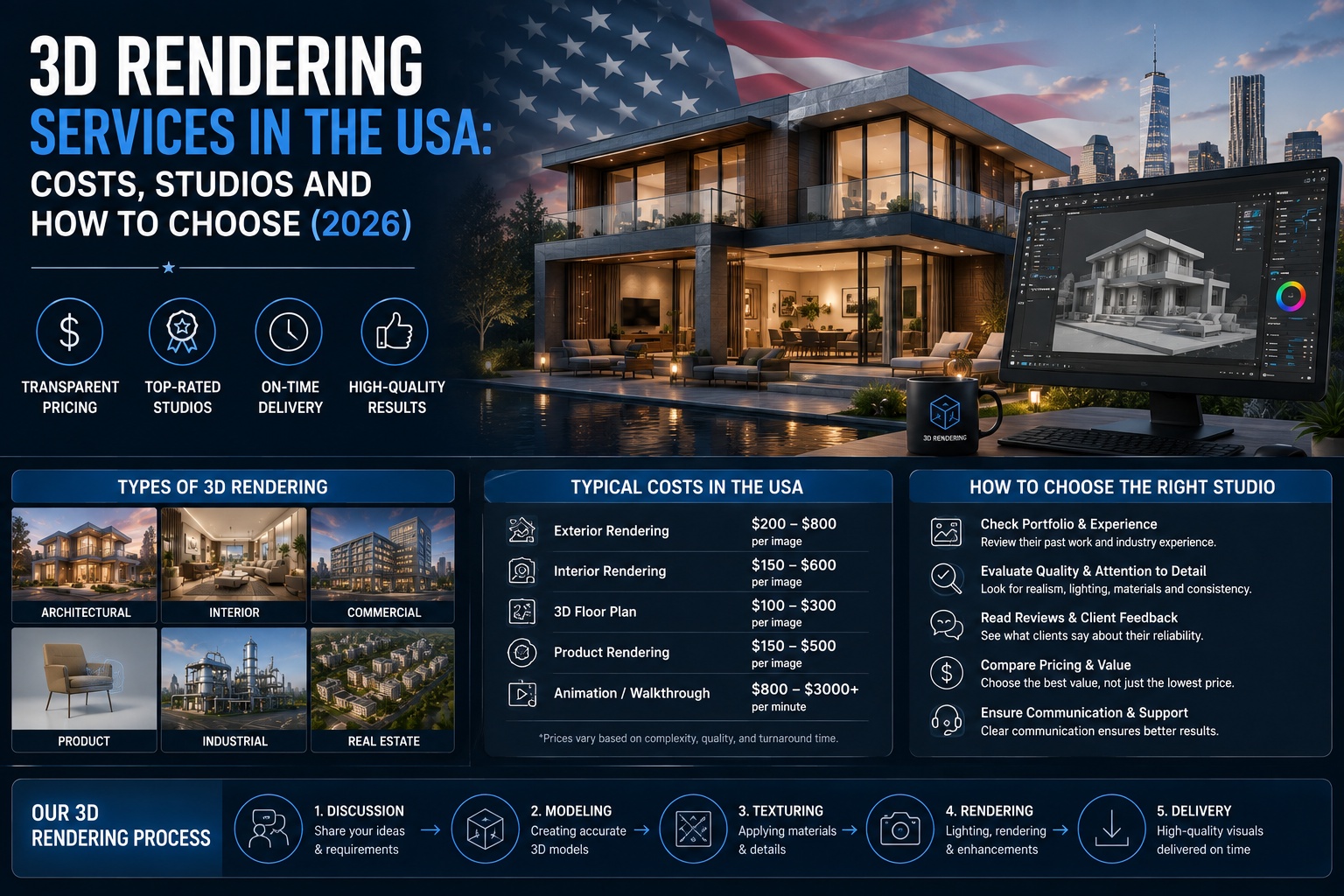
3D Rendering Cost in the USA: 2026 Verified Price Reference
The following ranges are compiled from published pricing guides across multiple US-based rendering studios and independent market research as of mid-2026.
Still Images (Per View)
Image Type | Budget | Mid-Market | Premium |
|---|---|---|---|
Interior render | $249 – $600 | $600 – $1,500 | $1,500 – $2,500 |
Exterior render | $499 – $800 | $800 – $2,500 | $2,500 – $4,000 |
Aerial / bird's-eye | $750 – $1,500 | $1,500 – $3,000 | $3,000 – $5,000+ |
3D floor plan | $300 – $600 | $600 – $1,200 | $1,200 – $1,500 |
Virtual staging (per room) | $60 – $300 | $300 – $800 | $800 – $1,800 |
Animation and Walkthroughs
Format | Budget | Mid-Market | Premium |
|---|---|---|---|
60-second walkthrough | $3,000 – $5,000 | $5,000 – $8,000 | $8,000 – $15,000 |
2-minute walkthrough | $6,000 – $10,000 | $10,000 – $18,000 | $18,000 – $35,000 |
360° interactive tour | $700 – $2,500 | $2,500 – $6,000 | $6,000 – $12,000 |
VR experience (full interactive) | $15,000 – $25,000 | $25,000 – $50,000 | $50,000+ |
Per finished minute (cinematic) | $3,000 – $5,000 | $5,000 – $10,000 | $10,000 – $15,000+ |
What Drives the Cost Difference
Price ranges across US rendering studios are wide enough that two quotes for the same project can differ by 300–500%. Understanding the drivers explains the gap.
Model complexity. A building with a straightforward rectangular envelope and standard materials renders faster than a curved glass tower with bespoke cladding, complex landscaping, and multiple material variants. Model complexity is the primary driver of production time — and time is the primary driver of cost.
Level of photorealism required. Budget renders use pre-built asset libraries and simplified lighting. Premium renders use custom-modelled elements, physically based materials calibrated to actual specification, and multi-pass lighting that simulates real-world conditions. The difference is visible at the pixel level, and it matters commercially when the visualization is the primary decision-making tool for a buyer or investor.
Number of views. Pricing is usually calculated per view — each camera angle requires separate setup, lighting balancing, and rendering optimization. A development needing twelve exterior views and eight interior renders will cost significantly more than one needing two exterior views and one interior.
Animation versus stills. Animation requires every frame to be rendered individually — 24 to 30 frames per second, meaning a 60-second walkthrough requires 1,440 to 1,800 individual rendered frames. This is why animation costs multiples of still-image production at every quality tier.
Timeline. A standard 7–10 day delivery timeline is far more cost-effective than a 48-hour rush. Rush delivery adds 30–50% to most studio quotes across the US market. Planning with adequate lead time is the most effective cost management strategy available.
Studio tier. The US market spans from freelancers at $30–$60 per hour to premium studios charging $150+ per hour with minimum project budgets in the tens of thousands. The right tier depends on the commercial purpose — a planning application needing technical accuracy but not lifestyle appeal does not require a premium studio's brand-forward output.
US Studio vs India-Based Studio: Honest Comparison
A meaningful share of US 3D rendering work — particularly in architectural and product visualization — is now commissioned from India-based studios. Understanding the actual tradeoffs helps US clients decide based on their specific needs rather than defaulting to geography.
Cost Differential
India-based professional rendering studios serving US clients typically charge 35–50% less than equivalent-tier US studios for the same scope and quality. For a 60-second architectural walkthrough, a US mid-market studio might quote $6,000–$9,000. An India-based studio at equivalent quality typically quotes $3,500–$5,500 for the same scope.
For high-volume requirements — a developer with ten residential units, a manufacturer with a product line needing CGI across multiple SKUs — this cost differential compounds significantly.
Timezone Reality
India is 9.5 to 12.5 hours ahead of US time zones. This means US clients send feedback at end of business day, the India team produces overnight, and updated assets arrive the following US morning. For iterative production with clear milestone deliverables and adequate lead time, this is a workable rhythm. For same-day iterations or last-minute changes, a US-based studio is operationally preferable.
Quality Reality
At the professional production tier, India-based studios use identical software — Unreal Engine 5, V-Ray, Corona Renderer, 3ds Max — to US studios and produce output that is technically indistinguishable for photorealistic architectural and product visualization.
The quality gap that does exist is primarily in local context knowledge. A US studio familiar with Miami's luxury condo aesthetic, New York's residential vernacular, or Dallas's suburban commercial character brings implicit understanding that reduces briefing overhead. An India-based studio requires more specific direction on US market aesthetics — achievable with clear reference images and a detailed brief.
For US developers with clear briefs, structured review processes, and projects where technical quality matters more than creative direction, India-based rendering delivers compelling value. Our architectural walkthrough services serve US clients from our Delhi production facility with USD pricing, English communication, and delivery schedules aligned to US project timelines.
Key US Markets — What Each Demands
New York and Northeast
Dense urban residential and commercial development drives volume. Planning board submissions, investor presentation materials, and pre-construction luxury condo marketing are the primary briefs. Renders must show buildings in accurate urban context — the relationship to streetscape, neighboring buildings, and public realm matters as much as the building itself.
Miami and South Florida
Pre-construction luxury residential dominates. International buyer audiences — Latin American and European — mean multilingual narration capability is genuinely useful. Virtual tours and VR experiences for overseas buyers who make purchase decisions remotely are more common here than in most other US markets.
Dallas-Fort Worth and Texas
Texas-based custom home builders and developers frequently commission 3D visualization for luxury residential projects before construction starts, reducing design confusion and accelerating client approvals. The Texas market also includes significant industrial visualization demand from oil, gas, and manufacturing sectors concentrated in the region.
Los Angeles and California
Entertainment-adjacent CGI sophistication raises buyer expectations. Cinematic-quality walkthroughs are effectively the standard in LA's luxury residential market. The entertainment industry's proximity means clients in this market have higher visual literacy and more demanding quality expectations than equivalent buyers in other US cities.
Chicago and Midwest
Corporate headquarters, mixed-use development, and institutional buildings drive the commercial rendering segment. Planning submissions and investor presentations are typically the primary use case, with lifestyle marketing being secondary to technical accuracy.
FTC Compliance — What US Developers Need to Know
The Federal Trade Commission's updated advertising disclosure guidelines now explicitly address synthetic imagery in real estate and consumer product marketing. FTC enforcement has classified undisclosed photorealistic renderings as potentially deceptive trade practices when consumers cannot distinguish CGI from photography.
For US developers and marketing teams using 3D rendering in consumer-facing campaigns, this means in practice:
Renders used in listings, advertisements, and consumer-facing marketing should be labeled as computer-generated imagery or architectural visualization
Material specifications shown must reflect the actual delivered specification, not an idealized version
Renders used in pre-construction sales should be consistent with the planning-approved design
Working with a studio that understands these requirements — and can produce renders that are both visually compelling and defensible under FTC scrutiny — is increasingly a practical requirement for US developers in consumer-facing contexts.
How to Choose a 3D Rendering Studio for Your US Project
Match the studio to your project type. A studio specializing in luxury residential may not have the technical knowledge for an industrial facility visualization. A studio experienced with planning submissions may not produce the lifestyle-oriented output your marketing team needs for a consumer campaign. Request portfolio examples in your specific project category.
Understand the pricing model. Standard per-image pricing runs $600–$2,500 for interior and $800–$4,000 for exterior at professional tier — ideal for architects and developers needing one to six polished images for marketing or planning. Package pricing — multiple images bundled at a lower per-image rate — suits developers with volume requirements.
Clarify what is included. Revision rounds, alternative lighting options, social media crops, and source file delivery are all items that may or may not be included depending on the studio's standard contract. Get this in writing before production begins.
Plan for your actual timeline. Most professional US studios deliver single stills in 5–10 working days and 60-second walkthroughs in 3–5 weeks. Rush delivery adds significant cost. Planning with adequate lead time is the single most effective cost management decision available.
Evaluate FTC compliance readiness. For consumer-facing US marketing, confirm the studio understands and can support CGI disclosure requirements. A studio that cannot confirm the render origin certification process is an operational risk for US clients in regulated advertising contexts.
Understanding the full range of 3D visualization types and what each involves is useful context before briefing any studio — it helps you specify exactly what you need rather than relying on the studio to interpret a vague brief.
Frequently Asked Questions
How much does 3D rendering cost in the USA in 2026?
Professional architectural renders run $300–$1,500 per still image for standard quality, $1,500–$3,000 for premium marketing shots, and $3,000+ for large commercial aerials. Walkthrough animations run $3,000–$5,000 per finished minute for functional quality and $5,000–$10,000 for full architectural animation. VR experiences run $15,000–$30,000+ depending on interactivity. India-based studios at equivalent quality run 35–50% lower across all categories.
What is the difference between a basic render and a premium render in the US?
Budget renders use pre-built asset libraries and simplified lighting — suitable for regulatory approvals and early concept validation at $250–$600 per image. Premium renders use custom-modelled elements, physically based materials calibrated to actual specification, and multi-pass lighting simulating real conditions — priced at $1,500–$3,000+ per image. The commercial difference is significant when the render is the primary decision-making tool for a buyer or investor rather than a design concept illustration.
How long does a 3D rendering take in the USA?
Single still renders: 5–10 working days. A package of 4–6 exterior and interior views: 1–2 weeks. A 60-second walkthrough: 3–5 weeks from approved brief. A 2-minute cinematic walkthrough: 5–8 weeks. VR experiences: 8–14 weeks. Rush delivery adds 30–50% to standard pricing at most studios.
Is it worth using an India-based studio for US architectural rendering?
For US developers with clear briefs, structured review processes, and projects requiring photorealistic technical quality, India-based rendering studios deliver equivalent output at 35–50% lower cost. The practical tradeoffs are timezone-separated collaboration (India is 9.5–12.5 hours ahead) and the need for more specific briefing on US market aesthetics. For developers with adequate lead time and structured review processes, the offshore model is increasingly common across the US market.
What does the FTC require for CGI renders in US advertising?
The FTC's updated guidelines require that photorealistic CGI renders in consumer-facing marketing be clearly identified as computer-generated imagery. Material specifications shown must reflect the actual delivered specification. For real estate pre-construction marketing, renders should be consistent with the planning-approved design. Working with a studio that can document CGI origin is a practical compliance requirement for consumer-facing campaigns.
What file inputs does a US rendering studio need?
For architectural rendering: drawings in DWG, PDF, or DXF format, elevation drawings, site plan, material and finish specifications, and style reference images. For product rendering: CAD files and material specifications. 3D CAD models in Revit, Rhino, or SketchUp reduce production time by 25–40% and improve accuracy compared to 2D drawing inputs alone.
3D Rendering for Your US Project
Chasing Illusions Studio serves US architects, property developers, and product companies from our production facility in Delhi — delivering photorealistic architectural renders, product visualization, medical animation, and industrial visualization with USD pricing, English communication, and delivery timelines calibrated to US project schedules.
Request a custom quote within 24 hours →
Ready to discuss a rendering project for your jewelry line? [Get a Quote →]
📞 +91-9910911696 | +91-9910660851
📩 info [@] chasingillusions [.] in
Written by Deepak, Content Strategist at Chasing Illusions Studio, who leads content for clients including Ambler Surgical, Practo, Bayer, SMT, Novartis, and 100+ brands across India, USA, Thailand, and the UK.
Our services for US clients:
Also read:
Chasing Illusions Studio
Premium animation & video production studio based in Delhi, India. Specialising in 3D animation, medical visualisation, architectural walkthroughs, and CGI.