Research from Hamptons published in May 2026 revealed that just 33% of new homes across England and Wales were sold before construction was complete in 2025 — the lowest share in more than a decade, down from a peak of 49% in 2016. The decline is concentrated in southern regions and is driven by the retreat of buy-to-let investors following stamp duty changes and sustained interest rate pressure.
The same data points to where off-plan sales are still working. In the North West of England, 69% of flats were sold off-plan in 2025 — the highest share of any region — driven by Manchester and Leeds city-centre developments delivering gross rental yields of 5.5–7%+. In London, 65% of flats were sold off-plan. The market that remains is investor-driven, concentrated in urban apartments, and increasingly international in its buyer base.
For developers operating in these markets, the pre-sales campaign has become harder and more commercially critical simultaneously. Harder because buyers have more choices and fewer emotional triggers to commit early. More critical because lenders increasingly require evidence of demand before releasing development finance — which means reservation numbers matter before a single foundation is poured.
3D visualization is not a marketing nicety in this environment. It is the primary tool through which a buyer commits to a building that does not yet exist. And for a growing number of UK developers — across residential, mixed-use, and Build to Rent schemes — India-based production studios are where that visualization is being made.
Why UK Developers Commission 3D Content From India
The short answer is cost and capability. Offshore architectural visualization reduces production costs by 40–60% compared to UK-based studio equivalents at the same photorealistic quality tier. For a developer commissioning a 2-minute walkthrough, a full still set, and social content cuts for a Manchester apartment scheme, the difference between a London-based studio and an India-based studio producing equivalent output is typically £6,000–£15,000 in production cost — significant for a scheme where the entire marketing budget is under scrutiny.
But cost alone does not explain the model. UK developers working with Indian studios consistently cite three additional factors:
Production scale at short notice. A Delhi-based studio with 80-plus in-house artists can mobilise a team for a scheme within days of brief sign-off. A boutique London visualization studio with eight artists may have a six-week backlog. For a developer whose planning consent has just been granted and whose sales launch is in ten weeks, this difference is operationally decisive.
The NRI buyer audience. Indians registered 684 buy-to-let companies in the UK in H1 2025 alone — more than any other foreign nationality, with the average Indian investor spending £950,000 per UK property. This buyer group is concentrated in Manchester, Birmingham, London, and university cities. They make purchase decisions remotely, often from India, the UAE, Singapore, or the US. An India-based animation studio that understands how to present a property for a buyer evaluating it on a laptop in Mumbai or Dubai brings something a UK studio cannot.
The time zone. India is 4.5–5.5 hours ahead of the UK. This means Indian studio teams complete overnight production cycles that arrive in UK inboxes first thing in the morning — effectively giving UK developers 24-hour production continuity without a premium rate card.
The UK Off-Plan Market Context: Why Visualization Has Become Non-Negotiable
Build to Rent investment in the UK reached a record £5.3 billion in 2025, according to Savills, as institutional capital continued backing professionally managed rental supply despite the challenging owner-occupier market. This capital influx has raised the standard for development marketing — institutional investors and their agents expect high-production visualization as a baseline, not a premium add-on.
At the same time, the closure of Help to Buy in 2023 removed a significant volume of first-time buyer demand for new-build flats, shifting the primary off-plan purchaser base further toward investors — both domestic and international. Investor buyers make decisions analytically rather than emotionally, but they make them remotely. A Manchester buy-to-let investor based in London will not attend a show home. An NRI investor in Mumbai cannot walk the Salford Quays. The visualization is the show home.
This shift in buyer composition directly affects what UK developers need from their visualization packages. The priorities are:
Investor-grade exterior renders that communicate location context, building quality, and environmental credentials clearly rather than aspirationally.
Interior staging that reflects a rental aesthetic — clean, neutral, professionally furnished — rather than the lifestyle-aspiration staging suited to owner-occupier marketing.
Multiple finish and specification options shown simultaneously, so investors can evaluate premium versus standard packages without physically visiting the site.
VR-compatible experiences for sales centre presentations and remote buyer viewings via tablet or headset.
Short-form social content cut from the master walkthrough for targeted paid digital campaigns on Instagram, Facebook, and YouTube — where the majority of international buyer discovery now happens.
An India-based studio producing all of these from a single production run — sharing a base model across the full asset suite rather than treating each as a separate commission — delivers the cost efficiency that makes the model commercially compelling for UK developers working on sub-50-unit schemes.
What the Production Package Looks Like
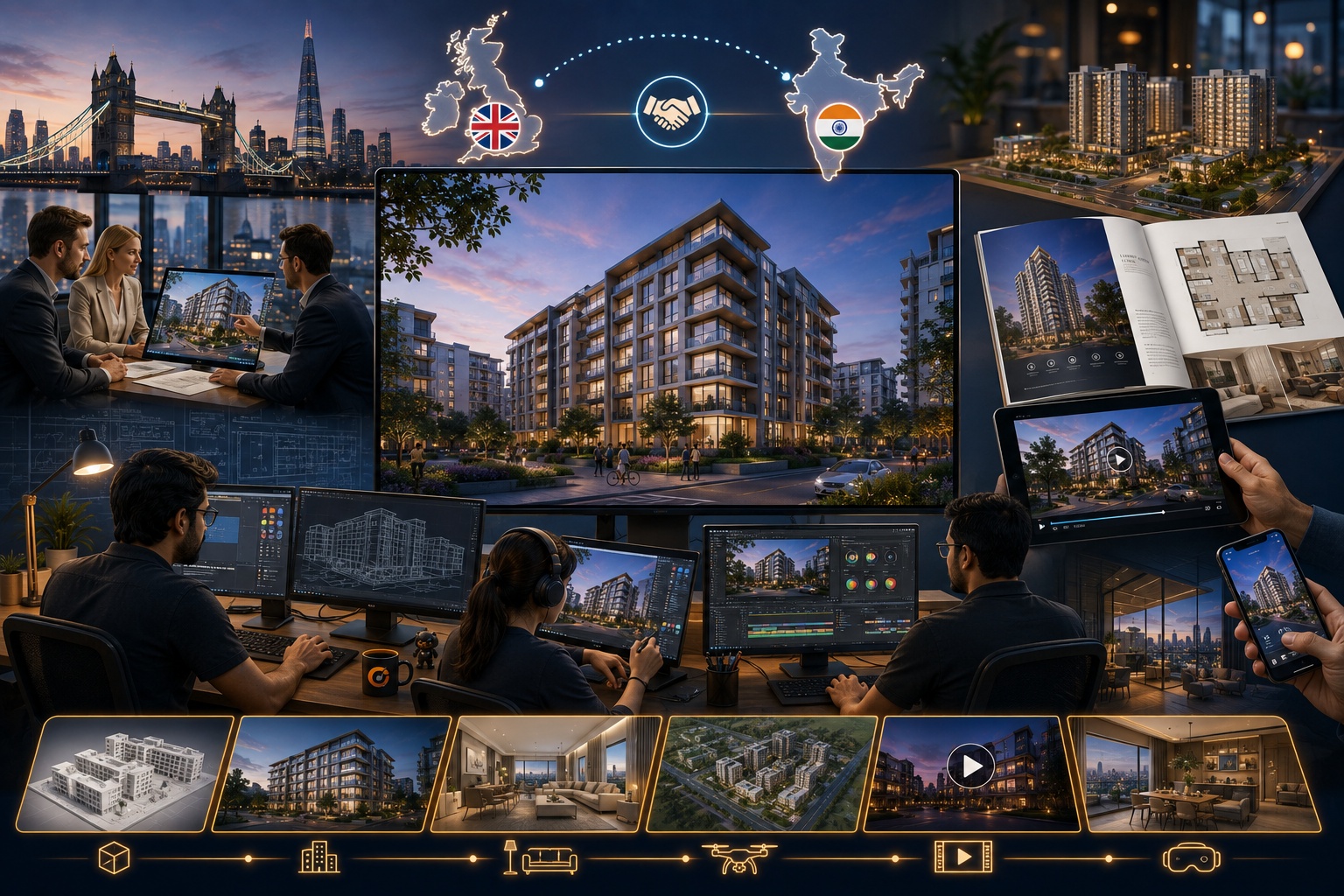
A complete pre-sales visualization package for a UK apartment scheme typically includes six asset types. Understanding what each involves — and how they relate to each other — is the starting point for briefing any studio, onshore or offshore.
1. Hero Exterior Render Set
Three to five photorealistic still renders of the building exterior, showing the primary facade, corner elevation, and street-level approach. For UK planning submissions, these must be contextually accurate — showing the actual street environment, neighbouring buildings, and landscaping — rather than idealized standalone compositions.
This is where UK developers most commonly encounter the difference between studios. A UK-based CGI studio that knows the specific design vernacular of Manchester's Northern Quarter or Birmingham's Digbeth understands the visual language expected by both planning authorities and regional investors without being briefed on it. An India-based studio produces technically excellent renders that require more specific client guidance on context and character.
2. Interior Render Suite
A room-by-room still set covering the primary living space, kitchen, master bedroom, and bathroom across one or two unit types. Interior renders for investor-targeted off-plan marketing should reflect contemporary but neutral specification — the buyer needs to visualise rental income, not personal lifestyle.
This is an area where Indian studios offer particular depth. High-end interior rendering is one of the most competitive specialisms in India's architectural visualization sector, with studios producing output at a quality level that matches the best UK and European equivalents.
3. Cinematic Walkthrough
A 90-second to 2-minute continuous walkthrough showing the full development experience — approach, lobby, corridor, and unit interior — with ambient sound, realistic lighting across day and evening conditions, and optionally a lifestyle narrative. This is the primary conversion asset: the video a buyer watches when they are deciding whether to request a viewing appointment.
For a typical 50-unit Manchester apartment scheme, a walkthrough of this specification from a UK studio costs £12,000–£25,000. From an India-based studio at equivalent quality, the same scope runs £6,000–£13,000. Our architectural walkthrough services include the full production pipeline from brief through to delivery in this price range.
4. Social Content Suite
Ten to fifteen short clips extracted from the master walkthrough and formatted for vertical (9:16), square (1:1), and landscape (16:9) aspect ratios for paid social distribution. These are not separate productions — they are derivative cuts from the approved master, produced for a fraction of the walkthrough cost when commissioned as part of the same production.
UK developers who commission the walkthrough and the social suite separately from different vendors consistently report paying 40–60% more than developers who brief the full package to a single studio upfront.
5. 3D Floor Plans
Isometric or perspective floor plan renders that replace the flat architectural drawings typically used in sales brochures and property portal listings. For investor buyers evaluating multiple schemes simultaneously on Rightmove or Zoopla, a 3D floor plan communicates unit layout more effectively than a 2D plan — particularly for international buyers less familiar with UK apartment configurations.
6. VR Tour
A navigable virtual tour compatible with iPad, browser, or VR headset, allowing remote buyers and sales centre visitors to move through the unit independently rather than following a fixed camera path. For NRI buyers attending a developer roadshow in Mumbai or Dubai, a VR tour allows the physical sales centre experience to travel.
The NRI Buyer Dimension
The Indian buyer presence in UK property has grown significantly in recent years. Non-resident Indians and India-based high-net-worth buyers form one of the most established and fastest-growing international purchaser groups in UK property, spanning prime central London, university-linked purchases near Oxford and Cambridge, and growing presence across Manchester and Birmingham regeneration schemes.
With a 17% rise in UK real estate investment from Indian HNIs and family offices, this buyer base is large enough and active enough to justify specific communication investment — which Indian studios are uniquely positioned to produce.
The practical implications for visualization:
Hindi narration versions of walkthroughs for use in Indian roadshow events, WhatsApp-distributed promotional content, and NRI investor-focused social campaigns. A UK studio producing a Hindi narration version subcontracts the voiceover and does not review the result for authenticity. An India-based studio produces it in-house with native speakers.
Cultural calibration of staging and lifestyle elements. Interior staging choices that read as aspirational to a UK owner-occupier buyer may not communicate the same way to an NRI investor evaluating the unit as a buy-to-let asset. Studios familiar with both markets can calibrate this without explicit client briefing.
Direct roadshow content. UK developers running NRI investor roadshows in Mumbai, Delhi, Dubai, or Singapore increasingly commission standalone India-market content — walkthrough versions with locally relevant voiceover, investment return callouts, and local currency pricing — as part of the same production package.
Our production capability for international buyer content covers multilingual narration, regional market calibration, and roadshow-specific format requirements within the same production pipeline.
Pricing Comparison: UK Studios vs India-Based Studios (2026)
Asset | UK Studio Range | India-Based Range | Saving |
|---|---|---|---|
Single exterior still (photorealistic) | £1,500 – £4,500 | £600 – £2,000 | 40–55% |
Interior render (per room) | £1,000 – £3,000 | £400 – £1,400 | 40–55% |
90-second walkthrough | £8,000 – £18,000 | £4,000 – £9,000 | 40–50% |
2-minute cinematic walkthrough | £14,000 – £28,000 | £7,000 – £14,000 | 40–50% |
Social content suite (10–15 clips) | £3,000 – £7,000 | £1,200 – £3,500 | 40–50% |
3D floor plans (per unit type) | £800 – £2,000 | £350 – £900 | 40–55% |
VR interactive tour | £12,000 – £30,000 | £5,500 – £15,000 | 40–50% |
Full campaign package (all above) | £35,000 – £80,000 | £18,000 – £42,000 | 40–50% |
UK studio prices based on market rates for professional-grade studio output. India-based studio ranges reflect professional-tier production at comparable photorealistic quality. Final pricing depends on unit count, revision rounds, language versions, and delivery format requirements.
The saving on a full campaign package — typically £17,000–£38,000 against equivalent UK studio pricing — represents the marketing budget for a small development entirely, or the equivalent of two additional months of sales support. For a 30-unit scheme in Manchester where the full visualization budget might otherwise consume 25–30% of total marketing spend, this reallocation is commercially material.
How the Remote Production Workflow Actually Operates
The most common objection from UK developers who have not worked with an offshore studio before is operational: if I cannot walk into the studio, how does it actually work?
The answer is that professional India-based studios serving UK clients have built their entire workflow around remote production. The practical process looks like this:
Week 1 — Brief and Asset Transfer. The developer or their architect sends the brief pack: architectural drawings (DWG, DXF, or PDF), specification documents, CGI reference images, brand guidelines, and a completed brief form covering camera angles, lighting preferences, unit types, and finishes. The studio confirms receipt, issues a production schedule with named milestones, and begins modelling.
Week 2–3 — Grey Model Review. The studio shares an unrendered 3D model — the spatial structure of the building without materials, lighting, or finishing — for client review. This is the stage at which spatial errors, layout issues, and brief mismatches are caught and corrected at minimal cost. Changes at grey model stage are far cheaper than changes after rendering begins.
Week 4–5 — Rendered Still Review. Two to three rendered stills at full resolution, showing the building with materials, lighting, and context. Client provides feedback on material selections, lighting mood, and any composition adjustments.
Week 6–8 — Walkthrough Production and Animation. Once stills are approved, the walkthrough camera path, animation, and motion are produced. A playblast (low-resolution preview) is shared for camera path approval before final rendering begins.
Week 9–10 — Final Delivery. Master walkthrough, full still set, social cuts, floor plans, and VR tour files delivered in agreed formats. Two rounds of revisions are typically included in the quoted price.
For UK developers with planning submission deadlines, sales launch dates, or lender evidence requirements, the milestone-based schedule — with named delivery dates on day one — provides the project management certainty that offshore production sometimes lacks when studios are not experienced in UK development timelines.
What to Look For in an India-Based Studio for UK Property Work
Not every India-based visualization studio is suited for UK property work. The technical capability exists broadly — the sector-specific knowledge varies significantly.
UK planning visualization experience. Planning submissions in England require contextually accurate photomontages that show the real street environment, neighbouring buildings, and accurate material representation. Studios unfamiliar with UK planning standards produce marketing-quality renders that local planning authorities reject as insufficient for formal assessment. Ask specifically whether the studio has produced planning-grade visual material for UK submissions.
UK building aesthetics. The design language of UK apartment developments — brick facades, sash-inspired window proportions, pitched roof references, local planning authority style guidelines — is specific and regional. A studio whose portfolio is concentrated in Indian or Gulf residential projects may not translate this accurately without explicit and detailed briefing.
Demonstrated UK client experience. Ask for portfolio examples from UK residential schemes specifically. Generic portfolio quality is not a substitute for demonstrated familiarity with UK property types, buyer expectations, and planning context.
Multilingual production. If NRI investor content is part of the scope, confirm that Hindi and regional language narration is produced in-house by native speakers, not subcontracted.
Contractual clarity. Agree revision rounds, file format specifications, intellectual property ownership, and delivery milestone dates in writing before production begins. Professional studios include these in their standard contract.
Our 3D architectural rendering services for UK developers cover planning visualization, marketing packages, NRI content, and full campaign production specifically for the UK market.
Frequently Asked Questions
How does a UK developer share design files with an India-based studio?
Standard process: architectural drawings in DWG, DXF, or PDF format are shared via secure file transfer (WeTransfer Pro, Google Drive, or Dropbox). Studios handling UK client work use NDAs and data handling policies as standard. The briefing process is completed via email and video call. Physical site visits are not part of the offshore production model — studios work from drawings, reference images, and specification documents.
What happens if the design changes during production?
Minor changes — material selections, finish upgrades, window detail adjustments — are typically handled within agreed revision rounds at no additional cost. Major structural changes to the building design require a discussion with the studio before the change is implemented, as they may affect already-completed modelling work. Studios experienced in UK development production will flag this in their contract and have a clear change management process.
Does an offshore studio understand UK planning visualization requirements?
Studios with established UK client work understand the distinction between planning-grade visualization (contextually accurate, technically documented, suitable for LPA submission) and marketing visualization (aspirational, lifestyle-driven, optimised for buyer engagement). The brief must specify which is required — and in some cases both, produced to different standards from the same base model. Ask for portfolio evidence of planning-grade photomontage work specifically if that is part of your requirement.
Can Indian studios produce content in Hindi for NRI roadshows?
Yes. This is a specific advantage of India-based production: native-speaker Hindi narration, culturally calibrated lifestyle content, and locally relevant investment return messaging are produced in-house rather than subcontracted. For UK developers running investor roadshows in Mumbai, Delhi, Dubai, or Singapore, this content is produced as part of the same campaign package.
What is the typical turnaround time compared to a UK studio?
For an equivalent scope, India-based studios typically match or beat UK studio timelines, partly due to larger team size and partly due to the overnight production cycle enabled by the 4.5–5.5-hour time zone lead over the UK. A standard walkthrough with a full still set runs 8–10 weeks from approved brief. Rush delivery in 5–6 weeks is available at a premium.
Is the quality actually comparable?
For photorealistic architectural rendering and walkthrough production, yes — at the professional production tier. India's architectural visualization sector is mature, internationally competitive, and export-oriented. Studios at the professional tier use the same rendering engines (Unreal Engine 5, V-Ray, Corona) and deliver output that is indistinguishable from equivalent UK studio work at the pixel level. Where differences do appear, they are most commonly in local context knowledge — street materials, neighbourhood character, planning aesthetic — rather than technical rendering capability. This is addressable through specific briefing.
Commission Your UK Pre-Sales Package
Chasing Illusions Studio produces architectural visualization for UK residential developers — exterior and interior renders, cinematic walkthroughs, social content, VR tours, and NRI-specific campaign content. We serve schemes across London, Manchester, Birmingham, Leeds, and regional cities, with pricing in GBP and production timelines aligned to UK development schedules.
Request your custom quote within 24 hours →
Book a discovery 20-minutes strategy call.
📞 +91-9910911696 | +91 9910660851
📩 info [@] chasingillusions [.] in
Written by Deepak, Content Strategist at Chasing Illusions Studio. Our clients include Tata Steel, Hindalco, Mase Atlantique, Epiroc, and 100+ industrial safety brands across India, USA, Thailand, and the UK.
Also read:
Chasing Illusions Studio
Premium animation & video production studio based in Delhi, India. Specialising in 3D animation, medical visualisation, architectural walkthroughs, and CGI.