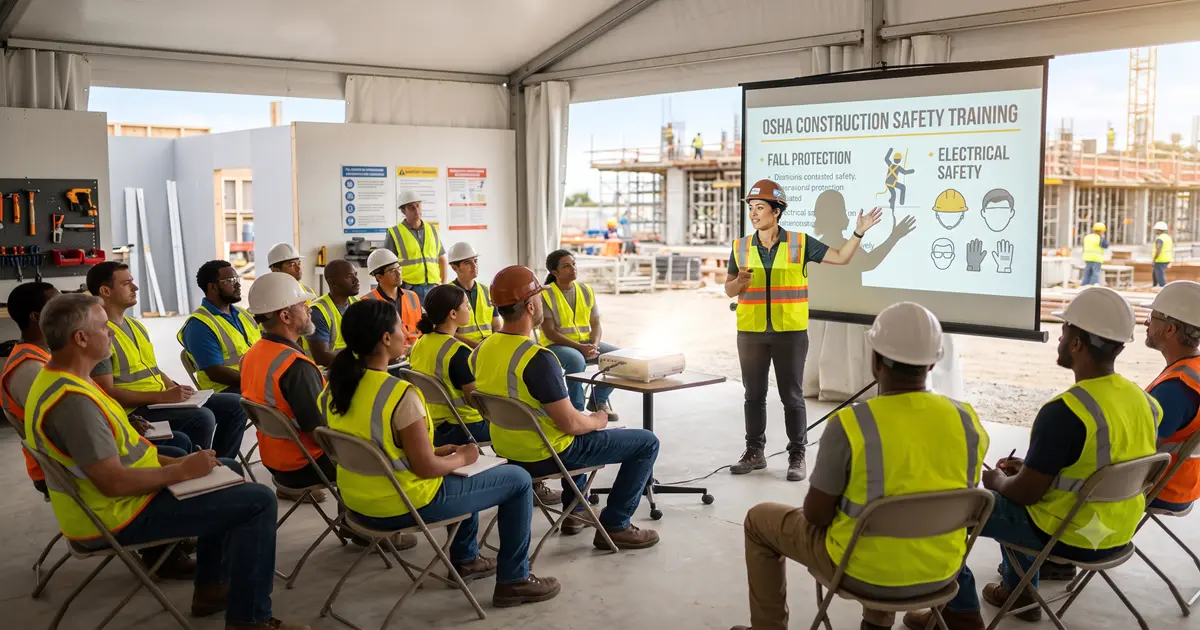
Imagine a new construction worker arriving on a busy jobsite for the first time. There are elevated work areas, scaffolding, electrical equipment, moving machinery, excavation zones, vehicles, and multiple crews working simultaneously. A verbal explanation may tell the worker what to do—but showing the correct procedure can make the instruction much easier to understand.
OSHA Safety Video Training uses video-based instruction to explain construction hazards, demonstrate safe work practices, and communicate procedures in a visual and repeatable format. It can support worker orientation, hazard awareness, equipment instruction, refresher training, and site-specific safety communication. However, watching a safety video alone does not automatically make a company OSHA-compliant. OSHA training requirements depend on the applicable hazard, work activity, standard, employee role, and workplace circumstances. Some activities also require qualified or competent-person instruction, hands-on training, or other forms of instruction.
For construction companies, the most effective approach is to use safety videos as part of a broader safety management and training program.
What Is OSHA Safety Video Training?
OSHA Safety Video Training refers to video-based safety instruction used to communicate workplace hazards, safety procedures, precautions, and appropriate work practices.
A construction safety video might show workers how to:
Wear and inspect personal protective equipment (PPE)
Identify common jobsite hazards
Use ladders and scaffolds correctly
Follow fall-protection procedures
Operate equipment safely
Respond to emergencies
Recognize unsafe conditions
Follow site-specific safety procedures
Report hazards and incidents
Apply safe material-handling practices
The important distinction is between video as a training medium and OSHA-required training.
OSHA construction standards contain specific training provisions for particular hazards and activities. For example, OSHA's fall-protection standard requires employers to provide a training program for employees who may be exposed to fall hazards, including instruction that enables workers to recognize fall hazards and understand procedures for minimizing them.
Similarly, OSHA's scaffold requirements specify training for workers using scaffolds and for workers involved in erecting, dismantling, moving, operating, repairing, maintaining, or inspecting them.
Therefore, a video can be an effective delivery method, but its content, use, and combination with other training must be appropriate to the applicable OSHA requirements.
Why Is Safety Training Important on Construction Sites?
Construction environments change constantly. Workers may encounter different equipment, materials, work areas, contractors, weather conditions, elevations, and hazards from one project phase to another.
Effective OSHA construction safety training helps workers understand the hazards associated with their work and the procedures intended to control or minimize those hazards.
OSHA identifies construction hazards across areas such as falls, struck-by hazards, caught-in or between hazards, and electrocution. Its Construction Focus Four training resources specifically address these hazard categories.
Safety training is particularly important for:
Hazard Awareness
Workers need to recognize hazards before interacting with equipment, materials, structures, or work areas. Training can help explain what an unsafe condition looks like and what action should be taken.
Safe Work Practices
Instructions should go beyond telling workers that a task is dangerous. Workers need to understand the correct procedure for performing the task.
Worker Onboarding
New employees and contractors may be unfamiliar with a particular site's layout, hazards, emergency procedures, PPE requirements, or reporting processes.
Refresher Training
Safety information can be reinforced when workers change roles, encounter new hazards, use different equipment, or demonstrate gaps in understanding.
Safety Communication
Consistent communication helps organizations present safety expectations to multiple crews and work groups in a standardized format.
OSHA also requires training to be presented in a language and vocabulary workers can understand in applicable circumstances.
Why Use Video for Construction Safety Training?
Traditional safety instructions can be useful, but construction procedures are often easier to understand when workers can see them.
Construction Safety Video Training can combine narration, animation, live-action footage, diagrams, demonstrations, captions, and realistic scenarios to explain a procedure.
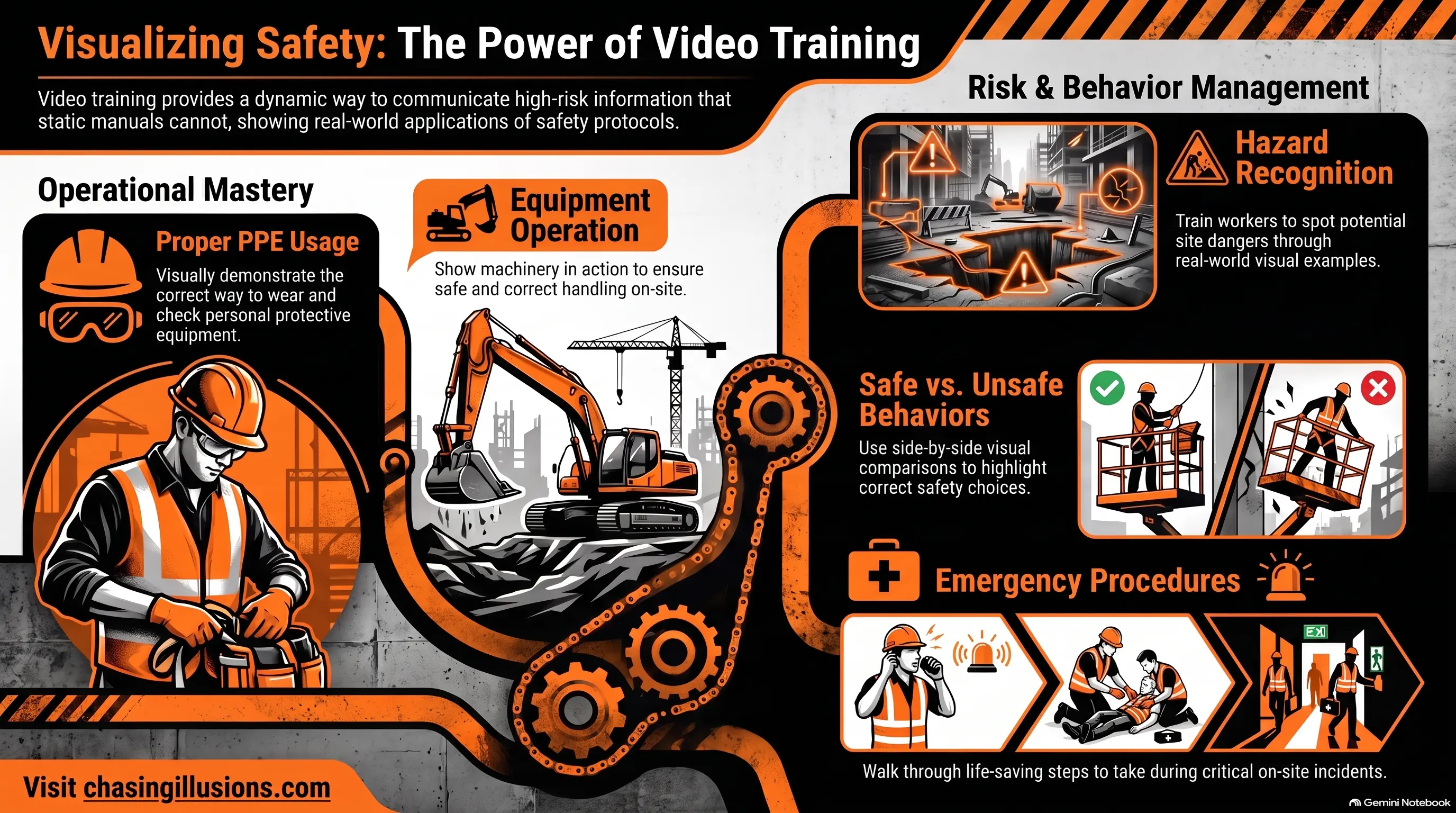
1. Demonstrating Correct PPE Use
A video can show workers how PPE should be selected, worn, adjusted, inspected, and used for a particular task.
PPE-related instruction can cover items such as:
Hard hats
Safety glasses
Gloves
Hearing protection
High-visibility clothing
Respiratory protection where applicable
Fall-arrest equipment
Protective footwear
OSHA maintains specific construction PPE requirements, and the appropriate equipment depends on the hazards associated with the work.
2. Showing Equipment Operation
Equipment operation can involve multiple steps that are difficult to explain through text alone.
An OSHA Safety Training Video can visually demonstrate:
Pre-use inspections
Safe startup procedures
Operator positioning
Restricted areas
Safe operating distances
Shutdown procedures
Equipment-specific hazards
For specialized equipment, video should complement—not replace—any training, qualification, competency demonstration, or supervision required for the task.
3. Demonstrating Hazard Recognition
A video can present a construction scenario and ask workers to identify hazards before revealing the correct answer.
For example, a scene might contain:
An improperly positioned ladder
An unprotected edge
Missing PPE
Poor housekeeping
Exposed electrical hazards
Unsafe material storage
Workers entering a restricted area
This transforms passive instruction into an opportunity for hazard-identification practice.
4. Showing Emergency Procedures
Emergency information can be easier to follow when workers see the sequence of actions.
A training video can demonstrate:
Recognizing an emergency
Stopping work when appropriate
Alerting supervisors or designated personnel
Contacting emergency services according to site procedures
Moving to designated areas
Following evacuation procedures
Reporting the incident
The actual procedure should always reflect the construction site's emergency plan and applicable requirements.
5. Comparing Unsafe and Safe Behaviors
One useful approach is to show the same task twice: first with an unsafe behavior and then with the correct procedure.
This makes the difference between the two approaches visually obvious and gives workers a practical reference for what should happen on the jobsite.
OSHA Safety Topics Construction Workers Should Understand
There is no single universal list of training topics that applies identically to every construction worker. Required training depends on the worker's duties, hazards, equipment, work environment, and applicable standards.
Nevertheless, several areas commonly require attention in construction safety programs.
Fall Protection
Falls are a major construction hazard. OSHA's construction fall-protection standards establish requirements for protecting workers in specified circumstances, and §1926.503 addresses training for employees exposed to fall hazards.
Training content may address:
Fall hazards
Guardrail systems
Personal fall-arrest systems
Personal fall restraint systems
Safety nets
Safe work practices
Fall-protection equipment
PPE Training
Workers should understand the PPE appropriate to the hazards they may encounter and how to use it correctly.
A PPE training video can make demonstrations more consistent by visually showing proper equipment use.
Scaffolding Safety
Scaffold users and workers involved in scaffold erection or dismantling have specific training considerations under OSHA's construction standards. These include recognizing scaffold hazards and understanding procedures for controlling or minimizing them.
Relevant topics can include:
Fall hazards
Falling objects
Electrical hazards
Scaffold access
Proper use
Material handling
Load capacity
Inspection and maintenance procedures
Ladder and Stairway Safety
OSHA requires training for employees who use ladders and stairways, including instruction related to hazards, proper construction and use, placement, care, and applicable requirements. Retraining is required when necessary to maintain understanding and knowledge.
Excavation and Trench Safety
Excavation work can expose employees to hazards involving cave-ins, falls, equipment, hazardous atmospheres, and other conditions.
Training should be specific to the excavation activities and hazards present rather than treating trench safety as a generic video topic.
Electrical Safety
Construction electrical safety training can address electrical hazards, safe work practices, equipment, power lines, and procedures applicable to the worker's duties.
Heavy Equipment and Machinery
Equipment-related training can cover:
Pre-operation inspection
Operator responsibilities
Blind spots
Pedestrian awareness
Equipment movement
Loading and unloading
Communication signals
Shutdown procedures
Hazard Communication
Workers who may be exposed to hazardous chemicals need appropriate hazard communication information and training according to applicable requirements.
Fire Prevention and Emergency Procedures
Training may address fire hazards, emergency communication, evacuation routes, emergency equipment, assembly areas, and site-specific response procedures.
The precise training requirements should always be checked against the applicable OSHA standards and the conditions of the workplace.
How Safety Videos Improve Hazard Awareness?
A written safety manual can explain that a hazard exists. A video can show what that hazard looks like in an actual or simulated work environment.
This distinction is particularly useful for construction safety.
For example, rather than simply stating "maintain three points of contact when using a ladder," a video can demonstrate:
The worker approaching the ladder
Correct ladder positioning
Proper climbing technique
Unsafe behavior
The consequences of improper positioning
The correct procedure
Visual demonstrations can therefore make safety information more concrete.
From Abstract Instruction to Practical Demonstration
A worker may understand the words "fall hazard" without recognizing every situation that creates one.
Video can present a sequence such as:
Work scenario → Hazard identification → Unsafe behavior → Correct procedure → Safety reminder
This format can support hazard awareness while giving workers a visual reference they can relate to their working environment.
Supporting Consistent Safety Communication
Construction companies may have multiple supervisors, crews, subcontractors, and shifts.
A standardized construction safety training video can provide consistent introductory information across groups while allowing supervisors and safety professionals to address site-specific conditions separately.
However, consistency should not be confused with universal applicability. A video created for one site, task, or hazard may not adequately address another.
OSHA Safety Videos vs. Traditional Safety Training
Video training does not have to compete with classroom instruction or hands-on training. In many situations, a blended approach can provide a more complete learning experience.
Training Method | Useful For | Important Consideration |
|---|---|---|
Safety videos | Visual demonstrations and standardized instruction | Content must be accurate and relevant |
Classroom instruction | Discussion, questions, and detailed explanations | Quality depends on instructor and participation |
Written manuals | Reference information and procedures | Workers must understand and use the material |
Toolbox talks | Short, focused safety discussions | Should address relevant jobsite conditions |
Hands-on demonstrations | Practical skill development | Appropriate supervision and competency assessment may be necessary |
On-the-job instruction | Task-specific learning | Requires suitable supervision |
Blended learning | Combining multiple approaches | Training elements should complement each other |
A video can explain what to do, while a qualified instructor or supervisor may need to demonstrate how to perform a task and verify that workers understand or can safely perform it.
For example, OSHA's scaffold requirements specifically address training by qualified or competent persons for certain scaffold-related activities.
This is why companies should avoid treating video completion as proof of competency for every construction task.
What Should an Effective Construction Safety Video Include?
An effective OSHA Safety Video Training program should begin with the learning objective rather than the visual effects.
1. Clear Learning Objectives
Workers should know what they are expected to understand or do after completing the training.
2. Accurate Safety Information
Content should reflect the applicable OSHA standards, manufacturer instructions, company procedures, and relevant safety requirements.
3. Realistic Construction Scenarios
Use recognizable jobsite situations instead of generic scenes whenever possible.
4. Simple and Understandable Language
Safety information should be communicated in language and terminology appropriate for the workforce.
5. Practical Demonstrations
Show workers how procedures should actually be performed.
6. Hazard Identification
Include examples of common hazards and explain how workers should recognize and respond to them.
7. PPE Examples
Show the appropriate PPE and demonstrate its proper use where relevant.
8. Correct Procedures
Clearly distinguish unsafe actions from the correct work practice.
9. Captions and Subtitles
Captions can improve accessibility and help workers follow technical terminology and instructions.
10. Emergency Information
Where appropriate, include site-specific emergency procedures, communication channels, evacuation routes, and response expectations.
11. Knowledge Checks
Questions, scenarios, quizzes, or assessments can help determine whether workers understood the material.
The assessment method should match the training objective. Watching a video and clicking "complete" is not necessarily equivalent to demonstrating practical competency.
How Construction Companies Can Use Safety Videos?
Construction Safety Training Videos can support several stages of a worker's training journey.
New-Worker Orientation
Use introductory videos to explain basic site rules, PPE expectations, reporting procedures, restricted areas, and general hazards.
Site Induction
Site-specific videos can introduce workers and contractors to the characteristics of a particular construction project.
Refresher Training
Short videos can reinforce important safety concepts periodically or when work conditions change.
Toolbox Training
Video clips can support toolbox talks by providing a visual starting point for discussion.
Equipment Training
Task-specific videos can explain inspection procedures, operating principles, hazards, and shutdown processes.
Hazard-Specific Training
Organizations can create focused modules for:
Fall protection
Scaffolding
Excavation
Electrical safety
Fire safety
PPE
Material handling
Machine safety
Heavy equipment
Emergency response
Contractor Onboarding
Videos can help communicate general site expectations before contractors begin work, followed by any required site-specific instruction.
EHS Communication
Environmental, Health and Safety teams can use visual content to reinforce safety campaigns, procedural updates, lessons learned, and recurring hazard awareness.
How to Make OSHA Safety Video Training More Effective?
Creating a video is only the first step. The training program surrounding it matters just as much.
Start With a Training Needs Assessment
Identify:
Who needs training?
What hazards do they face?
What tasks do they perform?
Which OSHA standards apply?
What knowledge or skills are required?
What training has already been completed?
What gaps have been identified?
Separate General Training From Task-Specific Training
A general construction safety video should not be expected to address every risk associated with specialized work.
For example, a general orientation may introduce fall hazards, while a separate module and practical instruction may be necessary for workers performing specific fall-protection tasks.
Use Site-Specific Examples
Whenever possible, show the actual equipment, PPE, work areas, signage, procedures, and emergency arrangements relevant to the workforce.
Combine Video With Human Instruction
Supervisors, safety professionals, qualified persons, or competent persons may need to provide additional instruction depending on the activity and applicable requirements.
Verify Understanding
Use quizzes, questions, demonstrations, observations, or other appropriate assessment methods.
Update Training When Conditions Change
New equipment, changed work processes, new hazards, incidents, or regulatory changes can create a need for additional or refresher training.
Common Mistakes to Avoid
Mistake 1: Assuming a Video Automatically Means OSHA Compliance
Completing a video does not automatically establish compliance. Applicable standards may impose specific training content, qualifications, instructors, retraining, or other requirements.
Mistake 2: Using Generic Content for Every Jobsite
Construction projects differ significantly. A generic safety video may omit hazards unique to a particular project.
Mistake 3: Focusing Only on Rules
Workers need to understand the practical reason behind a safety procedure and how to apply it during actual work.
Mistake 4: Ignoring Hands-On Training
Some tasks require practical instruction or competency verification. Video should not be treated as a universal substitute for hands-on learning.
Mistake 5: Failing to Update Content
Outdated procedures, equipment, terminology, or regulatory information can reduce the usefulness of a training program.
Frequently Asked Questions:
Is OSHA Safety Video Training required for every construction worker?
Not as a universal standalone video requirement. OSHA establishes training requirements for specific hazards, tasks, and standards. Employers need to determine which requirements apply to their workers and workplaces. For example, OSHA has specific construction training provisions for fall hazards, scaffolds, ladders and stairways, and other activities.
Can an OSHA safety video replace an instructor?
Not necessarily. Whether video can be used as part of required training depends on the applicable OSHA requirement and the nature of the training. Some activities specify instruction by a qualified or competent person.
What topics should a construction safety video cover?
Topics may include fall protection, PPE, scaffolding, ladders, excavation, electrical hazards, machinery, heavy equipment, hazard communication, fire prevention, emergency procedures, and site-specific hazards. The appropriate topics depend on the workers' duties and workplace conditions.
Are OSHA Safety Videos enough to make a company OSHA compliant?
No. Compliance involves more than watching videos. Employers must meet the applicable OSHA standards and implement appropriate hazard controls, training, procedures, supervision, equipment, and other requirements relevant to their workplaces.
Can animated videos be used for construction safety training?
Yes. Animation can be useful for illustrating equipment operation, hazardous scenarios, procedures, emergency sequences, and situations that may be difficult or unsafe to film directly. However, the content still needs to be accurate, relevant, and appropriate for the training objective.
Should construction safety videos include quizzes?
Knowledge checks can be useful for verifying understanding, particularly for e-learning programs. However, a quiz should not automatically be treated as proof that a worker has demonstrated practical competency when hands-on competency is required.
Conclusion:
A construction site can change from one day to the next. New workers arrive, equipment moves, work areas shift, hazards change, and different contractors perform specialized tasks. In that environment, safety information needs to be understandable, relevant, and easy to communicate consistently.
OSHA Safety Video Training can help construction organizations demonstrate hazards, visualize procedures, explain PPE use, support site induction, reinforce safe work practices, and make safety communication more engaging.
But the strongest safety program does not rely on video alone.
Effective construction safety requires the right combination of applicable OSHA-compliant training, hazard controls, hands-on instruction where needed, competent supervision, worker participation, competency assessment, and ongoing safety management.
The goal is not simply to have workers watch a safety video. The goal is to help them recognize hazards and understand what safe work looks like when they step onto the jobsite.
For organizations looking to develop professional animated safety training, equipment demonstrations, or visual construction safety content, Chasing Illusions Studio can help translate complex procedures into clear, practical visual communication.
CONTACT NOW
Want to develop a construction safety training video for your workforce?
Contact Chasing Illusions Studio to discuss your training objectives, audience, hazards, and production requirements.
Chasing Illusions Studio
Premium animation & video production studio based in Delhi, India. Specialising in 3D animation, medical visualisation, architectural walkthroughs, and CGI.