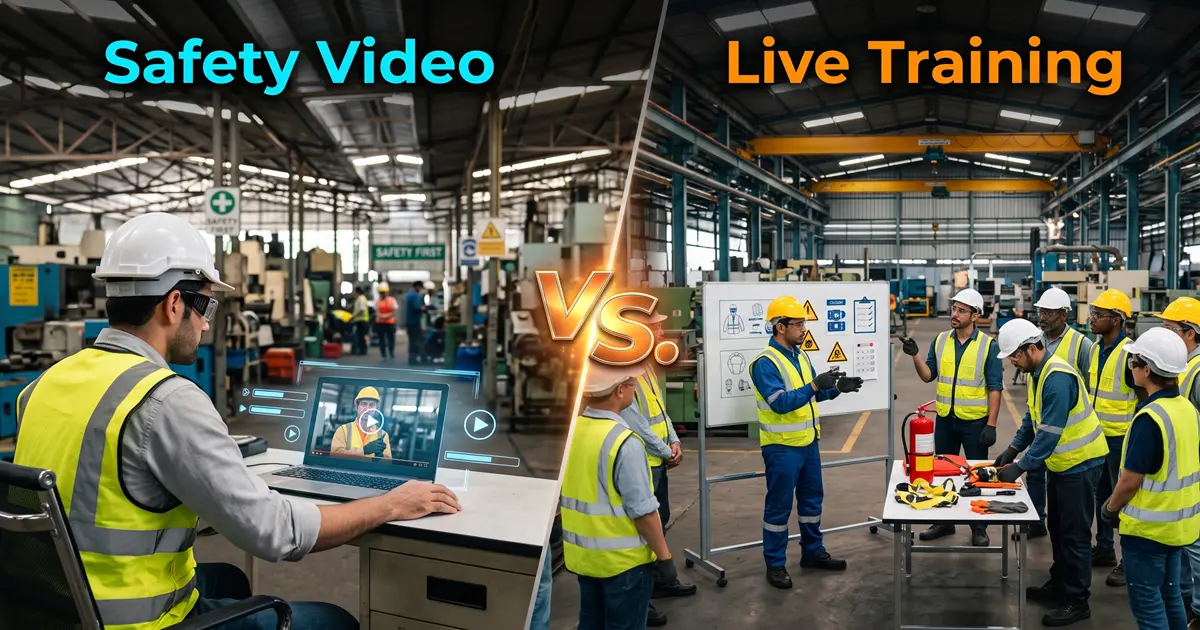
An employee watches a safety video about operating industrial machinery, passes a short quiz, and returns to work. But can they recognize a dangerous condition, respond to an equipment malfunction, or follow the correct shutdown procedure in a real situation?
This is the key question behind Workplace Safety Videos vs. Live Training. Both methods can help employees understand workplace hazards, but they serve different learning objectives.
Workplace safety videos are effective for consistent instruction, visual explanations, onboarding, and refresher training. Live instructor-led training is particularly valuable for interactive discussions, practical demonstrations, supervised exercises, and immediate feedback. The right choice depends on the hazards involved, the skills employees must demonstrate, applicable training requirements, and available resources. For many organizations, a blended approach combining videos with hands-on practice offers a practical way to address both knowledge and competency.
This guide compares both methods, explains their benefits and limitations, and outlines how EHS managers, safety officers, HR teams, and industrial employers can select and evaluate an effective workplace safety training program.
What Is Workplace Safety Video Training?
Workplace safety video training uses recorded or digitally delivered visual content to teach employees about occupational hazards, safe work practices, emergency procedures, and organizational safety policies.
Videos can combine animation, live-action demonstrations, narration, diagrams, labels, and realistic scenarios to explain procedures that might otherwise be difficult to communicate through written instructions alone.
Common applications include:
Safety induction training: Introducing new employees and contractors to workplace rules, hazards, and reporting procedures.
Personal protective equipment (PPE) training: Explaining the purpose, selection, inspection, and correct use of helmets, gloves, respirators, safety footwear, and other protective equipment.
Machine safety training: Illustrating machine hazards, guarding requirements, safe operating procedures, and lockout/tagout concepts.
Emergency response training: Explaining fire safety, evacuation routes, alarm systems, and emergency reporting procedures.
Hazard identification: Showing examples of unsafe acts, hazardous conditions, chemical exposure risks, and poor housekeeping.
Refresher training: Reinforcing established procedures and communicating changes to safety policies.
Video-based safety training can be delivered through learning management systems (LMSs), internal training portals, mobile devices, or supervised sessions in a training room.
What Is Live Workplace Safety Training?
Live workplace safety training involves direct instruction from a qualified trainer, safety professional, supervisor, or subject-matter expert. Depending on the topic, it may take place in a classroom, workshop, factory, construction site, or another controlled training environment.
Typical methods include:
Instructor-led classroom sessions and safety briefings.
Toolbox talks addressing specific workplace hazards.
Live PPE demonstrations and equipment inspections.
Supervised machine operation and practical exercises.
Emergency response and evacuation drills.
Interactive hazard-identification exercises.
Question-and-answer sessions and practical competency assessments.
The main advantage of instructor-led safety training is the opportunity to adapt instruction to employee questions, experience levels, and observed performance.
For example, a trainer can demonstrate the correct procedure for inspecting a safety harness, observe an employee performing the inspection, identify mistakes, and provide corrective feedback.
Workplace Safety Videos vs. Live Training: Key Differences
The most useful way to compare these workplace safety training methods is to examine what employees need to learn and demonstrate. A method that works well for explaining a safety policy may be insufficient for teaching a worker to operate hazardous machinery.
Evaluation Factors | Safety video training | Live instructor-led training |
Consistency | Delivers standardized information | Can vary between instructors |
Interaction | Limited unless supported by activities or discussion | Allows questions and direct discussion |
Practical skills | Demonstrates techniques visually | Enables supervised practice and feedback |
Knowledge assessment | Supports quizzes and digital assessments | Supports verbal questions and practical evaluation |
Scalability | Easy to distribute across multiple locations | Requires trainer availability and scheduling |
Accessibility | Can support remote access, subtitles, and multiple languages | Depends on trainer availability and language capability |
Training time | Can be scheduled flexibly and replayed | Requires coordination of participants and sessions |
Cost structure | Production or licensing costs, plus delivery and maintenance | Trainer fees, facilities, employee time, and equipment |
Refresher training | Convenient for repeated viewing | Useful for revisiting skills and correcting mistakes |
Site-specific learning | Can illustrate workplace scenarios and procedures | Can address local conditions through discussion and observation |
These comparisons describe typical delivery characteristics, not guaranteed learning outcomes. A well-designed video with interactive questions can be more effective than a poorly delivered lecture, while a practical session without clear instruction or assessment may also fall short.
The central distinction is that video-based training explains and demonstrates; live training can additionally test how employees apply that knowledge in practice. Neither method should be judged by completion rates alone.
What are the Benefits of Workplace Safety Videos?
Video-based safety training is particularly useful when an organization needs to communicate the same safety information to many employees without repeatedly delivering the same introductory explanation.
1. Consistent safety messaging
Every employee can receive the same core explanation of workplace policies, hazard controls, emergency procedures, and safe working practices.
Standardized content reduces the risk of essential information being omitted or explained differently across shifts, departments, and locations. Videos can also be reviewed and updated when procedures change.
2. Clear visual explanations of hazards
Some industrial hazards are difficult to explain through written instructions alone. Animation and live-action demonstrations can show how a hazard develops, why a safety control matters, and what can happen when a procedure is ignored.
For example, a machine safety animation can illustrate moving components, pinch points, entanglement risks, and the consequences of removing machine guards. A chemical safety video can explain exposure pathways and the correct sequence for responding to a spill.
These visual explanations support hazard awareness, but they should not replace required practical instruction when employees must demonstrate a skill.
3. Scalable employee onboarding
Organizations with multiple factories, warehouses, construction sites, or regional offices can use the same introductory content across locations.
Digital delivery also allows new employees to complete suitable introductory modules before attending a site-specific briefing. This can help trainers devote more time to local hazards and practical exercises.
4. Convenient refresher training
Employees may need to revisit a procedure after a long interval, a process change, or the identification of a recurring safety issue.
Short, topic-specific videos provide a convenient way to reinforce information about PPE inspection, fire prevention, manual handling, hazard reporting, or emergency response.
However, refresher content should be selected according to actual knowledge or performance gaps rather than used as a substitute for investigating why those gaps exist.
5. Multilingual and accessible delivery
Video content can incorporate subtitles, translated narration, clear diagrams, and demonstrations suited to different literacy levels.
This is important for organizations employing multilingual workforces. For US workplaces, OSHA emphasizes that safety instruction must be delivered in a language and vocabulary employees can understand.
Employers should also verify that translations accurately communicate technical terms, warnings, and emergency instructions.
6. Repeatable demonstrations of complex processes
Videos can show procedures from multiple angles, pause at important steps, and replay a sequence when necessary.
This is particularly useful for explaining equipment layouts, machine components, industrial processes, and emergency scenarios that cannot easily be demonstrated to an entire group at once.
Limitation to consider: A video can show an employee how to perform a task, but it cannot independently confirm that the employee can perform it correctly under workplace conditions.
Explore our Workplace Safety Training Animation Work
What are the Benefits of Live Safety Training?
Live safety training is valuable when employees need to ask questions, practice a procedure, receive corrective feedback, or demonstrate competence before undertaking hazardous work.
1. Immediate questions and clarification
Employees may misunderstand an instruction, encounter an unfamiliar hazard, or need clarification about a site-specific procedure.
An instructor can identify the misunderstanding and explain the correct approach before the employee returns to work. Discussion also allows trainers to identify hazards that employees encounter in their actual roles.
2. Hands-on demonstrations and supervised practice
Practical training allows employees to handle equipment, inspect protective devices, practice emergency procedures, and receive feedback.
Examples include:
Fitting and checking PPE correctly.
Inspecting fall-protection equipment.
Demonstrating safe lifting techniques.
Practicing lockout/tagout procedures under appropriate supervision.
Operating machinery in a controlled training environment.
Practicing emergency evacuation and other relevant drills.
The appropriate activities depend on the task, risk level, equipment, and applicable requirements. OSHA's training guidance highlights the role of hands-on instruction in helping workers develop and demonstrate practical skills.
3. Assessment of employee competence
A quiz can establish whether an employee recognizes the correct answer. It cannot necessarily establish whether the employee can execute the procedure safely.
During practical training, a qualified evaluator can observe performance against defined criteria, identify mistakes, and require corrective practice.
For example, a worker may correctly answer questions about isolating a machine's energy sources but still need supervised instruction to perform the applicable lockout/tagout procedure correctly.
4. Better discussion of site-specific hazards
General safety materials cannot cover every condition in a particular workplace.
A trainer can connect standard safety principles to local hazards, such as forklift routes in a warehouse, restricted access near manufacturing equipment, changing conditions on a construction site, or emergency exits in a specific facility.
This helps employees relate safety instructions to the conditions they encounter during their shifts.
5. Opportunities to identify training gaps
Questions, demonstrations, and observed exercises can reveal gaps in understanding, unsafe assumptions, or difficulties using equipment.
Training managers can use these observations to improve procedures, update training content, and determine whether employees need additional instruction or supervision.
Limitation to consider: Live training is not automatically effective. Its value depends on the trainer's competence, instructional quality, relevance to the job, opportunities for practice, and the quality of the assessment.
Which Method Is Better for Different Safety Training Needs?
There is no single winner in the workplace safety videos vs. live training comparison. The better method depends on the learning objective, the consequences of an error, and whether employees must demonstrate a practical skill.
Safety induction: Video + briefing
Use a video for company policies, general hazards, and reporting procedures. Follow it with a site-specific briefing covering local risks, emergency exits, and reporting contacts.
PPE awareness and use: Video + practice
Explain equipment selection and inspection visually, then have employees demonstrate correct fitting, adjustment, inspection, and use where required.
Emergency response: Instruction + drill
Use videos to explain alarms, evacuation routes, and emergency responsibilities. Conduct appropriate drills and practical exercises to evaluate response.
Machine operation: Demonstration + assessment
Explain hazards and procedures through visual instruction, then provide task-specific training, supervised practice, and competency evaluation as applicable.
Workplace hazard awareness: Video + discussion
Show realistic hazard scenarios and ask employees to identify unsafe conditions. Discuss hazards specific to their work areas and how to report them.
Refresher training: Video + targeted review
Use short videos and knowledge checks for routine refreshers. Add instructor-led review or practical reassessment when procedures change or performance gaps appear.
NOTE: These are general recommendations, not universal compliance rules. Employers should check the requirements applicable to their industry, jurisdiction, and specific tasks before deciding which activities are necessary.
Are Workplace Safety Videos Enough for Compliance?
Completing a safety video does not automatically establish regulatory compliance or prove that an employee can perform a task safely. Employers must determine whether their training method satisfies the specific requirements that apply to the work, the hazards involved, and the employee's responsibilities.
Requirements differ by jurisdiction and subject. In the United States, the Occupational Safety and Health Administration (OSHA) publishes training provisions across its general industry, construction, and other applicable standards.
For example, OSHA's powered industrial truck requirements call for both formal instruction and practical training, followed by workplace performance evaluation. Other standards have their own requirements for instruction, demonstrations, retraining, or competency.
What should employers verify?
Before relying on video-based safety training, check the following:
Applicable regulations: Identify the specific national, state, local, or industry requirements governing the task.
Required training components: Determine whether the applicable standard requires practical exercises, instructor interaction, supervised work, or competency evaluation.
Employee comprehension: Ensure the material is understandable to employees, considering language, literacy, and job-specific knowledge.
Task-specific competence: Verify that employees can apply the required procedures where practical competency is necessary.
Training documentation: Maintain records appropriate to the applicable requirements, including training dates, topics, assessments, and required certifications.
Retraining requirements: Identify circumstances that require refresher training, such as changes in equipment or procedures, or evidence that an employee lacks the necessary knowledge or skill.
OSHA's official Training Requirements in OSHA Standards is a useful starting point for US-focused content. Its Resource for Development and Delivery of Training to Workers also provides guidance on making training practical, understandable, and relevant to workers.
The practical principle is straightforward: use videos to support the required training, not as a substitute for a legal or competency requirement that the video alone cannot satisfy.
How to Measure Safety Training Effectiveness?
A training program should be evaluated by what employees understand, retain, and can demonstrate—not simply by the number of people who completed a course.
A useful evaluation framework combines knowledge assessments, practical observations, employee feedback, and workplace performance indicators.
1. Measure knowledge acquisition
Use short quizzes, scenario-based questions, or verbal questioning to evaluate whether employees understand hazards, safety procedures, emergency responses, and reporting responsibilities.
Compare results against defined learning objectives. If employees repeatedly answer questions incorrectly, review the instructional material and identify the underlying misunderstanding.
2. Evaluate practical competency
For tasks requiring physical skills, use a documented assessment checklist appropriate to the job.
For example, an evaluator may check whether an employee:
Selects the correct PPE.
Inspects equipment before use.
Follows the required sequence of safety steps.
Recognizes when a task must stop.
Responds appropriately to an identified hazard.
Record observed performance and provide corrective instruction where necessary. A high quiz score should not override a failed practical assessment when safe task performance is required.
3. Check knowledge retention
An employee may understand a procedure immediately after training but struggle to recall it weeks or months later.
Use follow-up assessments, refresher questions, and workplace observations to determine whether essential information remains accessible. The timing and frequency of reassessment should reflect task risk, changes in working conditions, and applicable requirements.
4. Gather employee feedback
Ask employees whether the training was clear, relevant, accessible, and sufficiently detailed.
Questions can explore which procedures remain confusing, whether demonstrations matched actual workplace conditions, and what additional practice would help.
Feedback is useful for improving both video content and instructor-led sessions, but satisfaction alone does not demonstrate competence.
5. Monitor relevant workplace indicators
Depending on the organization, useful indicators may include:
Reported hazards and near misses.
Compliance with observed safe-work procedures.
Repeat procedural errors.
Results of safety inspections and audits.
Practical competency assessment results.
Relevant incident and injury trends.
Interpret these measures carefully. An increase in reported near misses, for example, may reflect improved reporting rather than worsening safety. Changes in incident rates also cannot automatically be attributed to training because equipment, supervision, workloads, maintenance, and other controls influence outcomes.
6. Calculate training costs and operational value
To compare workplace safety training methods, account for more than the initial cost of producing a video or hiring a trainer.
Consider the following cost categories:
Cost factor | Video-based training | Live training |
Initial investment | Content production or licensing | Trainer preparation and materials |
Delivery | Platform, equipment, and administration | Trainer time, facilities, and equipment |
Employee time | Time spent viewing and completing assessments | Attendance, practice, and assessment time |
Updating content | Editing, re-recording, translation, and distribution | Updating materials and briefing trainers |
Assessment | Digital quizzes and any required practical checks | Knowledge checks and observed exercises |
Repeat delivery | Usually low marginal delivery effort | Additional trainer and scheduling effort |
How to Create a Workplace Safety Training Program?
A safety training combines video-based instruction, live teaching, practical exercises, and assessments according to the needs of each task. It is often a sensible approach when employees need both consistent explanations and demonstrated competence.
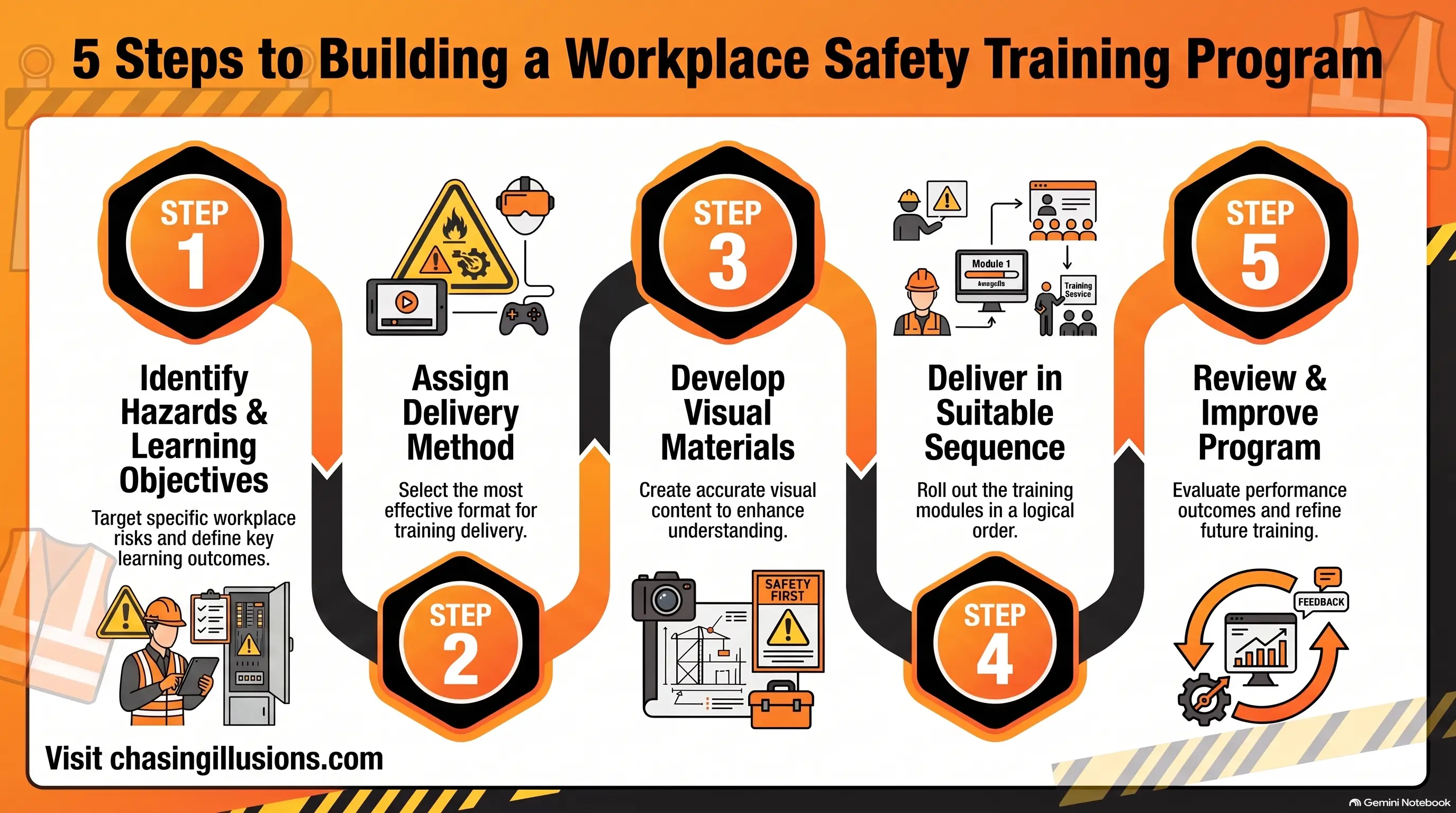
The objective is not to use every available training method. It is to select the combination that adequately prepares employees for the hazards they face.
Step 1: Identify hazards and learning objectives
Start with a workplace risk assessment, job hazard analysis, or other suitable hazard-identification process.
For each task, establish what employees must know, what they must be able to do, and what they must recognize or report. Review applicable training requirements before designing the program.
Step 2: Assign the right delivery method
Separate learning objectives into categories:
Knowledge: Policies, hazard awareness, terminology, and reporting procedures may be taught through videos, written materials, and discussion.
Procedural understanding: Complex sequences may benefit from animation, recorded demonstrations, and instructor explanation.
Practical competence: Tasks requiring physical skills should include appropriate demonstrations, supervised practice, and assessment when needed.
Emergency response: Explanatory content may be reinforced with drills or practical exercises appropriate to the emergency scenario.
This approach keeps training relevant without forcing every topic into the same format.
Step 3: Develop accurate visual training materials
Use real workplace procedures, verified technical information, and input from qualified safety professionals when creating instructional content.
Animation can be particularly useful for visualizing internal machine components, hidden hazards, chemical movement, energy isolation concepts, or dangerous scenarios that cannot safely be staged in a live demonstration.
However, visual materials should accurately represent the equipment, controls, PPE, and procedures employees will encounter. Have relevant subject-matter experts review the content before release.
For organizations that need custom visual demonstrations, Chasing Illusions Studio's Safety and Training Animation service covers areas such as PPE demonstrations, equipment operating procedures, emergency evacuation protocols, machine safety, fire safety, and site induction.
Step 4: Deliver training in a suitable sequence
A practical sequence for many programs is:
Introduce the hazard and explain why it matters.
Show the correct procedure through a video or demonstration.
Discuss site-specific risks and allow questions.
Provide supervised practice where required.
Assess understanding and practical competence against defined criteria.
Record completion and required assessment outcomes.
The sequence should be adapted to the task. Employees must receive any required instruction before being exposed to the relevant hazard.
Step 5: Review and improve the program
Periodically examine assessment results, employee feedback, workplace observations, and relevant incident trends.
If employees repeatedly make the same mistake, investigate whether the cause is unclear instruction, inadequate practice, poor equipment design, conflicting procedures, or another operational problem.
Update training materials and workplace controls as necessary. Effective safety management requires more than training alone.
Frequently Asked Questions:
Are safety videos more effective than in-person training?
Neither method is universally more effective. Safety videos are useful for consistent explanations, visual demonstrations, and repeatable instruction. In-person training is valuable for questions, practical exercises, and immediate feedback. The best choice depends on the learning objective and the risk involved.
Can workplace safety videos replace instructor-led training?
Sometimes videos can deliver suitable training content independently, but not when applicable requirements or the task require instructor interaction, hands-on practice, supervision, or competency assessment. Employers should evaluate the specific training obligation before replacing an existing method.
Which safety topics require hands-on practice?
Hands-on practice may be necessary for tasks such as operating powered industrial trucks, using certain types of PPE, performing hazardous energy-control procedures, and other activities where employees must demonstrate practical competence. Exact requirements depend on the applicable standards and task.
Can safety videos support OSHA training requirements?
Yes. Videos can form part of an OSHA-related training program when they meet the requirements applicable to the specific subject. Some standards require additional instruction, practical training, or evaluation. Employers should consult OSHA's official training guidance and the relevant standard.
When should employers use safety training video?
A safety training video is appropriate when employees need consistent visual instruction alongside discussion, practical experience, or assessment. It is particularly useful for industrial operations, manufacturing, construction, warehouses, and other workplaces where employees must understand hazards and apply specific safety procedures.
Conclusion:
Imagine the employee from the opening scenario again. They have watched the machine safety video and answered every question correctly. The remaining question is whether they can recognize the hazard and follow the required procedure when standing in front of the actual equipment.
That distinction explains why the debate over workplace safety videos vs. live training should focus on learning outcomes rather than choosing one format for every situation.
Videos offer consistent, repeatable instruction and make it easier to distribute safety information across teams and locations. Live training supports discussion, practical experience, and direct assessment. A blended approach can combine these strengths, provided it meets applicable requirements and gives employees the instruction and practice their work demands.
For EHS managers, training coordinators, and industrial operations leaders, the starting point is to identify the hazards, define the required competencies, and select the training methods that address them.
If your organization needs visual demonstrations to explain complex hazards, equipment procedures, or emergency protocols, Chasing Illusions Studio develops safety and training animation for workplace learning. Explore how customized visual content could support your existing safety training program, alongside the practical instruction and assessment your employees need.
Chasing Illusions Studio
Premium animation & video production studio based in Delhi, India. Specialising in 3D animation, medical visualisation, architectural walkthroughs, and CGI.