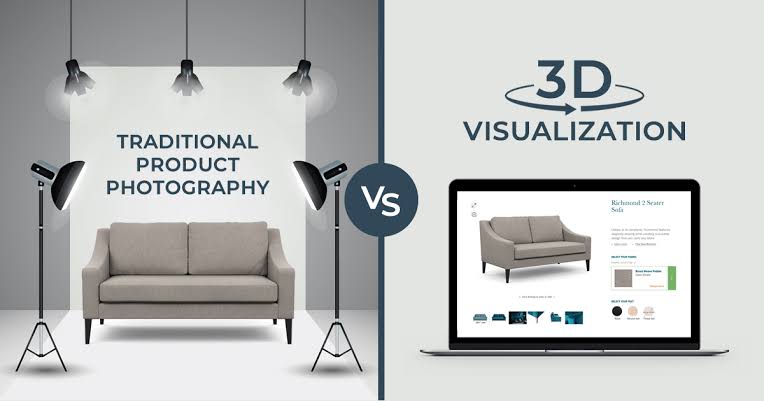
Neither is universally better. That is the honest starting point for this comparison — and it is the answer that most guides on this topic avoid because it does not make for a clean headline.
The right choice depends on your product category, your catalog size, your production timeline, your buyer's purchase psychology, and the specific job the image needs to do. A fresh food product and a flat-pack furniture piece have entirely different visualization requirements. A startup launching ten SKUs has different economics than an enterprise retailer managing ten thousand.
This guide works through the decision systematically — with real cost data, verified conversion research, and a clear framework for matching the format to your actual situation.
What Each Format Actually Produces
Traditional photography captures light bouncing off a real physical object at a specific moment. Its inherent strengths — organic texture, material depth, the subtle imperfection of real surfaces — come from the physical reality of the subject. Its inherent limitations come from the same source: the product must exist, must be available, must be shipped to a studio, and the resulting image is a single fixed capture.
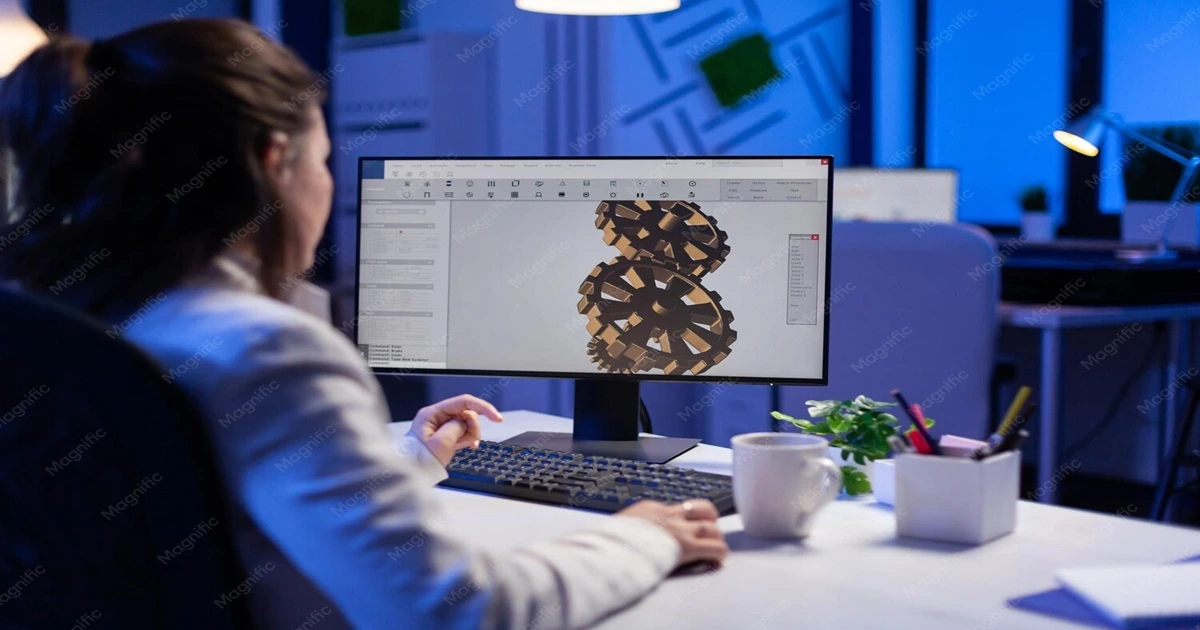
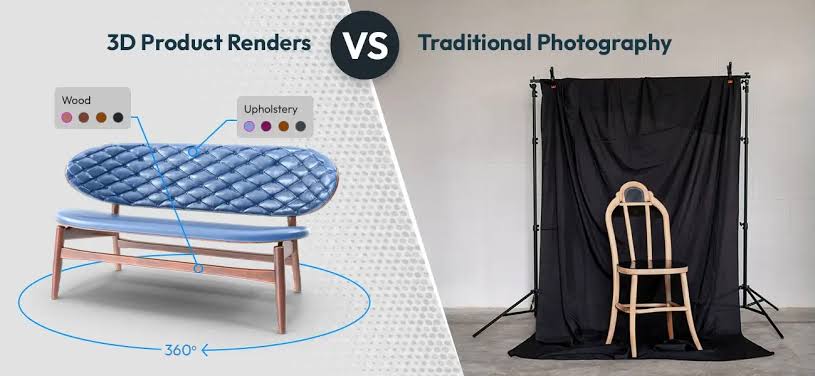
3D product rendering generates a photorealistic image from a digital model. The model can show any angle, any configuration, any color, any finish — including combinations that do not yet exist in the physical world. Its strengths are infinite flexibility and scalability. Its limitations are initial setup cost and the requirement for technical accuracy in the modeling stage.
Both produce images that buyers make purchase decisions from. The question is which produces those images more effectively for your specific product and commercial situation.
The Cost Reality in 2026
Understanding the true cost comparison requires looking at two different economic models: per-image cost and total campaign cost.
Per-Image Costs
Traditional photography: Standard e-commerce packshots cost between $25 and $75 per image, while styled or lifestyle shots range from $100 to $500+ per image, according to an audit of 47 enterprise photography contracts. Commercial day rates for photographers and studios sit between $800 and $3,000+ before props, styling, and post-production are added.
3D product rendering: Product renders for e-commerce typically run ₹60,000–₹3,00,000 per product for India-based production, or $200–$1,500 USD per finished image for international-standard output — depending on complexity, material difficulty, and number of variants. Our product animation and visualization services cover the full range from static 360-degree packshots through to interactive configurators.
At Scale, the Economics Flip
According to a global study of more than 100 photo studios, 3D virtual photography costs approximately six times less than traditional photography for a 30-image, 5-product project. The crossover point varies by product, but the general principle is consistent: 3D rendering becomes more economical than photography once a product has five or more variants or requires frequent visual updates.
The reason is asset reuse. A 3D model built for a product generates unlimited angles, unlimited color variants, and unlimited lighting conditions — all from the same base asset. A traditional photoshoot generates one set of images from one configuration of the physical product. Every new variant, every new angle, every seasonal update requires a new shoot.
Brands implementing 3D product rendering report saving 40–80% in content creation costs compared to traditional photoshoots, with the larger savings concentrated in high-variant, frequently updated catalogs.
What the Conversion Data Shows
The conversion impact of 3D product content is now well-documented across multiple independent studies.
Adding 3D content to product pages results in a 94% increase in conversion, with 82% of viewers activating and interacting with 3D assets when they appear on a product page. 66% of shoppers say a 3D configurator on a product page increases their buying confidence.
Shopify brands using consistent 3D packshots report a 5–12% uplift in add-to-cart rates when moving from mixed, inconsistent photography to uniform CGI — a more modest but more consistently reproducible figure than the higher headline numbers often cited.
These figures reflect a specific mechanism: 3D content reduces purchase uncertainty. When a buyer can examine a product from any angle, zoom to inspect texture and finish, and view it in multiple color options without loading a new image, the information gap that drives returns and abandoned carts decreases. NielsenIQ research indicates that clearer product visuals reduce "product not as described" returns by up to 20% in packaged goods categories.
One important note on interpreting conversion data: studies showing very large conversion lifts (90%+) typically compare 3D-plus-AR against static photography, not 3D renders against high-quality product photography. A more defensible baseline: build your business case for 3D rendering on conversion lift alone so the numbers stay conservative, and track return reduction separately — the actual ROI in high-return categories is usually materially higher than the initial projection.
When Photography Wins
Photography produces better results than 3D rendering in specific, well-defined situations.
Food and beverage. The appeal of food is inseparable from its physical reality — the steam rising from a bowl of soup, the glisten of a sauce, the imperfect char marks on a grill, the condensation on a cold glass. These are not visual effects added to a scene; they are physical phenomena that photography captures and 3D rendering must simulate. While 3D food rendering has improved significantly, high-quality food photography still outperforms CGI for most consumer food categories where sensory appeal drives purchase.
Textiles and apparel. The drape, hand, and movement of fabric is difficult to simulate convincingly. Luxury fashion brands in particular rely on photography because the physical behavior of their materials — silk, cashmere, leather — is central to what they are selling. Budget and mid-range apparel, where consistency across a large catalog matters more than artisanal feel, increasingly uses 3D.
Human-centric lifestyle content. When the selling message requires a real person — wearing the product, using it in a genuine environment, interacting with it authentically — photography is the format. Rendering can composite human figures, but lifestyle authenticity is difficult to achieve in CGI at a cost point that makes sense for most briefs.
Small product sets with simple variants. If your catalog is five products with two color options each, the setup cost of building 3D models may not be recovered through production efficiency before the product line changes. At small scale, photography is often simply faster and cheaper.
When 3D Rendering Wins
Large catalogs with many variants. A furniture brand offering a sofa in 20 fabric options and 3 sizes has 60 product combinations to photograph. A 3D model photographed in one configuration generates all 60 at marginal additional cost per variant. The economics are decisive.
Products that do not yet exist. Pre-launch visualization — showing a product in marketing, on investor presentations, or in Amazon listings before it has been manufactured — is only possible with 3D. This is the most clear-cut use case for rendering.
Technical and industrial products. Machinery, components, devices, and equipment are difficult or impossible to photograph in ways that communicate function. 3D rendering can show the product from any angle, zoom to internal components, and animate the mechanism in operation. Our product animation services include exploded-view animations and mechanism demonstrations that photography cannot produce.
High-customization products. Products where buyers configure their own specification — custom furniture, bespoke fixtures, personalized electronics — benefit from interactive 3D configurators that let buyers see their exact choices rendered in real time. Photography can only show pre-made samples.
Frequent catalog updates. Once a 3D model exists, updating a product — new color, new detail, new material — requires only model modification, not a new photoshoot. For brands managing seasonal collections or rapid iteration, this asset reuse significantly reduces ongoing content costs.
E-commerce scale. The e-commerce content strategy landscape has shifted in 2026, with high-growth DTC brands and enterprise retailers increasingly moving away from physical photoshoots for routine catalog updates, reserving studio time for high-concept brand campaigns. 3D rendering has become the primary engine for generating e-commerce content at scale across the consumer goods sector.
The Hybrid Approach Most Brands Actually Use
In practice, the most effective product visual strategies are not either/or. They use rendering and photography for different roles within the same campaign.
3D rendering for catalog and variant coverage. Every SKU, every color, every angle, every platform format — generated from 3D assets at scale.
Photography for hero campaign and lifestyle content. The brand shoot that appears in advertising, on social media, and at the top of the homepage — where human authenticity and brand character matter most — uses photography.
AR-ready 3D assets for interactive experiences. The AR in e-commerce market is forecast to grow at 35.8% CAGR through 2030, with furniture and home décor, fashion accessories, and beauty products driving adoption. A 3D model built for product rendering is the same asset that powers an AR try-before-you-buy experience. Understanding the full range of 3D product visualization types — from static renders through to interactive AR — is useful context before deciding what your brand actually needs.
A Practical Decision Framework
Before briefing a studio or a photographer, answer these five questions:
1. Does the product exist in final form? If not, you need 3D rendering. Photography requires a physical product.
2. How many variants need to be shown? Under five: photography may be simpler and cheaper. Over ten: 3D rendering almost certainly provides better economics. Between five and ten: run a cost comparison for your specific situation.
3. Is the appeal primarily physical or functional? Physical appeal (texture, warmth, authenticity) — photography. Functional appeal (mechanism, configuration, scale) — 3D rendering. Both — consider hybrid.
4. Will the content need to be updated frequently? If product details, colors, or specifications change regularly, 3D assets that can be updated at low marginal cost outperform photoshoots that must be redone for every change.
5. Does your product lend itself to interactive or AR experiences? If yes, a 3D model is the base asset for interactive content, AR visualization, and platform-optimized formats. Photography cannot directly generate these experiences.
Pricing Reference: 3D Product Visualization (2026)
Service | Scope | Cost Range (INR) | Cost Range (USD) |
|---|---|---|---|
Static product render | Per product, 3–5 angles | ₹60,000 – ₹1,20,000 | $700 – $1,500 |
360° product spin | Full rotation, web-ready | ₹90,000 – ₹2,00,000 | $1,100 – $2,500 |
Multi-variant render set | Per color/finish option | ₹15,000 – ₹40,000 | $200 – $500 |
Product lifestyle render | Product in scene context | ₹80,000 – ₹2,50,000 | $1,000 – $3,000 |
Exploded view animation | Internal components, 30–60 sec | ₹1,50,000 – ₹4,00,000 | $2,000 – $5,000 |
Interactive configurator (web) | Real-time variant switching | ₹4,00,000 – ₹12,00,000 | $5,000 – $15,000 |
For a detailed breakdown of pricing across all product visualization types, the 3D rendering and visualization pricing guide covers India and international market rates, along with timelines.
Frequently Asked Questions
Can you tell the difference between a 3D render and a photograph?
For professionally produced rendering, usually not — and that is the goal. The 3D rendering and visualization market reached $5.36 billion in 2026, driven in part by the fact that render quality has reached a standard where buyers cannot reliably distinguish CGI from photography at the resolution and context of e-commerce. The only consistent visual tells in lower-quality rendering are overly perfect surfaces, unnatural reflections, and lighting that does not interact with the environment convincingly.
Which produces better results on Amazon — renders or photography?
Amazon allows and accepts 3D renders as primary product images provided they accurately represent the physical product. For main image requirements (white background, product fills the frame, no lifestyle elements), renders and photography are treated identically. For A+ Content and lifestyle images, photography or lifestyle renders are both acceptable. The practical advantage of 3D on Amazon is consistent angle and lighting across a product family — which improves the catalog browsing experience and brand recognition.
Does 3D rendering reduce product returns?
The evidence is directional rather than definitive. Clear, accurate product visualization reduces "product not as described" returns by reducing the mismatch between what a buyer expects and what they receive. The mechanism is clearer with 3D configurators — buyers who choose their own specifications via a 3D tool have less uncertainty about what they ordered. NielsenIQ research suggests up to 20% reduction in description-related returns for FMCG categories with clearer product visuals. Fashion and furniture e-commerce, where return rates run higher and product expectation gaps are wider, likely see larger effects.
How long does 3D product rendering take?
A standard product render set (3–5 angles, single configuration) typically takes 5–10 working days. A 360° spin takes 7–12 working days. Multi-variant sets using the same base model are faster — each additional color or finish option typically takes 2–3 additional working days once the base model is approved. Interactive configurators take 4–8 weeks depending on the number of configurable options and technical complexity. For more on production timelines, our guide to how long 3D visualization takes covers all product and architectural visualization types.
Is 3D product rendering worth it for small businesses?
At small scale — under ten SKUs with limited variants — the setup cost of 3D modeling may not be recovered before the product line changes. Traditional photography is often more practical for very small catalogs. The inflection point is typically around five or more product variants, or when a product needs to be shown before the physical sample is available. Many small businesses use a hybrid approach: photography for hero campaign images, 3D for variant coverage on the catalog.
What file inputs does a studio need to produce product renders?
At minimum: CAD files or engineering drawings showing the product geometry, material specifications (colors, finishes, textures), and brand guidelines if brand environment renders are required. Existing photography or physical samples help guide material accuracy. The cleaner and more complete the input, the faster and more accurate the output.
Work With Chasing Illusions Studio on Your Product Visualization
Chasing Illusions Studio has produced product visualization for consumer goods, industrial equipment, medical devices, and fashion accessories across India, the UAE, the UK, and the US — working with clients including Tata, Bayer, and Novartis. Our 80-plus in-house artists cover the full product visualization range from static e-commerce renders through to interactive web configurators.
Request a custom quote within 24 hours →
📞 +91 99109 11696 | 📧 info@chasingillusions.com | 💬 WhatsApp available
Also read:
Ready to discuss your product visualization needs? [Get a Quote →]
Book a discovery 20-minutes strategy call.
📞 +91-9910911696 | +91-9910660851
📩 info [@] chasingillusions [.] in
Written by Deepak, content strategist at Chasing Illusions Studio. Our clients include Hindalco, Ernst & Young (EY), BinBase, Dozr, Equipment Wallet, Venwind, Healmate, Badacare, and 100+ brands across India, USA, Thailand, and the UK.
Chasing Illusions Studio
Premium animation & video production studio based in Delhi, India. Specialising in 3D animation, medical visualisation, architectural walkthroughs, and CGI.