At some point, most growing architecture firms hit the same question: should we build our own 3D rendering capability in-house, or outsource visualization work to an external studio? There's no universally correct answer — it depends on your project volume, budget structure, team, and how central rendering is to how you win and deliver work. This guide walks through the in-house vs. outsourced rendering decision in depth: what each model really costs, the trade-offs that matter, the questions to ask yourself, a hybrid option many firms settle on, and how to choose a rendering partner if you go the outsourced route.
Why this decision matters more than it looks
3D rendering has moved from a nice-to-have to a core part of how architecture is sold, approved, and communicated. Clients expect photorealistic visuals at pitch stage. Planning submissions increasingly lean on accurate contextual renders. Marketing a development off-plan depends on visualization quality. As rendering becomes more central, the question of how you resource it — own team or external studio — becomes a genuine strategic decision with real cost and competitive implications, not just an operational detail. Getting it wrong in either direction is expensive: over-investing in idle in-house capacity, or under-resourcing visualization that your pitches depend on.
What "in-house" 3D rendering actually means in practice
Building an in-house rendering capability isn't just hiring one person. Done properly it means:
Dedicated staff. At least one, usually more, trained specifically in 3D visualization — separate from your architectural design staff, because asking architects to render part-time rarely produces competitive quality and pulls them off billable design work. Skilled visualization artists are a distinct hire with their own salary market.
Software licensing. Ongoing costs for modeling and rendering software — 3ds Max, V-Ray, Corona, Lumion, Unreal Engine, or similar — which can run into thousands of dollars per seat annually, and usually more than one tool is needed.
Hardware investment. Rendering is computationally intensive. Producing photorealistic output at a professional pace generally requires workstations with strong GPUs, and often additional render-node capacity or cloud-render budget for animation. This is real capital expenditure, and it depreciates as hardware requirements climb.
Ongoing training and management. Rendering software and techniques evolve constantly; keeping a team current is continued investment, not a one-time setup. And like any staff, visualization artists need direction, feedback, and career development — a management cost that falls on someone senior.
The upside: a dedicated in-house team is always available, deeply familiar with your standards, and fully under your direction.
What "outsourced" 3D rendering actually means in practice
Outsourcing shifts those fixed costs into a per-project or retainer arrangement with an external rendering studio:
No fixed staffing cost. You pay for output, not headcount — regardless of how much or little rendering work you have in a given month. Your rendering cost scales with your actual project flow.
No software or hardware investment. The studio absorbs licensing and hardware as part of their own operation, including the ongoing upgrade cycle.
Access to a wider skill range. A studio working across many clients typically has broader stylistic range and more specialized capability — animation, VR, specific rendering styles — than a single in-house hire could reasonably cover. If one project needs a cinematic animated walkthrough and the next needs technical planning visuals, a studio can usually do both.
Dependency on external turnaround. You work within someone else's queue and timeline, which requires more advance planning than walking down the hall to your own team — the main practical trade-off, and the one that catches firms out when a deadline moves.
The real trade-offs, in depth
Cost
For firms with high, consistent rendering volume, in-house can become more cost-effective over time — the fixed costs of staff, software, and hardware spread across a large number of projects, and the per-render cost falls. For firms with variable or lower volume, in-house often ends up more expensive per render, because you're paying for capacity you're not always using: the salary and licenses cost the same in a quiet month as a busy one.
There's no universal breakeven point — it depends heavily on your actual pipeline. But as a general rule of thumb, firms doing fewer than a handful of rendering-heavy projects per month often find outsourcing meaningfully cheaper than carrying dedicated headcount, while firms with a steady, high monthly volume may find the economics tip toward in-house. The honest way to decide is to model your own numbers: total annual in-house cost (salaries + software + hardware + management time) divided by your realistic annual render count, versus quoted outsourced rates for the same work.
Speed and control
In-house rendering offers tighter iteration loops — your team is available for quick adjustments without waiting on an external queue, and communication overhead is lower because everyone shares the same context and can talk face to face. For fast, iterative design-stage visuals, that proximity is genuinely valuable.
Outsourced rendering requires more structured briefing and lead time. But a good studio partner compensates with dedicated focus and often faster raw production speed on any single deliverable, because rendering is their core specialty rather than a secondary skill layered onto an architect's job. The trade-off is really immediacy (in-house) versus specialist throughput (outsourced) — which matters more depends on how your projects run.
Quality and range
This cuts both ways. A well-trained in-house specialist working exclusively on your projects develops deep familiarity with your specific style, standards, and recurring client preferences — consistency that's hard for an external party to match. An external studio, by contrast, typically brings broader exposure, having rendered a wider range of project types, styles, and techniques across many clients. That range is valuable when a project calls for something outside your firm's usual visual language — a photoreal hospitality interior, an industrial context, a cinematic animation — that an in-house generalist may not have done before.
Flexibility through growth cycles
Often the most practical consideration of all. Architecture firms rarely have perfectly steady rendering demand — it spikes around major pitches, competition deadlines, client presentations, and project milestones, then quiets down between them. In-house staff are paid whether or not there's rendering work that month, so quiet periods are pure cost and overloaded periods can overwhelm a small team. An outsourced studio scales naturally with your actual demand, absorbing the spikes without leaving you carrying idle capacity in the troughs. For firms with lumpy, pitch-driven workloads, this alone often decides the question.
Questions to ask yourself
How consistent is your rendering volume, month to month? Steady, high volume favors in-house; variable or seasonal volume favors outsourcing.
How central is visualization quality to how you win work? If photorealistic rendering is a core part of your competitive pitch, dedicated in-house expertise embedded in your process may justify the investment. If it's a supporting deliverable rather than the centerpiece, outsourcing to a specialist is often more efficient.
Do you have the management bandwidth to run a rendering team? In-house artists need direction, feedback, and development like any role — a real cost in senior time, not just salary.
How much lead time do you typically have before a rendering deliverable is due? Consistent, reasonable lead time makes outsourcing smooth. If you frequently need same-day or next-day turnarounds, in-house proximity has real value.
What kind of rendering do your projects actually need? If it's mostly straightforward stills in a consistent style, an in-house hire can cover it. If your needs swing between stills, animation, VR, and varied styles, a studio's range may serve you better.
A middle path: hybrid arrangements
Many firms don't choose one model exclusively — they run a hybrid. They keep a small in-house capability for quick, lower-stakes visuals (internal design reviews, rough concept renders, fast iteration during design development) while outsourcing higher-stakes, client-facing deliverables (final marketing renders, animated walkthroughs, competition submissions, VR tours) to a specialist studio.
This captures the responsiveness of in-house work for day-to-day needs while still accessing specialist-level output for the renders that carry the most commercial weight. It also smooths the flexibility problem: your in-house person handles baseline demand, and the studio absorbs the spikes. The trade-off is that you're managing both a hire and a vendor relationship — but for many mid-sized firms, the hybrid is the most pragmatic answer to a genuinely mixed set of needs.
What to look for if you decide to outsource
If outsourcing looks like the better fit, the studio relationship matters as much as the decision itself:
Consistent point of contact. You want a studio that assigns dedicated project management, not a different person handling communication every time — continuity is what makes remote collaboration work.
Clear revision policy. Know exactly what's included before your first project starts. "Unlimited revisions" is a red flag, not a benefit — it usually signals undefined scope and drifting timelines. Look for a specific number of rounds with a clear revision-vs-scope-change distinction.
Portfolio relevance to your project type. A studio with strong hospitality rendering experience isn't automatically right for industrial or residential work. Ask for examples close to what you actually produce.
Realistic, honest turnaround estimates. Be wary of any studio promising fast, complex, photorealistic delivery on an unrealistically short timeline — overpromised speed usually shows up as quality problems or missed deadlines later.
Clear ownership of files and IP. Confirm upfront who owns the source files and final renders, and whether you can reuse assets across projects.
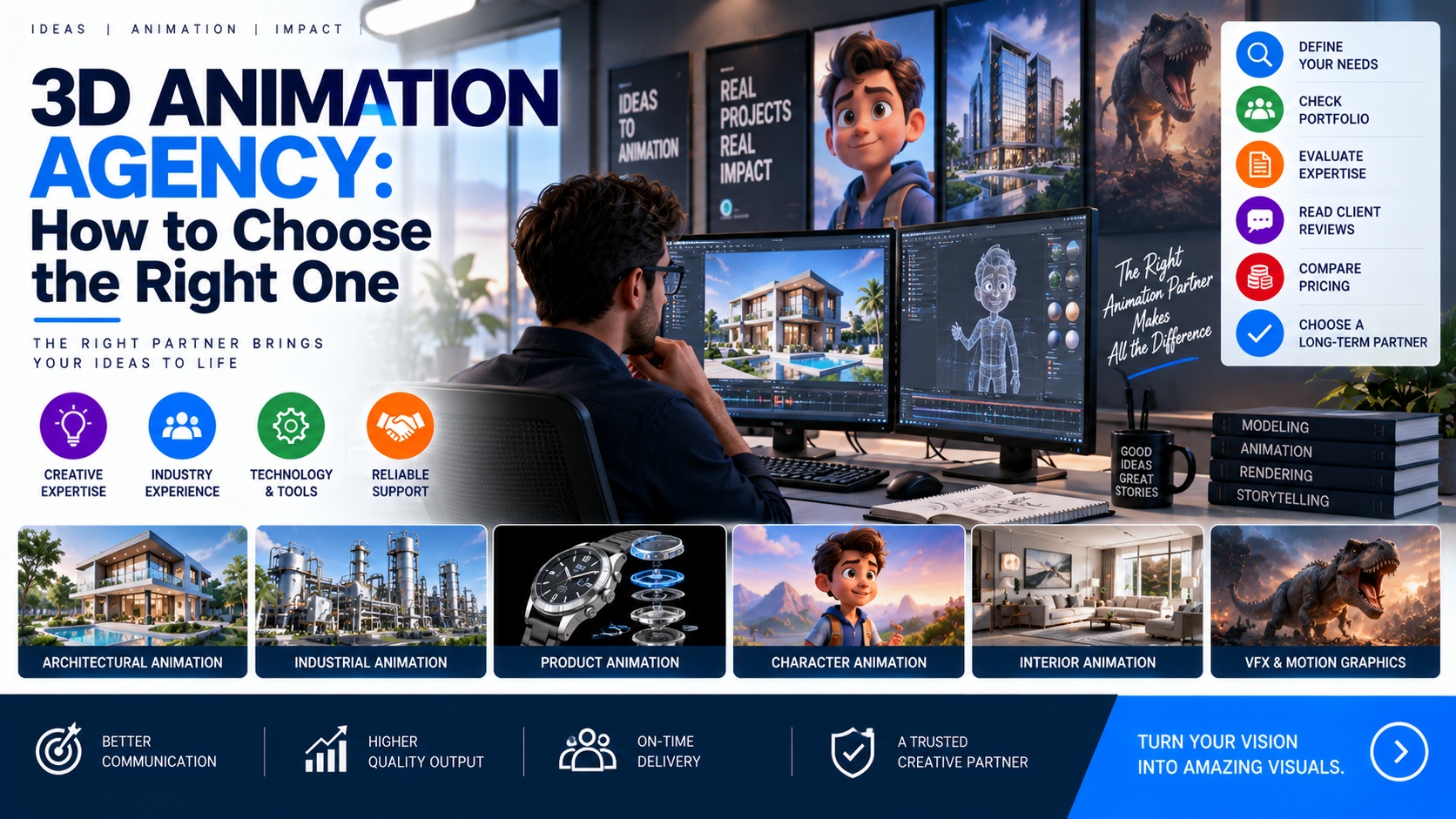
For more on running the outsourced relationship well — briefing, feedback, and getting accurate quotes — see how to brief a 3D animation studio. If cost is the deciding factor, our general rendering cost guide helps you compare quoted rates against the true internal cost of doing it yourself.
Our take
We work with architecture firms as an outsourced rendering partner — covering overflow capacity during busy pitch seasons, specialist deliverables like animated walkthroughs and VR-compatible tours, and ongoing rendering support for firms that have decided the in-house model doesn't fit their current volume. We're equally honest when it doesn't fit: for a firm with steady high-volume, stylistically consistent rendering needs and the management bandwidth to run a team, in-house or a hybrid model can be the better answer, and we'll say so.
The genuinely right choice comes down to your numbers and your pipeline, not a blanket rule. If you'd like to think it through, see our architectural walkthroughs service page or get in touch — we're happy to talk through your specific volume and needs, including the cases where keeping it in-house serves you better.
Frequently Asked Questions
Is in-house or outsourced 3D rendering cheaper?
It depends on volume. For firms with steady, high rendering volume, in-house can be cheaper per render once fixed costs spread across many projects. For variable or lower volume, outsourcing is usually cheaper because you pay only for output, not idle capacity. Model your real annual render count against total in-house cost (salary, software, hardware, management) to find your own answer.
What does an in-house rendering setup actually cost?
Beyond salary, budget for software licensing (often thousands per seat annually across multiple tools), high-GPU workstations and possibly render nodes or cloud-render budget, ongoing training, and the senior management time to direct the work. These fixed costs continue regardless of how busy a given month is.
Can outsourced rendering match in-house quality?
Yes — often it exceeds it, because rendering is the studio's core specialty rather than a secondary skill. The trade-off is less immediacy: outsourcing needs more structured briefing and lead time than a team down the hall. A good studio offsets this with dedicated project management and focus.
What's a hybrid rendering model?
Keeping a small in-house capability for quick, low-stakes visuals while outsourcing high-stakes, client-facing deliverables to a specialist studio. It combines in-house responsiveness for daily needs with specialist output for the renders that matter most, and smooths demand spikes.
How do I choose an outsourced rendering studio?
Look for a consistent point of contact, a clear revision policy, portfolio work relevant to your project type, honest turnaround estimates, and clear file/IP ownership. Prefer studios that show recent, relevant work over broad claims.
Chasing Illusions Studio
Premium animation & video production studio based in Delhi, India. Specialising in 3D animation, medical visualisation, architectural walkthroughs, and CGI.