In Gurugram’s hyper-competitive commercial real estate market, one developer struggling with slow pre-leasing transformed a stalled project into a near sell‑out by introducing a data‑driven 3D Commercial Property Walkthrough as the centerpiece of their marketing. Once prospects could virtually experience the property end‑to‑end, lead quality improved, decisions accelerated, and conversion rates aligned with broader findings that 3D visualization can help properties sell up to 20% faster and achieve higher prices.
Gurugram’s Commercial Property Challenge
Gurugram has emerged as the growth engine of Delhi‑NCR’s commercial real estate, driven by strong office absorption, tightening retail vacancies, and record investment flows. In Q1 2025 alone, Gurugram accounted for nearly 70% of NCR’s property sales value, with commercial office and mixed‑use projects seeing rising rents and robust demand across corridors like Golf Course Road, Cyber City, Dwarka Expressway, and New Gurugram.
For developers, this momentum also means intense competition: multiple Grade‑A projects vie for the same corporate tenants, investors, and retail brands, making differentiated, high‑trust marketing essential to win attention and close deals.
What Is a 3D Commercial Property Walkthrough?
A 3D Commercial Property Walkthrough is an immersive, visual journey through a commercial project, allowing buyers and tenants to virtually “walk” the property before it is built or fully fitted out. It typically combines 3D modeling, architectural rendering, camera animation, lighting, and storytelling to show how office, retail, or mixed‑use spaces will look and function once complete.
Unlike static floor plans or still CGI images, a 3D Commercial Property Walkthrough behaves like a guided tour: viewers can move through lobbies, corridors, office floors, retail bays, and amenities in a continuous, narrative flow, building a realistic mental model of the asset. This experience bridges the gap between technical drawings and real‑world usage, improving understanding and confidence in the project.
Case Study Overview: The Gurugram Builder and Project Profile
The case involves a mid‑to‑large scale mixed‑use commercial development along a high‑growth corridor in Gurugram, targeting corporate offices, retail brands, and F&B tenants. The project offered:
Grade‑A office floors aimed at IT, GCCs, and finance tenants.
High‑visibility retail and F&B spaces tuned to Gurugram’s experience‑led consumption trends.
Strong connectivity to metro, expressways, and established business districts like Cyber City and Golf Course Extension Road.
Despite sound fundamentals, pre‑leasing and pre‑sales lagged initial projections, largely because prospects struggled to visualize how the asset would feel and function once completed.
Pre‑Walkthrough Problems: Why Traditional Marketing Fell Short
Before adopting a 3D property walkthrough, the builder relied on a familiar mix of PDFs, static renders, and in‑person presentations. This created several friction points:
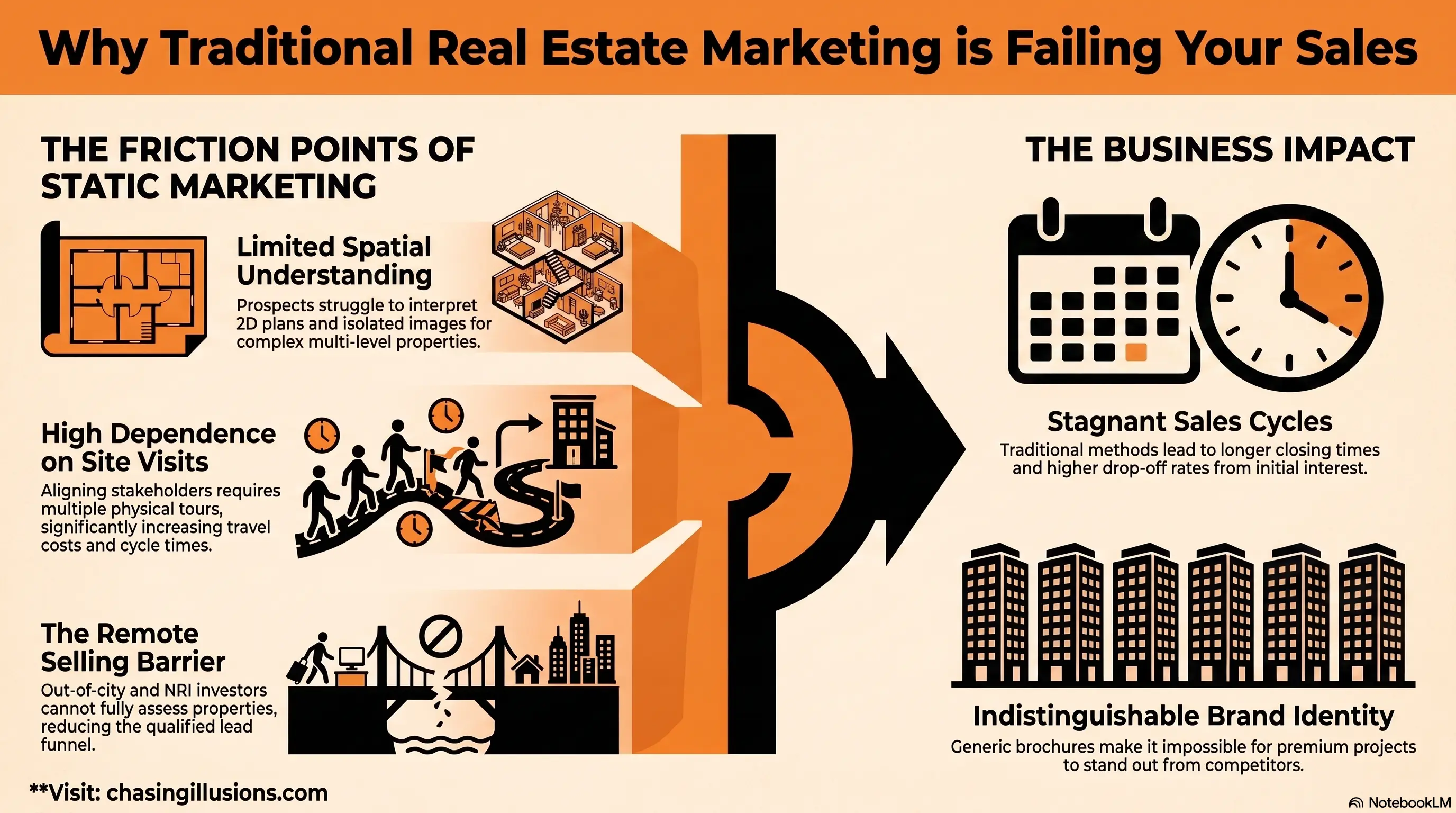
Limited spatial understanding: Many corporate and retail prospects found it hard to interpret 2D plans and isolated CGIs, especially for multi‑level commercial assets.
High dependence on site visits: Decision‑makers often needed multiple physical tours to align stakeholders, increasing cycle time and travel costs.
Weaker remote selling: NRI investors and out‑of‑city brands evaluating Gurugram could not fully assess the property without visiting, reducing the funnel of serious leads.
Indistinguishable marketing: Competing projects used similar brochures and still images, making it difficult for this builder’s project to stand out.
The result was longer sales cycles, lower pre‑commitment, and higher drop‑off between initial interest and final closure, despite Gurugram’s favorable market backdrop.
Strategic Shift: Deploying a 3D Commercial Property Walkthrough
Recognizing these barriers, the builder commissioned a cinematic 3D Commercial Property Walkthrough to reframe how prospects experienced the development. The walkthrough focused on three pillars:
1. Photorealistic Commercial Property Visualization
The walkthrough translated architectural drawings into a high‑fidelity, video‑style journey through the entire complex:
Exterior fly‑through showing façade, entrance plaza, and street presence.
Lobby sequence highlighting double‑height spaces, concierge zones, and visitor flow.
Office floor layouts with clear depiction of core areas, work zones, breakout spaces, and natural light.
Retail bays and F&B outlets with attention to frontage, circulation, and signage visibility.
Common amenities such as parking, drop‑offs, elevators, and landscaped terraces.
By layering CGI, material realism, lighting simulations, and controlled camera movement, the commercial property visualization offered a near‑real experience of the completed project long before construction reached final stages.
2. Narrative‑Driven Real Estate Walkthrough Animation
Rather than functioning as a pure technical demo, the 3D property walkthrough adopted a storytelling approach aligned with best practices in architectural animation:
A clear viewer path: from arrival at the site to exploring key zones (office, retail, amenities).
Use‑case framing: positioning scenes around specific tenant types (tech firm, retail brand, F&B operator) to show how they might use the space.
Emotional cues: music, pacing, and deliberate framing that emphasize prestige, efficiency, and visibility—factors that matter in high‑value commercial leasing.
This narrative layer increased engagement and helped prospects imagine themselves operating from the property, reinforcing buyer and tenant intent.
3. Integration Across the Digital Marketing Funnel
The builder embedded the 3D Commercial Property Walkthrough across all key touchpoints, echoing how leading Indian developers deploy virtual tours:
Landing pages and micro‑sites: The walkthrough became the hero element, placed near enquiry forms to encourage serious, informed leads.
Email and WhatsApp nurturing: Links to the virtual property tour were shared in follow‑ups, allowing decision‑makers to revisit the asset with colleagues and senior stakeholders.
Social media and performance ads: Short teaser clips from the walkthrough were used as creatives, driving traffic to the full interactive experience.
Broker and consultant presentations: Sales teams used the walkthrough during investor presentations and commercial leasing pitches, reducing reliance on static slides.
This consistent integration meant that nearly every serious prospect encountered the 3D walkthrough at least once before shortlisting or negotiating.
Measurable Outcomes: Sales, Engagement, and Decision Speed
While exact project‑level numbers remain confidential, the Gurugram builder’s performance closely mirrored broader industry data on 3D visualization and virtual tours. Key outcome themes included:
Faster Sales and Higher Conversion
Independent analyses show that properties using 3D visualization can sell up to 20% faster, achieve up to 9% higher prices, and spend about 30% less time on the market, thanks to clearer buyer understanding and reduced hesitation. Virtual tours have also been reported to generate up to four times more leads than listings with only photos, with a significantly higher share of serious prospects.
The builder observed a similar pattern: once the 3D Commercial Property Walkthrough was deployed, the ratio of site visits to final closures improved, and a larger proportion of inquiries progressed to negotiation because prospects already understood layout, visibility, and positioning before visiting.
Better‑Qualified Leads and Lower Wasted Showings
Commercial showings—especially for office and large retail—are time‑intensive for both brokers and corporate teams. By letting prospects conduct a virtual “gut check” online, the walkthrough filtered out casual interest and ensured that in‑person tours were reserved for stakeholders already comfortable with the project’s fundamentals.
Across the campaign, sales teams reported fewer wasted visits where prospects rejected the space due to basic layout mismatch, aligning with evidence that virtual tours help attract better‑qualified leads and streamline the leasing process.
Stronger Remote and NRI Engagement
Gurugram’s commercial growth is increasingly fueled by non‑local corporates, NRIs, and investors who evaluate multiple cities and corridors in parallel. The virtual property experience enabled these stakeholders to shortlist the project remotely, often involving architects, finance teams, and business heads who could review the asset without traveling.
This broader reach translated into more out‑of‑market enquiries and faster alignment among multi‑location decision‑making teams—a critical factor for commercial real estate lead generation and high‑value property sales.
Why 3D Commercial Property Walkthroughs Work in Gurugram?
Clearer Understanding of Complex Assets
Most commercial buyers and tenants struggle to fully grasp complex floor plates and mixed‑use schemes via 2D plans alone. 3D architectural walkthroughs solve this by visually communicating circulation, zoning, and volume in a form lay stakeholders can intuitively understand. This clarity reduces confusion and builds trust, especially for off‑plan property marketing where the final space does not yet exist.
Enhanced Brand Positioning and Competitive Edge
Listings and campaigns featuring 3D walkthroughs stand out as more professional, premium, and technology‑forward, which is especially powerful in competitive micro‑markets like Dwarka Expressway, Golf Course Extension Road, and Cyber City. High‑value CGI and interactive property tours contribute to stronger digital real estate marketing, signaling that the developer is serious about transparency and buyer experience.
Alignment with Modern Buyer Behavior
Video and interactive content dominate online attention; buyers of commercial assets increasingly expect to experience properties remotely, quickly, and on their own devices. 3D property walkthroughs and virtual property tours fit this behavior perfectly, letting viewers explore at their own pace, revisit details, and share links with their teams.
Implementation Framework for Developers and Marketers
For commercial real estate developers, builders, and marketing managers looking to replicate these results, a structured approach helps ensure ROI:
1. Define Clear Objectives and Metrics
Before production, outline what success looks like:
Pre‑sales targets (percentage of space leased/sold before completion).
Desired impact on enquiry‑to‑site‑visit and site‑visit‑to‑closure ratios.
Specific audiences: GCCs, IT firms, retail brands, investors, or leasing companies.
Align these objectives with known benchmarks from virtual tour adoption—such as faster sale cycles and higher lead quality—to track performance meaningfully.
2. Map the Buyer Journey and Funnel Touchpoints
Identify where prospects first hear about the project (social media, listings, broker outreach) and ensure the 3D walkthrough is discoverable at those points. Then embed the walkthrough into:
Landing pages for performance campaigns.
Email/WhatsApp nurturing sequences.
Broker decks and investor presentations.
This approach turns the 3D Commercial Property Walkthrough into a consistent asset across awareness, consideration, and decision stages.
3. Collaborate Closely with Architects and Visualization Teams
Accurate property visualization demands tight alignment between architects, structural consultants, and visualization specialists, particularly when representing Grade‑A specifications and compliance‑sensitive uses such as F&B or IT parks. Ensure that:
Final drawings and material palettes are locked before key animation passes.
Project USPs (frontage, ceiling height, flexible floor plates) are deliberately showcased.
Sequences reflect realistic lighting and occupancy patterns to avoid over‑promising.
This collaboration maintains both aesthetic impact and technical trustworthiness in real estate communication.
Best Practices for Commercial Property Walkthroughs
To maximize the impact of a 3D Commercial Property Walkthrough for commercial real estate marketing:
Lead with context: Start the animation with a clear sense of location—roads, landmark references, and connectivity to key business hubs.
Prioritize circulation clarity: Show how people and goods move through the building, from arrival to the deepest tenant spaces.
Use viewer‑centric camera paths: Keep movement smooth, realistic, and human‑scale to avoid disorienting viewers.
Highlight tenant‑relevant features: For office, emphasize column placements, core positions, and natural light; for retail, frontage, signage, and visibility; for F&B, kitchen and exhaust infrastructure.
Optimize for web and mobile: Host compressed but high‑quality versions compatible with major browsers and devices, with clear calls‑to‑action nearby.
Align messaging across channels: Ensure that copy in brochures, websites, and broker materials reinforces what viewers see in the walkthrough.
These practices help turn a 3D architectural walkthrough from a “nice‑to‑have video” into a core sales conversion tool.
Explore our 3D Architectural Walkthroughs for Real Estate Portfolio
FAQs: 3D Commercial Property Walkthroughs for Gurugram Developers
Q1. How does a 3D Commercial Property Walkthrough increase sales?
By giving prospects a realistic, immersive understanding of the property, a 3D walkthrough reduces ambiguity, builds trust, and moves them faster from interest to commitment. Studies indicate that 3D visualization can shorten time on market and improve both lead quality and achieved prices.
Q2. Is a 3D property walkthrough useful only for luxury projects?
No. While luxury and mixed‑use developments in Gurugram have adopted such tools early, 3D walkthroughs are equally valuable for mid‑segment offices, retail strips, industrial spaces, and business parks where tenants need to assess layout, logistics, and functionality. They are particularly helpful in corridors with rapid price appreciation and dense competition, such as Dwarka Expressway and New Gurugram.
Q3. What kind of ROI can commercial developers expect?
ROI comes from multiple sources: fewer wasted physical showings, faster decision cycles, higher conversion from enquiry to lease, and broader reach among remote and NRI buyers. Commercial scan providers often price services per square foot, and case analyses show that even a single saved trip or accelerated lease can offset production cost.
Q4. How early in the project should a walkthrough be produced?
For off‑plan commercial property marketing, developers typically commission 3D architectural walkthroughs once key design decisions are locked but well before final finishes, so the asset can anchor launch campaigns and pre‑sales. Ready or sample units can leverage scan‑based 3D experiences at any stage to reflect actual built space.
Q5. Are 3D walkthroughs relevant for brokers and leasing agencies?
Yes. Commercial property brokers and leasing companies benefit from virtual property tours by showcasing multiple listings more efficiently, attracting better‑qualified tenants, and differentiating their inventory on listing platforms. In Gurugram’s crowded commercial leasing landscape, brokers using 3D tours often report improved response rates and stronger client confidence.
Conclusion: Turning Visualization into Sales in Gurugram
In a city where commercial corridors such as Cyber City, Golf Course Road, Dwarka Expressway, and New Gurugram are reshaping India’s business landscape, developers who rely solely on PDFs and static renders risk blending into the background. This Gurugram builder’s experience shows that a well‑planned 3D Commercial Property Walkthrough can convert complex architecture into a compelling, buyer‑centric narrative that drives faster sales, stronger engagement, and more decisive client behavior.
For commercial real estate developers, builders, marketing managers, and brokers across Gurugram and Delhi‑NCR, the takeaway is clear: investing in property visualization, virtual property experiences, and architectural animation is no longer optional—it is a strategic lever for sales conversion and long‑term asset positioning.
What's Next?
If you’re considering a 3D Commercial Property Walkthrough for your next Gurugram project and want to design it around measurable sales outcomes rather than just aesthetics, you can collaborate with professional 3D visualization companies such as Chasing Illusions Studio, who focus on turning architectural intent into high‑impact commercial marketing assets.
Book a discovery 20-minutes strategy call.
📞 +91-9910911696 | +91-9910660851
📩 info [@] chasingillusions [.] in
Written by Deepak, Architectural Walkthrough content strategist at Chasing Illusions Studio. Our clients include DLF, Emaar, Ganga Reality, Banner Boswell, Shapoorji Pallonji, EC World, Taj, Florida Hospital, etc., 100+ architectural companies across India, USA, Thailand, and the UK.
Last Updated: July 14 2026 | Chasing Illusions Studio
Chasing Illusions Studio
Premium animation & video production studio based in Delhi, India. Specialising in 3D animation, medical visualisation, architectural walkthroughs, and CGI.