Introduction: Why VR & AR Are Reshaping Medical Training in India
Medical education in India is undergoing its most significant transformation in decades — and immersive technology is at the centre of it.
The global AR and VR in healthcare market was valued at USD 3.05 billion in 2025, is projected to reach USD 3.81 billion in 2026, and is expected to surge to USD 27.98 billion by 2035, growing at a CAGR of 24.81%. India is one of the primary growth engines in the Asia-Pacific region, with the Indian healthcare XR segment projected to reach USD 0.285 billion by 2026.
Traditional medical education has long relied on cadavers, physical models, and limited hands-on exposure — methods that are costly, ethically constrained, and difficult to scale across India's 600+ medical colleges. The augmented reality in healthcare market in India alone is expected to reach approximately USD 30.34 billion by 2027, expanding at a CAGR of 24.53% during the 2023–2027 period.
VR and AR change this equation entirely. They deliver repeatable, risk-free, hyper-realistic training environments that can reach every tier of India's medical education system — from AIIMS in Delhi to district medical colleges in tier-2 cities.
At Chasing Illusions Studio, we specialise in producing clinical-grade VR/AR medical training content, from 3D surgical simulations to augmented anatomy modules, for hospitals, medical institutions, and pharmaceutical companies across India, the UK, and the USA.
What Is Augmented Reality (AR) in Healthcare?
Augmented Reality (AR) in healthcare is a technology that overlays digital content — such as 3D anatomical models, real-time patient data, procedural step guides, and interactive simulations — onto a user's physical view of the real world, through devices such as smartphones, AR glasses, or headsets like Microsoft HoloLens.
Unlike Virtual Reality, which creates a fully immersive digital environment, AR enhances the real world without replacing it. This makes it particularly suited for surgical navigation, bedside teaching, and real-time procedural guidance where awareness of the physical environment remains critical.
In medical education specifically, AR enables students and surgeons to interact with three-dimensional anatomical structures in real-time — without requiring a cadaver, physical mannequin, or operating theatre time.
What Is Virtual Reality (VR) in Healthcare?
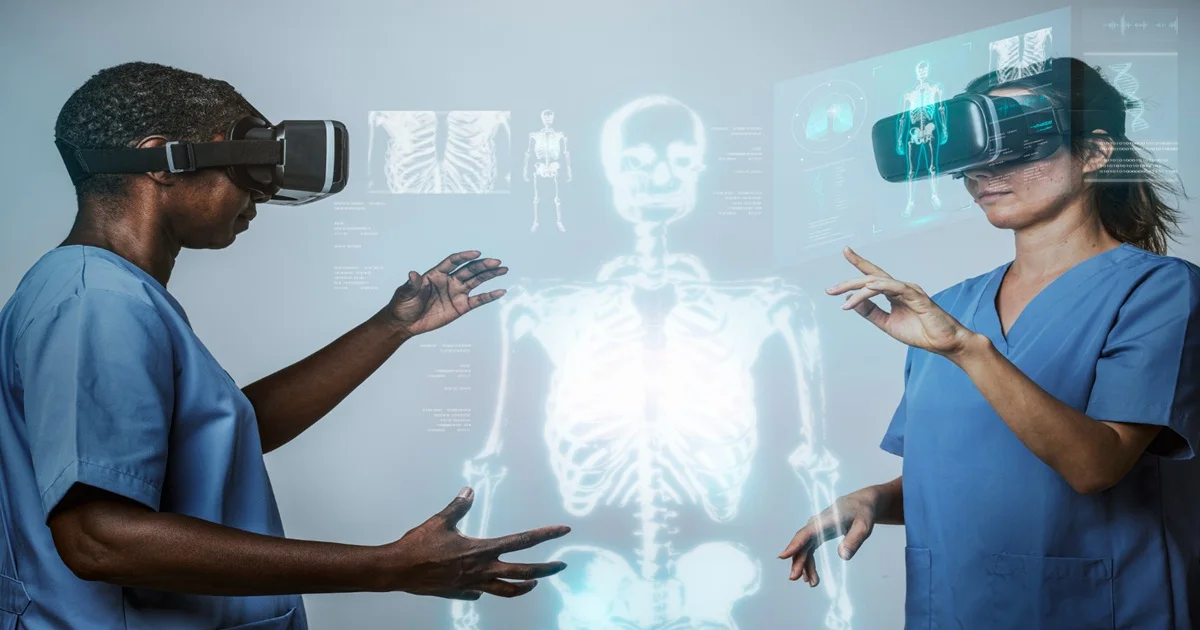
Virtual Reality (VR) in healthcare creates a fully immersive, computer-generated environment in which the user can interact with anatomical structures, perform simulated surgical procedures, navigate clinical scenarios, and receive real-time feedback — all without any risk to real patients.
VR in medical training is delivered through headsets such as Meta Quest, HTC Vive, and Apple Vision Pro. The VR in healthcare market reached USD 5.62 billion in 2025 and is projected to reach USD 7.58 billion by end of 2026, growing to USD 66.91 billion by 2034 at a 31.3% CAGR.
The core advantage of VR is repeatability. A surgical trainee can perform the same laparoscopic procedure 100 times in a VR environment before ever entering an operating theatre — building muscle memory, spatial awareness, and procedural confidence that directly transfers to real-world performance. Research published in Scientific Reports shows that AI-integrated VR training systems led to a 45% decrease in error rates and a 48% increase in trainee confidence.
How VR & AR Are Transforming Medical Education in India
1. Surgical Simulation and Training
A meta-analysis of 23 randomised controlled trials involving 1,091 participants confirmed that VR interventions led to significantly superior outcomes in knowledge scores, clinical operation scores, and surgical design capabilities compared to conventional methods. VR-trained surgeons demonstrate measurably better muscle memory, spatial awareness, and procedural dexterity.
For India's medical colleges, this is transformational. Rather than waiting for adequate clinical exposure in oversubscribed teaching hospitals, students can practise complex procedures — laparoscopy, orthopaedic fixation, neurosurgery — on-demand, repeatedly, and safely.
2. Anatomy Visualisation and 3D Learning
AR allows students to explore interactive, full-scale 3D anatomical models in real time — rotating structures, isolating organ systems, and examining tissue layers at a depth impossible with any textbook or 2D diagram. This is particularly impactful for spatial learners, and for institutions that lack well-funded anatomy labs.
3. Rare Case Simulation
One of the greatest limitations of traditional medical education is case-based learning being entirely dependent on which patients happen to be admitted. VR removes this constraint entirely — students can encounter and manage simulated presentations of rare conditions, emergency scenarios, and complex comorbidities, regardless of their clinical placement.
4. Remote and Scalable Medical Education
Developing economies like India are increasingly recognised as both major growth markets and key outsourcing destinations for AR and VR technology development and distribution in healthcare. AR/VR-based learning modules can be deployed digitally to any institution with compatible hardware — making quality medical education accessible to students in tier-2 and tier-3 cities who currently lack access to top-tier teaching hospitals.
5. Team Training and Collaborative Simulations
Multi-user VR environments allow entire surgical teams — surgeons, anaesthesiologists, scrub nurses — to rehearse complex procedures together in a shared virtual space before performing them on real patients. This improves coordination, communication, and reduces the risk of intraoperative errors.
10 Benefits of AR in Medical Education
Enhanced Spatial Understanding — Students explore 3D anatomical models and physiological processes in real time, building spatial comprehension that 2D materials cannot replicate.
Interactive, Hands-On Learning — AR simulations allow trainees to engage directly with clinical content, not just observe it — transforming passive study into active practice.
Improved Knowledge Retention — Visual and interactive learning modalities are consistently associated with higher long-term memory retention compared to textbook study alone.
Risk-Free Clinical Practice — Students and professionals can rehearse procedures without any risk to patient safety, allowing them to learn from mistakes in a consequence-free environment.
Scalable and Remotely Accessible — AR-based content can be deployed to any device, anywhere — eliminating geographic barriers to high-quality medical education across India.
Real-Time Procedural Guidance — AR overlays step-by-step instructions onto the trainee's field of view during simulated procedures, mimicking the experience of senior-supervised clinical work.
Faster Skill Acquisition — Repeated, structured practice of complex procedures through AR significantly accelerates the learning curve for both students and experienced clinicians learning new techniques.
Cost-Effective at Scale — Eliminating the need for cadavers, physical anatomical models, and lab consumables substantially reduces the cost of delivering high-quality medical education.
Simulation of Rare Clinical Presentations — AR enables students to encounter and manage conditions that may not be present in their clinical placement rotation.
Multi-User Collaborative Training — AR supports synchronised multi-user sessions, allowing surgical teams to train together on shared virtual models in real time.
Real-World Applications of AR in Patient Treatment
Beyond training, AR is already being used in live clinical settings across India and globally:
Surgical Navigation — AR headsets overlay real-time 3D models of organs and vascular structures directly onto the surgical field during procedures like neurosurgery, spinal surgery, and orthopaedic fixation — improving precision and reducing intraoperative risk.
Vein Visualisation — AR-powered devices such as AccuVein project a real-time map of subcutaneous veins onto the patient's skin, significantly improving first-attempt success rates for cannulation and blood draws.
Physical Rehabilitation — AR rehabilitation applications provide real-time movement analysis and guided feedback for patients recovering from orthopaedic procedures or strokes.
Pain Management — Clinical studies show VR reduces pain intensity by 35–50% during burn wound care procedures, with immersive AR and VR environments being increasingly used as non-pharmacological pain management tools.
Mental Health Therapy — AR and VR are integrated into cognitive behavioural therapy (CBT) programmes for conditions including PTSD, phobias, and anxiety disorders, enabling exposure therapy in fully controlled environments.
Stroke Neurorehabilitation — AR-based neurorehabilitation programmes assist stroke survivors in regaining motor and cognitive function through interactive, gamified exercise protocols.
AR-Assisted Dentistry — AR overlays digital impressions and real-time measurements onto the patient's oral cavity, supporting more accurate orthodontic, implant, and endodontic procedures.
Remote Surgical Guidance — AR-enabled telemedicine allows senior surgeons to guide junior doctors or trainees through procedures remotely, with real-time overlays visible in both locations.
How VR & AR Medical Training Videos Are Produced: A Step-by-Step Process?
At Chasing Illusions Studio, our production pipeline for VR and AR medical training content follows a rigorous seven-stage process developed over years of clinical media production:
Step 1 — Define Training Objectives Every project begins with a clinical brief: which procedure, anatomy, or training scenario is being visualised? We collaborate directly with qualified medical professionals — surgeons, clinicians, or academic consultants — to establish clinical accuracy requirements, target audience, and learning outcomes before a single asset is built.
Step 2 — Storyboarding and Medical Scripting Our medical content team develops a detailed clinical script outlining each step of the training scenario. This is accompanied by a complete storyboard mapping how the narrative will unfold across the AR or VR environment — including interaction points, perspective shifts, and key procedural moments.
Step 3 — 3D Medical Modelling and Animation We produce high-resolution 3D models of organs, tissue layers, surgical instruments, implants, and pathological structures — built to clinical specification. Advanced 3D animation simulates precise movements including dissection planes, instrumentation paths, blood flow, and cellular processes. All assets are optimised for real-time VR/AR rendering without performance compromise.
Step 4 — Interactive Element Development For full VR/AR experiences, we integrate interaction design: touch gestures, gaze-based navigation, voice command triggers, and haptic feedback integration. Every interactive layer is designed to mirror real clinical decision-making rather than passive observation.
Step 5 — VR/AR Platform Integration 3D assets are converted into VR/AR-compatible formats using Unreal Engine, Unity, or WebXR pipelines. For AR deployment, content is prepared for mobile AR platforms or headsets such as Microsoft HoloLens and Apple Vision Pro. For VR, we optimise specifically for Meta Quest 3, HTC Vive, and institutional VR training systems.
Step 6 — Clinical Testing and Quality Assurance All training modules undergo multi-phase testing with both medical professionals and target trainees. We validate clinical accuracy, assess interactivity, and conduct performance testing to ensure zero latency issues in live deployment environments.
Step 7 — Delivery and Deployment Final deliverables are provided in required formats — MP4, WebXR, SCORM-compatible e-learning packages, or standalone applications. We support deployment across medical e-learning platforms, hospital LMS systems, VR training simulators, and AR-enabled clinical environments. Ongoing support and content update services are available.
Chasing Illusions Studio: Medical Animation and VR/AR Services
Our medical animation practice covers the full spectrum of clinical visualisation needs:
Medical Device and Surgical Equipment Clients — We produce detailed product demonstration videos, surgical procedure animations, training and simulation content, and investor-facing pre-market approval presentations for device manufacturers and medtech companies.
Biotechnology and MedTech Clients — We visualise complex molecular and cellular processes, create gene and cellular therapy animations, and develop immersive VR/AR training modules for biotech research and product launch applications.
Hospitals and Medical Institutions — We create patient education and disease awareness videos, surgical procedure guides for both clinical staff and patients, staff training simulations, and institutional marketing content for hospitals across India, the UK, and the USA.
Pharmaceutical Companies — We produce mechanism-of-action animations, clinical trial explainers, drug delivery visualisations, and regulatory submission support content for pharmaceutical clients seeking to communicate complex science clearly and compliantly.
VR/AR Healthcare Specialists — We develop end-to-end immersive training environments: virtual surgery simulations, anatomy exploration modules, AR-assisted procedural guides, and collaborative multi-user clinical training platforms.
Why Indian Medical Institutions Are Investing in VR/AR Training Now
India's healthcare system faces a structural training challenge. With over 1.4 billion people and a healthcare workforce that must scale rapidly, traditional training infrastructure cannot keep pace. Medical colleges face shortages of cadavers, limited operating theatre access for students, and uneven distribution of specialist expertise across geographies.
Nearly 260 startups focusing on the AR/VR segment are currently operating in India, and the healthcare sector has been identified as a priority vertical for immersive technology investment.
The maturation of regulatory frameworks in India and Southeast Asia is creating fertile ground for startups and multinational corporations to deploy tailored AR/VR solutions in healthcare. Government initiatives under the National Digital Health Mission are further accelerating institutional adoption of digital medical education tools.
For hospital groups, medical colleges, and healthcare companies investing in training infrastructure today, VR and AR represent not a future technology — but the current standard of best practice in clinical simulation globally.
Why Choose Chasing Illusions Studio for VR/AR Medical Training in India?
Chasing Illusions Studio is one of India's most experienced medical animation and VR/AR production companies, with a track record serving hospitals, pharmaceutical brands, medical device manufacturers, and healthcare institutions across India, the United Kingdom, and the United States.
What sets us apart:
Clinical accuracy as a non-negotiable — every project is reviewed by subject matter experts before delivery.
Full-pipeline capability — from concept and script through 3D modelling, animation, interactive development, and final deployment.
Platform-agnostic delivery — we produce for mobile AR, headset VR, e-learning LMS, web-based WebXR, and standalone applications.
India-based production with global quality standards — cost-effective production without compromise on clinical or visual fidelity.
Hyper-realistic medical CGI — our 3D visualisation team produces anatomical detail at a level that supports genuine clinical learning, not just illustration.
Enterprise client experience — our portfolio includes production for hospital groups, pharmaceutical companies, and medical institutions with strict compliance and accuracy requirements.
Frequently Asked Questions: VR & AR in Medical Training India
What is VR and AR in medical training?
VR (Virtual Reality) and AR (Augmented Reality) in medical training refer to immersive digital technologies that allow healthcare students and professionals to practise clinical procedures, explore anatomy, and simulate patient interactions in risk-free, repeatable virtual environments — without requiring live patients or physical laboratory resources.
How effective is VR for surgical training?
A meta-analysis of 23 randomised controlled trials demonstrated that VR interventions produced significantly superior outcomes in knowledge, practical skills, and clinical performance compared to conventional surgical education methods. A 2025 randomised controlled study conducted across teaching hospitals in the UK and India found that VR-based simulation significantly enhanced technical proficiency, procedural confidence, and clinical decision-making in junior surgical trainees.
How much does VR/AR medical training content cost in India?
Production costs for VR/AR medical training content in India vary based on complexity, duration, interactivity level, and platform requirements. Chasing Illusions Studio offers custom project scoping — contact us for a detailed quote tailored to your training objectives and institutional requirements.
Which medical specialties benefit most from VR/AR training?
Surgery (general, orthopaedic, laparoscopic, and neurosurgery) has the most extensive evidence base for VR training outcomes. AR is also highly effective in anatomy education, radiology, emergency medicine training, and rehabilitation therapy.
Can VR/AR medical content be integrated with existing hospital LMS platforms?
Yes. Chasing Illusions Studio delivers content in SCORM-compatible formats, WebXR packages, and standalone applications that can be integrated with most major learning management systems used by Indian hospitals and medical institutions.
What platforms does Chasing Illusions Studio produce for?
We produce for Meta Quest 2 and 3, HTC Vive, Apple Vision Pro, Microsoft HoloLens, mobile AR (iOS and Android), web-based WebXR, and SCORM-compatible e-learning platforms.
Is VR/AR medical training recognised for CME/CPD credits in India?
Recognition of VR/AR-based training for Continuing Medical Education (CME) or Continuing Professional Development (CPD) credits is determined by the National Medical Commission (NMC) and individual institutional policies. We recommend confirming accreditation requirements with your institution prior to module commissioning.
Conclusion: The Future of Medical Training in India Is Immersive
VR and AR are no longer experimental technologies on the fringe of medical education — they are rapidly becoming the global standard for clinical simulation, surgical training, and anatomy learning. For India's healthcare system, which must train more clinicians, faster, and at greater geographic scale than almost any other nation, immersive training technology is not a luxury. It is an infrastructure investment.
The augmented reality segment in healthcare is growing at 33.9% CAGR — the fastest vertical growth rate in the entire XR industry. Indian medical institutions that invest in VR/AR training infrastructure today will be training a demonstrably more capable, more confident clinical workforce by 2030.
Chasing Illusions Studio brings together clinical accuracy, production quality, and immersive technology expertise in one India-based, globally experienced team. Whether you are a hospital group building a simulation centre, a pharmaceutical company creating a mechanism-of-action training module, or a medical college modernising your anatomy curriculum — we deliver the VR and AR content that makes training real.
CONTACT NOW
Ready to discuss your medical training project? Contact Chasing Illusions Studio for a consultation.
Chasing Illusions Studio
Premium animation & video production studio based in Delhi, India. Specialising in 3D animation, medical visualisation, architectural walkthroughs, and CGI.