Healthcare workforce readiness is the measurable ability of clinical and administrative staff to use current digital tools, maintain clinical competency, and adapt to new technology without disrupting patient care. It rests on four pillars — medical eLearning, simulation-based training, AI-personalized learning, and digital health literacy — and is built through a five-step workforce development process outlined below.
A nurse manager fits a mandatory compliance module into a fifteen-minute break. A hospital administrator reviews a staffing report showing a skills gap in a newly deployed clinical system. A medical school dean questions whether her curriculum keeps pace with AI diagnostic tools already in use down the hall. These scenarios repeat across institutions daily — and they define why healthcare workforce readiness has become a leadership priority rather than an HR checkbox.
Key takeaways:
Workforce readiness = clinical competency + digital fluency + adaptive capacity
WHO projects the global health worker shortage will narrow from 15 million (2020) to roughly 10 million by 2030 — but the gap won't close on its own
A structured 5-step development process outperforms one-off training rollouts
Retention testing, not completion rate, is the real readiness metric
This guide breaks down what healthcare workforce readiness actually means, why it matters now more than ever, and how hospitals, medical schools, and healthcare leaders can build a future-ready workforce using digital learning, AI, and simulation-based training.
What Is Healthcare Workforce Readiness?
Healthcare workforce readiness is the measurable ability of clinical and non-clinical staff to apply current knowledge, use modern digital tools, and adapt quickly to evolving care models, technologies, and patient needs.
It combines three core elements:
Clinical competency — up-to-date medical knowledge and hands-on skill
Digital fluency — comfort using electronic health records, AI-assisted diagnostics, telehealth platforms, and learning management systems (LMS)
Adaptive capacity — the ability to reskill or upskill as roles, tools, and regulations change
A workforce is considered "ready" not because it has completed a checklist of trainings, but because it can perform reliably under real clinical conditions, including new and unfamiliar ones.
Why Does Healthcare Workforce Readiness Matter Right Now?
Healthcare is undergoing one of the fastest technology shifts of any industry. Three forces are converging to make workforce readiness urgent:
1. The global health workforce shortage is significant — and closing slower than demand is rising
In 2020, the global health workforce stood at roughly 65.1 million workers across nursing, medicine, pharmacy, dentistry, and midwifery. Revised WHO projections put the global shortage at 15 million workers in 2020, narrowing to around 10 million by 2030 — meaning fewer people will be doing more, with newer tools, for at least the rest of this decade.
2. Healthcare digital transformation has moved past the pilot stage
EHRs, AI-assisted diagnostics, remote monitoring, and telehealth are now standard infrastructure. Staff trained years ago are expected to operate systems that didn't exist during their formal education.
3. Patient expectations have shifted to digital-first
Patients expect faster diagnostics and connected, digitally coordinated care. A workforce that isn't digitally fluent directly affects satisfaction scores and outcomes measures.
What Are the Core Pillars of a Digitally Ready Healthcare Workforce?
Pillar 1: Medical eLearning and Continuing Education
Medical eLearning allows clinicians to build and maintain competency without stepping away from patient care for extended periods. Effective programs typically include:
Microlearning modules for time-constrained clinical schedules
Continuing medical education (CME) tracking integrated into learning management systems
Scenario-based content that mirrors real clinical decision-making
Mobile-accessible platforms for remote and shift-based staff
Pillar 2: Simulation-Based Training
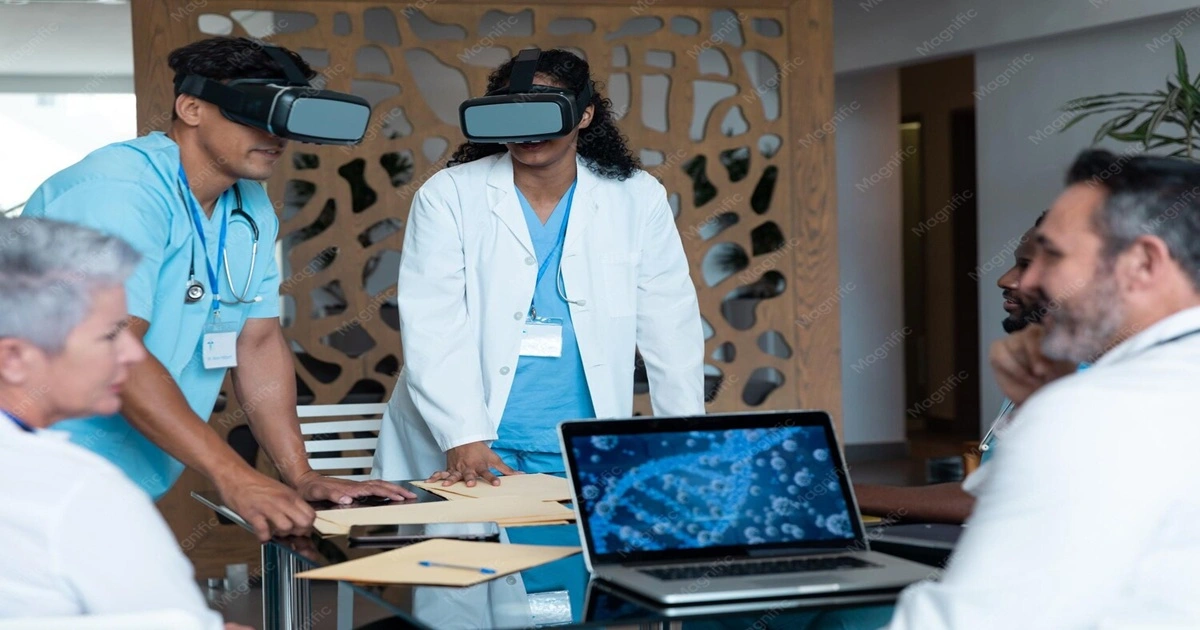
Healthcare simulation training lets clinicians practice high-risk, low-frequency procedures — emergency response, surgical technique, crisis communication — in a zero-risk environment. Simulation builds:
Muscle memory for critical procedures
Team-based coordination during emergencies
Confidence before real-world application
Pillar 3: AI in Healthcare Education
AI is increasingly used to personalize learning paths, flag competency gaps, and predict where a clinician may need additional support before it affects patient care. This shifts training from a one-size-fits-all model to adaptive, competency-based learning tailored to individual performance data.
Pillar 4: Digital Health Literacy
Beyond clinical skill, staff need working fluency in the platforms that now sit at the center of care delivery — EHR systems, remote monitoring dashboards, and AI-assisted diagnostic tools. Digital health literacy training ensures staff can use these tools accurately and confidently, not just operate them mechanically.
Digital Learning vs. Traditional Training: What's Actually Different?
Factor | Traditional (in-person only) | Digital / blended learning |
Scheduling | Fixed sessions, hard to fit around shifts | Self-paced, mobile-accessible |
Retention | Single exposure, limited reinforcement | Spaced repetition, revisit-on-demand |
Personalization | Uniform content for all staff | AI-adjusted paths based on performance |
Scalability | Limited by instructor availability | Scales across sites and shifts |
Measurement | Completion only | Completion + retention + applied assessment |
How Can Healthcare Organizations Build a Workforce Development Strategy?
A strong healthcare workforce development strategy combines needs assessment, structured digital learning, simulation practice, and ongoing measurement of competency and knowledge retention.
Step 1: Conduct a Skills and Technology Gap Assessment
Identify where current staff competency falls short of what new systems, procedures, or regulations require. This should be role-specific — a nurse's digital skill gaps differ from an administrator's or a physician's.
Step 2: Build Role-Based Learning Pathways
Instead of generic training, design pathways specific to nursing education, physician training, allied health roles, and administrative staff. Role-based learning improves relevance and completion rates.
Step 3: Blend Digital Learning With Simulation and Hands-On Practice
The most effective healthcare training programs combine self-paced digital learning with instructor-led simulation and real-world application, reinforcing knowledge through multiple learning formats.
Step 4: Measure Knowledge Retention, Not Just Completion
Completion rates tell you staff finished a module. Retention testing, spaced repetition, and applied assessments tell you whether the training actually changed clinical behavior.
Step 5: Build in Continuous Reskilling Cycles
Healthcare reskilling isn't a one-time event tied to a new system launch. Build recurring review cycles into workforce planning so skills stay current as technology and protocols evolve.
What Role Does Interprofessional Education Play in Workforce Readiness?
Interprofessional education — training different roles together instead of in silos — builds the shared vocabulary and coordination physicians, nurses, pharmacists, and allied staff need for real clinical teamwork, particularly during emergencies and complex cases. Organizations investing in team-based training see measurable gains in communication accuracy and patient safety outcomes.
How Does Workforce Readiness Improve Patient Safety and Outcomes?
A digitally competent workforce reduces technology-related errors, speeds emergency response, and improves protocol adherence — an under-trained staff member interacting with an unfamiliar system is a recognized risk factor in adverse events.
Specific impacts include:
Fewer technology-related errors when staff are properly trained on EHR and diagnostic systems
Faster emergency response through simulation-trained team coordination
More consistent compliance with safety and regulatory protocols through structured compliance training
Better patient communication through digital health literacy and interprofessional coordination
Patient safety and workforce readiness are directly linked — an under-trained staff member interacting with an unfamiliar system is a documented risk factor in adverse events.
What Should Medical Schools and Universities Do Differently?
Medical schools and universities carry the responsibility of building digital readiness before graduates ever enter clinical practice. This includes:
Integrate simulation and AI-assisted diagnostic tools into core curriculum — not electives
Teach competency-based learning rather than time-based progression
Build digital health literacy alongside clinical science
Partner with health systems to align academic training with real-world tool use
Institutions like Chasing Illusions Studio have worked alongside medical education programs to translate complex clinical and technical concepts into structured digital learning content that mirrors real clinical environments — helping bridge classroom theory and hospital-floor practice.
A 5-Question Readiness Self-Assessment
Use this to gauge where your organization stands before building a strategy:
Can staff name the last time they used a retention assessment (not just a completion log)?
Is training role-specific, or is it one generic module for everyone?
Does simulation training happen outside of emergency-only scenarios?
Are reskilling cycles scheduled on a recurring calendar, or triggered only by new system launches?
Do different professional roles train together on any shared scenarios?
Three or more "no" answers indicate a workforce development strategy gap worth addressing first.
What Does a Future-Ready Healthcare Workforce Look Like?
A future-ready healthcare workforce is:
Digitally fluent — comfortable using AI-assisted tools, LMS platforms, and remote care technology
Continuously learning — engaged in ongoing CME and upskilling rather than one-time onboarding
Adaptive — able to shift into new roles, tools, or care models with minimal disruption
Collaborative — trained across disciplines, not just within them
Measurably competent — assessed through retention and applied performance, not just course completion
Key Terms:
CME (Continuing Medical Education): Ongoing training required to maintain medical licensure and competency
LMS (Learning Management System): Software platform used to deliver, track, and report on training
Competency-based learning: Progression based on demonstrated skill rather than time spent in training
Interprofessional education: Training multiple healthcare roles together rather than separately
Frequently Asked Questions
What is the difference between healthcare workforce readiness and healthcare workforce development?
Readiness is the current state of staff capability — how prepared they are today. Development is the ongoing process — training programs and learning pathways — used to build and maintain that readiness over time.
How does digital learning improve healthcare training outcomes?
It allows flexible-schedule training, repeat access for better retention, and personalized content based on performance data — improving accessibility and long-term retention compared to one-time in-person-only training.
Is simulation training only useful for emergency scenarios?
No. Beyond high-risk, low-frequency events, it's used for routine procedural training, communication skills, and onboarding staff into unfamiliar systems.
How often should healthcare staff undergo digital upskilling?
Most organizations benefit from continuous, cyclical upskilling tied to technology updates, regulatory changes, and periodic competency assessments — not a single annual event.
How much does a healthcare workforce readiness program typically cost to implement?
Cost varies by scope — role-based pathways for a single department cost far less than an enterprise-wide rollout with simulation infrastructure. Most organizations start with a gap assessment (low cost, high clarity) before scaling investment into simulation or AI-personalized platforms.
Conclusion:
The nurse squeezing in a training module, the administrator facing a skills gap report, the dean rethinking her curriculum — they're navigating the same shift: healthcare is becoming a digital discipline as much as a clinical one. Workforce readiness determines whether that shift strengthens patient care or strains it.
Organizations that invest deliberately in medical eLearning, simulation training, AI-driven personalization, and continuous reskilling aren't checking a compliance box — they're building the operational foundation for safer, more adaptive care delivery.
If your organization is exploring how to translate complex clinical training into engaging, effective digital learning experiences, Chasing Illusions Studio partners with healthcare institutions to design eLearning, simulation-based content, and medical training modules built for real-world clinical readiness.
Book a discovery 20-minutes strategy call.
📞 +91-9910911696 | +91-9910660851
📩 info [@] chasingillusions [.] in
Written by Deepak, Healthcare Content Strategist at Chasing Illusions Studio, who leads content for clients including Ambler Surgical, Practo, Bayer, SMT, Novartis, and 100+ healthcare brands across India, USA, Thailand, and the UK.
Last Updated: July 31 2026 | Chasing Illusions Studio
Chasing Illusions Studio
Premium animation & video production studio based in Delhi, India. Specialising in 3D animation, medical visualisation, architectural walkthroughs, and CGI.