Picture this: A newly inducted ICU nurse reviews a paper-based protocol before a high-stakes procedure. Two weeks later, she recalls less than 20% of it — a gap that no amount of supervision fully closes. Now imagine the same nurse completing a 7-minute animated clinical walkthrough before every shift rotation. Her recall improves measurably.
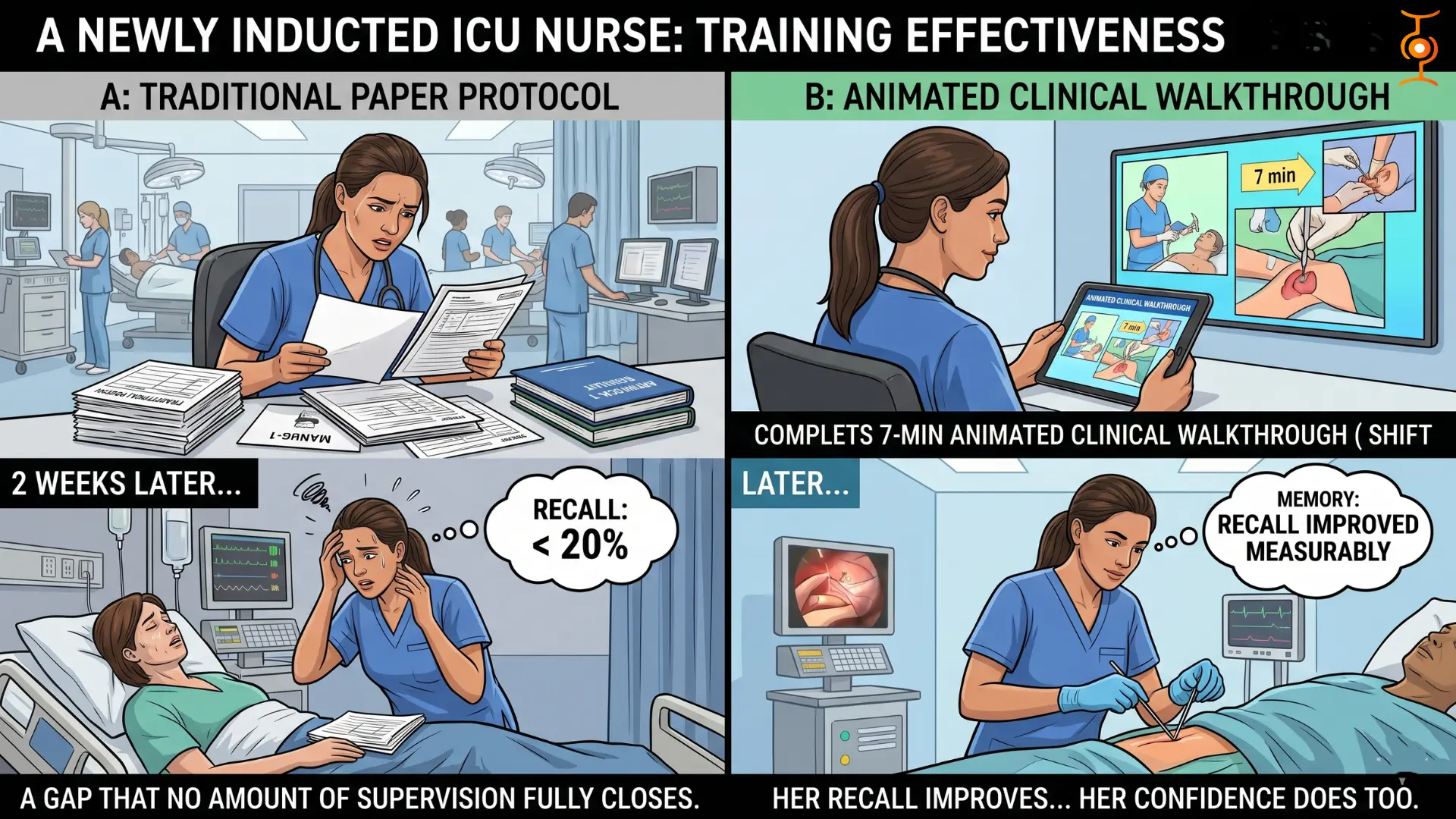
Her confidence does too. This is not a hypothetical. This is the documented impact of video-based learning on healthcare knowledge retention — and it is reshaping how hospitals, pharmaceutical companies, and clinical education teams invest in staff development.
The Retention Problem That Is Costing Healthcare Organisations
The healthcare industry runs on institutional knowledge. Protocols, drug interactions, surgical procedures, compliance requirements — the depth of information clinical staff must retain is enormous. Yet traditional training methods have a well-documented limitation: people forget.
The "forgetting curve," a principle established by psychologist Hermann Ebbinghaus, shows that without active reinforcement, people lose roughly 50% of new information within a day and up to 90% within a week. In a hospital environment, that rate of forgetting is not just a training inefficiency — it is a patient safety risk.
Standard approaches such as instructor-led classroom sessions, printed manuals, and one-time orientation programmes are struggling to keep pace with the clinical complexity, staff turnover rates, and geographically distributed teams that define modern healthcare organisations. The question for L&D leaders is no longer whether to modernise training — it is which digital learning investment delivers the clearest return.
Why Video-Based Learning Works: The Cognitive Science Behind It?
Video engages more cognitive pathways simultaneously than any other training medium. When a learner watches a well-structured healthcare video, the brain processes visual imagery, spoken narration, on-screen text, and sequential motion together — creating multiple memory encoding pathways that reinforce one another.
A controlled study comparing infographic-style animated video against traditional lecture capture found that animated video sustained higher levels of both emotional and cognitive engagement over longer viewing periods — whereas lecture capture produced stronger initial engagement that faded more quickly. Critically, when learners were tested on difficult subject matter, those trained with animated infographic video demonstrated significantly better performance. For healthcare organisations where clinical complexity is the norm, not the exception, this distinction matters: the format that maintains attention and improves performance on hard questions is the format that reduces knowledge gaps where they are most dangerous.
Based on many studies and research by Chen et al., during testing the various kinds of video courses, he found that there is a connection between negative emotions and students’ lower learning. So his research purpose that
The higher the emotional engagement, the better the student performance.
Among medical students studied in a peer-reviewed 2025 publication, 98.7% found video-based learning effective, and 89.9% reported that it enhanced their retention of information.
These are not outliers. A systematic review published in Frontiers in Communication found that across 15 eligible studies, 86.6% reported positive effects on knowledge, awareness, or self-efficacy among patients and healthcare workers — consistent with global findings that multimodal media such as video can enhance understanding and memory.
The cognitive mechanism is clear: video's layered delivery matches how clinical knowledge needs to be recalled — quickly, accurately, and under pressure.
Video-Based Learning vs Traditional Healthcare Training: A Direct Comparison
Dimension | Traditional Training | Video-Based Learning |
Consistency | Varies by trainer | Standardised every time |
Scalability | Location-bound | On-demand, global access |
Retention at 30 days | 10–20% (text) | Up to 60% |
Per-learner cost (3 years) | $200+ | $3–$6 |
Learner flexibility | Fixed schedule | Self-paced, repeatable |
Assessment integration | Manual, delayed | Embedded, real-time |
Compliance tracking | Paper-based | Automated via LMS |
Patient Safety Impact | Inconsistent — varies by trainer quality | Standardised, evidence-linked, auditable |
Regulatory/Accreditation Compliance | Manual, harder to prove | Automated tracking, audit-ready LMS records |
Video-based training consistently delivers higher ROI than traditional classroom instruction, with 49% of organisations reporting higher engagement and better attention levels compared to in-person training, and 86% saying it enables far more flexible operational learning models than other formats.
The long-term cost advantage is compelling: after three years, video-based training costs only $3–$6 per person, compared to $200 or more with conventional training — while also contributing to fewer clinical mistakes and higher staff retention.
Key Applications of Healthcare Video in Clinical Education
Onboarding and Procedural Training
New clinical hires must absorb enormous volumes of protocol information in compressed timeframes. Healthcare professionals can visualise techniques before applying them in clinical settings, and new staff members grasp complex procedures faster through training programmes incorporating healthcare animation videos, which show measurably improved learning outcomes.
Medical animation also standardises training — every learner receives the same information, eliminating the inconsistencies that arise when different trainers or clinical experiences shape knowledge acquisition differently.
Complex Procedure Visualisation with 3D Medical Animation
Some clinical content simply cannot be conveyed adequately through text or 2D imagery. Through 3D medical animations, trainees obtain precise, detailed visualisations of complex medical procedures that conventional teaching methods would make difficult to interpret — including surgical procedures involving the brain or heart, where precision is critical to real-world clinical readiness.
The 3D medical animation market reached £693 million in 2025, reflecting the scale at which online medical education now relies on this technology.
Continuing Medical Education (CME) and Protocol Updates
Healthcare professionals can access animated training materials remotely, supporting flexible learning schedules. This accessibility ensures consistent knowledge updates across distributed healthcare teams.
For hospital networks spanning multiple sites — or pharmaceutical companies training field reps across cities — this distributed delivery capability alone represents a significant operational advantage.
Pharmaceutical and Compliance Training
Pharmaceutical training managers face a persistent challenge: ensuring all representatives carry identical, scientifically accurate product knowledge. Healthcare video modules allow MOA (mechanism of action) content, pharmacovigilance protocols, and regulatory compliance training to be delivered, tracked, and verified at scale — without the scheduling complexity of live instruction.
Who Benefits From Healthcare Video Training? A Role-by-Role Breakdown
Hospital Administrators
Your primary concern is cost, compliance, and staff turnover. Video-based training reduces per-learner cost by over 97% at scale, automates compliance tracking, and contributes to higher staff satisfaction — a documented driver of retention. For you, the ROI argument is financial and operational.
Healthcare L&D and Training Managers
You need content that is consistent, scalable, and measurable. Healthcare video modules standardise delivery across sites, integrate with your existing LMS, and produce trackable completion and assessment data — removing the guesswork from training effectiveness reporting.
Clinical Education Directors
Your mandate is clinical accuracy and competency outcomes. 3D medical animation allows complex procedures, anatomical structures, and physiological pathways to be visualised with precision impossible to achieve in text or 2D formats. It reduces the gap between theoretical knowledge and clinical readiness.
Pharmaceutical Training Managers
You face the challenge of training field forces across geographies on scientifically exact product information. Healthcare video content ensures every representative receives identical MOA briefings, pharmacovigilance updates, and compliance training — at a fraction of the cost of live workshops.
Healthcare Executives and Decision-Makers
Your lens is strategic. Digital learning investment signals organisational maturity, supports accreditation requirements, and directly connects to patient safety outcomes. Video-based training is no longer a cost centre — it is a risk management tool.
The Role of Microlearning and Engagement Formats
Not all healthcare video content is equally effective. Format matters as much as content.
According to a research, the average completion rate for non-interactive training videos dropped to 60% in 2024, indicating specific challenges with learner attention — driving the industry to pivot toward engagement, as the global interactive learning market was valued at USD 27.85 billion in 2024 and is projected to grow at a CAGR of 15.1% through 2030.
According to study in Nigeria, most healthcare learners prefer video content of 10 minutes or less — a finding consistent with microlearning principles that emphasise short, focused modules tied to single learning objectives.
Microlearning has demonstrated positive impacts on knowledge acquisition, skill performance, knowledge retention, study habits, and collaborative engagement among health professions students.
The most effective healthcare video formats combine short duration, clinical accuracy, visual richness, and embedded knowledge checks — turning passive viewing into active, measurable learning.
ALSO READ: The Business Case for Healthcare Training Videos
Measuring Training ROI: What Healthcare Executives Need to Track
For Clinical Education Directors and Healthcare Executives evaluating a digital learning investment, the business case must be quantifiable. The framework most adopted by healthcare L&D teams follows the Kirkpatrick-Phillips model: measuring learner reaction, knowledge acquisition, behavioural change, organisational results, and financial ROI.
Recent reports confirm that 90% of L&D professionals find video content significantly improves learner engagement and knowledge retention in corporate training programmes.
Key metrics to track when deploying video-based training in a clinical setting include pre- and post-assessment score improvements, protocol adherence rates, clinical error frequency, staff onboarding time, compliance audit outcomes, and long-term employee retention. Each of these carries a direct financial value that can be mapped against production and platform costs.
The training ROI formula — ((Benefits – Costs) / Costs) × 100 — consistently favours video-based formats, with effective programmes typically earning $1.25 to $4 for every dollar spent.
Common Concerns Before Investing in Healthcare Video Training
"The upfront production cost is too high."
Production cost is a one-time investment. A single 5-minute 3D medical animation module, once produced, can train hundreds of staff over three or more years. The per-learner cost drops dramatically with scale. Compare this against the recurring cost of facilitator time, venue hire, and printed materials for every cohort.
"Our content will become outdated quickly."
Modular production mitigates this. Well-designed healthcare video programmes are built in discrete chapters — a drug mechanism, a procedural step, a compliance update — so individual modules can be updated without rebuilding the entire programme.
"We're not sure how to ensure clinical accuracy in animated content."
Reputable medical animation studios work with clinical subject matter experts (SMEs) during scripting, storyboarding, and review stages. Accuracy validation is a standard part of professional medical video production, not an afterthought.
"We already have an LMS. Will video content work with it?"
SCORM and xAPI are industry-standard formats that make medical video content compatible with virtually every major LMS platform. This should be confirmed at the briefing stage with your production partner.
How to Implement Video-Based Learning in a Healthcare Organisation: A Practical Starting Framework
Shifting from traditional to video-based training does not require a full overhaul of your L&D infrastructure. Most healthcare organisations implement it effectively in four stages:
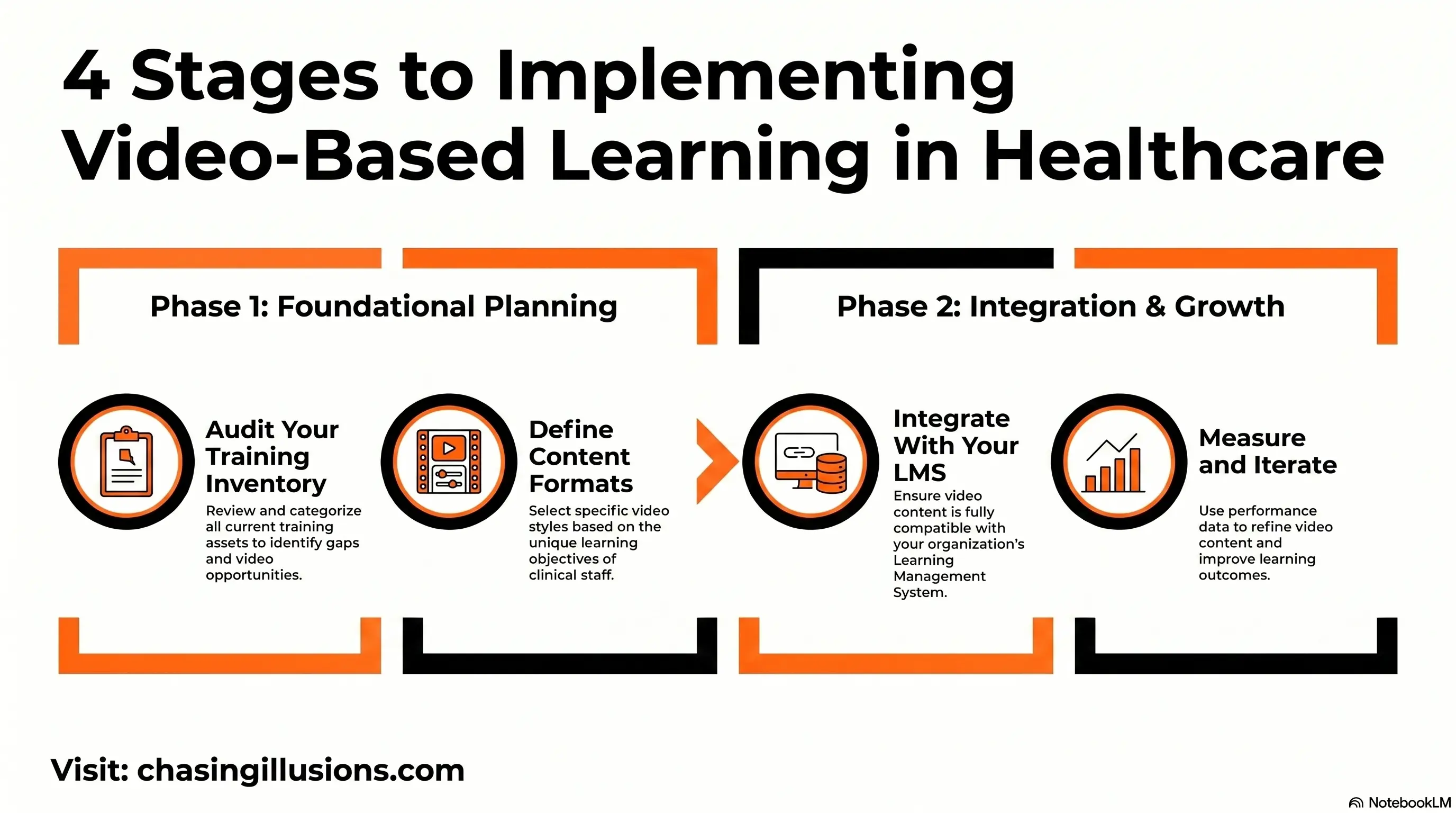
Stage 1 — Audit Your Current Training Inventory
Identify which modules are highest-stakes (compliance, onboarding, procedural), highest-frequency (repeated annually or quarterly), and lowest-retention (where knowledge gaps are most documented). These are your priority candidates for video conversion.
Stage 2 — Define Content Formats by Learning Objective
Not every topic requires 3D animation. A simple protocol update may work as a 4-minute narrated screen recording. A surgical technique demonstration benefits from full 3D medical animation. Match format complexity to clinical stakes and budget.
Stage 3 — Integrate With Your LMS
Effective healthcare video training is not a standalone solution. Content should be deployed through your Learning Management System to enable automated tracking, assessment scoring, and compliance reporting. Confirm SCORM or xAPI compatibility with your content vendor before production begins.
Stage 4 — Measure and Iterate
Establish pre- and post-assessment baselines before launch. Track knowledge scores, completion rates, and downstream clinical metrics (error rates, audit outcomes) at 30, 60, and 90 days. Use this data to justify further investment and identify gaps requiring additional content.
Frequently Asked Questions
Q: How long does it take to produce a healthcare training video?
Production timelines vary by format and complexity. A 3-5 minute 3D medical animation typically takes 6–12 weeks from script approval to final delivery, including clinical review cycles. Simple 2D explainer videos or screen-recorded procedural walkthroughs can be delivered in 2–4 weeks.
Q: What information do we need to provide a medical animation studio to get started?
A good production partner will guide you through a structured brief. You will typically need to provide: the clinical topic and target learner profile, existing training materials or SME access for accuracy review, your LMS platform details, preferred video length and format, and any brand or compliance guidelines.
Q: Can one healthcare video programme cover multiple departments or specialties?
Yes. A modular production approach allows a single programme to be structured with core modules shared across departments and specialty-specific modules branching from that core — reducing redundancy and production cost while maintaining clinical relevance per audience.
Q: How does video-based learning improve knowledge retention in healthcare?
Video-based learning combines visual, auditory, and narrative cues that align with how the brain encodes and recalls information. Research shows it can increase information retention rates by up to 60% compared to text-only formats, making it significantly more effective for clinical education.
Q: What is the ROI of switching to video-based healthcare training?
Video-based training dramatically reduces long-term per-learner costs — from over $200 per person with traditional in-person training to as low as $3–$6 per person over three years. It also reduces clinical errors, improves compliance, and increases staff retention.
Q: Can video-based learning replace classroom training in hospitals?
Video-based learning works best in a blended model — complementing, not entirely replacing, hands-on clinical practice. It excels at onboarding, procedural demonstrations, protocol updates, and continuing medical education (CME).
Q: What types of healthcare video content improve training outcomes?
The most effective formats include 3D medical animations, procedural step-by-step demonstrations, microlearning modules under 10 minutes, interactive videos with embedded assessments, and simulation-based scenario walkthroughs.
Q: Is video-based learning effective for pharmaceutical training teams?
Yes. Pharmaceutical training teams use healthcare video content to standardise MOA training, compliance onboarding, and product knowledge updates — ensuring all staff receive identical, accurate information regardless of location.
Q: How do hospitals track the effectiveness of video-based training?
Effectiveness is typically tracked via LMS (Learning Management System) data: completion rates, quiz scores, knowledge improvement percentages, and time-to-competency metrics. These are mapped against operational KPIs such as error rates and protocol compliance.
Conclusion: The Strategic Case for Video-Based Learning in Healthcare
The healthcare industry cannot afford a knowledge retention gap. Whether the context is a large hospital network onboarding clinical staff, a pharmaceutical company standardising product training, or a medical device firm educating surgeons on a new procedure — the stakes of inadequate training are clinical, financial, and reputational.
Video-based learning closes that gap. The evidence is consistent, the ROI is measurable, and the technology has matured to a point where 3D medical animation and interactive healthcare video are accessible at scale. Organisations that continue to rely solely on traditional training methods are not just falling behind best practice — they are accepting preventable inefficiencies as standard.
The shift is not a trend. It is a structural change in how clinical knowledge is built, retained, and applied.
CONTACT NOW
Ready to elevate your healthcare training with best medical animation studio? If your organisation is evaluating video-based learning solutions for clinical education, pharmaceutical training, or medical device communication, Chasing Illusions Studio produces medically accurate, visually compelling animation content designed to improve learner outcomes and deliver measurable training ROI. Get in touch to discuss your training brief.
What's Your Next Step?
If you're still building the business case:
Still need more evidence of healthcare training videos improving the knowledge retention and educating the patient. Read our medical case studies.
If you're evaluating content formats:
Browse our healthcare animation portfolio to see how medical concepts translate into clinical training programmes.
If you're ready to discuss a specific training brief:
Chasing Illusions Studio specialises in medically accurate 3D animation, pharmaceutical training content, and clinical eLearning video — with production experience across hospital networks, medical device companies, and pharma brands. Request a project consultation here.
📞 +91-9910911696
Written by Deepak, Healthcare Content Strategist at Chasing Illusions Studio. Our clients include Ambler Surgical, Practo, Bayer, SMT, Novartis, and 100+ healthcare brands across India, USA, Thailand, and the UK.
Last Updated: June 23 2026 | Chasing Illusions Studio.
Chasing Illusions Studio
Premium animation & video production studio based in Delhi, India. Specialising in 3D animation, medical visualisation, architectural walkthroughs, and CGI.