Situation
Within a single accreditation cycle, a multi-site healthcare group saw a worrying pattern: inconsistent procedural compliance, high staff turnover in critical departments, and patient complaints linked directly to communication gaps during diagnostics and treatment. Senior leadership realized their slide-heavy lectures and dense PDFs were not keeping pace with complex procedures, new devices, and evolving patient expectations.
At the same time, a 2024 systematic review of 40 studies in health education showed that video-based learning (VBL) delivers large gains in knowledge and moderate gains in clinical skills and attitudes compared with non-video methods, signalling that their current approach was leaving measurable value on the table. In parallel, another meta-analysis of 16 studies found that patient-facing educational videos significantly reduce anxiety and improve satisfaction around diagnostic procedures, strengthening the case for a unified video-first strategy across both staff and patient education.
Recognizing the urgency, the group engaged Chasing Illusions Studio to redesign their training ecosystem using evidence-based, video-led learning tailored to clinical reality.
Challenge
The organization’s existing training model relied on annual in-person seminars, static PowerPoint decks, and lengthy text handbooks that staff rarely revisited after initial onboarding. Educators reported that complex anatomy, device workflows, and interprofessional collaboration scenarios were almost impossible to convey clearly in this format, especially for time-poor clinicians rotating between shifts. The research on diagnostic procedures confirmed what their patient experience team was already hearing: traditional verbal or leaflet-based explanations often failed to reduce fear, leaving many patients anxious and uncertain before imaging and interventional procedures.
Past attempts to “modernize” training had stalled because they focused on platform swaps—new LMS, new intranet—without rethinking the content itself. Modules were still text-forward, cognitively heavy, and poorly aligned to how adults in high-stress healthcare settings actually learn: visually, in context, and just in time. Leadership needed a solution that was not only engaging, but clearly defensible to clinical committees, regulators, and budget holders.
Approach
Chasing Illusions Studio anchored the entire program design on the strongest available evidence for video-based learning in health education. The 40-study meta-analysis showed a large overall effect on knowledge acquisition (Cohen’s d = 1.44), with very large gains in dentistry (d = 2.18) and moderate gains in medicine (d = 0.67), when video-based approaches were used versus non-video training. It also reported a moderate overall effect on skills development (d = 0.81), with consistent benefits in medicine (d = 0.76) and nursing (d = 0.59), as well as a moderate effect on attitude change (d = 0.74), indicating that well-designed video can shift not just what learners know, but how they behave.
Using these findings as design constraints rather than afterthoughts, the team implemented a three-layer video strategy:
Core 3D clinical explainers
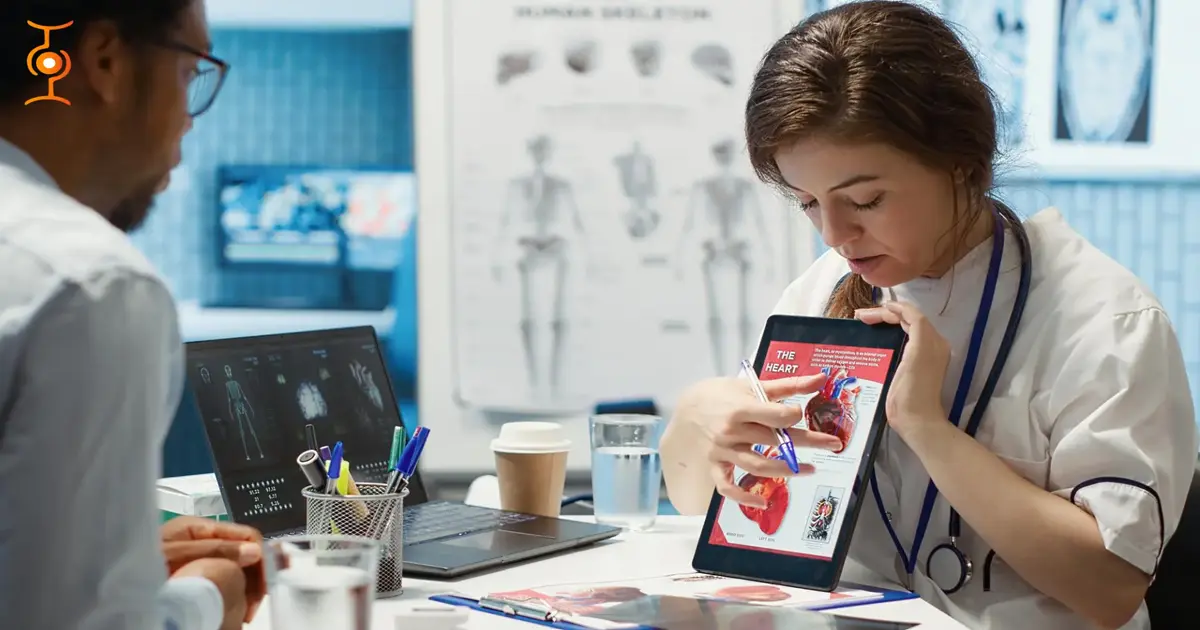
High-fidelity animations and 3D visualizations were developed to show procedures, device mechanisms, and anatomy in motion, closely mirroring the “video demonstration” and “video simulation” formats that the evidence base associates with strong gains in knowledge and skills. These were used for onboarding and mandatory refreshers across hospitals, pharma field teams, and medical device specialists.
Scenario-based microlearning for skills and attitude
Short, scenario-driven videos recreated real-world clinical situations—emergency response, handoff communication, consent conversations—to leverage the documented impact of VBL on skills development and attitude change in medicine and nursing. Each scenario ended with a decision point and debrief, encouraging reflection and better transfer to practice.
Patient-facing video walkthroughs for key procedures
For imaging and invasive diagnostics, Chasing Illusions Studio produced clear, plain-language videos that walked patients step-by-step through what to expect, aligning with studies showing educational videos reduce anxiety and increase satisfaction, understanding, tolerance, and adherence compared with standard verbal or leaflet-based information. These assets were accessible via QR codes on appointment letters, waiting-room screens, and patient portals.
Across all three layers, content was modular, captioned, and optimized for mobile, enabling busy clinicians and patients to engage when and where it mattered most. Analytics from the client’s LMS and portals were configured to track usage, completion, and assessment scores, so outcomes could be compared against the benchmarks reported in the literature.
Results
Instead of treating the videos as “nice-to-have,” the organization benchmarked its rollout against the research evidence to frame expectations and measure impact. The systematic review of 40 health-education studies had already demonstrated that, across 20 trials, video-based learning produced a large overall knowledge gain (Cohen’s d = 1.44) and discipline-specific benefits: very large in dentistry (d = 2.18) and moderate in medicine (d = 0.67), suggesting that well-designed video can more than double the learning impact of traditional formats in some domains. For skills, 16 studies showed a moderate overall effect (d = 0.81), with medicine (d = 0.76) and nursing (d = 0.59) benefiting consistently—critical for any hospital or device firm where procedural accuracy and team coordination are non-negotiable.
On the patient side, the diagnostic-preparation meta-analysis offered equally compelling benchmarks: of 14 studies that evaluated anxiety, 9 reported statistically significant reductions when educational videos were used, and all studies in the meta-analysis showed lower post-procedure anxiety levels in the video group than in controls. Similarly, 7 of 13 studies reported significantly higher satisfaction with diagnostic procedures when videos supplemented or replaced standard information, and the remaining studies still favored the video condition even when differences were not statistically significant.
By aligning its program with these empirically validated formats—video demonstrations, simulations, case-based videos, and patient explainers—the organization could credibly present its own emerging metrics (knowledge tests, skills checklists, satisfaction surveys) to leadership as part of a broader, research-backed shift rather than an isolated internal experiment. The result was faster buy-in from medical boards, stronger support from L&D, and a clear narrative for regulators and partners: their training strategy now stood on the same ground as the global evidence base.
ALSO READ: The Business Case for Healthcare Training Videos
Key takeaway
For hospital administrators, pharmaceutical and medical device leaders, and healthcare L&D teams, the message is clear: video-based learning is no longer a speculative innovation—it is a modality with demonstrated, meta-analytic gains in knowledge, skills, attitudes, and patient experience across 40 education trials and 16 diagnostic-preparation studies. Organizations that continue to rely on static lectures and PDFs risk leaving measurable clinical and experiential improvements unrealized, even as peer institutions quietly compound the benefits of video-first training.
What's Next?
If you are responsible for healthcare training or patient education, this is the moment to act. Partner with Chasing Illusions Studio to audit your current programs, map them against the strongest available evidence, and rapidly prototype a video-based learning portfolio that can withstand scrutiny from clinicians, regulators, and finance teams alike—before another training cycle passes on outdated content and missed outcomes.
Book a discovery 20-minutes strategy call.
📞 +91-9910911696 | +91 9910660851
📩 info [@] chasingillusions [.] in
Written by Deepak, Healthcare Content Strategist at Chasing Illusions Studio. Our clients include Ambler Surgical, Practo, Bayer, SMT, Novartis, and 100+ healthcare brands across India, USA, Thailand, and the UK.
Last Updated: June 23 2026 | Chasing Illusions Studio.
Chasing Illusions Studio
Premium animation & video production studio based in Delhi, India. Specialising in 3D animation, medical visualisation, architectural walkthroughs, and CGI.