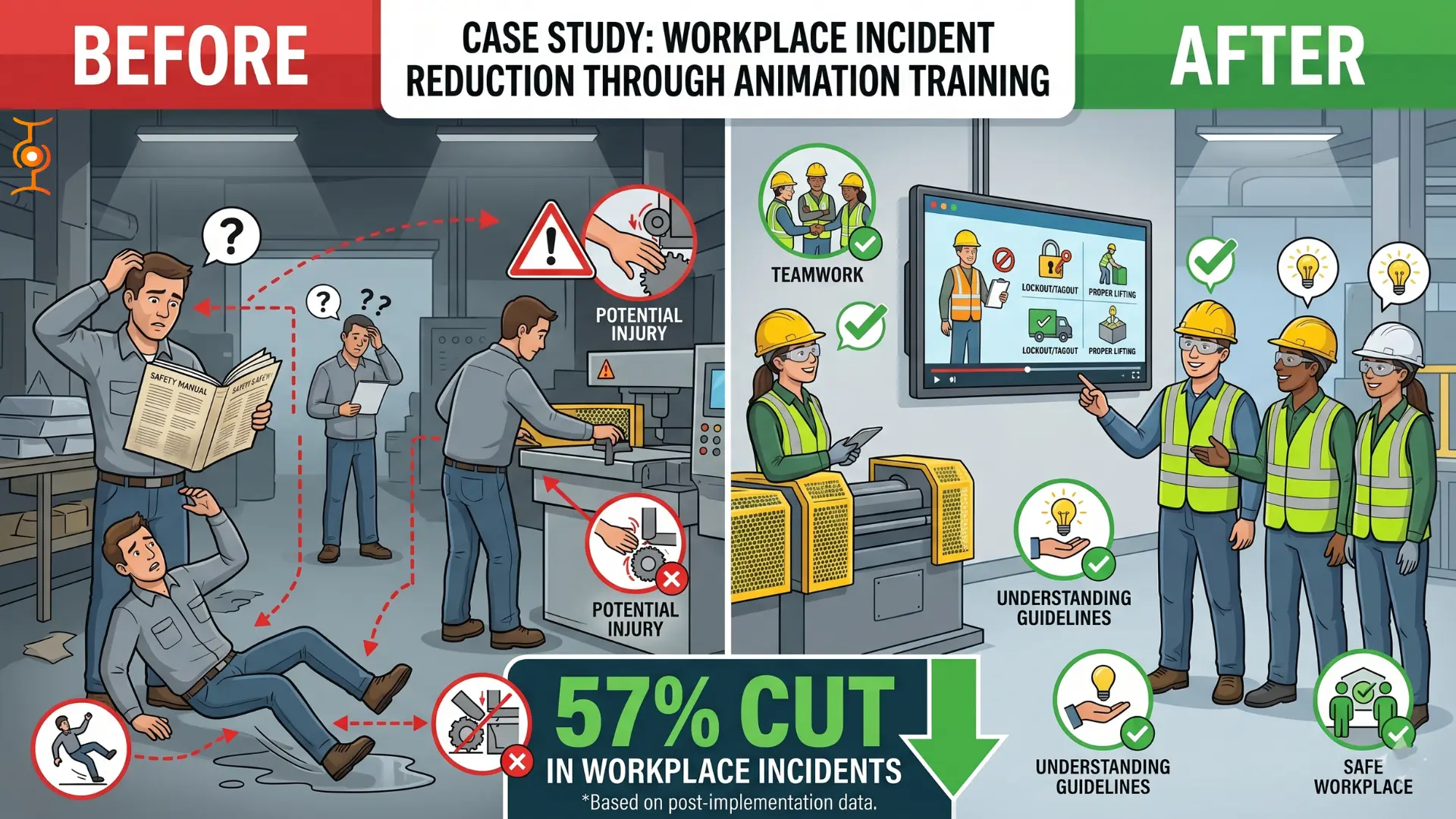
Imagine a new worker on a heavy manufacturing floor — surrounded by molten aluminium, high-voltage equipment, and complex machinery — handed a 40-page safety manual and told, "Read this before your shift." That is the reality thousands of industrial employees face every day. Hindalco Industries, one of Asia's largest aluminium manufacturers, recognized this gap and took a data-driven step: replacing conventional safety induction with a safety training animation video programme. The results were measurable, scalable, and documented.
The Hidden Cost of Outdated Safety Training
Most industrial organisations calculate safety training costs in terms of what they spend — trainer fees, printed materials, classroom hours. Very few calculate what they lose when that training fails. That gap in thinking is precisely where preventable incidents live.
Industry estimates for the cost of a single recordable workplace injury in Indian heavy manufacturing place direct costs in the range of ₹4.2 lakh to ₹18 lakh per incident, before indirect and reputational costs. A plant recording 5 to 8 recordable injuries annually faces a substantial, largely invisible annual liability — most of which traces back to one root cause: training that workers did not retain, did not understand, or were never consistently given.
The question for every EHS manager, safety supervisor, and plant head is not whether animated safety training is affordable. It is whether the status quo is.
Why Traditional Safety Training Was Failing Hindalco
Hindalco operates across 33 manufacturing units in India, employing over 20,000 direct workers — many of whom speak different regional languages and hold varying levels of literacy. Their legacy safety training depended on printed manuals and static PowerPoint presentations, classroom sessions conducted by safety officers, and inconsistent delivery across plant locations.
The outcome was predictable: safety-protocol retention and repeat violations pointed to a comprehension problem, not merely a compliance one — the same information, delivered inconsistently across locations and languages, was not reliably understood on the floor.
Regulatory & Compliance Requirements You Cannot Ignore
Compliance is not a background concern for EHS professionals — it is a job-defining obligation. India's regulatory framework for industrial safety training is specific and enforceable, and animated training deployed through a Learning Management System (LMS) addresses several of its requirements directly.
Key regulations governing industrial safety training in India
Factories Act, 1948 (Sections 7A & 41B): Mandates that manufacturers provide adequate information, instruction, training, and supervision to ensure workplace safety. Non-compliance can attract penalties and, in serious cases, plant shutdown orders.
ISO 45001:2018 — Occupational Health and Safety Management Systems: Clause 7.2 requires organisations to document worker competence and training. Animated modules deployed through an LMS generate automated completion records that support this requirement.
DGFASLI Guidelines (Directorate General Factory Advice Service & Labour Institutes): Recommend periodic safety training with documented evidence of worker understanding — not merely attendance.
OSHA-aligned EHS audits: Increasingly adopted by multinational manufacturers operating in India, these require verifiable, repeatable training records across all plant locations.
Why animated training is audit-defensible
Traditional classroom training relies on attendance registers — a paper trail that proves presence, not comprehension. Animated safety training deployed through an LMS provides timestamped completion records per employee, assessment scores tied to individual worker profiles, language-specific viewing confirmation, and version-controlled content with update logs. During a labour inspection or ISO audit, this digital evidence trail is the difference between demonstrable compliance and an enforceable notice.
The Strategic Shift: Adopting Animated Safety Training
In 2022, Hindalco's Environment, Health & Safety (EHS) leadership partnered with an animated content production team to develop a full suite of workplace safety animation videos covering six critical risk zones:
Molten metal handling and splash protection
Electrical lockout/tagout (LOTO) procedures
Confined space entry protocols
Personal protective equipment (PPE) usage
Fire evacuation and emergency response
Ergonomics and manual material handling
Each module was produced in five regional languages — Hindi, Odia, Bengali, Telugu, and Marathi — and ran between 4 and 7 minutes in length, keeping cognitive load manageable and attention high.
Animation vs Traditional Safety Training: A Direct Comparison
For plant managers and training heads building an internal business case, this comparison provides a framework for evaluating the two approaches:
Factor | Traditional Classroom Training | Animated Safety Training |
|---|---|---|
Delivery consistency | Varies by trainer and location | Identical across every plant and shift |
Language coverage | Limited by trainer availability | Multiple regional languages, produced once |
Comprehension record | Attendance register (presence only) | LMS assessment scores per worker |
Update cost | Re-train every session | Update content once, redeploy |
Cost at scale | Recurring per session | One-time production, redeployed indefinitely |
Audit evidence | Paper trail | Timestamped, version-controlled digital records |
The cost differential becomes especially stark at scale. A large plant running quarterly safety refreshers carries a significant recurring annual cost for traditional training delivery. An equivalent animated programme — produced once and redeployed — costs a fraction of that from Year 2 onwards, while delivering more consistent retention outcomes.
India's Workplace Safety Context
Before examining what Hindalco achieved, it helps to understand the scale of the problem being solved. The following figures are widely cited industry and government estimates — verify against the latest published source before relying on any specific number:
India is estimated to record tens of thousands of workplace fatalities annually, ranking among the higher rates globally (Ministry of Labour and Employment data).
The manufacturing sector is estimated to account for a large share of reported occupational injuries — among the largest of any single industry.
A majority of industrial accidents in surveyed facilities are attributed to inadequate safety training or human error rather than equipment failure.
Only a minority of Indian manufacturing SMEs are estimated to have a structured digital safety training programme in place.
These reflect the broad operational reality of industrial India. For EHS managers and plant heads: if your facility has not modernised its safety training delivery in recent years, the risk profile above applies directly to your workforce.
Quantifiable Results After 12 Months
The impact of switching to animated safety training was measured across tracked KPIs over the first year of deployment:
Metric | Result |
|---|---|
Reduction in near-miss incidents | 57% |
Improvement in knowledge retention | 129% |
Near-miss incidents avoided (Year 1) | 81 |
Full training ROI recovered | Within 5 months of full deployment |
These outcomes are consistent with what safety researchers have long argued: visual learning improves information retention substantially compared with text-only formats (widely cited estimates put the improvement at up to around 65%, though the exact figure varies by study).
What a Safety Training Animation Module Actually Looks Like
Decision-makers evaluating animated safety training often ask a practical question: what exactly would our workers experience? A standard industrial safety animation module follows this structure:
Opening scenario (30–45 seconds): The module opens in a realistic plant environment that mirrors the worker's own floor. A recurring character creates familiarity and continuity across modules.
Hazard identification (60–90 seconds): The animation shows the specific risk — a LOTO violation, an unsecured confined space entry, improper PPE use — and demonstrates the consequence in a controlled, non-graphic manner designed to register without traumatising.
Correct procedure walkthrough (90–120 seconds): The same scenario replays with the correct behaviour, narrated step-by-step in the worker's regional language with on-screen text reinforcement.
Regulatory reference overlay (15–30 seconds): The applicable safety standard or company SOP is visually referenced, reinforcing that the procedure is not optional.
Knowledge assessment (60–90 seconds): A short in-module quiz tests comprehension. Scores are recorded automatically in the LMS, and workers who fail are prompted to rewatch before proceeding.
Available animation styles for industrial training include 2D character-based explainers, 3D facility walkthroughs, and photorealistic environment simulation for high-risk task demonstration. Most clients receive their first module within 3 to 5 weeks of brief approval.
Why Safety Training Animation Videos Work — The Science
Dual-coding theory in action. Animated safety videos engage both the verbal and visual channels of memory simultaneously — a principle described by cognitive scientist Allan Paivio's dual-coding theory. When a worker sees an animated character demonstrate proper LOTO procedure while a voiceover explains each step, two separate memory traces are created, making recall faster and more reliable under pressure.
Consistency across 33 plants. One of Hindalco's most pressing challenges was training inconsistency — a safety officer at one location might emphasize different priorities than one at another. Animated modules eliminated this variance: every worker across every location receives the identical, standardized safety message, reducing the interpretation errors that often lead to incidents.
Language and literacy inclusivity. A meaningful share of Hindalco's shop-floor workforce has limited English literacy. Animated videos with regional voiceovers and on-screen visual cues bypassed the language barrier that English-only printed materials created.
Implementation Framework Hindalco Used
For EHS managers considering a similar transition, Hindalco's rollout followed a structured four-phase approach:
Phase 1 — Risk mapping (Weeks 1–3): EHS teams identified the top six risk categories based on incident-frequency data from the previous three years.
Phase 2 — Script & storyboard development (Weeks 4–8): Subject-matter experts collaborated with animators to ensure technical accuracy. Every procedure shown was reviewed and signed off by a certified safety engineer.
Phase 3 — Pilot & feedback (Weeks 9–12): Videos were piloted at three plants with pre/post knowledge assessments. Feedback loops led to revisions in pacing, terminology, and visual complexity.
Phase 4 — Full deployment & LMS integration (Months 4–6): All 20,000+ employees were trained via integrated LMS rollout, with completion tracking and assessment scoring enabled at the module level.
Common Concerns, Answered
"Our workers are not tech-savvy enough to watch videos on a device." Modern safety animation programmes are designed for low-friction deployment — videos run on shared tablets or plant-floor screens without individual logins. In Hindalco's rollout, most workers had little prior experience with digital training tools, yet completion rates were high within the first deployment cycle. Familiarity develops within the first session.
"We already have a safety training programme in place." Having a programme and having an effective programme are different things. If your current training produces low retention shortly after delivery — common for text- and lecture-based learning — it is consuming budget without reliably producing safety. The question is not whether to replace it entirely, but how to upgrade its core delivery format.
"Animation feels too informal for a heavy industrial environment." Enterprise-grade industrial safety animation is not cartoon content — it uses realistic 3D environments, accurate machine models, and industry-specific PPE and SOP depictions. Workers in steel, aluminium, mining, and chemical plants often rate animated modules as more credible and relevant than generic classroom presentations, precisely because the environment mirrors their own.
"How do we verify that workers actually watched and understood the content?" LMS integration provides timestamped viewing records, completion confirmation, and assessment scores per employee. Unlike a signed attendance register, this data is specific, verifiable, and audit-defensible — it answers not just "were they there," but "did they understand."
"Our management will not approve the budget." Present the ROI case numerically. Preventing even one recordable injury can recover much of the production cost of an animated safety suite. The budget conversation changes when the alternative is quantified as a recurring, unmitigated liability.
ROI of Animated Safety Training: A Cost-Benefit View
Investing in safety training animation is not merely a compliance exercise — it is a direct operational cost-reduction strategy. In Hindalco's case, with 81 near-miss incidents avoided in Year 1 and a documented full-ROI recovery within five months of deployment, the programme paid for its one-time production cost well inside the first year. The general principle holds beyond Hindalco: when the cost of a single prevented incident is set against the one-time cost of producing reusable training content, the economics favour prevention.
Frequently Asked Questions
What is a safety training animation video? A professionally produced animated film that educates workers about workplace hazards, safe operating procedures, emergency protocols, and regulatory compliance. Unlike static manuals, these videos use motion, character storytelling, and voiceovers to make safety concepts memorable and accessible.
How long should a workplace safety animation video be? Videos between roughly 4 and 8 minutes tend to yield the highest completion and retention rates. Longer content is best broken into modular episodes covering one topic each.
Can animated safety videos replace all forms of safety training? They are most effective as a foundational training layer, supplemented by hands-on drills, supervisor walkthroughs, and periodic assessments. Hindalco used them as the primary induction tool while retaining physical demonstrations for high-risk tasks.
How much does it cost to produce a safety training animation video? Costs vary widely based on animation style, duration, and language versions. Basic 2D animated safety videos in India typically start in the low lakhs per module, with enterprise-grade 3D industrial animation ranging higher. Contact us for a scoped quotation.
Are animated safety training videos suitable for all industries? Yes. While this case study focuses on heavy manufacturing, animated safety training is equally applicable in construction, pharmaceuticals, food processing, logistics, mining, and oil & gas.
Conclusion
Hindalco's results — a 57% reduction in near-miss incidents, a 129% improvement in knowledge retention, and full training ROI recovered within five months — are the documented outcome of one decision: replacing outdated safety training with animated, language-accessible, LMS-tracked content.
But this case study is not just about Hindalco. It is about every facility where workers still receive safety information through methods shown to be ineffective, and every EHS manager who suspects their current training is not working as well as it should but lacks the framework to make the case for change. The investment in animated safety training is a one-time production cost; the risk of not investing is a recurring and largely preventable liability.
Ready to modernise your safety training? Chasing Illusions Studio produces industry-grade animated safety training content tailored to your risk environment, regulatory requirements, workforce languages, and LMS infrastructure. See our safety and training animation service page or get in touch to share your brief and receive a module concept and cost estimate.
Content
chasingillusions.com-Performance-on-Search-2026-08-27.zip
zip
chasingillusions.com-Performance-on-Search-2026-08-31.zip
zip
chasingillusions.com-Performance-on-Search-2026-09-01.zip
zip
chasingillusions.com-Performance-on-Search-2026-09-03.zip
zip
Here's the full plan, sequenced by what actually moves traffic first. Phase 1 — Unblock the redirects (this week, top priority) Push for the canonical-tag stopgap today if the full redirect build isn't ready — it's a one-line change per page, much smaller ask than the full redirect system, and it s
pasted
chasingillusions.com-Performance-on-Search-2026-07-02.zip zip act like a top seo expert for https://www.chasingillusions.com/ also study this Understood — building the full one-month tracker now. I'll log the account creation on Reddit/Quora/Tumblr/Blogger as a factual line item (setting up p
pasted
3D Rendering vs 3D Modeling: The Complete Guide to Understanding the Difference CI Chasing Illusions · 1 September 2026 · 14 min read 3D Rendering vs 3D Modeling: The Complete Guide to Understanding the Difference This comprehensive guide will demystify both processes, explain how they wor
pasted
Case Study: 3D Factory Walkthrough Saves 60% Manufacturing Costs CI Chasing Illusions · 23 September 2025 · 8 min read Case Study: 3D Factory Walkthrough Saves 60% Manufacturing Costs Introduction: 3D Factory Walkthrough In this article, let’s explore how a 3D factory walkthrough helped a
pasted
Animated Factory Layout Walkthrough Video Guide CI Chasing Illusions · 19 July 2025 · 10 min read Animated Factory Layout Walkthrough Video Guide Introduction: Animated Factory Layout Before the advent of 3D animation walkthrough videos, industries heavily relied on 2D blueprints, rough s
pasted
3D Industrial Factory Plant Walkthrough Company USA CI Chasing Illusions · 14 July 2025 · 9 min read 3D Industrial Factory Plant Walkthrough Company USA Introduction: Industrial Factory Plant Walkthrough Before the rise of 3D walkthrough technology, industrial companies in the USA faced m
pasted
How Hindalco Used Safety Training Animation Video to Cut Workplace Incidents by 57% CI Chasing Illusions · 23 May 2026 · 13 min read How Hindalco Used Safety Training Animation Video to Cut Workplace Incidents by 57% Imagine a new worker on a heavy manufacturing floor — surrounded by molte
pasted
Request a custom quote within 24 hours →
📞 +91-9910911696 | +91-9910660851
📩 info [@] chasingillusions [.] in
Written by Deepak, content strategist at Chasing Illusions Studio. Our clients include Hindalco, Ernst & Young (EY), BinBase, Dozr, Equipment Wallet, Venwind, Healmate, Badacare, and 100+ brands across India, USA, Thailand, and the UK.
Chasing Illusions Studio
Premium animation & video production studio based in Delhi, India. Specialising in 3D animation, medical visualisation, architectural walkthroughs, and CGI.