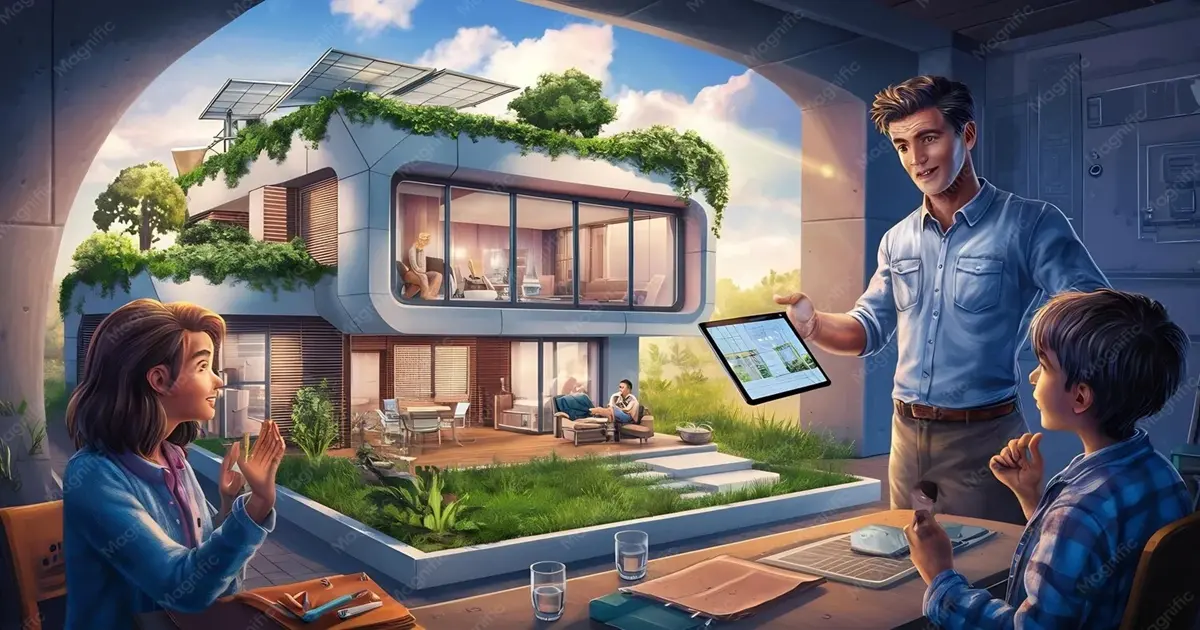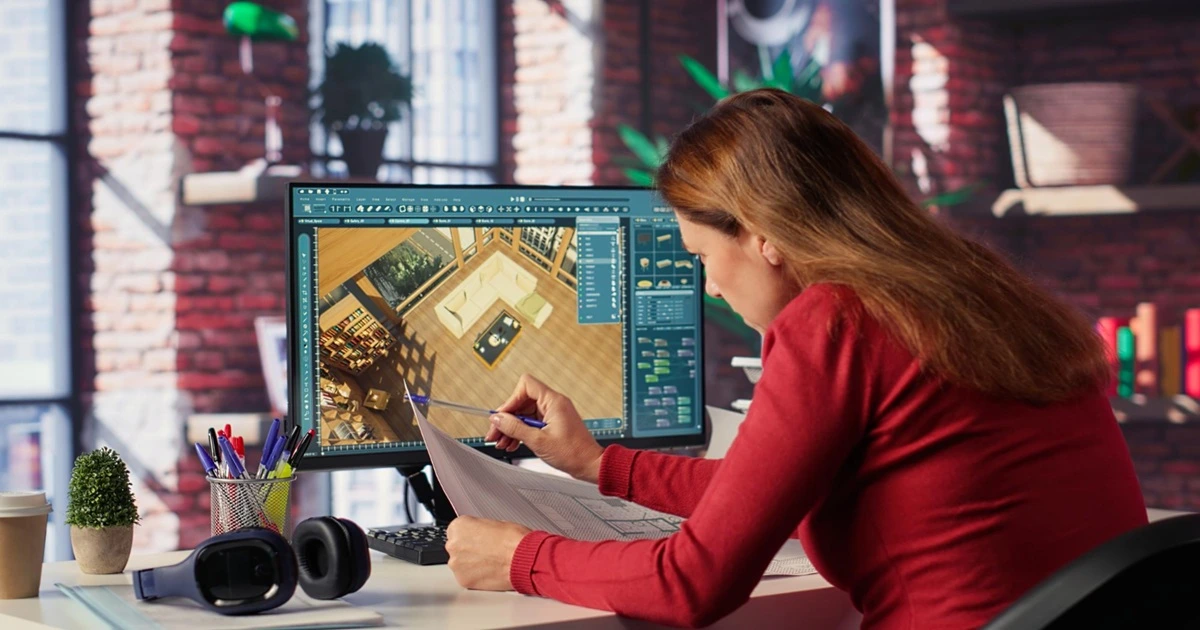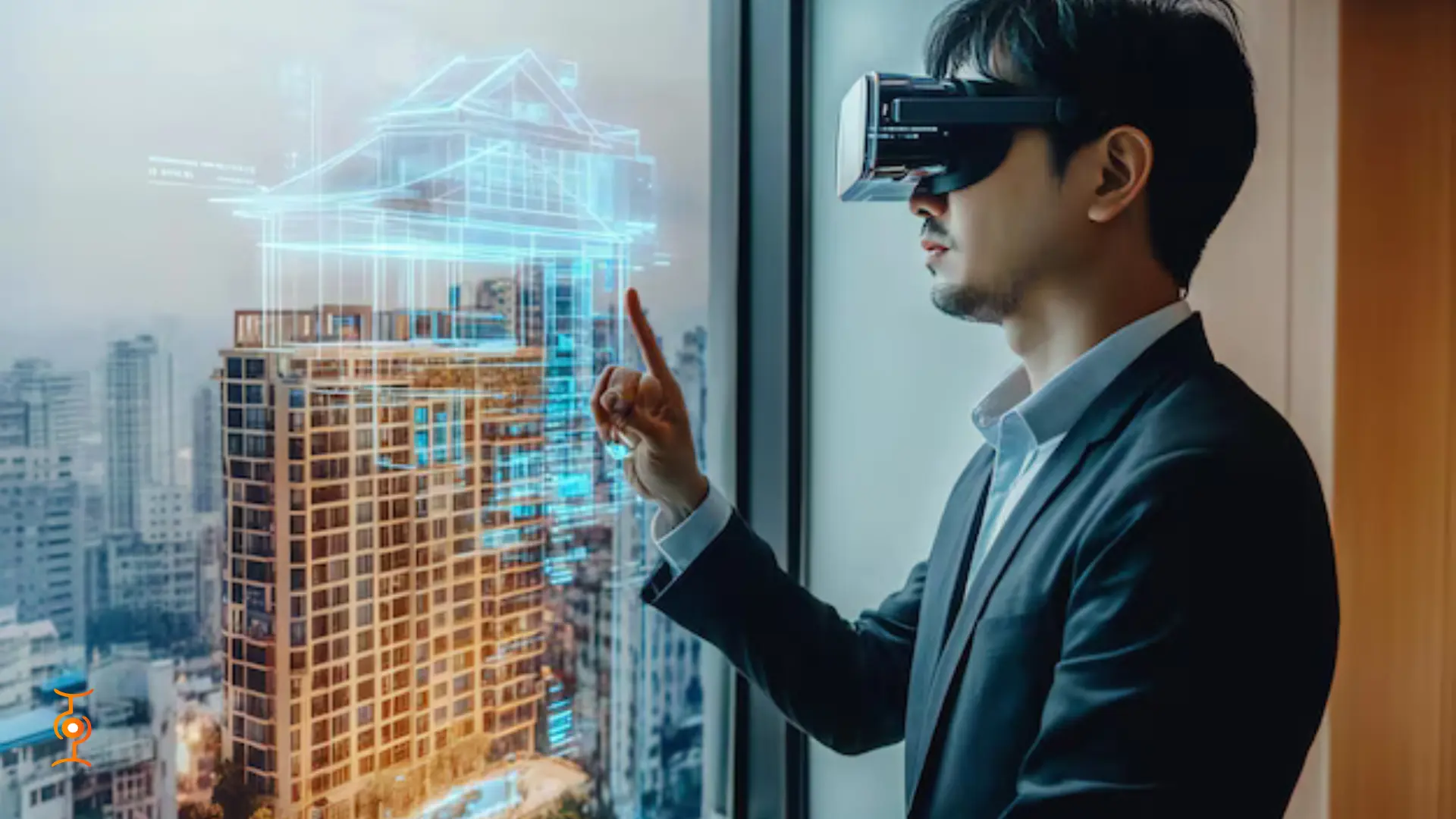
Imagine handing a client the keys to their dream home — before a single brick has been laid. They walk through the living room, feel the natural light flooding in from the south-facing windows, and adjust the kitchen layout on the spot. This isn't science fiction. Thanks to AI architectural walkthrough technology, this is fast becoming everyday practice for architects, developers, and interior designers across India.
In a country where real estate, urban infrastructure, and cultural heritage are evolving at breakneck speed, AI-powered architectural visualization is no longer a luxury — it's a competitive edge.
What Is an AI Architectural Walkthrough?
An AI architectural walkthrough is a digitally rendered, immersive simulation of a built environment — generated and enhanced using artificial intelligence. Unlike traditional 3D renderings or static floor plans, these walkthroughs let stakeholders virtually "step inside" a structure that exists only on paper.
AI enhances the process in several ways:
Automated scene generation based on architectural drawings and BIM (Building Information Modeling) data
Intelligent lighting simulation that mimics real-world sun angles, shadows, and ambient conditions
Material and texture rendering that adapts to design changes in real time
Natural language input where architects can describe changes ("add more windows facing east") and AI updates the model instantly
The result is a photorealistic, interactive virtual tour of a building — accessible via desktop, VR headset, or even a smartphone.
Why India Is Embracing AI Architectural Walkthrough Visualization?
India is in the middle of one of the largest construction booms in human history. With smart city projects, affordable housing missions, luxury residential towers, and heritage restoration initiatives all running simultaneously, the need for accurate, compelling visualization has never been greater.
The Scale of India's Construction Sector
According to an official study, India ranks among the top five countries globally for construction output. Cities like Hyderabad, Pune, Bengaluru, and the NCR region are witnessing thousands of new residential and commercial projects annually. Architects and developers face immense pressure to communicate complex designs quickly — to clients, investors, municipal bodies, and end buyers.
Traditional architectural renderings, while effective, are time-consuming and expensive to revise. An AI architectural walkthrough compresses weeks of revision cycles into hours, enabling faster decision-making at every stage of a project.
Client Expectations Have Changed
Indian homebuyers and investors are increasingly tech-savvy. They expect transparency and interactivity before committing to a purchase. A 3D walkthrough powered by AI doesn't just show what a space will look like — it helps clients feel it, fostering trust and confidence in ways that blueprints and mood boards never could.
Key Applications of AI Architectural Walkthrough in India
Residential Real Estate
Pre-launch marketing for housing projects has been transformed. Developers now offer potential buyers an immersive virtual experience of apartments, villas, and townships long before construction begins. AI enables real-time customization — change the flooring, swap the wall paint, adjust furniture layouts — all within the walkthrough environment.
Commercial and Hospitality Projects
For hotels, malls, office campuses, and mixed-use developments, AI-powered virtual tours help secure financing and tenant agreements earlier. Investors in Delhi, Mumbai, or Chennai can evaluate a project in Ahmedabad without boarding a flight — and still experience the space as if they were standing inside it.
3D Architectural & Interior Walkthrough
We bring complex architectural visions to life with 3D Architectural Walkthroughs. Whether it's exterior building design or a detailed 3D Interior Walkthrough revealing the flow of its spaces, we create captivating experiences. Our visualisations allow clients to explore every detail to preview the final product before construction even begins.
Urban Planning and Smart Cities
Government bodies and urban planners are using AI-driven architectural visualization to model entire neighbourhoods. From traffic flow to green space placement, AI walkthroughs allow planners to test multiple urban design scenarios quickly, supporting India's Smart Cities Mission with data-backed spatial decision-making.
Heritage Conservation and Restoration
India's rich architectural heritage — from Mughal-era structures to colonial-period bungalows — often requires sensitive restoration. AI walkthroughs allow conservationists to digitally reconstruct damaged or deteriorated spaces, enabling stakeholders to approve restoration plans with full visual clarity before work begins.
Explore our 3D Walkthroughs for Real Estate Projects Portfolio.
How AI Architectural Walkthroughs Are Created?
Step 1 — Input and Data Collection
The process begins with architectural drawings, CAD files, or BIM models. AI tools extract spatial data, dimensions, and structural relationships from these inputs.
Step 2 — Scene Assembly and Environment Mapping
AI algorithms generate the three-dimensional environment — walls, floors, ceilings, openings — and apply contextual intelligence to place lighting sources, determine material properties, and simulate environmental conditions such as time-of-day lighting or monsoon-season ambience.
Step 3 — Rendering and Optimization
High-fidelity rendering engines, accelerated by AI, produce photorealistic outputs. Unlike traditional rendering, which can take hours per frame, AI-assisted rendering dramatically reduces processing time through techniques like neural rendering and deep learning-based denoising.
Step 4 — Interactivity and Client Customization
The finished walkthrough is made interactive. Clients can navigate freely, trigger design variations, and experience the space through multiple perspectives — from a child's eye level to a rooftop view.
AI Walkthrough vs Traditional 3D Walkthrough: What's the Real Difference?
This is a question many architects and developers ask before committing to a technology upgrade — and it deserves a straight answer.
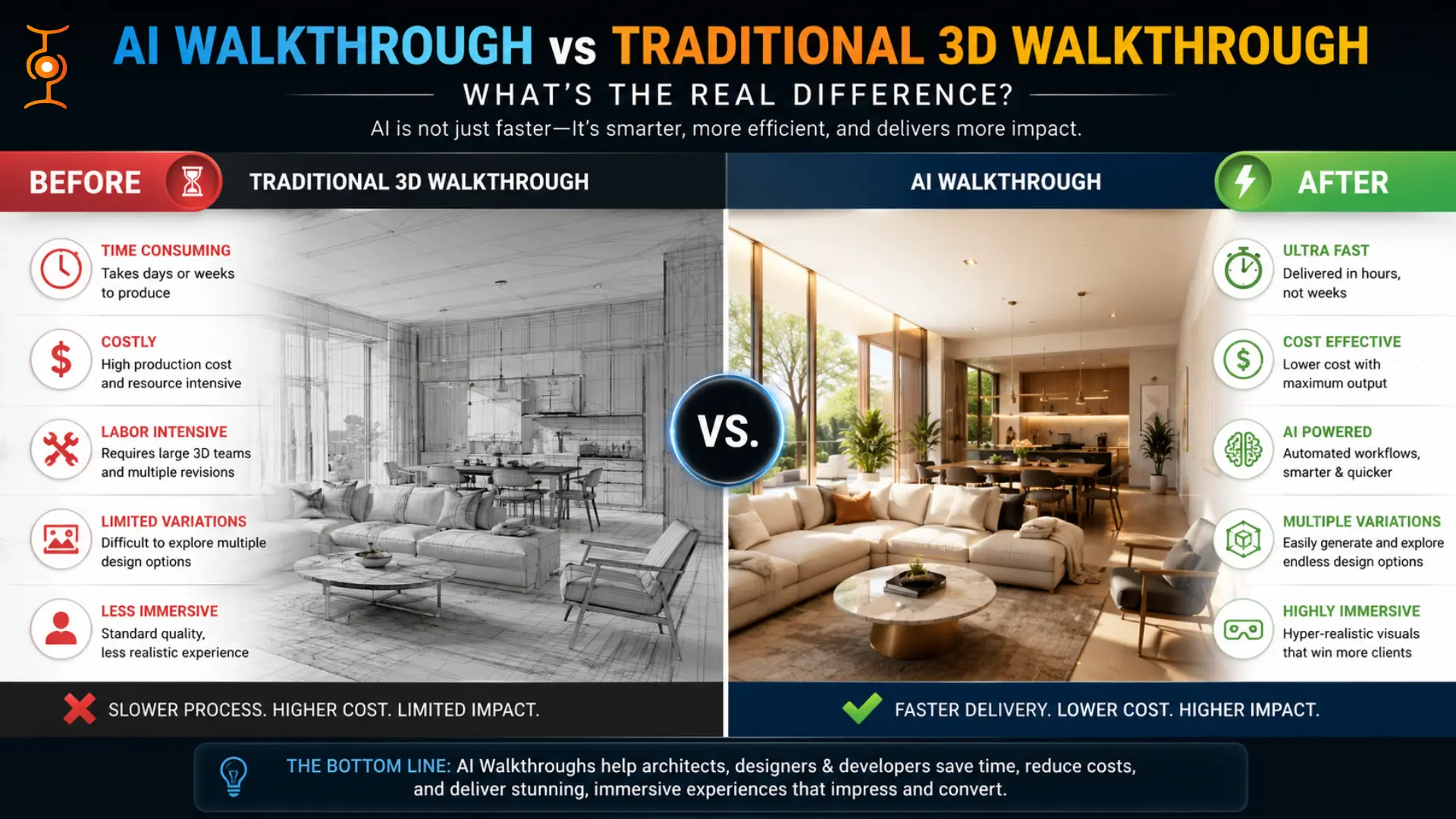
A traditional 3D architectural walkthrough is built manually by a visualization artist who models each element, sets up lights, applies textures, and renders the scene frame by frame. It's skilled, time-intensive work. A high-quality traditional walkthrough for a mid-size residential project can take 3–6 weeks and still requires significant back-and-forth for revisions.
An AI-powered walkthrough uses machine learning to automate large portions of this pipeline — from interpreting CAD drawings to generating lighting setups and material suggestions. The result is:
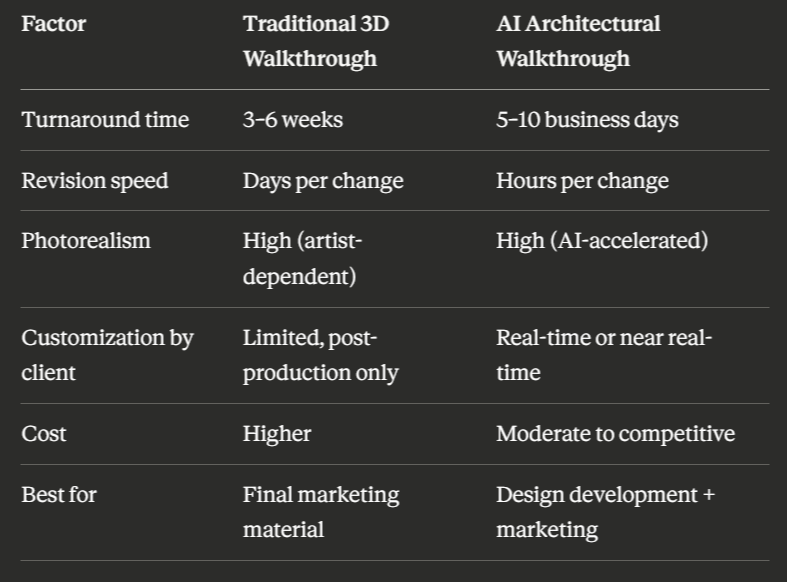
The key insight: AI walkthroughs are not a replacement for artistry — they are a force multiplier. The best studios combine AI tools with experienced designers to produce results that are both fast and visually outstanding.
What Software and Tools Power AI Architectural Walkthroughs?
For architects, students, and technically minded clients, understanding the toolchain matters. Here are the primary platforms currently shaping AI-powered architectural visualization in India and globally:
Rendering and Real-Time Engines
Unreal Engine 5 — Industry-leading real-time rendering with cinematic quality. Widely used for high-end residential and commercial walkthroughs.
Lumion — Popular among Indian architectural firms for its speed and library of Indian-context assets (vegetation, materials, lighting conditions).
D5 Render — A fast-growing real-time renderer with strong AI-assisted lighting and material tools, increasingly adopted in Indian studios.
Twinmotion — Accessible and BIM-compatible, well-suited for mid-size firms transitioning from traditional workflows.
AI-Specific Tools
Midjourney / Stable Diffusion — Used for rapid concept visualization and mood board generation in early design stages.
Nvidia Omniverse — Enterprise-grade platform for collaborative, AI-enhanced 3D design and simulation.
Chaos V-Ray with AI denoising — Still a benchmark for photorealistic stills, now integrated with AI rendering acceleration.
BIM and CAD Integration
Autodesk Revit + Enscape — Common workflow in Indian AEC firms; Enscape enables live walkthroughs directly from Revit models.
SketchUp + AI plugins — Widely used in smaller Indian practices for fast concept-to-visualization pipelines.
The choice of tools depends on project scale, budget, and the type of output required. A professional studio will select the right combination based on your specific brief.
How Much Does an AI Architectural Walkthrough Cost in India?
Pricing is the question most articles avoid — and it's exactly what clients need to know. Here's an honest breakdown.
Architectural walkthrough costs in India vary based on several factors: project size, level of detail, number of rooms or zones, animation length, revision rounds, and the studio's experience level.
Approximate price ranges (India, 2025–26):
Basic walkthrough (1–2 BHK apartment, 60–90 seconds): ₹15,000 – ₹40,000
Mid-range walkthrough (villa or 3 BHK, 90–180 seconds): ₹40,000 – ₹1,20,000
High-end residential or commercial project (2–4 minutes, full photorealism): ₹1,20,000 – ₹4,00,000+
Township or large-scale development (multi-zone, marketing-grade): ₹4,00,000 – ₹15,00,000+
Note: This is market research price, get FREE quotation + cost guide within 6 hours, contact now.
How Long Does an AI Architectural Walkthrough Take?
Turnaround time depends on complexity, but here are realistic expectations for projects produced in India:
Concept/schematic stage walkthrough: 3–5 business days
Standard residential walkthrough (fully detailed interior + exterior): 7–12 business days
Commercial or large-scale project: 15–25 business days
Rush delivery (premium pricing applies): 48–72 hours for select studios
AI-assisted production pipelines have cut average delivery times by 40–60% compared to fully manual workflows. Revision rounds — which used to extend timelines significantly — are now faster, since AI tools allow material swaps, lighting changes, and layout adjustments without rebuilding scenes from scratch.
To minimize delays on your end, provide complete CAD or BIM files, reference images, material selections, and brand/style guidelines at the start of the project.
Can Small Architectural Firms and Individual Designers Use This Technology?
Absolutely — and this is an important misconception to address. AI architectural walkthroughs are not exclusive to large developers or corporate real estate firms.
Individual architects, interior designers, and boutique studios across India are increasingly using AI-powered visualization to compete with larger firms. The economics have shifted: what once required a dedicated in-house rendering team or an expensive outsourcing engagement is now accessible through specialized studios that serve projects of all sizes.
For a solo architect working on a residential commission, a well-produced walkthrough can be the difference between winning and losing a competitive pitch. For an interior designer, a virtual tour of a proposed space communicates vision in ways that flat mood boards and sample swatches simply cannot.
The minimum viable project is smaller than most people assume. Even a single-room interior walkthrough — a living room redesign, a kitchen renovation, a hotel suite — can be produced cost-effectively with today's AI tools.
Challenges and Considerations
Despite its advantages, adopting AI architectural walkthrough technology in India comes with challenges:
Data quality: AI tools perform best with accurate, detailed source drawings. Many projects — especially in smaller cities and towns — still rely on hand-drafted plans, which require significant preprocessing.
Infrastructure gaps: High-quality real-time rendering demands robust computing infrastructure. While cloud-based solutions are improving accessibility, reliable high-speed internet remains uneven across the country.
Skill gaps and training: Architectural firms need professionals who understand both design and AI tools. Bridging this gap requires targeted upskilling, which is gradually happening through design schools and online platforms.
Client readiness: Not all clients are immediately comfortable with immersive digital environments. Effective onboarding and user-friendly interfaces are key to adoption.
The Role of Specialized Studios in This Transformation
As AI architectural visualization matures in India, specialized studios are stepping in to bridge the gap between technology and design. One such example is Chasing Illusions Studio, which works at the intersection of architectural storytelling and AI-powered visualization — helping developers and architects create walkthroughs that are not only technically accurate but also emotionally resonant.
Studios like these bring a critical blend of artistic sensibility and technical expertise, ensuring that an AI-generated virtual tour doesn't feel sterile or mechanical, but captures the soul of a space.
What to Look for in an AI Architectural Walkthrough Studio?
If you're an architect, developer, or real estate professional in India looking to adopt this technology, consider the following when choosing a 3d walkthrough architectural studio:
Portfolio of photorealistic outputs with attention to lighting, texture, and spatial storytelling
Experience with Indian building typologies — from high-rise residential to traditional courtyard homes
Ability to handle BIM and CAD integration seamlessly
Post-production and animation capabilities for marketing materials
Turnaround time and revision flexibility
Conclusion: Visualization as a Competitive Advantage
We started with an image — a client walking through their future home, adjusting the kitchen, feeling the light. That possibility is now within reach for any architectural firm or developer willing to invest in AI-powered visualization.
India's built environment is changing at a pace unprecedented in its history. The firms that communicate their vision most vividly — not just on paper, but through immersive, intelligent experiences — will be the ones that win clients, secure funding, and lead the market.
Whether you're planning a luxury villa in Goa, a mixed-use township in Hyderabad, or a heritage restoration in Jaipur, an AI architectural walkthrough can be the difference between a client who hesitates and one who signs.
If you're ready to bring your architectural vision to life before it's built, Chasing Illusions Studio offers bespoke AI-powered walkthrough solutions tailored for the Indian market — combining precision, creativity, and storytelling to make your spaces unforgettable.
Frequently Asked Questions About AI Architectural Walkthroughs in India
Q: What files do I need to share with a studio to get started?
A: Most studios work with CAD drawings (DWG/DXF), PDF floor plans, SketchUp models, or Revit/BIM files. Reference images for style, material preferences, and any brand guidelines are also helpful. The more complete your inputs, the faster and more accurate the output.
Q: Can I make changes after the walkthrough is delivered?
A: Yes. Most studios offer revision rounds as part of their packages. With AI-assisted workflows, minor changes (material swaps, lighting adjustments, furniture placement) can typically be turned around within 24–48 hours. Structural or layout changes take longer.
Q: Is a 3D walkthrough the same as a VR tour?
A: Not exactly. A 3D walkthrough is typically a pre-rendered animation or an interactive real-time experience viewed on a screen. A VR tour is the same environment adapted for a virtual reality headset, offering a fully immersive 360° perspective. Many studios can deliver both from the same base model — it's worth asking upfront if VR output is a requirement.
Q: Can AI walkthroughs be used for RERA compliance or regulatory submissions?
A: AI walkthroughs are primarily visualization tools and are not certified technical documents. However, they are increasingly used as supplementary materials in project presentations to regulatory bodies, housing boards, and municipal authorities — particularly for urban planning consultations and smart city proposals. For formal RERA filings, consult your legal and technical team on acceptable document formats.
Q: How realistic can an AI architectural walkthrough get?
A: With current tools, photorealistic output is achievable — meaning the final video or interactive tour can be difficult to distinguish from photographs of a built space. Quality depends on the detail of inputs, the skill of the production studio, and the rendering pipeline used. The best results come from studios that combine AI tools with experienced designers who understand light, materials, and spatial storytelling.
Q: Do I need a fast internet connection to view the walkthrough?
A: For pre-rendered video walkthroughs, no — they can be shared as standard video files (MP4) viewable on any device. For real-time interactive walkthroughs hosted online, a stable broadband connection is recommended. VR tours may require a local installation or a high-bandwidth stream depending on the platform.
Q: Are AI walkthroughs useful for projects still in the concept stage?
A: Yes — in fact, this is one of the most valuable use cases. Early-stage walkthroughs help architects and clients align on spatial feel and design direction before expensive detailing decisions are locked in. Changes at the concept stage are far cheaper than revisions during construction documentation.
CONTACT NOW
Explore how AI-driven architectural visualization can accelerate your next project. Get in touch today.
Book a discovery 20-minutes strategy call.
📞 +91-9910911696 | +91-9910660851
📩 info [@] chasingillusions [.] in
Written by Deepak, Architectural Walkthrough content strategist at Chasing Illusions Studio. Our clients include DLF, Emaar, Ganga Reality, Banner Boswell, Shapoorji Pallonji, EC World, Taj, Florida Hospital, etc., 100+ architectural companies across India, USA, Thailand, and the UK.
Last Updated: July 09 2026 | Chasing Illusions Studio
Chasing Illusions Studio
Premium animation & video production studio based in Delhi, India. Specialising in 3D animation, medical visualisation, architectural walkthroughs, and CGI.