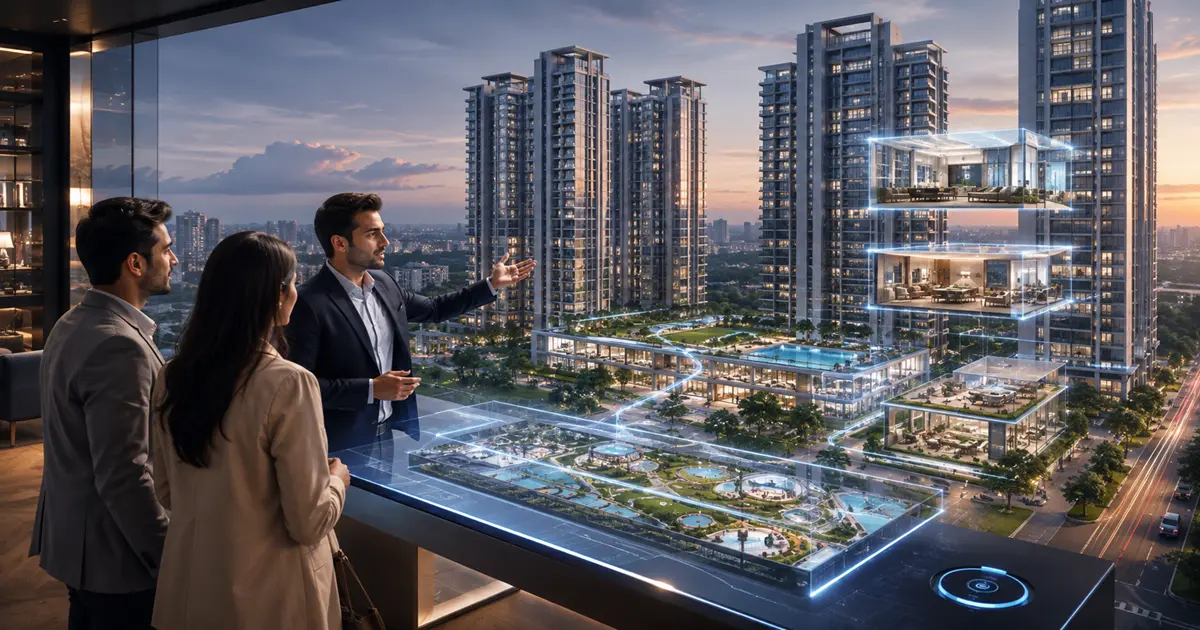
Imagine presenting an apartment tower that will not be completed for another two years. Your buyers cannot walk through it, your sales team cannot physically demonstrate the experience, and static floor plans do little to communicate how the finished property will actually feel.
This is where the Photorealistic Architectural Walkthrough Trends 2027 become important. Architectural visualization is moving beyond attractive animation toward interactive, data-connected and increasingly realistic digital experiences that can influence design decisions, buyer engagement, property pre-sales and long-term building operations.
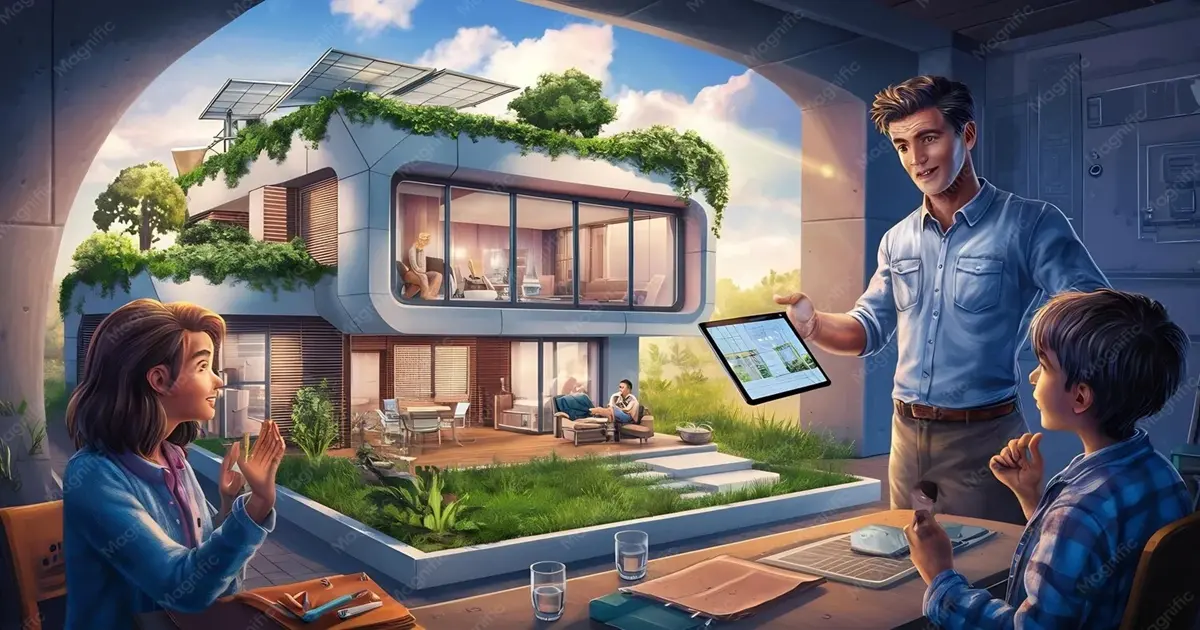
For developers, architects, property marketers and visualization teams, the biggest change is not simply better-looking 3D imagery. It is the evolution from a rendered representation of a building to a digital experience that can be explored, adjusted and connected to real project information.
What Are Photorealistic Architectural Walkthrough Trends 2027?
The Photorealistic Architectural Walkthrough Trends 2027 refer to the technologies and workflows expected to shape how buildings and properties are visualized, presented and experienced in the coming year.
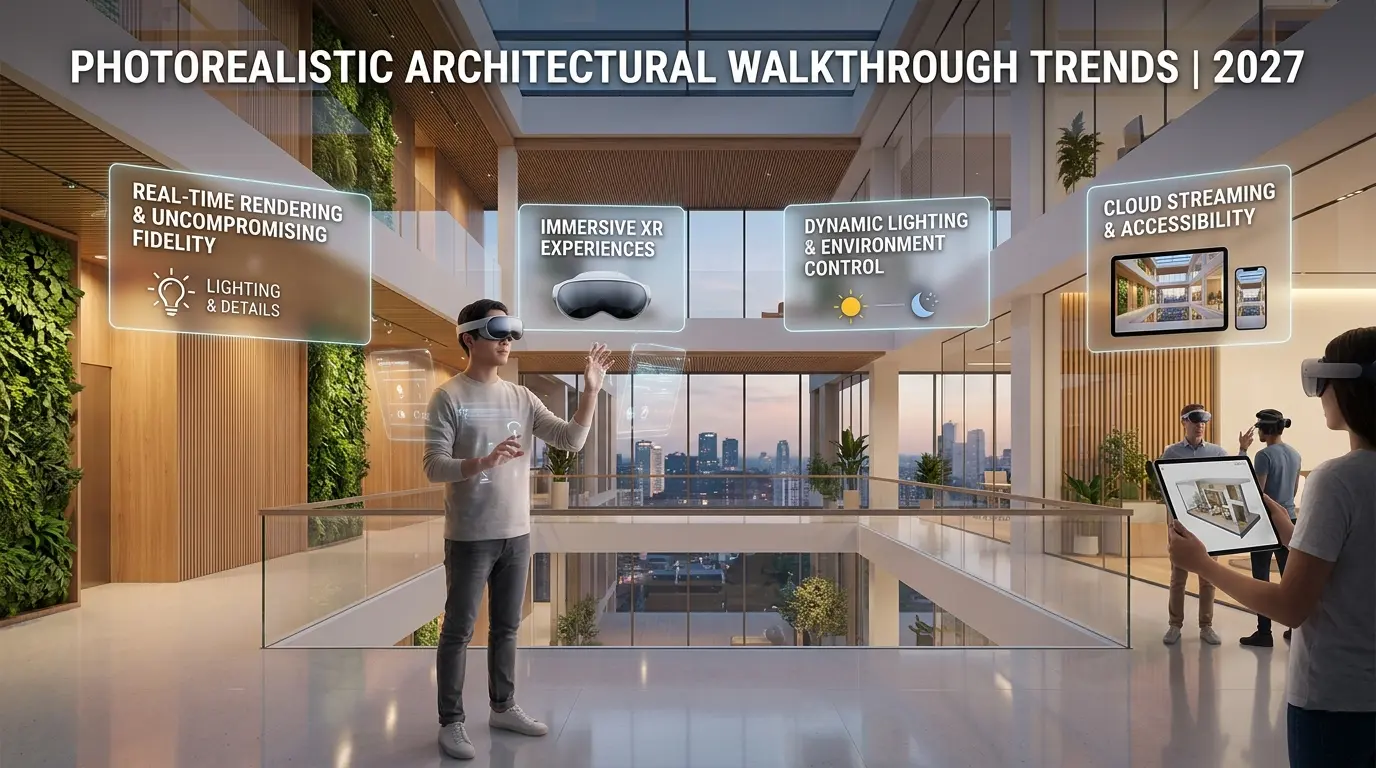
These trends include AI-assisted visualization, real-time 3D rendering, immersive VR and AR experiences, interactive walkthroughs, digital twins, more realistic materials and lighting, and increasingly data-driven architectural storytelling.
The important distinction is that these technologies are not developing independently. They are increasingly converging.
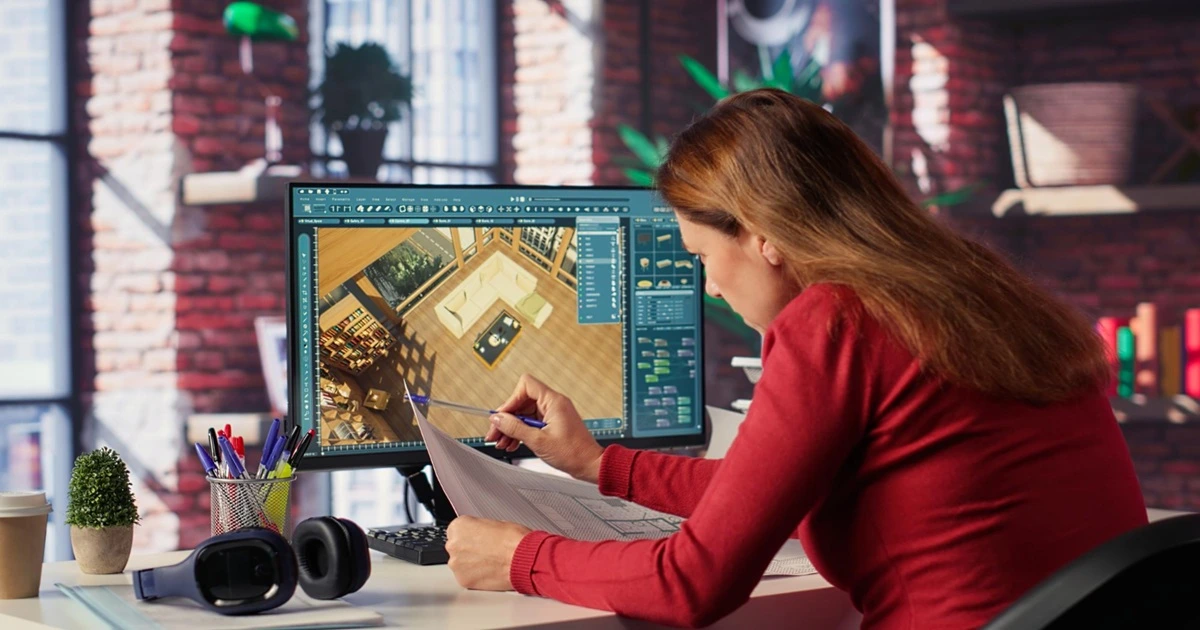
An architectural walkthrough may begin with BIM or CAD information, be enhanced through AI-assisted workflows, rendered in a real-time engine, published as an interactive experience and eventually connected to a digital twin.
That convergence is likely to define the next stage of 3D Architectural Walkthrough 2027.
Why Architectural Walkthroughs Are Changing?
Traditional walkthroughs were largely linear.
A camera moved through a building. The viewer watched. The visual communicated appearance, but interaction was limited.
That model is still useful for promotional films, yet the expectations of property buyers and project stakeholders are changing.
Real estate marketing increasingly relies on digital experiences that allow audiences to understand a property remotely. JLL, for example, has highlighted immersive virtual reality experiences and AI-based digital marketing as part of the changing way properties are presented and marketed.
At the same time, real-time visualization platforms are making it easier to work with high-fidelity architectural environments interactively. Unreal Engine specifically positions real-time architecture visualization around immersive design exploration before construction, including high-fidelity data from 3D, CAD and BIM applications.
The result is a shift from:
“Look at this building.”
to:
“Experience, explore and understand this building.”
That shift explains many of the emerging Architectural Walkthrough Trends 2027.
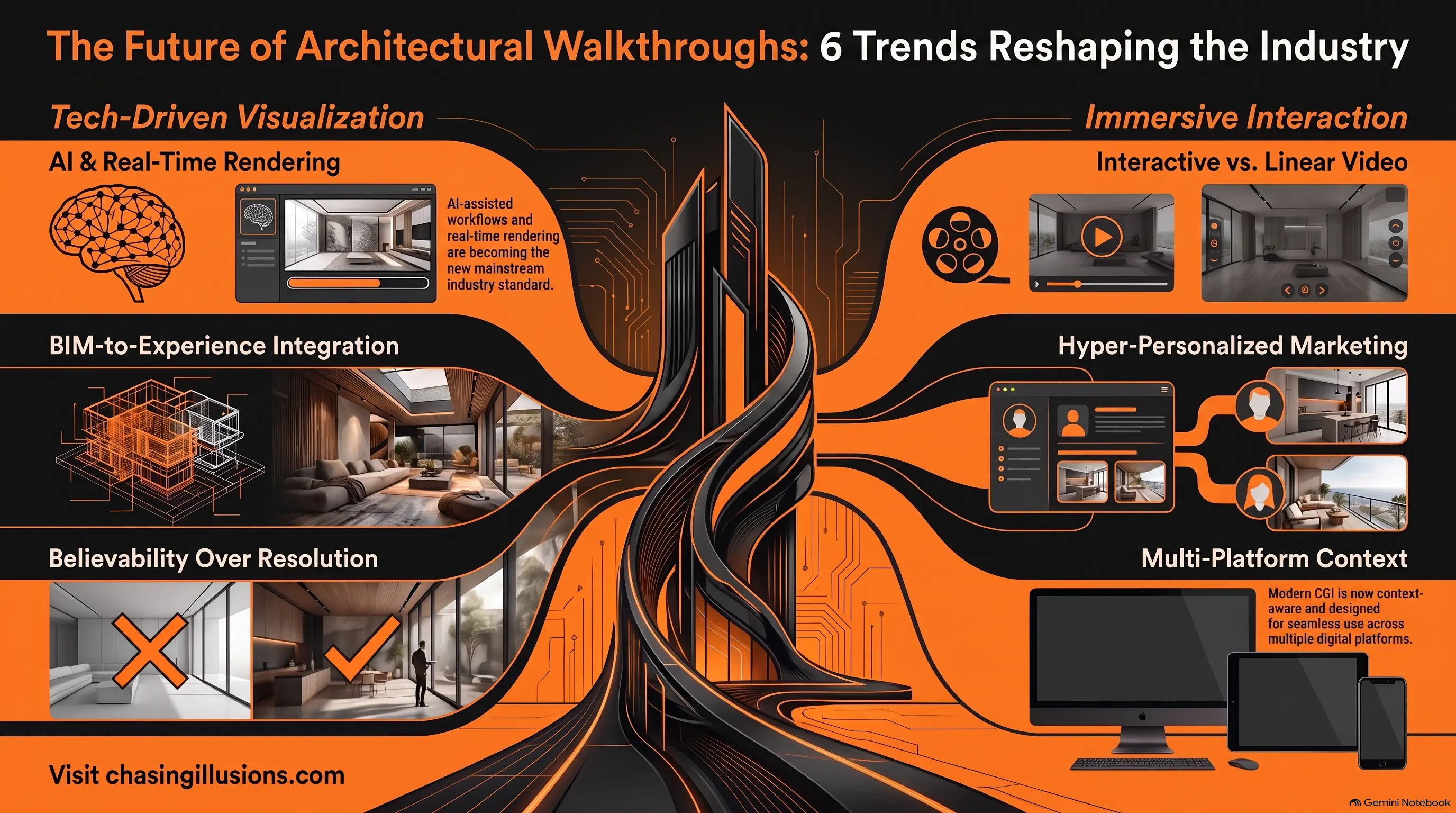
1. AI-Assisted Architectural Visualization Will Become Part of the Workflow
AI will be one of the most visible forces influencing Photorealistic Architectural Walkthrough Trends 2027, but its role should be understood carefully.
AI is unlikely to eliminate the need for architects, visualization artists or technical specialists. Instead, its practical value will increasingly come from assisting repetitive and time-consuming parts of the workflow.
Where AI Can Add Value
AI-assisted visualization can help with tasks such as:
Concept exploration
Material and finish variations
Environment generation
Reference-image analysis
Scene preparation
Image enhancement
Lighting exploration
Visual ideation
Content adaptation for different audiences
This can make visualization teams more responsive when a developer asks for multiple façade finishes, landscaping options, furniture styles or lighting scenarios.
Autodesk's 2025 research illustrates the broader movement: AI is becoming an increasingly important technology across Design and Make industries, with organizations exploring it for productivity, sustainability and decision support. The research also indicates that organizations are increasingly planning to integrate large language models into their workflows over the coming years.
However, AI introduces a major responsibility: visual accuracy.
Generated imagery may look convincing while still introducing incorrect architectural elements, materials or spatial relationships. NIST's AI Risk Management Framework emphasizes the importance of trustworthy AI practices, including managing risks associated with AI systems throughout their lifecycle.
For architectural visualization, that means AI should support the process—not replace professional review.
What This Means for Developers?
The competitive advantage will not necessarily belong to firms that simply “use AI.”
It will belong to teams that know where AI can accelerate production without compromising design intent, technical accuracy or brand consistency.
2. Real-Time Architectural Rendering Will Move Further Into the Mainstream
One of the strongest Real Estate Visualization Trends is the movement from offline rendering toward real-time experiences.
Traditional rendering can produce exceptional results, but changes often require additional processing. Real-time rendering changes the interaction model.
A developer can potentially adjust:
Flooring
Wall finishes
Furniture
Landscaping
Lighting
Time of day
Camera positions
Exterior materials
and review the outcome interactively.
Unreal Engine's architecture platform demonstrates how real-time engines can combine high-fidelity geometry, BIM and CAD data with immersive visualization workflows. Its current architecture offering emphasizes exploring designs with lifelike detail before construction.
Why Real-Time Matters?
Real-time visualization matters for more than presentation.
It can support collaboration.
An architect, developer and marketing team can review a shared environment rather than interpreting several disconnected images.
This makes Real-Time Architectural Rendering particularly valuable during design reviews, stakeholder presentations and property marketing preparation.
By 2027, the distinction between a “rendered walkthrough” and a “real-time interactive environment” is likely to become less significant.
3. Photorealism Will Become More About Believability Than Resolution
Higher resolution has always been associated with better visualization.
But Photorealistic 3D Walkthrough experiences are increasingly judged by something more subtle: whether the environment feels believable.
A highly detailed image can still look artificial if the lighting, proportions, materials, reflections or movement feel wrong.
Future-facing visualization will therefore focus heavily on:
Physically Convincing Materials
Wood, stone, glass, metal, concrete, fabric and landscaping materials need realistic surface response rather than simply high-resolution textures.
Natural Lighting
Lighting should communicate time, atmosphere and spatial depth.
Realistic Environmental Context
Trees, pedestrians, vehicles, skies, neighboring buildings and streets should support the architectural story rather than distract from it.
Human-Scale Experience
A walkthrough becomes more convincing when viewers understand how spaces feel at human eye level.
This is particularly important for luxury residences, hospitality projects, commercial interiors and high-end real estate visualization, where buyers are often evaluating atmosphere as much as geometry.
4. Interactive Walkthroughs Will Challenge Linear Video
A conventional walkthrough tells the viewer where to look.
An interactive walkthrough allows the viewer to decide.
That difference is significant.
Instead of watching a predefined sequence, a potential buyer could explore a property and move between spaces according to personal interest.
For example, a residential buyer might:
Enter through the lobby.
Explore the living room.
Change the lighting.
View an alternate kitchen finish.
Open an interactive floor plan.
Move to a balcony.
Compare another unit type.
This makes 3D Real Estate Walkthrough technology more useful for sales and education, rather than purely promotional content.
Interactive experiences may become especially valuable for off-plan property marketing because the physical property is unavailable during much of the buying journey.
5. Virtual Property Tours Will Become More Immersive
Virtual property tours are already used to allow prospects to experience locations remotely. The next stage will likely involve richer environments, greater interactivity and stronger integration with other visualization formats.
The rise of immersive web technologies supports this direction. The W3C WebXR specification provides web interfaces for accessing VR and AR devices, creating a foundation for browser-based immersive experiences across supported hardware.
For real estate, this creates several possibilities.
A buyer could explore a future apartment from another country.
A commercial tenant could examine office layouts without immediately visiting the site.
A property consultant could use a digital environment to explain a development to investors.
A developer could present multiple unit configurations from one shared digital model.
VR and AR in Real Estate Will Serve Different Purposes
VR is particularly useful when the goal is deep immersion.
AR can be useful when a digital property visualization needs to appear within the viewer's real-world environment.
For example, an AR experience could help demonstrate how a proposed structure, interior element or landscape feature could appear within a physical context.
The broader opportunity is not simply “using VR.” It is selecting the right immersive format for the decision being made.
6. Digital Twins Will Extend Visualization Beyond Marketing
One of the most important long-term developments is the connection between visualization and digital twin technology.
A digital twin is more than a beautiful 3D model.
NIST describes digital twins as computer-based representations of physical systems that can support modeling, simulation, monitoring, optimization and decision-making.
For buildings, NIST is actively researching digital infrastructure that connects lifecycle building data, BIM information, operational systems and machine-readable representations.
This creates a much bigger opportunity for architectural visualization.
The visual model could eventually become part of a wider digital environment used for:
Facility management
Maintenance planning
Building performance analysis
Asset monitoring
Space management
Energy analysis
Operational decision-making
Why This Changes Architectural Visualization
Historically, visualization was often created for a specific presentation or campaign.
Digital twins shift the mindset toward persistent digital assets.
The model may continue to have value after the sales campaign ends.
NIST also emphasizes interoperability, standards and trust as important issues for successful digital twin ecosystems.
That means future visualization strategies should think about data structure and interoperability, not only visual quality.
7. BIM-to-Experience Workflows Will Become More Important
A major opportunity for the 3D Architectural Walkthrough 2027 workflow is tighter integration between BIM, CAD and visualization.
Instead of treating visualization as a separate stage that begins after design work, projects can move toward connected pipelines in which design information feeds immersive experiences more efficiently.
The benefits include:
Reduced duplication
Faster updates
Better design coordination
More consistent project information
Faster creation of visualization variants
Greater reuse of digital assets
NIST's building digitization work specifically addresses the need for machine-readable building information and interoperability across lifecycle stages.
This is important because photorealism alone does not create an efficient visualization workflow.
The underlying data pipeline matters just as much.
8. Interactive Floor Plans Will Become More Valuable
Traditional floor plans require users to mentally translate two-dimensional information into three-dimensional space.
Interactive floor plans can reduce that cognitive gap.
A user may click on a room and instantly transition into a corresponding walkthrough view.
This creates a connection between:
Plan → Space → Experience
For property sales teams, that connection can make project information easier to understand.
For architects and developers, it can also make presentations more effective because stakeholders can move directly from technical information to spatial experience.
This approach can be particularly useful for large residential developments where users need to compare multiple unit types.
9. Personalization Will Become a Major Property Marketing Advantage
Not every buyer wants the same property experience.
A family may prioritize bedrooms and outdoor space.
An investor may focus on unit efficiency and amenities.
A luxury buyer may care more about materials, lighting, views and interior atmosphere.
This creates an opportunity for personalized Immersive Property Visualization.
Instead of presenting a single generic walkthrough, future platforms may adapt the experience according to audience requirements.
For example:
Investor view: area efficiency, unit mix, amenities, commercial potential.
Buyer view: interiors, lifestyle spaces, views and customization.
Architect view: materials, geometry, façade systems and design details.
Sales view: premium spaces, differentiators and buyer objections.
The visualization becomes a communication tool rather than just a marketing asset.
10. Exterior and Interior Visualization Will Become More Context-Aware
Photorealistic visualization is moving beyond isolated buildings.
Future architectural storytelling will increasingly show the relationship between the property and its surroundings.
For exterior visualization, this may include:
Accurate neighboring context
Streetscape
Landscaping
Traffic
Weather
Seasonal conditions
Day and night scenarios
For interior visualization, it may involve:
Natural light changes
Material interactions
Occupancy scenarios
Furniture configurations
Smart-building features
Different lifestyle use cases
This is particularly relevant to High-End Real Estate Visualization, where the surrounding experience often contributes to perceived property value.
11. Sustainable Architecture Visualization Will Gain Importance
Sustainability is becoming increasingly connected to technology, design and decision-making.
Autodesk's 2025 State of Design & Make research found that AI was identified by 39% of surveyed leaders as a sustainability enabler, while the report also highlights applications such as energy optimization, flood-impact visualization and lifecycle analysis.
For architectural visualization, this could mean that sustainable performance is increasingly communicated visually.
Instead of simply stating that a building includes sustainable features, teams can demonstrate:
Daylight behavior
Solar exposure
Shading strategies
Green spaces
Material choices
Energy-related scenarios
Environmental conditions
This makes Sustainable Architecture Visualization more explanatory and decision-oriented.
The goal is not to turn every marketing walkthrough into a technical simulation.
It is to make sustainability easier to understand.
12. Smart Building Features Will Become Part of the Experience
The “smart building” story can be difficult to communicate through static images.
A future walkthrough could make those systems visible.
Imagine entering an apartment and seeing how lighting responds automatically, how shading adjusts to sunlight, how access systems work or how building amenities interact with residents.
This is where visualization and digital building data can begin to overlap.
NIST's work on AI-enabled building systems and digital twins highlights the importance of connecting building information, semantic interoperability and AI-enabled services.
For property marketing, that creates an important opportunity:
Do not only show what the building looks like. Show what the building does.
13. Real Estate CGI Will Become More Multi-Platform
A single visualization project may increasingly generate many forms of content.
One digital environment could produce:
A cinematic walkthrough
Interactive website content
Social media clips
VR experiences
AR experiences
Still renders
Sales presentations
Interactive floor plans
Unit configurators
Investor presentations
This makes the original 3D asset more valuable.
Rather than producing one video and starting again for every channel, developers can think in terms of a reusable visualization ecosystem.
That approach can improve consistency across marketing, sales and stakeholder communication.
14. The Viewer Will Expect More Control
One of the defining characteristics of future Architectural Visualization Trends is greater audience control.
People increasingly expect digital experiences to respond to their actions.
For property visualization, that may mean selecting:
Unit type
Interior package
Flooring
Kitchen finish
Furniture
Lighting
View
Time of day
Landscaping
Furniture layouts
This is especially relevant to developers selling customizable or premium properties.
The visualization can become an early-stage product configurator.
15. Visualization Quality Will Still Depend on Human Expertise
Technology will evolve rapidly, but technology alone will not guarantee effective architectural visualization.
A technically impressive walkthrough can still fail when:
The camera movement is distracting.
The story is unclear.
Materials lack realism.
Scale feels incorrect.
Lighting is inconsistent.
The project context is missing.
The walkthrough shows too much irrelevant detail.
The experience does not answer buyer questions.
This is why architectural storytelling remains essential.
The most successful Photorealistic Architectural Walkthrough Trends 2027 will not simply produce more realistic imagery.
They will use realism to communicate something meaningful.
How Developers Should Prepare for the 2027 Walkthrough Landscape?
Developers do not need to adopt every emerging technology at once.
A better strategy is to build a visualization roadmap around the project's goals.
Start With the Business Objective
Ask what the visualization needs to achieve.
Is it intended to:
Sell off-plan units?
Win investor confidence?
Explain a design?
Secure stakeholder approval?
Create a luxury brand experience?
Demonstrate sustainability?
Support post-construction operations?
The answer should influence the technology choice.
Build From Reliable Project Data
Good visualization starts with reliable information.
BIM, CAD, floor plans, material specifications and design references should be structured carefully so that visualization can evolve alongside the project.
Design for Multiple Experiences
Instead of creating a single finished walkthrough, think about how one digital environment can support multiple outputs.
Use AI With Human Oversight
AI can accelerate exploration and production, but architectural accuracy, project consistency and final quality require professional validation. NIST's AI guidance provides a useful framework for thinking about trustworthy AI deployment.
Prioritize Interactivity Where It Adds Value
Interactive features should solve a problem.
A complicated interface that does not help a buyer understand the project is less valuable than a simple, intuitive walkthrough.
What Will Separate Great Walkthroughs From Average Ones in 2027?
The difference may not be the most expensive software or the highest polygon count.
It will be the ability to combine technology, accuracy and storytelling.
A strong future-ready workflow may look like this:
BIM/CAD Data → AI-Assisted Production → Real-Time 3D Environment → Photorealistic Rendering → Interactive Experience → VR/AR → Digital Twin
Not every project will use every stage.
But this model shows how architectural visualization is evolving from an isolated production service into a broader digital ecosystem.
For professional architectural walkthrough studios and project teams, this also changes the skills that matter.
The future visualization professional may need to understand not only modeling and rendering, but also real-time engines, BIM interoperability, AI workflows, interactive UX, immersive technologies and data management.
Frequently Asked Questions:
What are the biggest Photorealistic Architectural Walkthrough Trends 2027?
The most significant trends include AI-assisted visualization, real-time rendering, interactive walkthroughs, photorealistic materials and lighting, VR and AR, digital twins, BIM-connected workflows, personalized property experiences and multi-platform 3D content.
How will AI affect architectural walkthroughs in 2027?
AI is expected to assist with visualization ideation, scene preparation, variations, image enhancement, environmental generation and other repetitive tasks. Human supervision will remain important for architectural accuracy, design intent and trustworthy outputs.
Will real-time rendering replace traditional rendering?
Not completely. Offline rendering can still be valuable when maximum image quality and controlled output are the priority. Real-time rendering is particularly useful for interactive experiences, rapid iteration, collaboration and immersive applications.
Are VR property tours useful for real estate developers?
Yes, particularly for off-plan properties, international buyers and projects that need to communicate spatial experience before construction is complete. VR can provide a deeper sense of scale and movement than static imagery, while web-based immersive technologies can broaden accessibility.
What is the difference between a 3D walkthrough and a digital twin?
A 3D walkthrough is primarily an experience for viewing and communicating a designed environment. A digital twin is a digital representation connected to a real-world system or asset and can support monitoring, simulation, optimization and decision-making.
Will photorealistic visualization become fully automated?
Some parts of production are likely to become increasingly automated, particularly repetitive and assistive tasks. However, successful architectural visualization still depends on design judgment, technical accuracy, storytelling, art direction and quality control.
How can architectural firms prepare for 2027?
They should focus on reliable BIM/CAD data, real-time visualization capabilities, AI-assisted workflows, interactive experiences and reusable digital assets. It is also important to select technologies based on the project's actual objectives rather than adopting new tools simply because they are fashionable.
Conclusion:
Return to the opening scenario: a property that does not physically exist yet.
In the past, buyers had to rely heavily on plans, brochures and imagination.
The next generation of architectural visualization is changing that.
The Photorealistic Architectural Walkthrough Trends 2027 point toward experiences that are not only more realistic, but also more interactive, intelligent, connected and useful.
AI can accelerate visualization workflows.
Real-time rendering can make environments easier to explore.
VR and AR can make future spaces feel tangible.
Interactive tools can give buyers more control.
Digital twins can extend the value of visual assets beyond marketing.
And better BIM-to-visualization workflows can connect design information with richer digital experiences.
The real opportunity is not simply to make buildings look real.
It is to make future buildings understandable, explorable and emotionally convincing before they exist physically.
For developers, architects and real estate marketing teams, that is the direction worth preparing for now.
For organizations looking to turn architectural data and design concepts into high-quality visual experiences, Chasing Illusions Studio provides visualization expertise across architectural and 3D content workflows. The focus should always remain on the project's audience, story and business objective—not technology for technology's sake.
Explore how Chasing Illusions Studio can help bring your next architectural project to life through future-ready visualization.
Book a discovery 20-minutes strategy call.
📞 +91-9910911696 | +91-9910660851
📩 info [@] chasingillusions [.] in
Written by Deepak, Architectural Walkthrough content strategist at Chasing Illusions Studio. Our clients include DLF, Emaar, Ganga Reality, Banner Boswell, Shapoorji Pallonji, EC World, Taj, Florida Hospital, etc., 100+ architectural companies across India, USA, Thailand, and the UK.
Last Updated: Aug 14, 2026, | Chasing Illusions Studio
Chasing Illusions Studio
Premium animation & video production studio based in Delhi, India. Specialising in 3D animation, medical visualisation, architectural walkthroughs, and CGI.