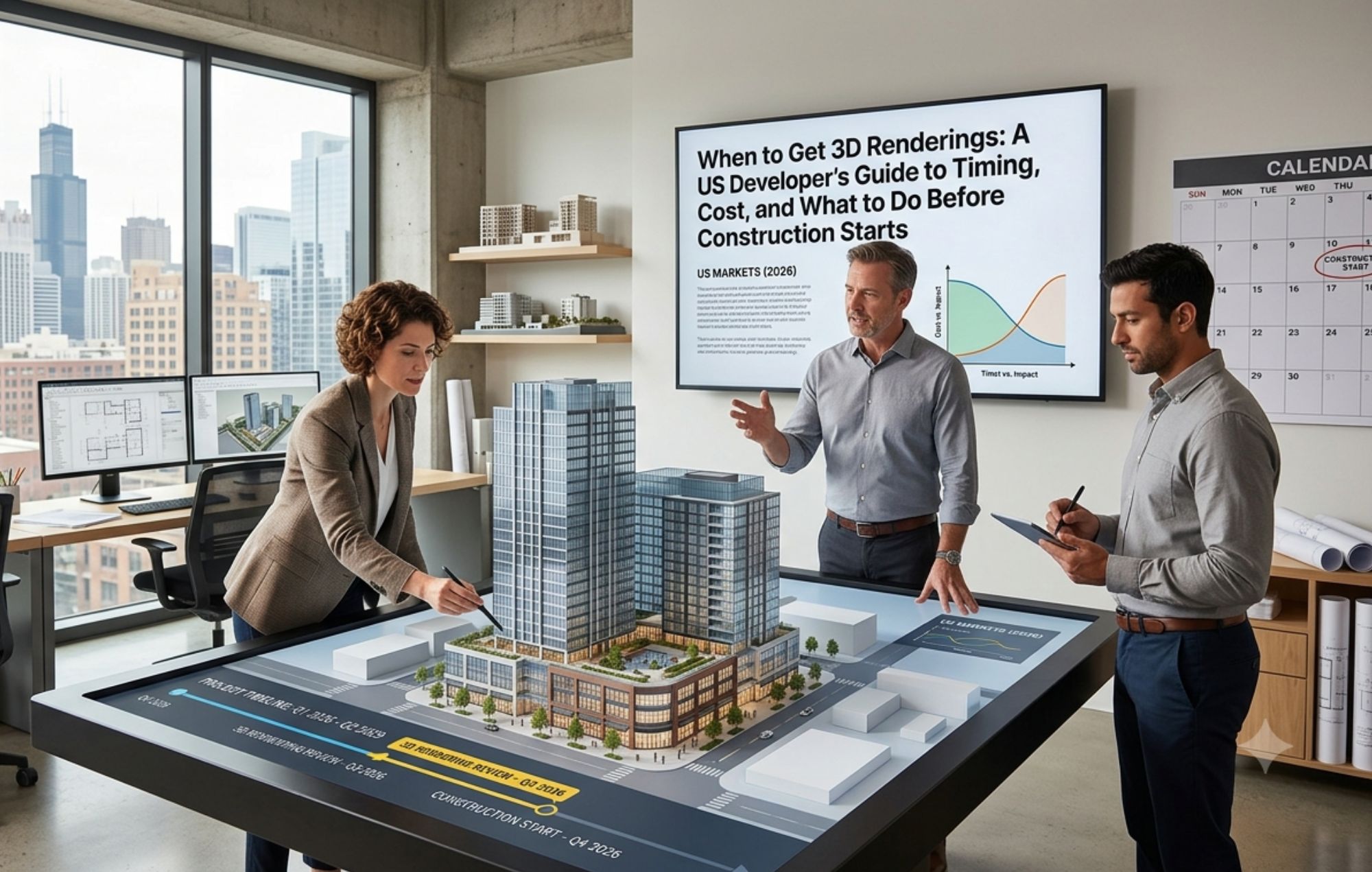
The most common mistake US developers make with 3D renderings is not the wrong studio or the wrong budget — it is the wrong timing. Either they commission too late and miss the financing or pre-sales window, or they wait for a fully finished design before starting, by which point the visualization can't help with any of the decisions that actually needed it.
This guide answers the timing question directly: when in a development project should you commission renderings, what can be produced at each stage, and how do you justify the cost before a single unit is finished or a foundation is poured. It is written specifically for US developers and architects working on residential, multifamily, and mixed-use projects — not a general overview of 3D rendering as a concept.
The Short Answer First
Commission renderings at the end of schematic design or the beginning of design development — as soon as the project shows massing, facade character, and site context. Waiting for a fully finalized design often means missing the financing or marketing launch window by three to five months.
This surprises most developers who assume they need a complete design before approaching a visualization studio. You don't. A studio can build a render-ready 3D model from schematic drawings, approximate material directions, and site context — and that model can be updated efficiently as the design develops, at a fraction of the cost of starting over later.
The practical consequence: the developer who starts visualization at schematic stage has finished, approved marketing assets ready for launch day. The developer who waits until construction documents are complete is still waiting for renders while competitors are already selling.
Why Timing Matters More Than Budget
Most guides on 3D rendering focus on price per image. The more important variable is where in the project lifecycle the visualization happens — because different stages require different outputs, serve different audiences, and justify different budgets.
Here is what each stage actually needs:
Schematic Design (SD) — Internal and Investor Use At this stage, massing is established but materials and details are not locked. The right output is concept-level visualization: enough photorealism to communicate design intent to investors, lenders, or internal stakeholders, but not the final marketing quality needed for public pre-sales. These are working tools, not marketing assets.
Cost range: $1,500–$4,500 per exterior view at concept/schematic quality. Production time: 1–2 weeks from good schematic drawings.
What you can commission from schematic drawings alone: massing renders showing overall form and context, aerial contextual views, hero exterior from one or two key angles, simple floor plan layouts. What you cannot commission yet: furnished interior renders, material-specific close-ups, final marketing walkthroughs.
Design Development (DD) — Investor Packages and Pre-Sales Launch Preparation Materials are being specified, floor plans are stabilizing, and the design is close enough to final that marketing-quality renders are appropriate. This is the stage where most serious US developers commission their full visualization package — because the lead time from brief to finished assets (typically 3–6 weeks for a full package) needs to align with the pre-sales launch date.
12 to 16 weeks before your planned sales launch: commission the hero exterior, contextual aerial, and 2–3 key unit interiors. These are the foundation assets that every subsequent deliverable — website, brochure, sales center, digital ads — depends on.
Cost range: $3,000–$8,000 per marketing-quality exterior view; $1,800–$4,500 per interior view. Full pre-sales package for a multifamily development: $15,000–$60,000 depending on number of unit types, amenity spaces, and whether animation is included.
Construction Documents (CD) — Do Not Wait This Long for Your First Renders By the time CDs are complete, you have lost 3–6 months of potential pre-sales runway. If your first visualization brief goes out at CD stage, the project has a problem: either the pre-sales launch is being delayed waiting for renders, or the renders are being rushed to catch up with a timeline they should have led.
The exception: design changes during CD phase that need to be reflected in already-produced marketing assets. Updating an existing 3D model is significantly faster and cheaper than starting from scratch — which is another argument for starting early and building the model as a reusable asset rather than a one-time deliverable.
What You Can Produce From Drawings Only
The most common question from developers at early project stages is whether there is enough design information to produce anything useful. In most cases, the answer is yes — with caveats about what is realistic at each level of drawing completeness.
From schematic floor plans and basic elevations (SD level):
Massing renders showing overall form, site footprint, and relationship to neighboring buildings
Contextual aerial views showing the development in its block/neighborhood context
Simple exterior views from 1–2 hero angles showing overall design intent
Timeline: 10–14 days from a clear brief and clean SD drawings
What you need to provide at minimum: floor plans for all levels, elevations for all facades, a site plan showing context, and approximate material direction ("mid-rise brick residential with floor-to-ceiling glass" is enough to start — you don't need a final spec sheet). Send even a rough material direction at the start of the project. A studio can model the building accurately from good plans, but if material palette isn't defined, they'll make assumptions — and revisions to correct material choices add days to delivery.
From design development drawings with material specs: Everything above plus furnished interior renders for unit types, amenity space visualization (lobby, rooftop, pool, fitness center), 3D floor plans per unit type, and animated walkthrough production. This is the full marketing package.
From 2D plans only, no 3D CAD files: Yes — studios build 3D models from 2D drawings routinely. It adds approximately 1–2 weeks to the timeline and some cost to the base quote compared to starting from a Revit or SketchUp file. For early-stage work where no 3D model exists yet, this is standard practice, not an exception.
The Justification Question: How to Make the Case Internally
The question most development teams actually struggle with is not when to get renderings — it is how to justify the cost to a CFO, a partner, or a lender before the project is generating revenue.
The calculation is simpler than it looks.
Against financing cost: A $40M development carrying at 6% annual interest costs approximately $200,000 per month. A pre-sales campaign that begins 3 months earlier — enabled by having visualization assets ready at launch — represents $600,000 in avoided carry. A $30,000 visualization package that enables that earlier launch has a straightforward ROI even before counting the revenue from pre-sold units.
A $2,200 rendering that accelerates unit absorption by 15% can generate over $85,000 in additional cash flow on a $3M condo. At a project scale of $20M–$40M, the math is proportionally larger.
Against marketing budget: Most established developers allocate 0.5%–1.5% of the total marketing budget exclusively to visualization. On a $40M project with a 2% marketing budget ($800,000), a $20,000–$40,000 visualization package represents 2.5%–5% of marketing spend — a small allocation generating the core asset that every other marketing channel depends on.
Against the cost of local studios: US developers sometimes hesitate over the cost gap between local visualization studios ($8,000–$15,000+ per exterior view at premium New York or LA studios) and offshore studios producing equivalent quality at $1,500–$4,000 per view. The price difference is real and reflects operating costs, not output ceiling. For developers who need to justify visualization costs at early project stages before revenue is certain, working with a qualified offshore studio on the initial package — and reserving local studio relationships for specific needs — is a practical approach many experienced developers use. The full breakdown of what to look for and what questions to ask is in our guide to working with offshore visualization studios.
The Five Use Cases and What Each One Needs
Understanding which audience a rendering is serving determines what it needs to look like, how much it should cost, and when in the project it should be commissioned.
1. Investor and Lender Packages
When: As early as SD stage, sometimes earlier for land acquisition discussions. What it needs: Design credibility and market positioning clarity — not photorealistic perfection. Investors evaluating a pitch deck need to understand what is being built and why it will sell. Schematic-quality massing renders, a site context aerial, and a clear floor plan layout serve this purpose better than spending $50,000 on final marketing renders at a stage when the design may still change significantly. Typical package: 2–4 exterior views, site aerial, floor plan layouts. Cost: $8,000–$20,000.
2. Planning and Entitlement Submissions
When: Timed to the submission deadline, typically at DD stage or later. What it needs: Accuracy and contextual honesty. A planning submission rendering needs to show the building as it will actually look in its context — accurate neighboring buildings, correct scale, realistic shadow and light. Styled or aspirational rendering that exaggerates the building's qualities or minimizes its impact is counterproductive in this context and can damage credibility with planning staff. Typical package: Contextual exterior views from required angles, shadow studies, streetscape renders. Cost: $5,000–$15,000 for a standard submission package.
3. Pre-Construction Sales (Off-Plan)
When: 12–16 weeks before planned sales launch. What it needs: The highest production quality of any use case, because you are asking buyers to commit $300,000–$1,500,000+ on something they cannot physically experience. The rendering has to replace that experience completely. Unit-specific interior renders with actual specified materials, a 3D floor plan that makes spatial proportions immediately legible, and a walkthrough or virtual tour that lets an out-of-market buyer explore the unit on their phone. Typical package: Hero exterior (1–2 views), interior renders for each unit type, amenity spaces, 3D floor plans, animated walkthrough or 360° virtual tour. Cost: $20,000–$60,000+ for a full multifamily pre-sales package. For a breakdown of what changes at each price tier, our architectural walkthrough pricing guide covers the US market in detail.
4. Financing and Construction Lender Presentations
When: Alongside or slightly after investor packages, at DD stage. What it needs: Proof of market viability and sales conviction — demonstrated through pre-sales numbers or reservation activity where possible, supported by visualization quality that signals the project will attract buyers. Construction lenders are evaluating risk; visualization that makes the project look credible and well-positioned reduces perceived risk. Typical package: Core exterior and interior renders from the pre-sales package, repurposed for lender presentation format. Marginal additional cost if visualization is already being produced for pre-sales.
5. Marketing Launch and Digital Channels
When: 4–8 weeks before launch, produced simultaneously with the pre-sales package. What it needs: Format versatility — the same renders need to work across website hero images, digital advertising (multiple aspect ratios), social media (vertical format for Instagram/TikTok), brochure layouts, sales center displays, and listing platforms. Specify all required formats at the brief stage, not as add-ons after production — format changes after final render are a common source of unexpected additional cost. Typical package: Core pre-sales renders plus social media cuts, web-optimized video, and platform-specific formats. Cost: $2,000–$8,000 additional on top of the core package if specified upfront.
The Timeline That Actually Works
Based on how US developers structure visualization across a typical 18-month development cycle from design start to sales launch:
Month 1–3 (Schematic Design): Commission concept-level massing renders for investor/lender presentations. Brief a studio, get your first views within 2 weeks. Use them immediately in any financing conversations happening at this stage.
Month 4–6 (Design Development begins): Begin the full visualization package brief. Lock material directions even if specs are not 100% final — approximate directions are sufficient. A studio building a model at this stage can update materials efficiently as specs are finalized, at far lower cost than starting the model fresh at CD stage.
Month 6–9 (Design Development): Receive hero exterior, interior renders for key unit types, amenity spaces. Review and approve. Begin website development and brochure layout using approved renders. Commission animated walkthrough if planned.
Month 10–12 (Construction Documents): Core visualization package complete and approved. Website live. Brochure to print. Sales center materials produced. Any CD-phase design changes updated in the existing model — not restarted.
Month 12–15: Pre-sales launch. All assets ready. Developers who pre-sell 20–40% of units before breaking ground secure better loan terms, negotiate from a position of strength with contractors, and launch to market with momentum that compounds through the sales cycle.
Common Questions US Developers Ask
Our local studio quoted 6 weeks and more than we can justify at this stage — what are developers using instead?
Two approaches. First, offshore studios producing equivalent quality at 30–50% lower cost on the same timeline — covered in detail in our guide to working with offshore visualization studios. Second, staging the visualization investment: a concept-quality massing package now ($5,000–$10,000) for immediate investor use, followed by the full marketing package ($25,000–$50,000) when design is further developed and pre-sales revenue is closer. Most experienced developers do not produce everything at once — they produce what each stage actually needs.
How do we cut the cost of third-party visualizations for a project that's still just drawings?
Brief precisely and brief early. The two biggest drivers of cost overruns in visualization are vague briefs (which produce misaligned first drafts requiring expensive rework) and late starts (which require rush delivery premiums). A developer who briefs precisely — clear drawings, approximate material directions, specific intended use for each render, and required formats — consistently gets better value than one who sends minimal information and asks the studio to interpret. The brief quality guide we use with our own clients is available in our architectural walkthroughs guide.
I need renderings of a condo building for brochures before a single unit is finished — what should I use?
A full pre-sales visualization package commissioned at DD stage: hero exterior, furnished interior renders for each unit type, 3D floor plans, and a lobby/amenity render. This is standard practice for US multifamily pre-sales and is exactly what the renders are designed for. You do not need a finished unit — you need clean DD drawings, a material specification, and a studio brief. Timeline from brief to finished marketing assets: 4–6 weeks for a standard multifamily package.
We need a walkthrough video of an apartment complex for our sales site before it's built — any recommendations?
Yes — an animated walkthrough commissioned at DD stage. The typical scope for a multifamily pre-sales walkthrough: 60–120 seconds showing exterior approach, lobby/amenity spaces, and a representative unit interior. Production time: 3–5 weeks from a clear brief and approved design drawings. Cost: $8,000–$18,000 for a standard marketing-grade walkthrough. For a full breakdown of what each budget level delivers, our architectural walkthrough pricing guide covers the detail.
FAQs
When is the right time to get 3D renderings for a real estate development?
At the end of schematic design or the beginning of design development — as soon as massing, facade character, and site context are established. Waiting for construction documents means missing the financing and marketing launch window by three to five months. A studio can produce useful concept-level renders from schematic drawings, and update the model efficiently as design develops.
Can 3D renderings be produced from 2D drawings only?
Yes. Studios routinely build 3D models from 2D architectural plans (floor plans, elevations, site plan). It adds approximately 1–2 weeks to the timeline and some cost compared to starting from a Revit or SketchUp file, but it is standard practice for early-stage visualization before a 3D model exists.
How much do early-stage 3D renderings cost for a US developer?
Concept-quality massing renders for investor use: $1,500–$4,500 per view. Marketing-quality exterior renders for pre-sales: $3,000–$8,000 per view. Full pre-sales package for a multifamily development (exterior, interiors, amenities, walkthrough): $20,000–$60,000+. Visualization investment typically represents 0.5%–1.5% of the total marketing budget for established developers.
How long does a full pre-sales visualization package take to produce?
4–6 weeks for a standard multifamily package from a clear brief and DD-stage drawings. Studios with offshore production capability can deliver in 10–14 days for concept-quality work and 3–4 weeks for full marketing packages. Rush delivery (1–2 weeks for marketing quality) is available at most studios for a 20–35% premium.
What is the ROI of early-stage 3D renderings? The clearest calculation is against financing carry cost. A $40M development carrying at 6% costs approximately $200,000 per month. A pre-sales campaign that begins 3 months earlier — enabled by having visualization assets ready at launch — represents $600,000 in avoided carry against a visualization investment that might be $30,000–$50,000. Additional ROI comes from pre-sales velocity, better lender terms, and price premiums achievable when buyers have high confidence in the finished product.
Book a discovery 20-minutes strategy call.
📞 +91-9910911696 | +91-9910660851
📩 info [@] chasingillusions [.] in
Written by Deepak, Content Strategist at Chasing Illusions Studio, who leads content for clients including Ambler Surgical, Practo, Bayer, SMT, Novartis, and 100+ brands across India, USA, Thailand, and the UK.
Chasing Illusions Studio
Premium animation & video production studio based in Delhi, India. Specialising in 3D animation, medical visualisation, architectural walkthroughs, and CGI.