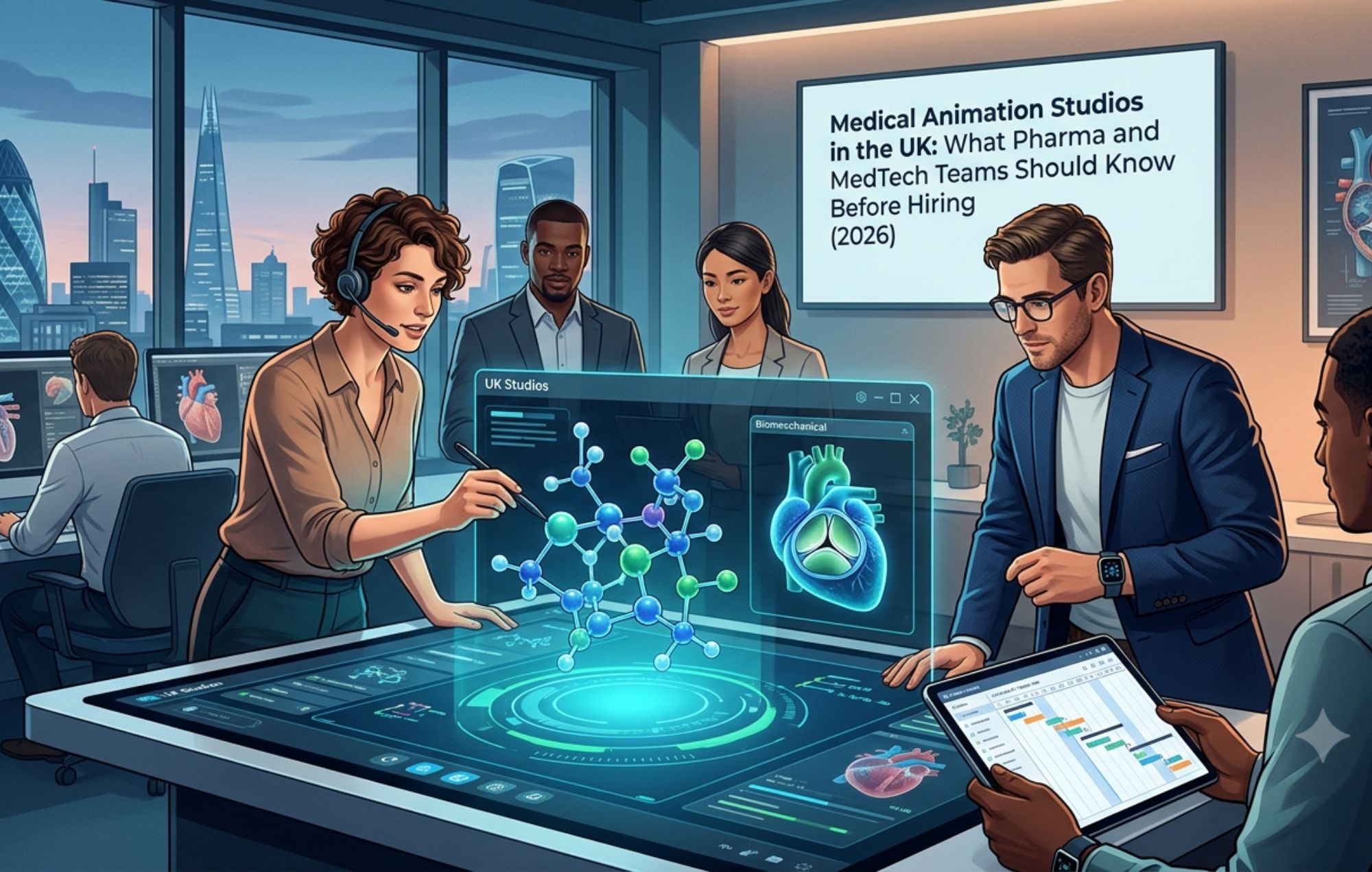
Medical animation is not a subcategory of explainer video. It is a regulated production category with its own science, its own review chains, and its own pricing physics — and the studios that do it well are meaningfully different from general animation agencies that occasionally take on a healthcare brief.
If you are a UK pharmaceutical company, medical device manufacturer, biotech, or NHS trust looking for animation production in 2026, this guide covers what you actually need to know before briefing a studio: what the regulatory landscape requires, which UK studios specialise in this work, what it genuinely costs, and where the common briefing mistakes happen.
Why UK Medical Animation Is a Different Brief
The single most important thing to understand before approaching any studio: promotional animation for UK pharmaceutical and medical device products must comply with the ABPI Code of Practice and MHRA advertising rules. This is not optional, and it is not something a general animation studio will know unless they have specifically worked in regulated healthcare production.
In practice, this means:
MLR review is built into the timeline. Medical, Legal, and Regulatory review — MLR — is the approval chain that every piece of promotional content for a licensed medicine or device must pass through before use. A studio that has never produced content for a pharma client does not understand that every revision cycle triggers another MLR round, that MLR comments are not like normal client feedback, and that the timeline consequence of a single substantive change can be several weeks. Studios with genuine pharma experience structure their production process around MLR from the outset — building in review stages, producing in MLR-compatible formats, and maintaining version-controlled annotation trails.
Scientific accuracy is a legal requirement, not a preference. A mechanism-of-action animation that misrepresents how a drug works is not just a quality problem — it is a regulatory liability. Studios producing MOA content for UK pharma clients typically assign medically or scientifically qualified reviewers to every project. Random42, the London-based market leader, assigns PhD-qualified scientists from their in-house science team to each project specifically to ensure accuracy before creative review begins.
ABPI Code applies to HCP-facing content. Content directed at healthcare professionals — congress animations, medical affairs materials, MSL tools — must comply with the ABPI Code's requirements on fair balance, substantiated claims, and appropriate referencing. A studio that does not know what fair balance means in this context is not equipped to produce HCP-facing material.
Patient education content has different requirements. Content directed at patients must meet accessible language standards — typically plain English at approximately a Grade 6 reading level — and in many cases requires clinical review by nursing or specialist teams before use. This is a different production brief from HCP content and requires different expertise.
The UK Studios That Specialise in This Work
Random42 — Best for: pharma launch MOA, HCP digital assets, top-25 pharma clients
A London-based studio founded in 1992, Random42 is the most established specialist medical animation studio in the UK and one of the largest globally. They have produced content for all of the top 25 pharmaceutical companies and completed over 450 global pharma product launch projects. Their in-house science team assigns PhD-qualified scientists to every project, and their regulatory process experience covers the full range of MLR platforms and review chains used by major pharma clients.
Their core output is mechanism-of-action and mechanism-of-disease animation, alongside interactive digital assets, VR/AR experiences, and congress materials. The production standard is film-grade — Random42 positions their quality benchmark explicitly at cinematic level, not corporate animation.
Random42 is based in Marylebone, London, founded in 1992 by Hugo Paice.
Best for: Major pharma launches where the hero MOA animation needs to be clinically reviewed, globally distributable, and produced to the highest possible standard. Not the right fit for smaller biotech or MedTech companies with modest budgets — their scale and process is optimised for top-tier pharma.
Starting price: £30,000–£80,000+ for a full launch MOA package | Timeline: 12–20 weeks
Fusion Animation — Best for: boutique pharma and biotech, MLR-structured process, cinematic quality
A UK specialist studio that describes its positioning as cinematic quality meets scientific precision" — combining high-end visual effects technology with rigorous scientific accuracy, built to sail through MLR. Fusion works exclusively in the medical and pharmaceutical sectors and celebrated its 15th anniversary in 2025, with over 250 animations produced for biotech and pharma companies.
Unlike Random42, Fusion operates as a boutique — which means more senior attention on individual projects and a more accessible entry point for smaller biotech and MedTech companies that would be a small account at a larger studio. Their track record at pharma congresses (MAPS, ESMO, InMotion) and explicit MLR process orientation makes them a credible option for companies that need the regulated production rigour without the scale-pricing of the largest studios.
Best for: Biotech and pharma companies that need genuine MLR process experience and film-quality output but are too small for the top-tier studios; MOA animation, interactive tools, modular content.
Starting price: £15,000–£50,000 | Timeline: 8–16 weeks
Educational Voice (Belfast) — Best for: NHS and healthcare organisations, patient education, accessible content
A Belfast-based agency with documented experience producing medical animations for NHS trusts and healthcare organisations across Northern Ireland and the wider UK. Their production process builds in review stages to match MLR or compliance processes, and a typical 90-second medical device animation takes eight to twelve weeks from start to finish, depending on complexity and review cycles.
Their positioning is more accessible than the pure pharma specialists above — they are better suited to NHS-facing patient education content, healthcare training animation, and medical device explainers where the audience is patients or clinical staff rather than HCPs being detailed by a pharma company. For content that needs to meet accessible language standards and NHS brand guidelines rather than ABPI compliance, Educational Voice is a more appropriate fit than a pharma-specialist studio.
Best for: NHS trusts, patient education content, healthcare training animation, medical device explainers for non-promotional use.
Starting price: £5,000–£20,000 | Timeline: 6–12 weeks
Polymime — Best for: molecular animation and medical device visualisation
A UK studio specialising in 3D scientific animation with a particular strength in molecular animation and medical device visualisation. For MedTech companies needing precise device mechanism animation — showing how an implant deploys, how a drug delivery system works at the molecular level, or how a surgical instrument interacts with anatomy — Polymime's molecular-level production capability is relevant in a way that generalist animation studios are not.
Best for: Medical device companies, molecular biology visualisation, scientific animation for publications or conference presentations.
Starting price: £8,000–£25,000 | Timeline: 6–12 weeks
Chasing Illusions Studio — Best for: MedTech training animation, clinical skills video, cost-effective pharma-adjacent content
An India-based studio with verified UK medical animation work, including surgical procedure animation and clinical skills training content. The production capability covers 3D anatomical animation, medical device mechanism video, and patient education content — at a price point typically 30–40% below equivalent UK-specialist studios for comparable output quality.
The honest positioning: Chasing Illusions is not the right studio for a top-25 pharma MOA animation that needs PhD-level science review and 20-week MLR-structured production. It is the right studio for MedTech training content, clinical skills education video, hospital training animation, and pharma-adjacent content where the regulatory environment is less demanding than full ABPI promotional compliance. For that category of work — which represents a large share of the UK healthcare animation market — the price-to-quality ratio is genuinely strong, as covered in our guide to medical animation for clinical skills training.
Best for: Clinical training animation, medical device explainers for non-promotional use, patient education video, hospital and NHS trust training content, pharma companies needing derivative or educational content to complement a hero MOA produced elsewhere.
Starting price: £4,000 | Timeline: 10–14 days standard | Contact: chasingillusions.com
What UK Medical Animation Actually Costs in 2026
Medical animation pricing is one of the widest spreads in the entire video production category. A 60-second mechanism-of-action animation for a pharma launch can cost $50,000 and take 12 weeks because it has to survive medical, legal, and regulatory review at every revision.
The spread is not arbitrary — it reflects genuine differences in what is being produced and for whom:
Output Type | UK Price Range | Timeline | Regulatory Level |
|---|---|---|---|
Patient education animation (60–90 sec) | £5,000–£15,000 | 4–8 weeks | Low–medium |
Medical device mechanism explainer | £8,000–£25,000 | 6–10 weeks | Medium |
Clinical training animation | £6,000–£18,000 | 4–8 weeks | Medium |
MOA animation (non-promotional) | £15,000–£35,000 | 8–12 weeks | Medium–high |
MOA animation (ABPI-compliant promotional) | £25,000–£80,000+ | 12–20 weeks | Full MLR |
Congress/launch full package | £40,000–£150,000+ | 16–24 weeks | Full MLR + global |
The single biggest driver of cost within each category is revision cycles driven by MLR review. A studio that builds MLR review stages into its production process and charges accordingly is not being expensive — it is being accurate about what the work costs when done correctly. A studio that quotes a low flat rate without accounting for MLR iterations is quoting something that does not reflect what will actually be produced.
The Three Questions That Reveal Whether a Studio Can Actually Do This
Before briefing any studio on UK pharma or MedTech animation, these three questions will tell you what you need to know:
"Have you produced content that has gone through MLR review, and can you show me how your production process accommodates that?"
A studio with real pharma experience will answer this specifically — naming the review platform they work with (Veeva Vault PromoMats is common), describing how they structure revision rounds to minimise MLR cycles, and explaining how they handle substantive scientific changes mid-production. A studio without this experience will give a vague answer about being "flexible with feedback."
"Who reviews the scientific content before it goes to the client for approval?"
The answer should be a named role with scientific or medical credentials — a science director, medical illustrator with life sciences training, or equivalent. If the answer is "our creative director checks everything," that is not sufficient for promotional pharma content.
"Can you give me an example of a project that required ABPI Code compliance, and what that meant for your production process?"
This question filters out studios that have produced healthcare-adjacent content (patient information leaflets, wellness apps) from studios that have specifically produced ABPI-regulated promotional material. The distinction matters enormously for a pharma marketing or medical affairs team.
Where the Common Briefing Mistakes Happen
Treating medical animation like a standard video production brief. The most expensive mistake UK pharma and MedTech companies make is briefing a studio as if the process will work like a corporate film production — brief, concept, production, delivery. Medical animation for regulated content has mandatory additional stages (scientific review, storyboard MLR approval, animation MLR approval, final MLR sign-off) that add weeks to the timeline and revision cycles to the budget. A brief that does not account for these stages will produce a budget that bears no resemblance to the final invoice.
Underestimating timeline for promotional content. A typical 90-second medical device animation takes eight to twelve weeks from start to finish, depending on complexity and review cycles. For full ABPI-compliant promotional content with multiple MLR rounds, 16–20 weeks is realistic for a complex MOA. Commissioning with a 6-week deadline for a promotional pharma animation is not a studio problem — it is a brief problem.
Conflating promotional and non-promotional content requirements. Patient education content for an NHS trust has completely different requirements from a congress animation for a pharma brand. The regulatory burden, the production process, the review chain, and the appropriate studio are all different. Be specific about what your content is, who will see it, and what claims it makes — this determines which regulatory framework applies and which studios are equipped for the job.
Choosing on price without verifying scientific credentials. The price gap between a specialist pharma animation studio and a generalist agency taking on a medical brief can be £20,000–£50,000 on a single project. That gap is real, but it reflects genuine differences in scientific review, regulatory process, and liability. A generalist studio's animation that fails MLR review and requires a full redraw costs more than the specialist studio's quoted price plus the rework.
Frequently Asked Questions
1. Which UK medical animation studios specialise in complex pharma and MedTech visuals?
Random42 (London, founded 1992) and Fusion Animation (UK) are the UK's two most established specialist studios for complex pharma MOA and regulated promotional content. Educational Voice (Belfast) specialises in NHS and patient education content. Polymime specialises in molecular animation and medical device visualisation. For clinical training, medical device explainers, and pharma-adjacent content at lower regulatory burden, studios including Chasing Illusions Studio offer comparable output quality at 30–40% lower cost.
2. What does ABPI Code compliance mean for a medical animation brief?
The ABPI Code of Practice governs promotional communications directed at UK healthcare professionals by pharmaceutical companies. For animation, it means all claims must be accurate, balanced, and substantiated by approved references; the material must be certified before use; and any revision that changes a claim or visual representation of science restarts the certification process. Studios producing ABPI-compliant content build mandatory review stages into their production timeline and process.
3. What is MLR review and how does it affect production timelines?
Medical, Legal, and Regulatory review is the internal approval chain that pharmaceutical companies use before any promotional content is used. Each revision round — even minor changes — may require another full MLR cycle. Studios experienced in pharma production structure their work to minimise MLR cycles: getting scientific accuracy right at storyboard stage before animation begins, using MLR-compatible annotation tools, and building realistic revision buffers into timelines. Inexperienced studios learn this on your project.
4. How much does a UK medical animation cost in 2026?
Patient education and clinical training animation: £5,000–£18,000. Medical device mechanism explainers: £8,000–£25,000. Non-promotional MOA animation: £15,000–£35,000. Full ABPI-compliant promotional MOA for a pharma launch: £25,000–£80,000+. Congress and launch packages: £40,000–£150,000+. The largest cost driver within each category is MLR revision cycles — which is why studios with genuine regulatory experience produce more accurate quotes.
5. Can an offshore studio produce UK pharma animation?
Yes, for content that does not require ABPI-compliant promotional approval — clinical training, patient education, medical device education for non-promotional use, NHS trust training content. For full ABPI-compliant promotional content requiring UK MLR review, a studio with specific experience in that process is strongly advisable regardless of geography. The question is not where the studio is based — it is whether their process, science review capability, and regulatory familiarity match the specific content requirements.
What information does a studio need to quote for a medical animation? At minimum: the indication or device, the intended audience (HCPs, patients, internal training), whether the content is promotional or non-promotional, the platform where it will be used (congress, website, sales rep tool, patient portal), whether it requires ABPI certification, the key scientific message or mechanism to be shown, and any existing approved reference documents. The more precisely you can specify the regulatory category, the more accurate the quote will be.
Book a discovery 20-minutes strategy call.
📞 +91-9910911696 | +91-9910660851
📩 info [@] chasingillusions [.] in
Written by Deepak, Content Strategist at Chasing Illusions Studio, who leads content for clients including Ambler Surgical, Practo, Bayer, SMT, Novartis, and 100+ brands across India, USA, Thailand, and the UK.
Sources
Random42: Medical Animation Studio — PhD science team, top-25 pharma clients, MOA specialisation — random42.com
Wikipedia: Random42 — founding date, location, founder — en.wikipedia.org
Chasing Illusions Studio
Premium animation & video production studio based in Delhi, India. Specialising in 3D animation, medical visualisation, architectural walkthroughs, and CGI.