Commissioning a 3D walkthrough for the first time is harder than it looks. You know roughly what you want — a video that shows the space before it's built — but you don't know what a fair price looks like, how long it takes, or how to assess whether a studio's workflow and capacity match your project requirements.
This guide explains what goes into a Singapore residential walkthrough, using an illustrative three-bedroom show-unit scenario to demonstrate project scope, indicative costs, production stages and timelines — along with a practical guide to choosing the right studio.
Video Walkthrough vs. Interactive 3D Walkthrough
Before briefing any studio, confirm which type you actually need.
Video walkthrough: A pre-rendered animation with a fixed camera path, delivered as an MP4 file. The viewer watches the camera move through the space — they don't control it. This format is widely used for property launches, digital campaigns and investor presentations. It is generally faster to produce and lower in cost than an interactive walkthrough.
Interactive 3D walkthrough: A real-time environment where the viewer navigates themselves — choosing rooms, switching viewpoints, sometimes changing finishes. Delivered as a web app or standalone executable. Production time and cost are substantially higher. Used for high-budget developments, virtual showrooms and overseas buyer platforms.
This guide focuses on video walkthroughs — the most common format for Singapore property and architectural projects.
Illustrative Project Scenario: 3-Bedroom Show Unit, Central Singapore
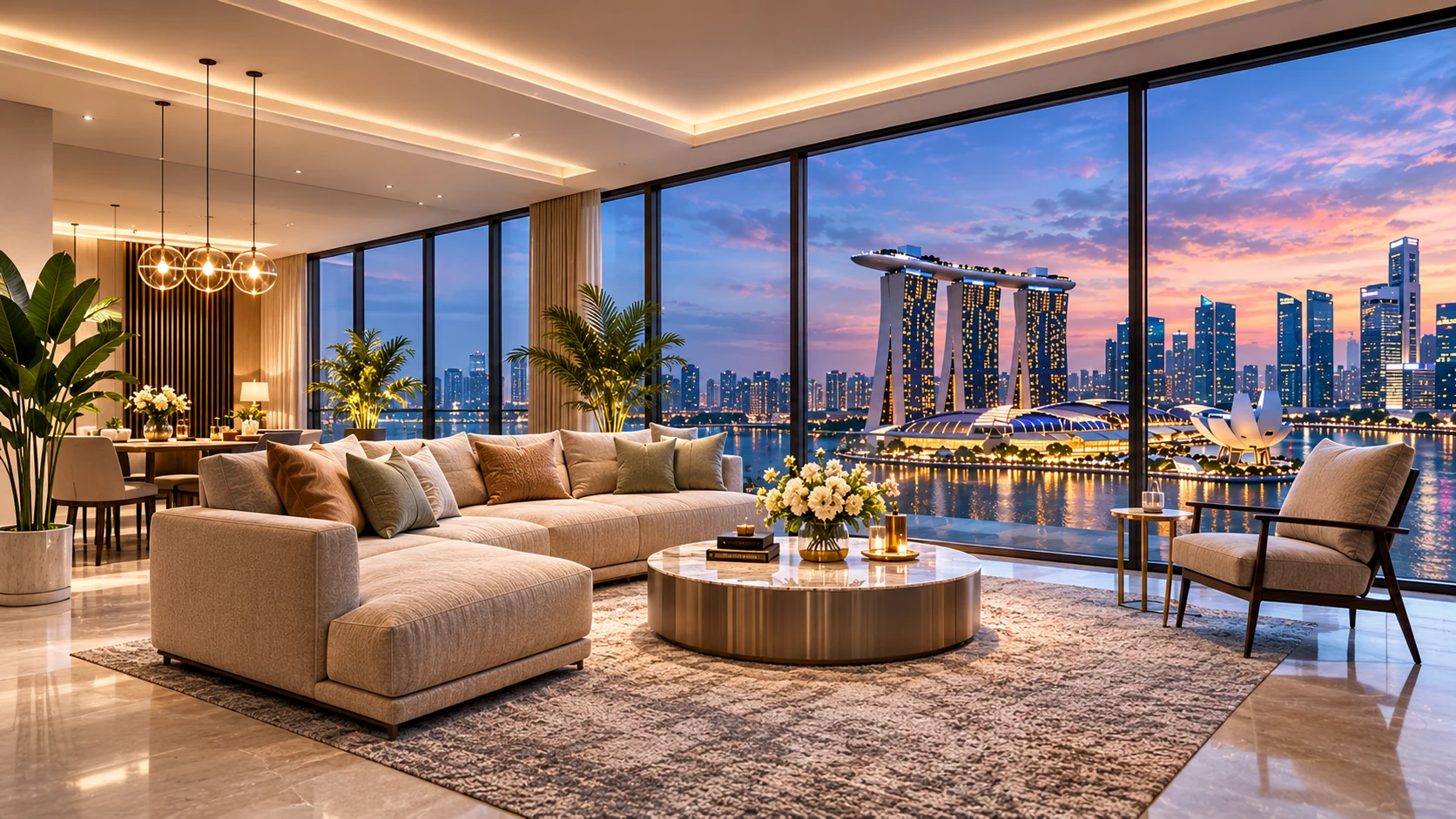
The following is a hypothetical planning scenario based on typical project parameters for a Singapore residential walkthrough commission. It is intended to illustrate how scope, cost and timeline interact — not to represent a specific client project.
The scenario: A developer launching a mid-rise residential development in central Singapore requires a 3D walkthrough of their 3-bedroom show unit for the pre-sales campaign. The developer has allocated a separate budget for the physical show-unit fit-out; the walkthrough budget is assessed independently based on the visualisation scope and required deliverables. The developer wants the 3D walkthrough ready six weeks before the physical unit is complete, so marketing can begin ahead of the launch event.
What the studio would need:
Architectural drawings (floor plans, elevations, reflected ceiling plan)
Interior design specification with material codes
Furniture schedule from the ID firm
Brand guidelines for title cards and end frame
Spaces covered:
Living and dining area
Master bedroom with en-suite bathroom
Second bedroom
Kitchen with island
Balcony overlooking the development's landscaped deck
Typical deliverables for this scope:
2 minute 30 second to 3 minute walkthrough video in 4K resolution
30-second social cut-down for Instagram and LinkedIn
15-second teaser for digital advertising
Two rounds of revisions
Indicative walkthrough budget: SGD 12,000–16,000 Indicative production timeline: 4–6 weeks from brief to final delivery
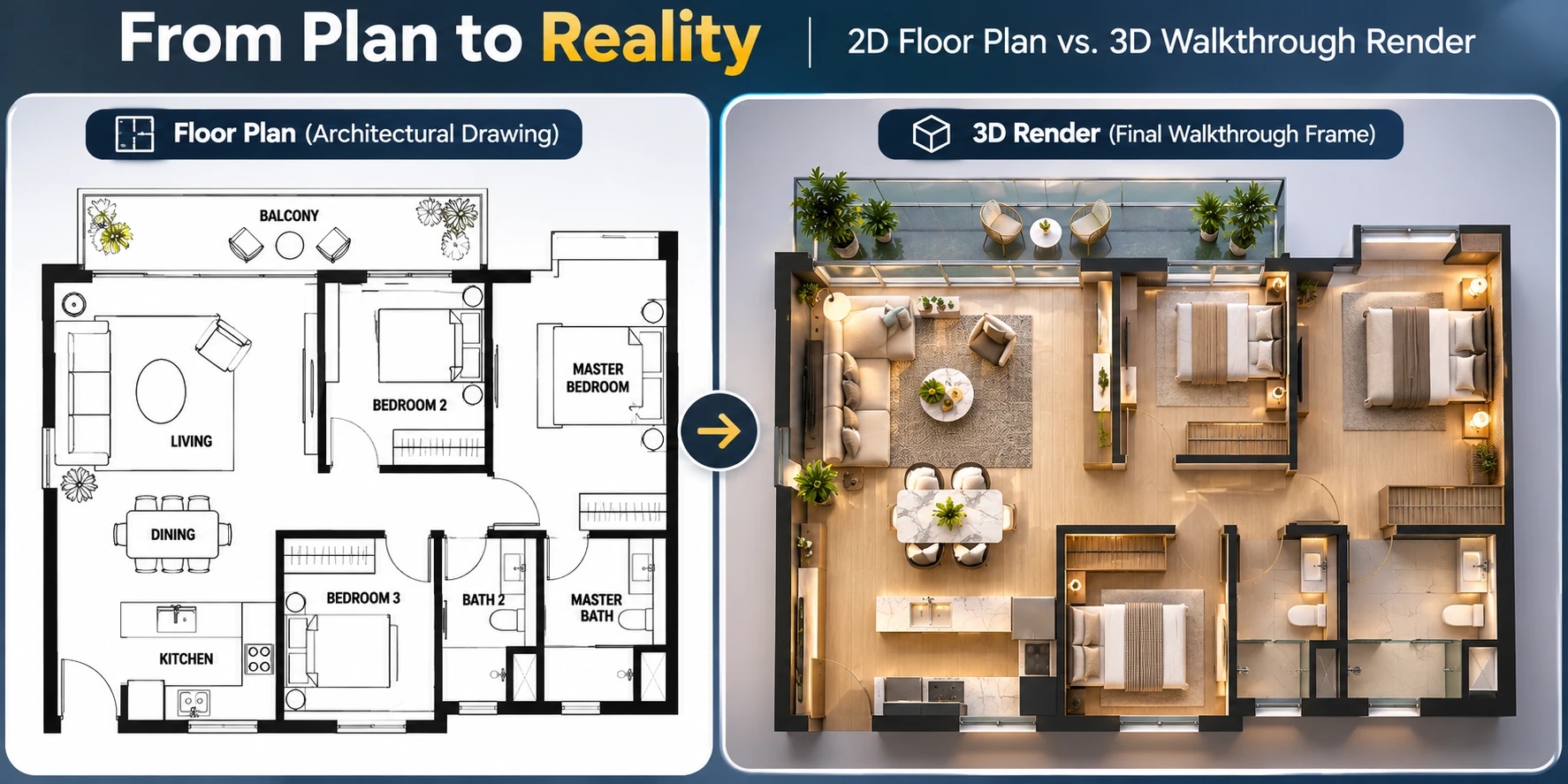
This is a mid-range project scope for Singapore. The pricing reflects the number of spaces, the level of furniture and material detail, and the post-production package. The main pricing table shows SGD 2,000–8,000 for a 1–2 room interior — the lower end of that range covers short videos with standard post-production, while a fully styled 1-bedroom unit with a complete marketing finish sits toward the upper end. A full development scope — aerial, exterior and multiple unit types — moves into SGD 25,000 and above.
Understanding Construction Costs vs. Walkthrough Costs
One of the most useful ways to frame 3D walkthrough pricing is against the construction cost of what you're marketing.
In the scenario above, the physical show unit fit-out is estimated at SGD 180,000. The 3D walkthrough budget falls between SGD 12,000–16,000 — roughly 7–9% of the show unit cost. That walkthrough would typically be used in the pre-sales campaign, on the developer's website, at the launch event, across social media and in overseas buyer presentations — while the physical unit has a limited display window before handover.
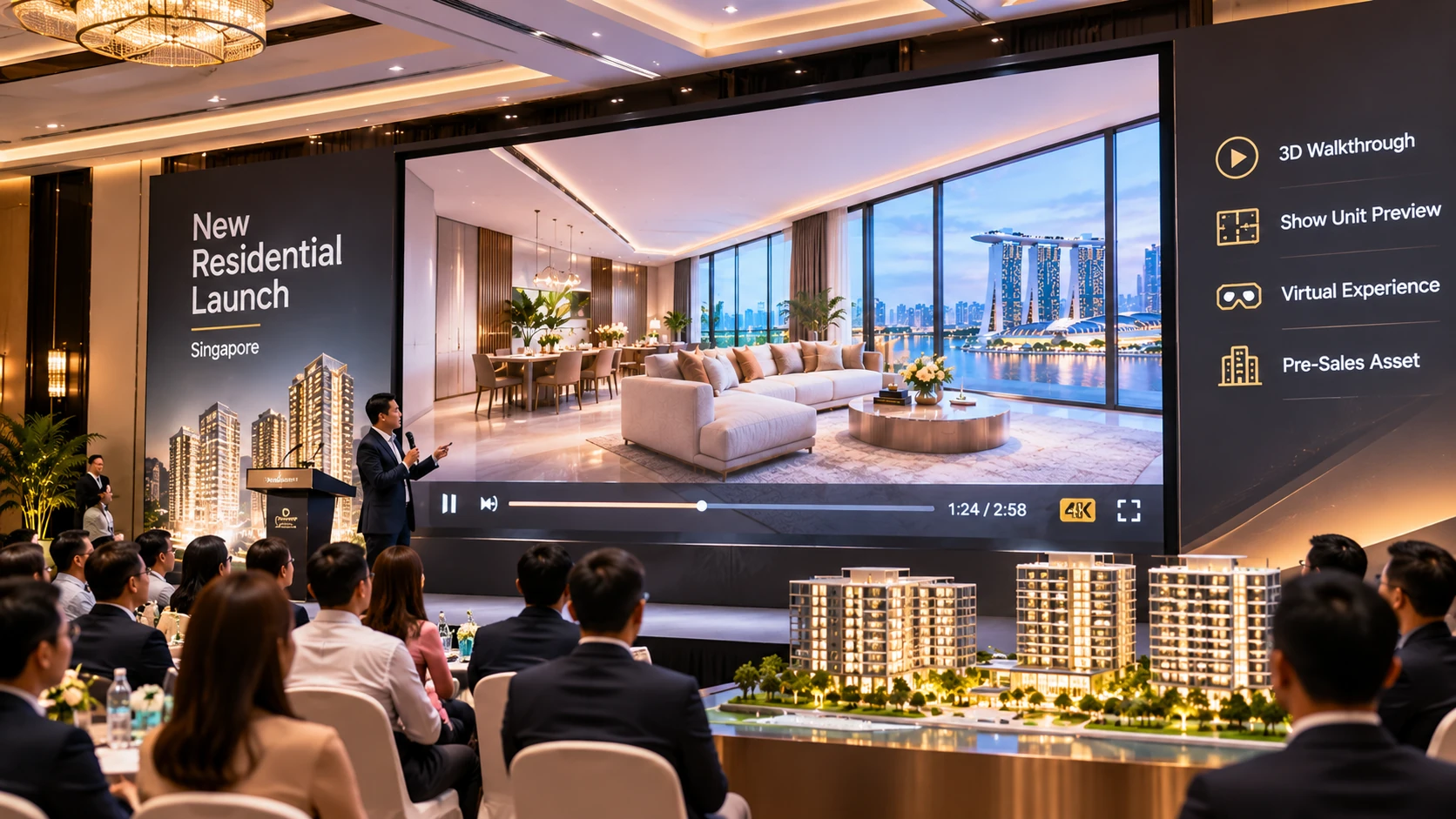
The point is not that walkthrough costs scale with construction costs — they don't. Walkthrough pricing depends on scope, animation duration, number of spaces, modelling complexity and post-production requirements. What the comparison illustrates is that most clients who commission a walkthrough are spending a relatively small fraction of their physical marketing or build budget on a visual asset that works across every channel they use.
The Production Process: 8 Stages
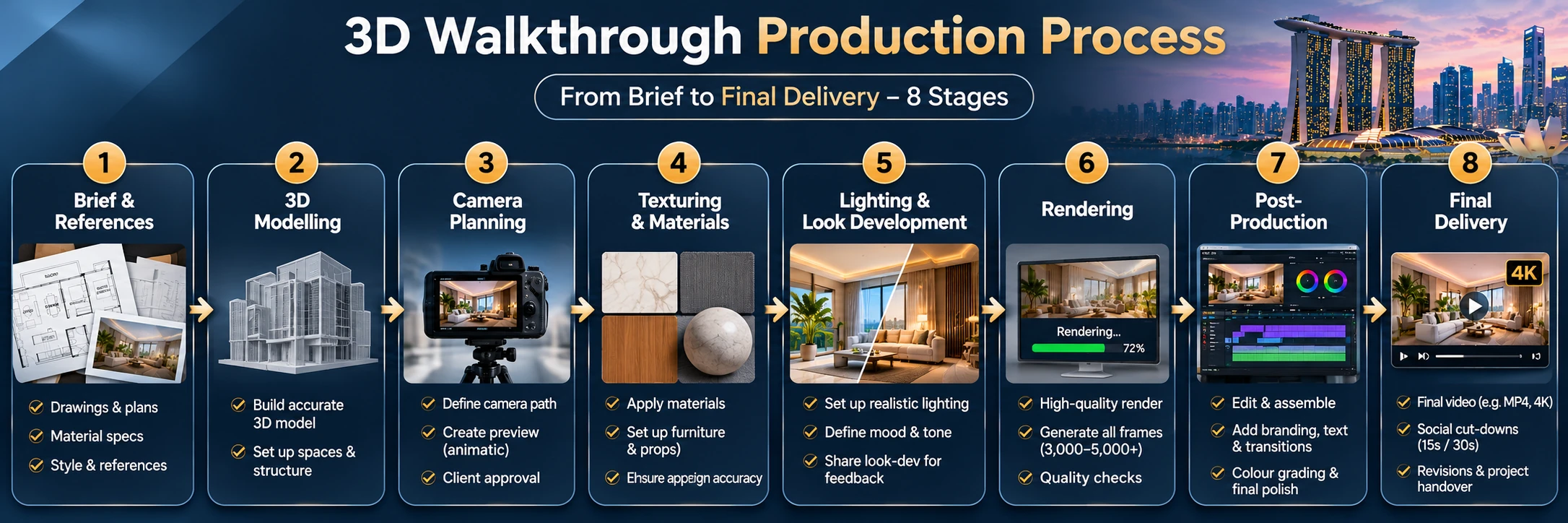
Here is what happens between your brief and your finished video.
Stage 1 — Brief and reference collection The studio needs architectural drawings (floor plans, elevations, sections), material specs, furniture references and mood images. The more complete this package is at the start, the fewer revision cycles later.
Stage 2 — 3D modelling Your space is built as a 3D model from the drawings. Based on our production experience, a standard 3-bedroom apartment unit typically takes 5–8 working days to model, depending on drawing quality and detailing. A full tower exterior with podium and landscaping can take 2–3 weeks.
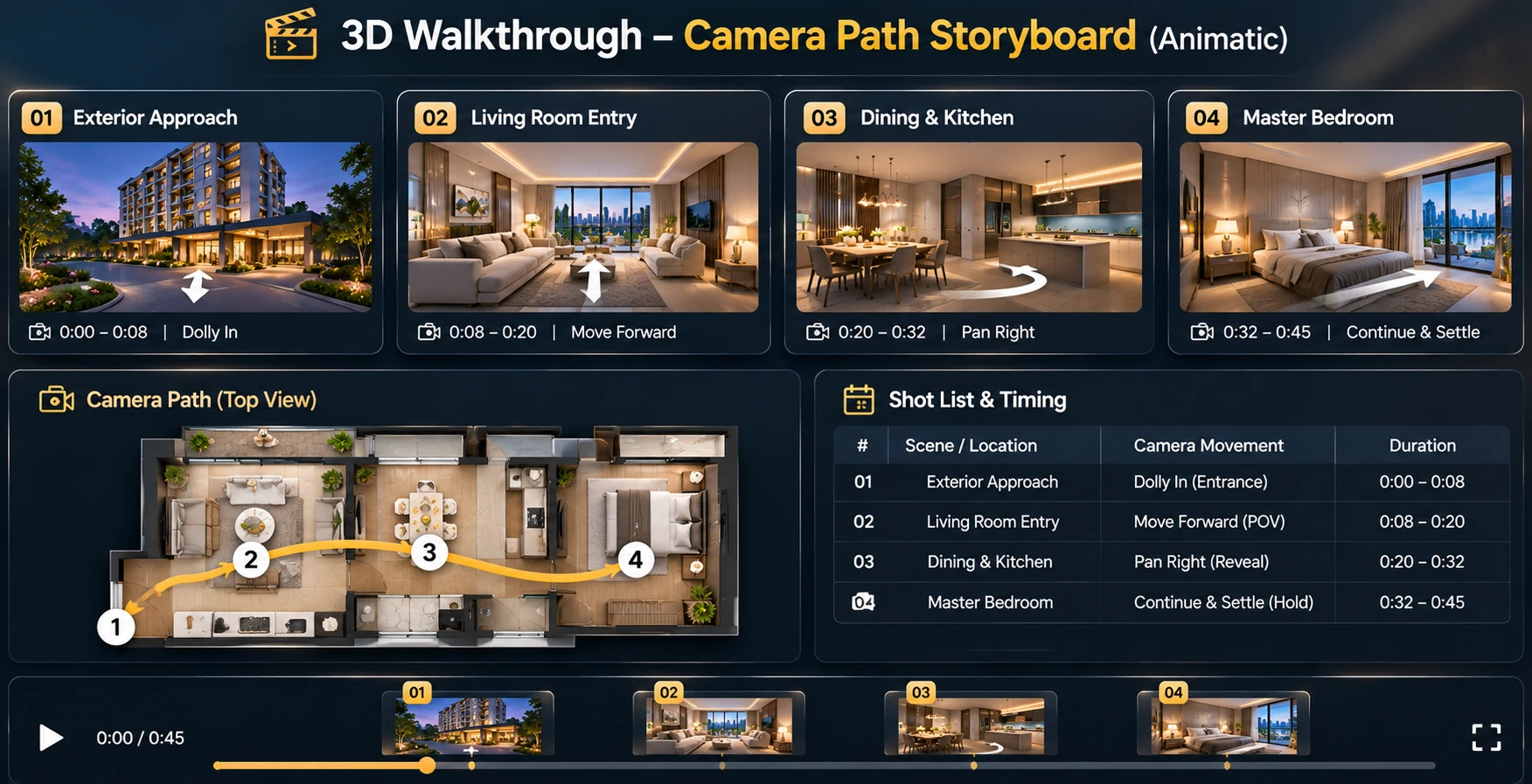
Stage 3 — Camera path and storyboard The studio maps the camera route — entry point, movement through each space, what it pauses on, exit. This is presented for approval before any texturing or lighting begins. Once approved, camera-path changes that require rework of texturing, lighting or animation will affect both timeline and cost. Approve it carefully here.
Stage 4 — Texturing and material application Surfaces are assigned materials — timber flooring, stone countertops, painted walls, glass balustrades, fabric upholstery. Each material is matched to your specification documents. Inaccuracies here are the most common cause of revision requests.
Stage 5 — Lighting setup Lighting is designed, not automatic. A north-facing Singapore unit at 4pm has a fundamentally different quality of light than a west-facing one at golden hour. The studio uses your unit orientation and the design mood references to set the lighting before rendering begins.
Stage 6 — Animation and rendering The camera path is animated and frames are rendered at high resolution — a 2–3 minute walkthrough typically produces 3,000–5,000 individual frames based on our standard frame rates. Render times depend on scene complexity and output quality.
Stage 7 — Post-production Colour grading, music, sound design, title cards, branding and any voiceover. This is where the technical output becomes a finished marketing video.
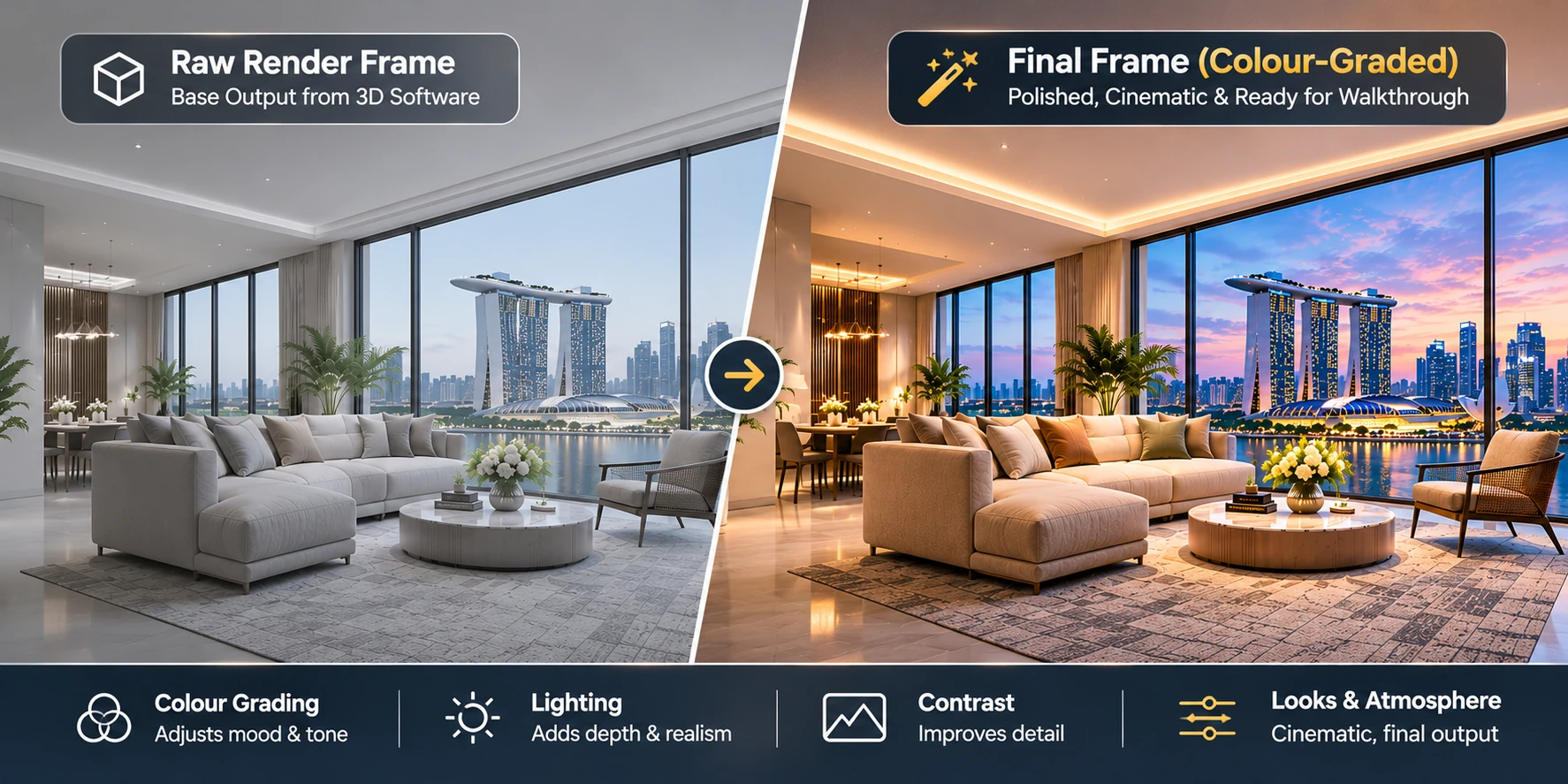
Stage 8 — Review and delivery Client review against the agreed brief. Revisions within the agreed scope. Final delivery in required formats.
Indicative Pricing for Singapore Projects
These are planning budgets, not verified market averages. Request itemised quotes based on your actual scope, spaces, animation duration and delivery requirements.
The illustrative scenario above (SGD 12,000–16,000) sits within the broader three-to-four-room range. The final quote depends on animation duration, custom modelling requirements, material detail level, camera movements and the number of deliverables included in the package.
Scope | Planning Budget |
|---|---|
1–2 room interior, short video | SGD 2,000–8,000 |
3–4 room show unit, full marketing video | SGD 8,000–20,000 |
Exterior + interior combined | SGD 15,000–30,000 |
Full development (aerial + exterior + multiple units) | SGD 30,000–60,000+ |
Variables that move the price:
Total video duration
Number of spaces covered
Furniture detail level (custom modelled vs. library assets)
Number of revision rounds included
Post-production scope (music, voiceover, social cut-downs)
Rush timeline vs. standard lead time
How Long Does It Take?
Scope | Indicative Timeline |
|---|---|
1–2 room interior | 2–3 weeks |
3–4 room show unit | 4–6 weeks |
Exterior + interiors | 6–9 weeks |
Full development scope | 10–16 weeks |
Actual timelines depend on drawing completeness, revision scope, feedback turnaround and studio availability. Confirm lead times before finalising your project schedule.
If you have a fixed launch date, work backwards from it and allow at least 10–12 weeks for a full-scope project. Brief the studio before the drawings are finalised if possible — early briefings allow the studio to flag information gaps before they delay production.
What a Quote Should Include
When you receive a quote, check it covers all of the following. If it doesn't, ask before signing.
Total video duration (minutes and seconds)
Each space covered (list them individually)
Number of revision rounds and at which stages
What counts as a revision vs. a scope change
Whether post-production (music, grading, titles) is included
Social cut-down formats and lengths, if needed
Delivery formats and resolution specifications
Milestone dates and final delivery date
Payment schedule
How to Choose the Right Studio
Match the portfolio to your project type. An excellent product animation studio may not have the architectural depth a residential development requires. Look for work that shows comparable space types — furnished interiors, property launches, architectural scale — not just technically impressive animation of unrelated subjects.
Ask about the production workflow. How many people work on your project? Who handles modelling vs. lighting vs. post-production? Studios with a clear, structured workflow tend to run more predictable projects.
Check revision terms before you brief. How many rounds are included? Do camera-path changes after Stage 3 incur additional charges? What happens if the material specifications change mid-production? These questions are much easier to answer before the project starts than after.
Look at the brief they ask for. A studio that asks detailed questions about your unit orientation, target buyer, launch format and delivery requirements is thinking about your project properly. One that asks only for drawings and a budget is not.
Consider studios beyond Singapore. Some developers commission 3D walkthrough work from specialist studios in India and across Asia. The brief, milestone reviews and delivery can be managed digitally — though time zones, project management arrangements and communication responsiveness are worth assessing before committing. What matters most is portfolio quality, process clarity and whether the studio's experience matches your project type.
Common Mistakes to Avoid
Sending drawings before they're finalised. Changes to the floor plan after modelling begins mean rework. If your drawings are still live, say so upfront.
Approving the camera path without the full decision-making team. Changing the sequence after texturing is underway is expensive and delays delivery.
Treating post-production as an afterthought. Music, colour grading and social cut-downs should be scoped at brief stage. Adding them after delivery costs more and takes longer.
Leaving the brief too late. A 5-week production timeline doesn't compress to 2 weeks because the launch date moved. Brief the studio early, even if the drawings are still in progress.
FAQ
Can a 3D walkthrough be made before construction starts?
Yes. This is one of the primary reasons developers commission them. The walkthrough is built from your architectural drawings and specifications — not from the physical site.
What file formats are typically delivered?
MP4 is commonly used for web, social and digital campaigns. Higher-quality formats such as MOV may be available for event screens or broadcast. Confirm your delivery requirements at briefing stage — formats vary by studio and package.
How many revision rounds should I expect?
Revision allowances vary between studios and packages. Ask how many rounds are included, which production stages they cover, and whether structural changes (camera path, space selection) incur additional charges.
Can I get shorter cuts for social media?
Many studios can produce shorter edits alongside the main walkthrough for Instagram, LinkedIn or YouTube. Commissioning these at brief stage may be more cost-effective than requesting them separately after final delivery.
What's the difference between a 3D rendering and a 3D walkthrough?
A rendering is a single static image. A walkthrough is thousands of rendered frames assembled into a video — the camera moves through the space rather than capturing one fixed view.
What if my drawings change during production?
Inform the studio immediately. Minor changes (material updates, furniture swaps) can often be absorbed within revision rounds. Structural changes (wall positions, room layouts) will likely affect the timeline and cost. Establish a change-management process at briefing stage.
Working with Chasing Illusions
Chasing Illusions produces 3D architectural walkthroughs and visualization work for developers, architects and design firms across India, Southeast Asia and the Middle East. Our clients include Mitsubishi Electric, Rolls Royce and Hindalco.
If you have a Singapore project brief — pre-sales launch, show unit, commercial development or investor presentation — share your drawings and scope with us at chasingillusions.com.
Have a launch date and drawings in hand? Get in touch and we'll tell you what's achievable within your timeline and budget.
Chasing Illusions Studio
Premium animation & video production studio based in Delhi, India. Specialising in 3D animation, medical visualisation, architectural walkthroughs, and CGI.