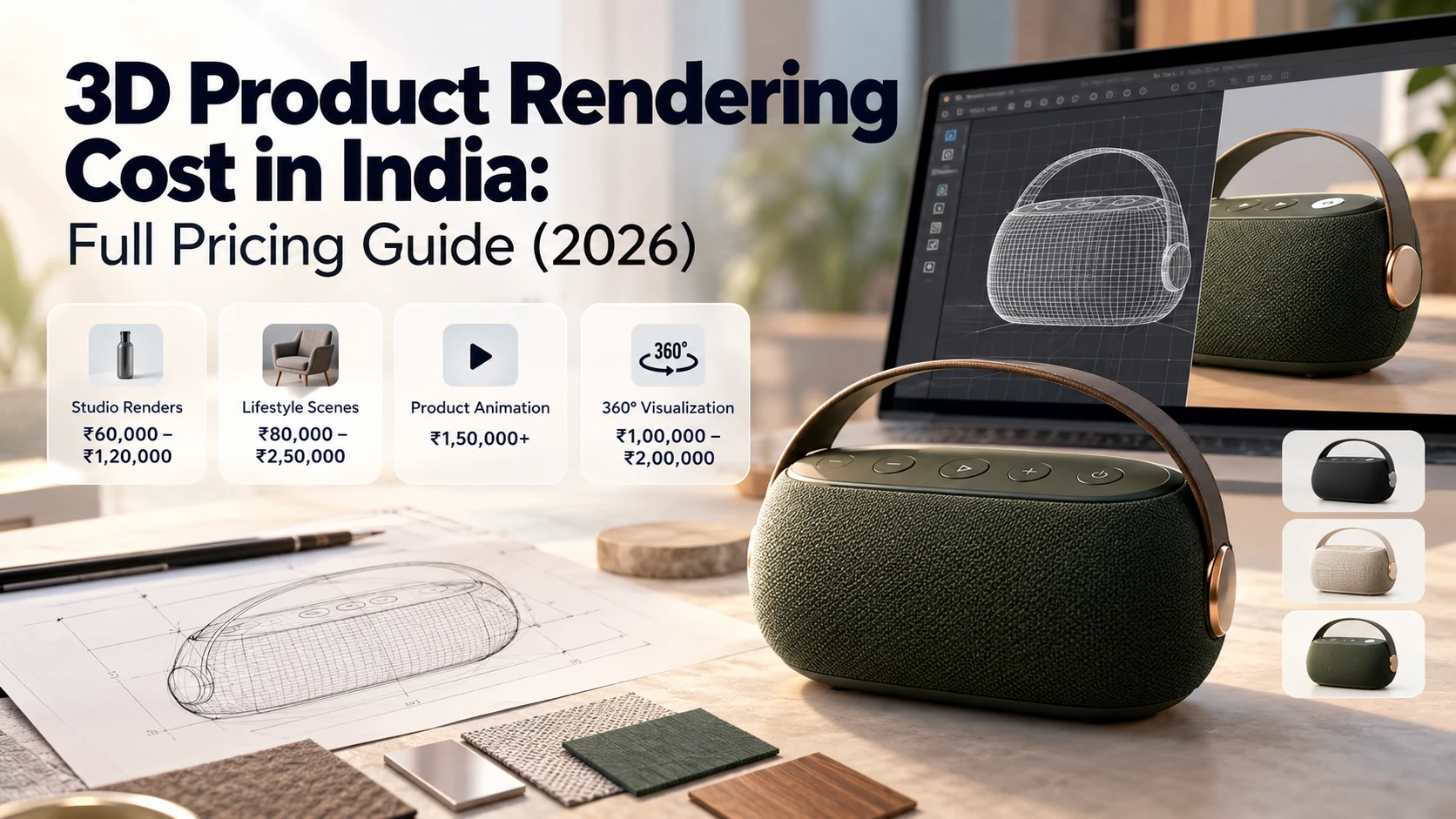
At Chasing Illusions Studio, a standard 3D product rendering package typically costs ₹60,000–₹1,20,000 for 3–5 studio images of a single product configuration. Lifestyle scenes, animations, and multi-variant campaigns are priced separately according to scope.
That range answers the first question most buyers ask. But the more useful question is: why does the cost sit where it does, and what changes it?
This guide breaks down exactly that — what each factor contributes to the final cost, how the production process maps to those costs, and what realistic pricing looks like across different output types. All figures reflect India-based studio production at professional quality.
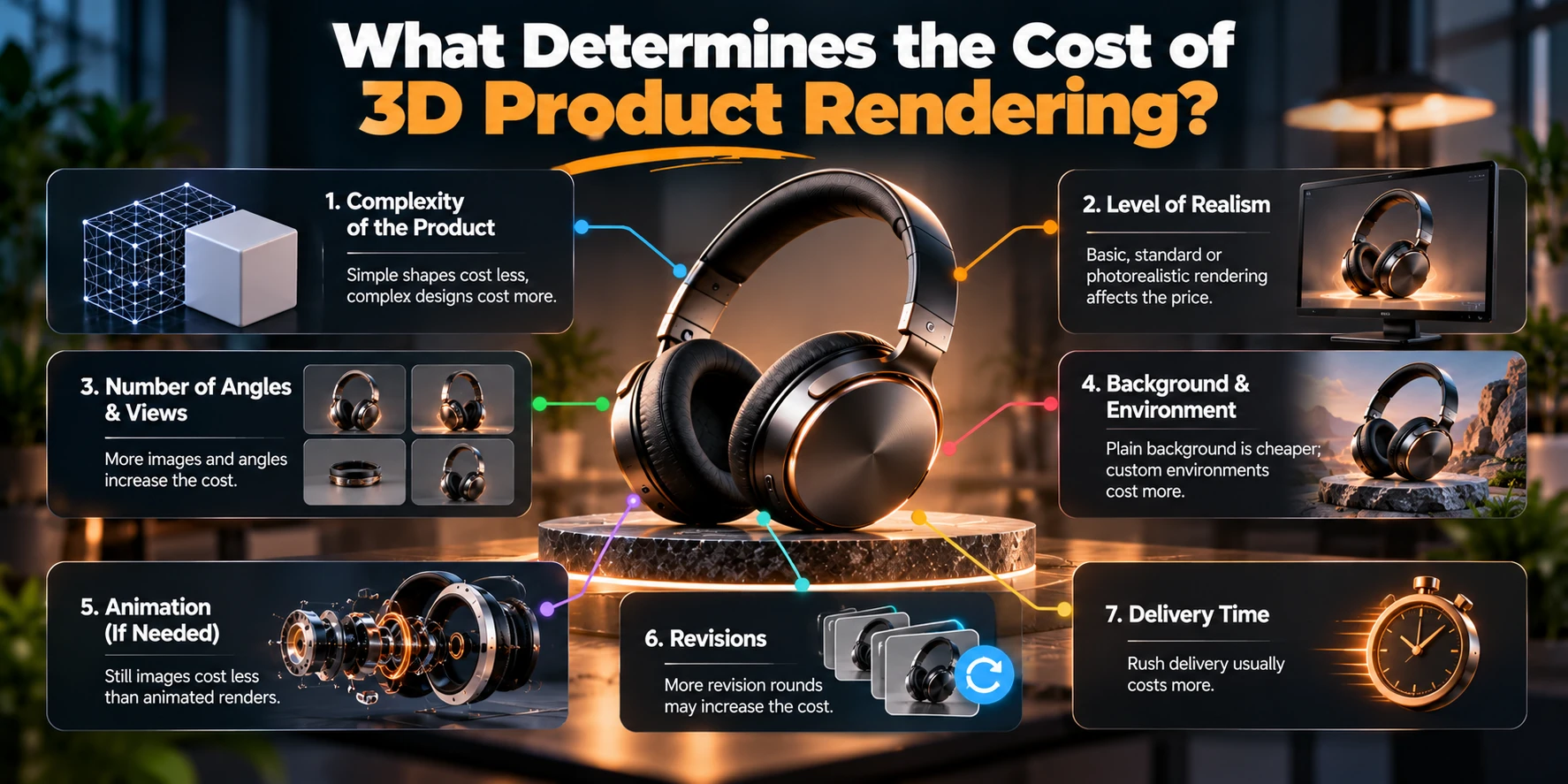
What Determines the Cost of 3D Product Rendering?
Eight factors drive the price of any product rendering project. Understanding each one helps you scope your brief more accurately and compare quotes from different studios on equal terms.
1. Product Complexity
The single biggest cost driver is how much geometry a product contains. A product with a uniform surface and clean lines — a water bottle, a candle, a plain electronics enclosure — is relatively straightforward to model. A product with intricate mechanical components, fine surface detailing, perforated materials, fabric texture, or transparent parts requires significantly more modelling time.
Example: A matte-finish wireless speaker with a fabric grille, buttons, and ports is a moderately complex product. A hydraulic industrial valve with internal seals, thread geometry, and metal hardware is in a different complexity tier entirely.
2. Availability of 3D Model or CAD Files
If your product already has a usable CAD file, engineering drawing, or existing 3D model, the production team may be able to build on it rather than constructing the model from scratch. This can reduce the modelling stage of the project.
If your only inputs are photographs from different angles, the studio must reconstruct the product's geometry from visual reference. This is achievable for most products but adds to the initial setup cost.
Important: Not all CAD files are ready for rendering. Files optimized for engineering or manufacturing often need preparation and clean-up before they can be used in a visualization workflow.
3. Number of Images and Camera Angles
Each additional camera angle requires its own composition setup, rendering pass, and quality check. A standard deliverable of 3–5 angles — front, side, three-quarter, rear — sits within the base pricing range. Projects requiring 8, 10, or 15+ angles are priced at a higher scope.
4. Number of Product Variants
Once the base model is built and approved, producing additional color or finish variants requires material changes rather than rebuilding the entire product. This means variant costs are typically lower than the base setup — but each still requires material adjustments, review, and quality control.
Example: A speaker available in matte black, silver, and forest green can reuse the same approved geometry. The additional variants cost less per set than the initial setup, but the more variants you add, the higher the total project cost.
5. Lighting and Background Complexity
A clean studio render — the product against a white or neutral background with controlled lighting — is less complex to produce than a lifestyle scene. Lifestyle renders place the product in a realistic environment: a kitchen countertop, a living room, a retail shelf. They require set design, environment modelling or sourcing, and more complex lighting setups.
Output type | Environment complexity |
|---|---|
Studio render | White/gradient background, controlled lighting |
Contextual render | Simple props and surface |
Lifestyle scene | Full room or environment, styled set |
Outdoor or location render | Exterior environment, sky, surface textures |
6. Level of Realism Required
High-quality photorealistic output — where the render is indistinguishable from professional photography at product listing resolution — requires longer rendering times, more refined material work, and additional post-production. Technical renders or concept-stage visuals for internal review can be produced at a lower quality tier and correspondingly lower cost.
7. Revisions and Scope Changes
Professional studios typically include one or two structured revision rounds within the base scope. Additional rounds, or material changes to the brief after production has begun, can increase the final cost. Clear references and consolidated feedback at key review stages — grey model, lighting proof, final render — help manage avoidable rework.
8. Animation and Additional Output Formats
Static rendered images require a different production workflow than animation, 360-degree spins, or interactive web assets. Product animation requires motion planning, animation setup, scene preparation, and rendering of the required frames. These additional production stages are quoted separately from static images and are not included in a standard render scope.
3D Product Rendering Cost by Service Type (India, 2026)
The table below shows indicative pricing for India-based production at professional quality. Each range reflects standard deliverables — modelling, materials, lighting, rendering, and one revision round.
The figures below are indicative estimates based on Chasing Illusions Studio's production experience and reflect the scope described in each row. Actual quotes depend on product complexity, available references, and specific project requirements. Each range assumes standard modelling, materials, lighting, rendering, and one round of revisions unless stated otherwise.
Service | What's included | Cost Range (INR) | Cost Range (USD) |
|---|---|---|---|
Studio product render | 3–5 final angles, single configuration, white/neutral background, one revision round | ₹60,000 – ₹1,20,000 | $700 – $1,500 |
360° product spin | Full-rotation rendered image sequence delivered as a web-ready interactive viewer; single configuration | ₹90,000 – ₹2,00,000 | $1,100 – $2,500 |
Additional color/finish variant | Per variant package (same angles as base set) from an approved existing model; new material setup and one revision round included | ₹15,000 – ₹40,000 per variant | $200 – $500 per variant |
Lifestyle product render | Product placed in a styled environment; one scene per price; scene complexity affects where cost falls within the range | ₹80,000 – ₹2,50,000 per scene | $1,000 – $3,000 per scene |
Exploded-view animation | Internal components visualized separating outward; 30–60 sec rendered animation | ₹1,50,000 – ₹4,00,000 | $2,000 – $5,000 |
Product feature animation | Product in use or feature highlight; 15–30 sec rendered animation | ₹1,20,000 – ₹3,00,000 | $1,500 – $4,000 |
Interactive web configurator | Real-time variant switching in browser; scope and option count determine cost | ₹4,00,000 – ₹12,00,000 | $5,000 – $15,000 |
Note on INR vs USD pricing: India-based studios quoting in INR and international studios quoting in USD reflect different market tiers and overhead structures. These are not currency conversions of the same deliverable. Always confirm what is included in any quote — modelling, materials, revisions, file formats, and usage rights — before comparing across studios.
The Production Process and Where Cost Accumulates
Understanding how production works helps explain why costs sit where they do. Each stage contributes to the final price.
The following example traces a real-world product type through the production workflow. It is an illustrative example and not a completed Chasing Illusions client project.
Example: A Cosmetics Brand Launching a Serum Bottle
A skincare brand is preparing to launch a new serum. The product is a 30ml glass bottle with a gold metal dropper cap, embossed brand name, and a frosted glass finish. They need 4 product angles, 2 lifestyle renders, and one additional color variant (clear glass version).
Production Stage | What Happens | Cost Contribution |
|---|---|---|
1. Brief and References | Studio receives bottle dimensions, label artwork, embossing details, material specs, and lifestyle mood references. Creative brief is approved. | Low — but incomplete references at this stage cause rework later. |
2. 3D Modelling | Artist builds the glass bottle geometry, dropper mechanism, metal cap, and embossed surface detail. Frosted glass material is a technically complex material requiring specific simulation. | Medium-high — glass geometry with surface detail and a complex material (frosted + transparent) takes longer than a matte solid product. |
3. Materials and Texturing | Frosted glass shader is created and refined. Gold metallic finish is applied to the cap. Label artwork is mapped onto the bottle surface with correct placement and curvature. | Medium — multiple distinct materials, each needing individual calibration. |
4. Lighting and Scene Setup | Studio lighting is configured to reveal the glass quality, frosted finish, and gold detail. Clean white background set for product angles. Two lifestyle environments — a marble bathroom surface and a skincare flatlay — are set up separately. | Medium-high — lifestyle environments require additional set design and scene preparation. |
5. Rendering | Four product angles are rendered at high resolution. Two lifestyle scenes are rendered. | Low-medium in isolation — rendered at the end, but render time reflects all the setup preceding it. |
6. Post-Production | Colour correction, cleanup, shadow refinement, label verification, and format export. | Low — finishing work on a clean render is manageable. |
7. Variant | Frosted glass material replaced with clear glass for the alternative version. Same geometry and scene setup reused. 4 angles rendered for the clear variant. | Low-medium — geometry reuse reduces setup; new material calibration for clear glass is the main work. |
Estimated total scope breakdown:
Deliverable | Indicative range |
|---|---|
Studio renders — 4 angles, frosted glass bottle | ₹1,00,000 – ₹1,20,000 |
Lifestyle render 1 — marble bathroom surface | ₹80,000 – ₹1,20,000 |
Lifestyle render 2 — skincare flatlay | ₹80,000 – ₹1,20,000 |
1 color variant — clear glass, 4 angles from approved model | ₹20,000 – ₹40,000 |
Total | ₹2,80,000 – ₹4,00,000 |
The final cost depends on lifestyle scene complexity, revision rounds, and the effort required for clear glass material calibration. These are indicative estimates, not a fixed quote.
How Product Complexity Changes the Price: Three Products Compared
Product | Complexity | Typical Studio Render Cost (3–5 angles) |
|---|---|---|
Matte-finish water bottle, single color, no label | Simple | ₹60,000 – ₹80,000 |
Wireless speaker with fabric grille, buttons, ports | Moderate | ₹80,000 – ₹1,10,000 |
Glass skincare bottle with embossing, frosted finish, metal cap | Moderate-high | ₹1,00,000 – ₹1,20,000 |
Industrial machine component with internal geometry | Complex | ₹1,50,000 – ₹3,00,000+ |
Consumer electronics product with fine surface detail, branding, multiple ports | High | ₹1,20,000 – ₹2,00,000+ |
These are indicative ranges. The actual cost for any product depends on the final project scope, available references, and studio-specific pricing.
What Is Included vs. What Costs Extra
Before accepting any quote, confirm what is and isn't included. This varies significantly between studios.
Typically included in a standard scope:
3D modelling from provided references
Material and texture creation
Lighting and scene setup
Rendering at agreed specifications
One revision round
Final delivery in agreed file formats
Commonly priced separately:
Additional revision rounds beyond the included scope
New variants from an approved base model
Lifestyle environments or set dressing
Animation from static renders
AR-ready asset export (USDZ, GLB)
Source file transfer or model ownership
Commercial usage rights for extended distribution
Urgent turnaround or expedited production
Ask for a clear scope document before production begins. Ambiguity about revisions and what counts as a "change" is the most common source of unexpected costs.
3D Product Rendering vs. Traditional Photography: The Cost Comparison
Scenario | Traditional Photography | 3D Rendering |
|---|---|---|
Single product, 4 angles, white background | ₹15,000 – ₹50,000 (studio day rate + editing) | ₹60,000 – ₹1,20,000 (includes modelling) |
Same product, 10 color variants | Multiple variants may require additional product preparation, setup, and retouching per session; incremental cost depends on how many variants can be photographed together | Material changes from existing model at ₹15,000–₹40,000 per variant package |
Pre-launch (product not yet manufactured) | Usually unavailable until a physical prototype or product sample exists | Full rendering from CAD or design references |
Lifestyle scene | Studio hire, props, stylist, photographer | ₹80,000 – ₹2,50,000 per scene |
Annual update (new finish, new label) | May require a new shoot or retouching, depending on the change | Model update and re-render — lower cost than rebuilding |
At small catalog sizes with simple products, photography can be more cost-effective. As the number of variants, the frequency of updates, or the need for pre-launch content increases, 3D rendering becomes more economical over time.
For a full comparison of when each format makes sense, see the 3D product rendering vs traditional photography guide.
Typical Project Timelines
The timelines below are indicative estimates based on our studio's production workflow. Actual delivery depends on model complexity, availability of references, number of revision rounds, and approval speed at each stage.
Deliverable | Indicative Timeline |
|---|---|
Studio render set (3–5 angles) | 5–10 working days |
Additional variant from approved model | 2–3 working days |
360° product spin (image sequence + web viewer) | 7–12 working days |
Lifestyle render | 7–14 working days |
Product feature animation (15–30 sec) | 3–5 weeks |
Exploded-view animation | 4–6 weeks |
Interactive web configurator | 6–10 weeks |
Incomplete briefs, delayed feedback, or scope changes during production extend delivery time. Clear references and consolidated feedback at each review stage keep projects on schedule.
Frequently Asked Questions
How much does 3D product rendering cost in India?
A standard set of 3–5 studio renders for a single product typically costs ₹60,000–₹1,20,000 at professional quality. More complex scopes — lifestyle scenes, animations, or multi-variant campaigns — are priced based on the specific project requirements.
Why is 3D rendering more expensive than photography for a single product?
The initial cost of 3D rendering includes building a reusable digital model — an asset that doesn't exist in traditional photography. Once the model exists, the economics change: additional variants, angles, and formats can be produced from the same asset without a new photoshoot. The comparison shifts in 3D's favour as the catalog grows and the model is reused.
What do I need to provide to get an accurate quote?
A studio needs to know: product dimensions and geometry, available reference material (photographs, CAD files, physical samples), required number of angles and variants, intended use and platform specifications, and whether lifestyle environments or animation are needed. The more complete your brief, the more accurate the quote.
Can I own the 3D model after the project?
This depends on the studio's contract terms. Some studios transfer source file ownership on request, sometimes for an additional fee. Others retain the model but license usage of the rendered outputs to the client. Confirm model ownership terms before the project begins.
Is 3D rendering useful for pre-launch products?
3D rendering is a useful option for pre-launch visualization when accurate product dimensions, CAD files, or design references are available. In that context, the cost is compared against waiting for manufacturing or proceeding without product visuals, not against photography cost.
How many revision rounds are included?
The number of revision rounds depends on the agreed project scope. Chasing Illusions Studio's standard package includes one structured revision round. The most efficient approach is to provide consolidated feedback at the grey model stage (before materials are applied) and the lighting proof stage (before final rendering). Changes requested at the final render stage take more time to implement.
Can 3D renders be used on Amazon main image listings?
3D renders can be used for product marketing and supplementary images. Eligibility for the main listing image depends on Amazon's current category-specific requirements — confirm the applicable rules before using CGI as the primary listing image.
Work With Chasing Illusions Studio
Chasing Illusions Studio is a full-service animation and visualization company with operations in Delhi, the USA, and Thailand. Our product rendering team works with e-commerce brands, FMCG manufacturers, and marketing agencies across India, the UK, and North America — with clients including Tata, Bayer, Novartis, Vivo Mobile, and McDonald's. Our 80-plus in-house artists cover the full range from clean studio renders to lifestyle scenes, product animations, and interactive web configurators.
Book a free 20-minute product rendering consultation to discuss your product scope, timeline, and deliverables.
📞 +91-9910911696 | +91-9910660851
Also read:
Chasing Illusions Studio
Premium animation & video production studio based in Delhi, India. Specialising in 3D animation, medical visualisation, architectural walkthroughs, and CGI.