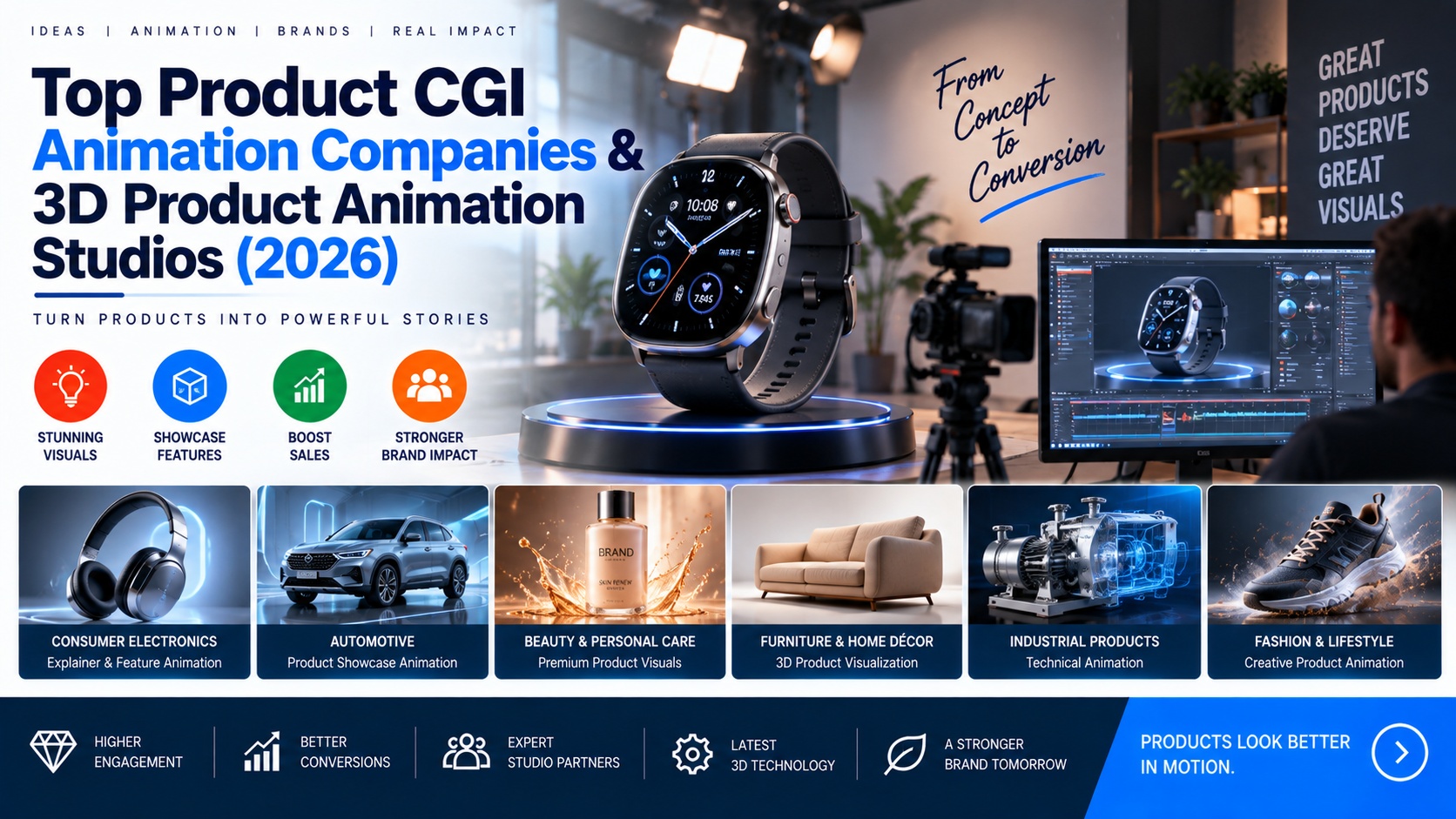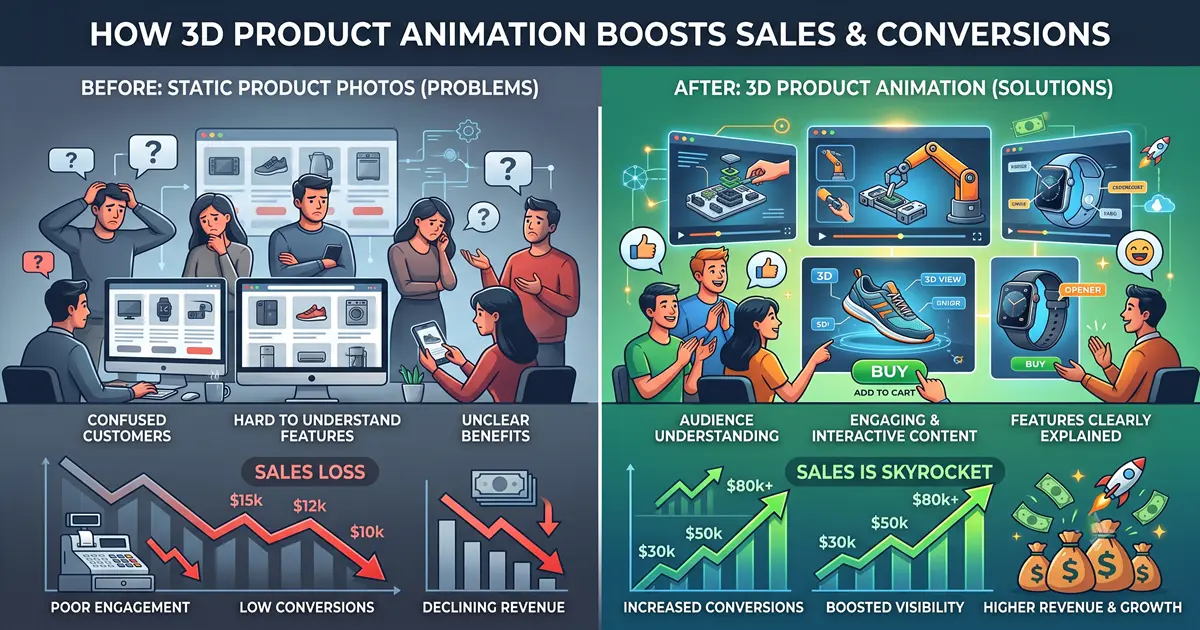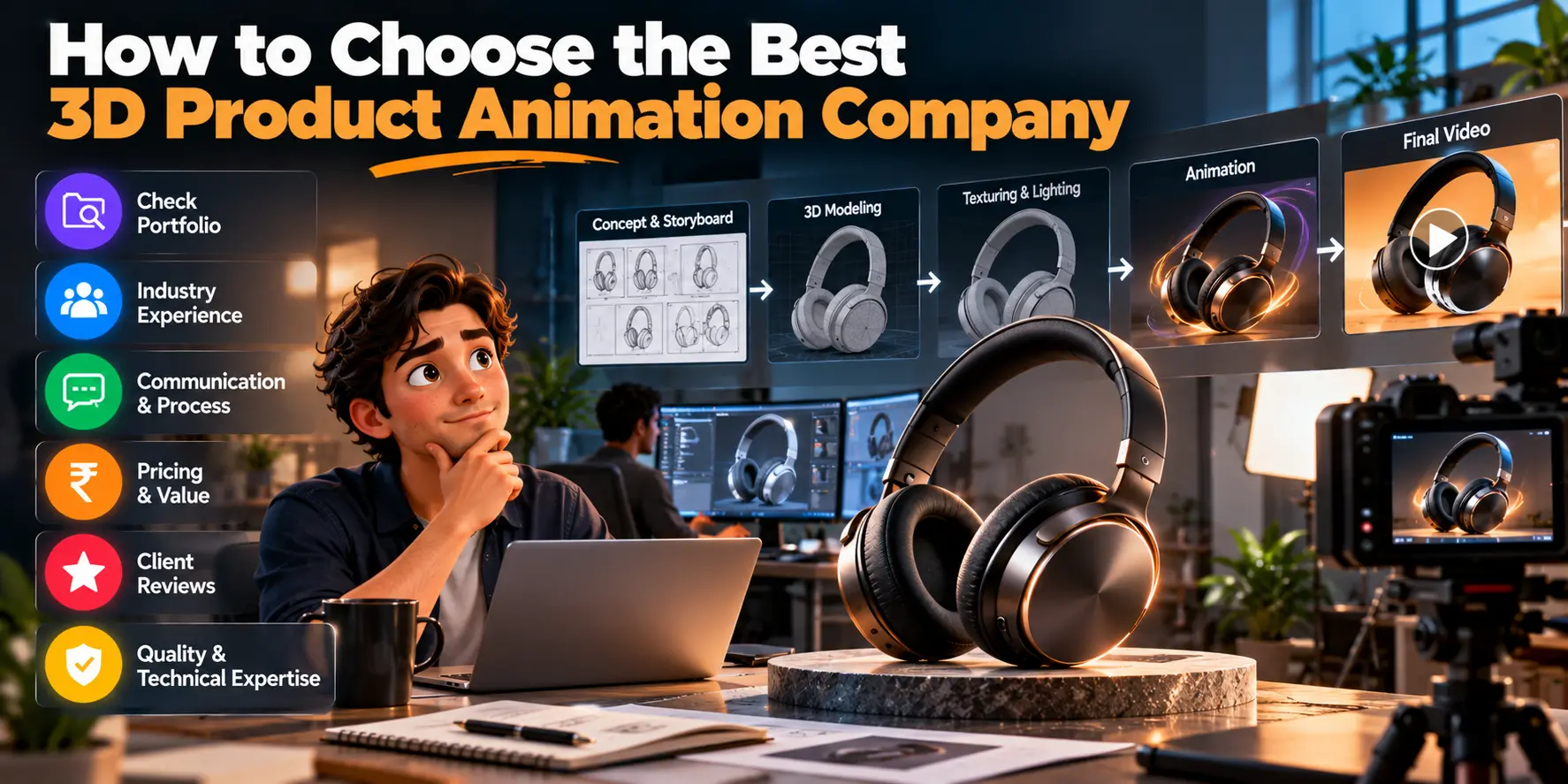
Choosing a 3D product animation company requires more than comparing showreels or selecting the studio with the most realistic renders. The right partner must understand the product, communicate its important features accurately, and deliver visuals suited to the intended audience and distribution channel.
A product animation may be used to demonstrate an internal mechanism, explain an engineering concept, introduce a new product, or present a consumer item for an e-commerce campaign. Each application requires a different balance of technical accuracy, visual detail, storytelling, and production complexity.
This guide explains what 3D product animation companies do, when their services are useful, how the production process works, what to evaluate before hiring a studio, and which factors influence project costs.
What Does a 3D Product Animation Company Do?
A 3D product animation company creates digital product visualizations and animated videos using computer-generated imagery (CGI). Instead of filming a physical product, the production team builds or adapts a digital model and uses animation, materials, lighting, cameras, and rendering to show how the product looks or functions.
What Services Does a 3D Product Animation Company Offer?
Our photorealistic 3D product animations showcase every detail — from surface texture and material finish to internal mechanisms and assembly sequences — and can help explain product features that are difficult to demonstrate through conventional filming. Let's take a look below at 3D product animation services.
1. Luxury & High End Products 3D animation allows luxury brands to show material detail — leather grain, metal sheen, gem faceting — at a level that standard product photography rarely achieves without specialist equipment and controlled conditions. It is also used for products not yet in stock: a limited-edition watch or bag can be shown to wholesale buyers and in pre-launch content before a physical unit is available for shooting. For brands managing multiple colourways or finishes across markets, rendering from a single 3D model is more consistent than coordinating separate shoots per variant.
2. Electronics & Tech The main use case in electronics is showing what the casing hides: internal PCB layout, chip architecture, wireless charging coil position, antenna placement. These teardown and x-ray animations explain how a device works to consumers, press, and retail buyers — without disassembling a physical unit on camera. They are also used in product launch campaigns where the technical differentiation is the core message.
3. FMCG Product For fast-moving consumer goods, the common use cases are SKU variant renders (eight colour options from one base model rather than eight photoshoots), pour and splash sequences for beverages and liquids, and pre-launch campaign visuals produced from packaging artwork before physical stock arrives. It is also used by brands selling across multiple markets who need the same asset in different formats and aspect ratios without rebooking a shoot.
4. Technical & Mechanical Products 3D animation excels at deconstructing complex machinery to reveal internal operations, assembly sequences, and moving parts. It provides a clear, x-ray-style visualization of mechanical workflows, helping manufacturers explain functionality to stakeholders or train operators — including internal components that cannot be accessed by a camera in a physical unit. For communication and sales purposes, this can reduce the need for physical prototypes at early stages, though it does not replace physical testing where testing is required. For equipment at facility scale, see our industrial plant and factory visualization work.
5. Furniture & Interior Design Furniture animation is primarily used for two things: showing material options (fabric colours, wood finishes, leg configurations) from a single base model without producing a physical sample for each variant, and placing the piece in a room setting to show scale and proportion. It is particularly useful for e-commerce sellers and brands presenting to retail buyers when in-store browsing isn't available, and for products with a wide range of customization options that would be expensive to photograph individually. Where the brief involves an architectural or interior environment alongside the product, see our architectural walkthrough services.
6. Automotive and Robotics This category covers everything from vehicle exterior styling to intricate robotic arm kinematics, highlighting engineering excellence and movement. 3D animation simulates aerodynamics, drivetrain mechanics, and automated workflows, offering a comprehensive view of performance and efficiency. It is essential for demonstrating how vehicles and robots interact with their environment or perform specific tasks.
7. Aerospace and Defense 3D animation provides detailed visualizations of aircraft systems, satellite deployments, and defense equipment — useful for training, presentations, and stakeholder briefings. It simulates flight dynamics, component stress points, and operational procedures at a level of detail that diagrams and photography cannot reach. As with any visualization, data handling and confidentiality protocols remain the client's responsibility.
8. Medical Device & Surgery Equipment Medical animation shows how a device functions at a level of detail that no photograph reaches — drug delivery mechanisms, implant deployment sequences, catheter navigation, surgical instrument operation. Common outputs include healthcare professional education content, patient-facing explanation videos, and sales aid animations used by medical device reps. Where animations are prepared to accompany regulatory submissions, the technical accuracy requirements are higher and the production process is scoped accordingly — confirm this capability directly with any studio you shortlist for that use case.
Why Do Businesses Use 3D Product Animation?
Businesses use 3D product animation when they need to communicate product information clearly, create consistent marketing assets, or present a product before conventional filming is practical.
Key applications include:
Explaining complex products: Help audiences understand how a product functions without relying entirely on technical descriptions.
Supporting pre-launch marketing: Create visual assets for products that are still in development, subject to the availability and accuracy of the required design information.
Demonstrating features consistently: Present specific product details in a controlled visual environment, including features that may be difficult to film.
Adapting content for different channels: Repurpose approved 3D assets into suitable video versions for websites, presentations, advertising, and social media, depending on the original project scope.
Supporting sales and product education: Give sales teams, distributors, and customers a visual resource for understanding product functionality and design.
The value of 3D product animation depends on the product and its communication goals. Define the intended audience and the information viewers need to understand before deciding which animation format to produce.
How Does the 3D Product Animation Production Process Work?
Understanding the 3D animation production workflow helps buyers evaluate a company's technical capability, project management, and ability to deliver the intended result.
Step 1: Define the Objective and Audience The project begins by identifying what the video must communicate and who will watch it. A consumer advertisement may emphasize product appearance and lifestyle context. An engineering demonstration may prioritize component accuracy, operation, and technical detail. The brief should specify the target audience, main message, distribution channels, desired duration, and expected deliverables.
Step 2: Review Product References The production team reviews available CAD files, engineering drawings, photographs, measurements, material references, and product specifications. The quality and completeness of these references influence modelling time and technical accuracy. If essential information is missing, the team may need clarification or additional reference material before proceeding.
Step 3: Develop the Concept and Storyboard The creative team plans the sequence of shots, camera movements, product actions, and visual explanations. A storyboard establishes the intended visual flow before detailed animation work begins. For technical projects, it also helps subject-matter experts verify that the sequence communicates the product's operation correctly.
Step 4: Create or Prepare the 3D Model Artists build a digital representation of the product or adapt an existing model for animation. The required level of detail depends on the camera distance, output resolution, product complexity, and intended visual style.
Step 5: Apply Materials and Textures Materials define how surfaces appear under lighting, including their colour, roughness, reflectivity, transparency, and other visual properties. Accurate material setup is particularly important for products with glass, polished metal, plastic, fabric, or complex surface finishes.
Step 6: Animate the Product The team creates the necessary product movements, component interactions, camera transitions, rotations, or exploded sequences. For products with moving parts, animation should follow the actual mechanical relationships and operating principles.
Step 7: Set Up Lighting and Render the Scenes Lighting establishes the product's appearance, visual hierarchy, shadows, and reflections. Rendering converts the prepared 3D scenes into final images or video frames. Render time depends on scene complexity, resolution, lighting, materials, effects, and hardware.
Step 8: Complete Post-Production The rendered sequences are edited and refined. Depending on the brief, post-production may include compositing, colour correction, labels, motion graphics, sound design, voice-over, and music.
Step 9: Review and Deliver the Final Video The client and production team review the animation against the approved storyboard, references, and technical requirements. The final delivery should follow the agreed specifications for resolution, aspect ratio, file format, duration, audio, and included versions.
How to Choose the Best 3D Product Animation Company?
Choosing the right 3D product animation company involves more than reviewing attractive visuals. Evaluate the provider's technical capabilities, production workflow, communication, and ability to deliver the assets your project requires.
1. Review Relevant Portfolio Projects Look for product animations similar to your industry, product complexity, and intended application. Check whether the examples clearly communicate product features, demonstrate functionality, and maintain consistent visual quality. For an overview of what a full-service product animation brief looks like, see our 3D product animation services page.
2. Evaluate Technical Expertise For products with complex components or internal mechanisms, confirm that the team can handle accurate 3D modelling, materials, lighting, and technically appropriate animation.
3. Understand the Production Workflow Ask how the team manages project briefing, storyboarding, modelling, animation, rendering, feedback, and final delivery.
4. Compare Quotes and Deliverables Compare proposals based on the same project scope. Check the animation duration, scene complexity, modelling requirements, output formats, revision limits, delivery timeline, and usage rights.
5. Assess Communication and Project Management Confirm who will manage your project, how feedback will be collected, and how changes will be approved.
6. Verify Timelines and Production Capacity Ask for a realistic schedule based on your project's complexity, asset readiness, and approval process.
Professional 3D Product Animation Studio vs. Freelancer
The comparison below describes typical differences. Actual costs, delivery times, and capabilities depend on the provider, project complexity, and agreed scope.
Factors | Professional Animation Studio | Freelancer |
|---|---|---|
Cost | Delhi NCR product animation starts from ₹75,000 for a 15-second single-product hero video (standard finish, 2 revision rounds, MP4 delivery). Complex animations, mechanism breakdowns, and lifestyle sequences are priced higher. | Typically lower than a studio for equivalent scope; varies by individual. |
Project scope | Good for multi-scene videos, complex products, multiple deliverables, and larger campaigns. | Often suitable for a defined task, such as a product rotation, a short animation, or a specific production stage. |
Production process | May provide a structured workflow from briefing and storyboarding through production, review, and final delivery. | Process varies by individual; the client may need to coordinate more of the workflow. |
Team and expertise | Can bring together specialists in creative development, 3D modelling, animation, rendering, and technical review. | Expertise depends on the individual's skills; specialist work may require additional contractors. |
Timeline | 2–3 weeks for a standard 15–30 second hero video; 3–4 weeks for mechanism animations or lifestyle sequences — both after brief and references are approved. Project-specific schedule confirmed at kickoff. | Can be efficient for small assignments; depends on individual workload and project complexity. |
Availability | A team may provide greater continuity and backup if a team member becomes unavailable. | Availability can be limited by one person's schedule, workload, or unexpected absence. |
Quality control | May include peer reviews, specialist checks, and formal approval stages. | Quality assurance depends on the freelancer's own workflow. |
Technical accuracy | Can support multidisciplinary review when appropriate technical expertise is available. | Can deliver excellent technical work when the freelancer has the required domain expertise and references. |
Revisions | May have a defined review process and revision allowance; changes outside the scope can cost extra. | Terms vary; revision capacity depends on the contract, schedule, and nature of the changes. |
Scalability | May be better positioned to manage additional scenes, product variants, and multiple output formats. | Can scale through subcontractors or collaborators, but coordination may become more complex. |
Contact us to get a customized 3D animation product video quotation.
Practical checklist before choosing:
Request at least one full case study in your product category — not just a highlight reel
Ask who performs technical review on mechanism or engineering animations
Confirm backup capacity if your project spans multiple weeks
Get revision terms and file ownership in writing before signing
What Factors Affect 3D Product Animation Cost?
There is no single price that applies to every 3D product animation project. Costs depend on the production work required and the agreed scope.
Product Complexity Products with intricate geometry, numerous components, transparent materials, or complex mechanisms typically require more preparation than simple objects.
Availability of 3D and CAD Files Production may be more efficient when usable, well-organized models are available. However, CAD files often need optimization before they can be used for animation and rendering. If only photographs or incomplete drawings are available, additional modelling and reference development may be necessary.
Animation Complexity A static camera rotation, a feature-highlight sequence, an exploded view, and a simulated mechanical demonstration involve different levels of work.
Visual Style and Rendering Quality Stylized animation and photorealistic CGI have different requirements. Detailed reflections, transparent materials, complex environments, simulations, and high-resolution output may increase production effort.
Duration and Number of Deliverables Longer videos often require more shots, animation, editing, and rendering. Multiple aspect ratios, product variants, languages, or campaign versions may also affect the total scope.
Revisions and Project Management Changes to an approved storyboard, product model, or completed animation may require reworking several production stages. The quotation should explain the revision allowance and how out-of-scope changes are priced.
How should you compare quotations? Provide shortlisted companies with the same brief, reference files, target duration, visual style, technical requirements, and deliverable list. Compare the resulting scope, production schedule, revision terms, and ownership conditions alongside the total price.
Common Mistakes to Avoid When Hiring a Product Animation Studio
Choosing based on showreel alone: A polished showreel can demonstrate visual quality, but it may not reveal how well a company handles your product's technical requirements or project scope.
Choosing on price alone: Compare the complete scope, deliverables, and additional charges rather than selecting the lowest quote.
Leaving requirements undefined: Agree on the target audience, animation objectives, scene requirements, and final formats before production begins.
Overlooking usage rights: Confirm the permitted uses of the final animation and whether editable project files or underlying 3D assets are included.
Ignoring approval responsibilities: Establish who provides feedback, how revisions are handled, and who approves the final output.
Accepting unrealistic deadlines: Make sure the timeline accounts for modelling, animation, rendering, reviews, and stakeholder approvals.
Frequently Asked Questions
What is the difference between 3D product animation and product photography?
Product photography captures a physical product using a camera. 3D product animation creates digital scenes in which the product can be rotated, disassembled, animated, or shown in environments that may be difficult to film. Photography may be more suitable for straightforward product documentation, while 3D animation is useful when motion, internal structure, or pre-production visualization is required.
When should a business hire a 3D product animation company?
A business should consider hiring a 3D product animation company when product features, internal mechanisms, assembly processes, or technical benefits are difficult to communicate through conventional photography or live-action video. It is particularly useful for product launches, e-commerce demonstrations, industrial equipment, complex components, and products that are not yet physically manufactured.
How long does it take to produce a 3D product animation video?
A 15–30 second hero product animation typically takes 2–3 weeks after the brief and reference materials are approved. More complex mechanism animations or lifestyle sequences can take 3–4 weeks or longer, depending on modelling requirements, scene complexity, and feedback turnaround. We confirm the project-specific schedule before production begins.
How much does a 3D product animation video cost?
The cost depends on product complexity, animation type, duration, and number of deliverables. For Delhi NCR projects, a 15-second hero product video starts from ₹75,000; mechanism animations, lifestyle sequences, and multi-variant renders are priced higher. Contact us for a scoped quote — we respond within 12 hours.
What files should I provide to a 3D product animation company?
Where available, provide CAD files, 3D models, engineering drawings, product photographs, dimensions, material references, branding assets, and technical specifications. Explain the intended audience and objective, and identify any details that are still subject to change.
How should I compare a professional studio with a freelancer?
Compare both options using the same project brief rather than price alone. Evaluate their relevant portfolio, technical expertise, production workflow, communication, availability, delivery timeline, revision policy, and experience with similar products. Request itemized quotes covering the same scope, deliverables, revisions, and usage rights before making a decision.
What deliverables and usage rights should a product animation quote include?
A product animation quote should clearly specify the final video format, resolution, aspect ratios, duration, number of scenes, and any required versions for websites, social media, presentations, or advertising. Confirm the delivery schedule, approval stages, revision limits, and any additional costs before production begins. Usage rights should explain where and how you can use the finished animation, including commercial use, advertising, and social media.
Choosing a 3D product animation company starts with defining what the audience needs to see and understand. The right studio should demonstrate relevant experience, a structured production workflow, technical accuracy, clear communication, and a deliverable scope that matches the project.
Compare providers using the same brief and evaluate their work, production methods, revision terms, timeline, and ownership conditions. This approach makes it easier to identify a suitable partner without relying solely on marketing claims, headline prices, or generalized rankings.
Ready to Bring Your Product to Life with 3D Animation?
Have a product animation project in mind? Contact Chasing Illusions Studio to discuss your requirements and get a customized quote for your project. We've worked with consumer brands, industrial equipment manufacturers, medical device companies, and e-commerce sellers across India and the UAE — see our 3D product animation services for the full scope of what we produce.
📞 +91-9910911696 | +91-9910660851
Last Updated: October 2026 | Chasing Illusions Studio
Chasing Illusions Studio
Premium animation & video production studio based in Delhi, India. Specialising in 3D animation, medical visualisation, architectural walkthroughs, and CGI.