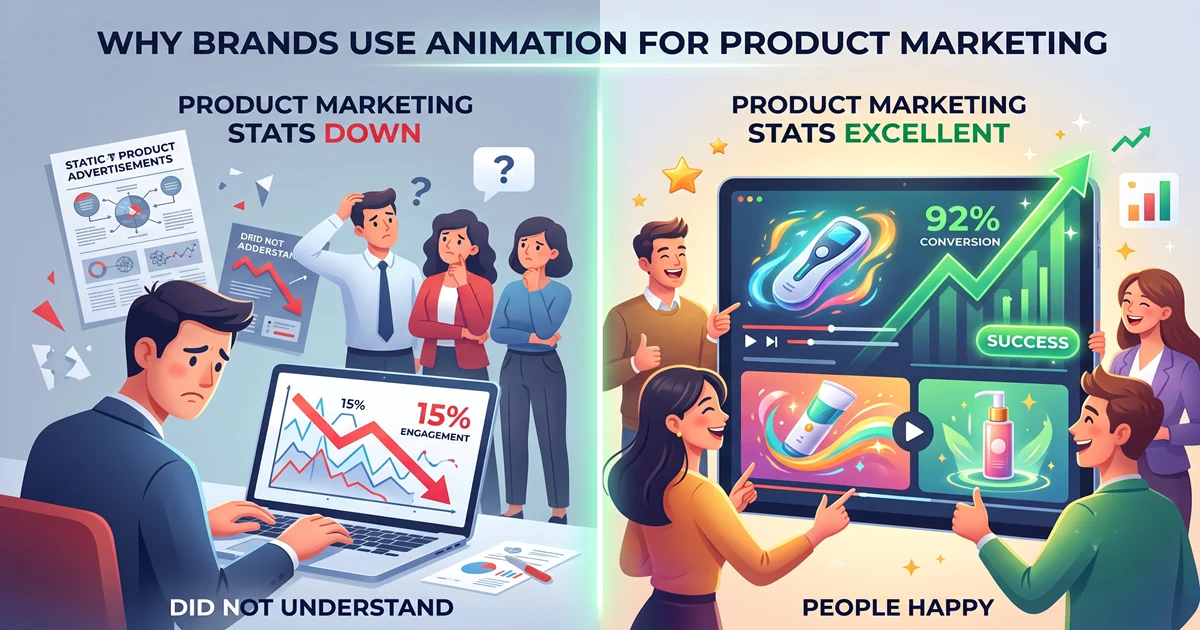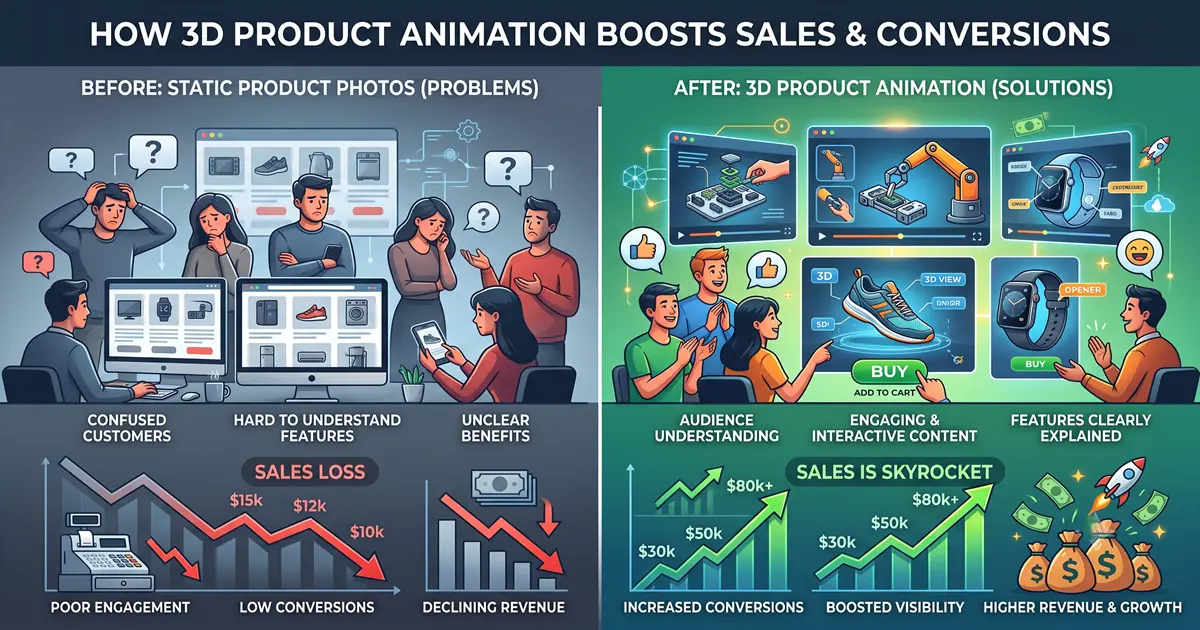
3D product animation boosts sales by making products easier to understand. It shows buyers how a product works, what's inside it, and why it matters — things static photos and spec sheets can't communicate. This reduces buyer uncertainty at every stage of the sales journey (awareness, evaluation, decision), which shortens hesitation and improves the odds of conversion. It does not replace product quality, pricing, or credibility — it strengthens how those advantages are communicated.
Key Takeaways
3D animation reveals functionality, internal mechanisms, and processes that photography physically cannot capture.
It supports every stage of the buyer journey — not just the "wow" moment at the top of the funnel.
It's especially valuable for technically complex, hidden-mechanism, or not-yet-manufactured products.
One 3D model can be repurposed into dozens of marketing assets (web, social, trade show, training, ads).
Conversion impact depends on more than the animation itself: accuracy, message relevance, pricing, and distribution all matter.
Impact should be measured against defined objectives (conversion rate, sales-cycle length, lead quality) — not view counts alone.
What Is 3D Product Animation?
3D product animation is a fully computer-generated visual — created from 3D models, not a camera. Unlike product photography, it is not limited by physical constraints: you can show internal mechanisms, assembly sequences, impossible camera angles, and any material finish or lighting condition. It delivers complete creative control, limitless scalability, and visuals that are simply impossible to achieve with traditional photography.
A 3D product animation may include:
A photorealistic exterior presentation
A step-by-step product demonstration
An exploded-view animation
Internal mechanism visualization
Product assembly or installation sequences
Feature and benefit demonstrations
Material, colour, or configuration variations
Simulated operating environments
Product launch or advertising sequences
The final animation can be used across product pages, sales presentations, trade shows, social media, eCommerce listings, training materials, exhibitions, investor presentations, and digital advertising campaigns.
For manufacturers and technology companies, the real value is not simply making a product look impressive. It is giving prospective buyers enough visual information to understand why the product matters.
Key Terms
Photorealistic rendering — a still or animated image built to look like a real photograph, used when accuracy of finish, colour, and material matters most.
Exploded-view animation — a sequence that separates a product's components in a controlled path so the viewer can see how each part connects.
Cross-section animation — a view that cuts through a product's exterior to show internal structure or function while it operates.
CGI (computer-generated imagery) — the broader category of digitally built visuals, of which product animation is one application.
Rigging — the internal skeleton and control system added to a 3D model so it can move realistically (parts that rotate, slide, or fold).
3D Animation vs. Product Photography vs. Live-Action Video
Format | Shows appearance | Shows internal function | Shows motion/process | Needs a finished product | Reusable across markets |
Photography | Yes | No | No | Yes | Limited |
Live-action video | Yes | No | Yes | Yes | Limited |
3D product animation | Yes | Yes | Yes | No | High |
Each format solves a different problem. Photography authentically documents an existing product; live-action video shows it in real use; 3D animation can explain functionality, reveal hidden components, and simulate operation — including for products that don't exist yet. Most conversion-focused campaigns use more than one.
How Does 3D Product Animation Boost Sales Across the Buyer Journey?
3D animation supports every stage of the buyer journey, not just the first impression — from grabbing attention, to explaining function, to easing post-purchase setup.
A sale rarely happens because a customer sees one attractive image. Buyers usually move through several stages: awareness, understanding, evaluation, confidence, and decision.
3D product animation can support each stage.
Buyer-journey stage | Common customer obstacle | Role of 3D animation |
|---|---|---|
Awareness | The product fails to attract attention | Creates an engaging visual introduction |
Understanding | Features are difficult to interpret | Demonstrates functions and benefits visually |
Evaluation | Buyers cannot compare solutions confidently | Highlights differentiators and use cases |
Consideration | Technical uncertainty creates hesitation | Reveals mechanisms, dimensions and workflows |
Decision | The buyer still questions product value | Connects capabilities with practical outcomes |
Post-purchase | Customers struggle with setup or operation | Provides assembly, installation and usage guidance |
The commercial logic can be expressed simply:
Product complexity → poor understanding → buyer hesitation → 3D visualization → better comprehension → greater confidence → stronger conversion potential
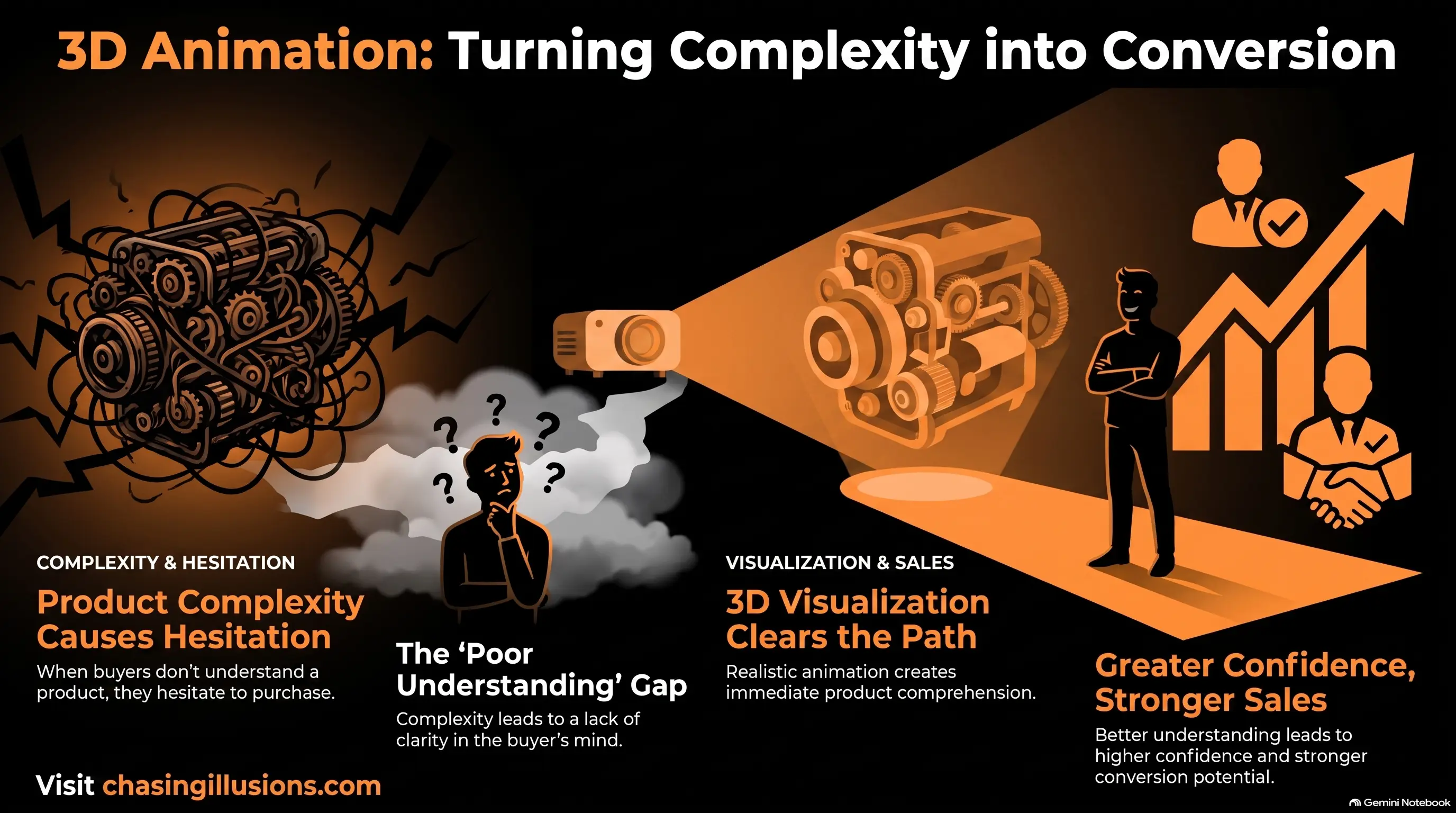
Animation does not replace product quality, competitive pricing, credible claims, reviews, or effective distribution. It strengthens the way these advantages are communicated.
Why Does Making Complex Products Easier to Understand Increase Sales?
Because confusion delays or kills purchase decisions. When buyers can't understand what a product does or how it works, they leave the page, postpone the decision, or repeatedly ask sales for basic clarification — all of which slow or stall conversion.
A buyer may be interested in an industrial machine, electronic device, automotive component, medical device, or engineering system but still struggle to understand:
What the product does
How its components interact
Why its design is different
How it fits into an existing process
What business or operational problem it solves
Whether its performance justifies the investment
Long technical descriptions often make this problem worse.
Long technical descriptions often make this problem worse.
A 3D product explainer video can convert specifications into a visual sequence. Instead of merely stating that a device has an advanced cooling system, the animation can reveal the internal airflow, heat transfer, and component response while the product operates.
Research into eCommerce presentation videos found that usage-focused videos produced stronger purchase intention than appearance-focused videos. The effect was connected to better perceived diagnosticity—how useful the information felt for evaluating the product—and stronger mental imagery.
The lesson is important: showing how a product works is often more valuable than presenting a visually impressive rotation without meaningful information.
What Can 3D Animation Show That Photography Cannot?
3D animation can show anything that isn't visible from the outside — internal mechanisms, fluid or energy movement, microscopic processes, and full assembly sequences — none of which a camera can capture.
Product photography is useful for colour, finish, size, and exterior design. Its limitation is that it can record only what is physically visible. It cannot easily show:
Fluid moving through a sealed system
Energy transfer inside a device
A component working at a microscopic scale
Hidden mechanical movement
Airflow through an appliance
Layers beneath a product surface
A complete assembly sequence in a clean environment
A product operating under dangerous or inaccessible conditions
An exploded-view animation, for example, can separate dozens of components in a controlled sequence, identify how they connect, and reassemble the product without requiring physical disassembly. Cross-sectional animation can take the viewer inside a motor, pump, medical instrument, battery, filtration system, or automotive assembly while it continues to operate.
How Does Animation Turn Product Features Into Buyer Benefits?
A common marketing mistake is to list features without explaining their practical value.
Animation pairs each technical feature directly with the outcome it produces, so buyers don't have to infer why a spec matters.
A common marketing mistake is to list features without explaining their practical value. Consider these statements:
"The system uses a redesigned internal impeller."
"The product contains a multi-layer filtration unit."
"The device includes a modular locking mechanism."
These may be technically correct, but buyers still need to understand why they matter. Animation can connect each feature with its outcome:
The redesigned impeller improves fluid movement.
The filtration layers remove different types of contaminants.
The modular locking mechanism simplifies assembly and maintenance.
This feature-to-benefit connection is especially important for B2B sales, where several stakeholders evaluate the same product from different angles — an engineer focused on performance, an operations manager on workflow, a procurement professional on value, a senior decision-maker on business impact. A well-structured demonstration animation can speak to all of them without oversimplifying the product.
Does 3D Animation Reduce Buyer Hesitation and Purchase Risk?
Yes — research indicates richer product presentation reduces perceived risk, which is one of the main reasons buyers hesitate before purchasing online.
Online buyers cannot physically inspect, operate, or test most products before purchasing. That creates uncertainty around appearance, compatibility, usability, quality, and performance.
Research comparing rich-media product presentations with static text and images found that product videos and virtual product experiences increased consumers' sense of being informed. Interactive virtual product experiences also showed a direct positive effect on purchase intention in the studied conditions.
Similarly, research on virtual product experience suggests that 3D visualization can support product learning and influence brand attitudes and purchase intention.
These studies should not be read as proof that any single animation will increase conversion rates. Their value is in showing the mechanism: better information reduces perceived risk and helps buyers form a clearer mental picture of the product.
Wyzowl's 2026 State of Video Marketing report found that total 39% of businesses used animated product video as their marketing strategy to promote their product & services in 2026. Moreover, explainer videos used of about 68% and social media videos stood at 69%. This is self-reported survey data, treat it as market context rather than a guaranteed lift for any specific animation.
The effect depends on factors such as:
Product-market fit
Animation accuracy
Message relevance
Website experience
Product reviews
Pricing
Brand credibility
Call-to-action placement
The buyer’s existing knowledge
Can 3D Animation Help Products Stand Out in Competitive Markets?
Yes — animation can surface differentiators that look identical in photos and spec sheets, such as internal architecture, patented mechanisms, or faster real-world workflows.
This is common in consumer electronics, industrial equipment, automotive components, medical technology, appliances, engineering products, construction materials, and technology hardware — categories where competing products frequently appear similar when presented through standard photographs and spec tables.
A 3D product marketing video can compare internal architecture, show a patented mechanism, demonstrate a faster workflow, or explain how the product performs in a realistic setting. Chasing Illusions Studio, for example, can transform engineering information, CAD files, and technical specifications into a story built around buyer problems, product advantages, and real-world applications.
The strongest product CGI animation doesn't rely on visual effects alone — every scene should answer a buyer's question or support a meaningful point of differentiation.
Can a Product Be Marketed With 3D Animation Before It's Manufactured?
Yes — 3D animation can be built from CAD models, drawings, and prototypes, letting brands market a product before a single physical unit exists.
Traditional product photography requires a finished prototype or manufactured product, which can delay marketing until late in the development cycle. 3D product visualization can begin with:
CAD models
Engineering drawings
Product sketches
Design files
Material references
Technical documentation
Approved prototypes
This is valuable for startups seeking investment, manufacturers planning a trade-show launch, sales teams collecting early enquiries, or companies introducing a product across several markets simultaneously.
Caution: pre-production visualization must accurately represent the intended product. If the final design may change, the animation should avoid presenting unconfirmed capabilities as finished facts.
How Does 3D Animation Support B2B Sales With Multiple Decision-Makers?
A single modular animation can be cut into different sequences for different stakeholders — technical, operational, financial, and executive — without re-explaining the product from scratch each time.
B2B products commonly involve long sales cycles and multiple decision-makers. A salesperson may need to explain the same product to technical, operational, financial, and executive audiences. For example:
A short overview can introduce the product to senior management.
A technical sequence can explain the mechanism to engineers.
An application scene can demonstrate workflow improvements.
An assembly animation can answer installation questions.
A maintenance sequence can support after-sales discussions.
The animation becomes a reusable sales asset rather than a one-time advertisement — shown during meetings, embedded in proposals, added to landing pages, included in email campaigns, or displayed at exhibitions.
ALSO READ: How a 3D Animated Product Video Boosted Sales by 200% – Case Study
How Does 3D Animation Improve eCommerce Product Pages?
It answers the questions static images leave open — scale, configuration, how a part moves, how installation works — directly on the product page, where the buyer is already deciding.
An eCommerce product page must help the buyer evaluate a product without touching it. Static images remain essential, but animation can answer what images leave unresolved. Effective eCommerce applications include:
Effective eCommerce applications include:
360-degree product views
Size and scale demonstrations
Feature callouts
Usage sequences
Material variations
Installation demonstrations
Configuration options
Interactive 3D models
Google supports referencing a 3D model within merchant-listing structured data through the 3DModel type. This doesn't guarantee enhanced search visibility, but it shows 3D product assets are becoming part of the technical infrastructure around online product discovery.
Google also recommends accurate product structured data — price, availability, ratings, shipping, returns — so 3D visuals should complement, not replace, complete product information.
How Many Marketing Assets Can One 3D Product Model Produce?
A single detailed 3D model can be repurposed into a dozen or more distinct marketing assets without re-shooting or re-building anything.
Website hero animations
Product launch films
Short social media videos
Animated product demos
High-resolution CGI stills
Sales presentation clips
Trade-show display content
Training animations
Assembly instructions
Interactive product visualization
Advertising variations
This improves content consistency, since the product's geometry, materials, colours, and design stay controlled across every channel. It also simplifies localisation: voice-over, captions, measurements, packaging, and selected scenes can be adapted for different countries or buyer segments without filming the physical product again.
When Is 3D Product Animation Most Valuable?
It's most valuable when a product is complex, has hidden components, is dangerous or impossible to film, or doesn't exist yet. At least one of these conditions usually signals a strong return on investment:
The product is technically complex — industrial machines, medical devices, automotive systems, and electronics often need more explanation than photographs can provide.
Important components are hidden — cross-sections, transparency effects, and exploded views reveal internal mechanisms without physically damaging the product.
The product is difficult or dangerous to film — animation can simulate extreme temperatures, microscopic processes, high-speed movement, hazardous environments, or large industrial settings safely.
The product does not yet exist — a verified digital model can support pre-launch promotion, investor communication, exhibitions, distributor discussions, and early sales activity.
Several configurations must be presented — one 3D model can demonstrate multiple materials, colours, components, sizes, and optional features.
Product differentiation is difficult to communicate — animation can focus attention on the design or engineering decisions that create customer value.
The sales team repeatedly explains the same process — a clear animation standardizes the explanation and gives prospects a resource they can revisit or share internally.
How Is a 3D Product Animation Produced?
To create a 3D product animation video, we follow a systematic approach step by step from research and script writing to rendering & final delivery. Let's take a look at the complete product animation video cycle.
Stage | Description | Timeline |
Discovery & Understanding of Product and Goals | We begin by analyzing your product's features, target audience, and marketing objectives. Whether it's a product launch, e-commerce listing, trade show demo, or brand campaign — we ensure every animation decision is driven by clear commercial goals. | 1-2 Days |
Concept Development & Storyboarding | Our team develops a detailed visual narrative — camera paths, key product moments, feature highlights, and the overall story arc. A storyboard is submitted for approval before any 3D work begins, ensuring complete alignment on creative direction. | 2-3 Days |
3D Modeling & Texturing | We craft precise 3D models of your product — built from reference images, CAD files, or physical samples — with photorealistic materials, surface finishes, and textures that match your exact product specifications down to every reflection and shadow. | 3-7 Days |
Dynamic Animation & Visual Effects | We bring the product to life with cinematic camera movements, assembly sequences, exploded views, and feature callouts. Advanced lighting, particle effects, and environment design are added to create visuals that are impossible to achieve with traditional photography. | 5-10 Days |
Feedback & Refinement | We share the draft animation for your review and incorporate your feedback with precision. Our revision process is structured and transparent — you know exactly what's changing, why, and when the final version will be ready. | 2-3 Days |
Final Delivery & Optimisation | The final animation is exported in all required formats — broadcast ProRes for TV, web-optimised MP4 for digital campaigns, transparent PNG sequences for compositing, and still renders for print and e-commerce listings. One production, every channel covered. | 1-2 Days |
Generally, it takes around 25-30 days to create a complete promotional 3D Product Animation video.
NOTE: The above timeline is based on a short survey of in-house product animation studios in Delhi NCR.
What Makes a 3D Product Animation Conversion-Focused?
A conversion-focused animation opens with the buyer's problem, demonstrates rather than decorates, and ends with a next step matched to buyer readiness — not just technically impressive visuals.
Begin with the buyer's problem. Open with the situation the customer recognizes — the operational difficulty, inefficiency, inconvenience, risk, or unmet need — before presenting the solution.
Demonstrate instead of decorating. Every camera movement, cutaway, and visual effect should communicate something useful. Unnecessary effects distract from the product.
Prioritize outcomes. Connect functionality with consequences — easier operation, better consistency, faster installation, reduced complexity, improved user experience. Only include performance claims the company can substantiate.
Keep the visual sequence focused. Avoid demonstrating every feature in one video; prioritize the capabilities most closely connected to purchase decisions.
Design for the distribution channel. A website hero video, technical sales presentation, Amazon listing, LinkedIn campaign, trade-show screen, and training module each need different pacing, framing, duration, and level of detail.
Include a relevant next step. Match the call to action to buyer readiness: watch the technical demonstration, download specifications, compare models, request a quotation, schedule a demonstration, or contact the sales team.
Why Does Accuracy Matter So Much in Product Animation?
Because photorealistic CGI can look completely real, which raises the bar for factual accuracy and regulatory compliance. The animation should not:
Show features the product does not possess
Exaggerate speed, strength, capacity, or durability
Present conceptual functions as commercially available
Remove material safety limitations
Imply unsupported medical or performance outcomes
Misrepresent product dimensions or operating conditions
The US Federal Trade Commission advises that advertisers must have a reasonable basis for objective claims before advertising them. It evaluates both express claims and reasonable implications created by words and pictures.
For health-related products, the FTC states that advertising must be truthful, not misleading, and supported by adequate evidence, with a particularly rigorous standard for health and safety claims.
For medical devices and other regulated products, the animation should be reviewed by relevant technical, medical, regulatory, and legal stakeholders before publication.
How Do You Measure Whether 3D Product Animation Boosts Sales?
Measure it against a defined business objective — not view count. Track metrics across four stages: awareness, engagement, conversion, and sales impact.
Useful metrics include:
Category | Metrics to track |
Awareness | Video reach, view-through rate, cost per completed view, social engagement, product-page traffic |
Understanding & engagement | Average watch time, product-page dwell time, feature-section interactions, technical-document downloads, interactive model engagement |
Conversion | Add-to-cart rate, enquiry-form completion, demo requests, quote requests, lead-to-opportunity rate, product-page conversion rate, assisted conversions |
Sales impact | Sales-cycle duration, proposal-to-close rate, sales-qualified leads, revenue influenced, average order value, cost per acquisition |
To determine actual impact, compare pages or campaigns with and without the animation through controlled A/B testing when practical, keeping product, traffic source, pricing, offer, and measurement window as consistent as possible. This is the most reliable way to establish whether 3D product animation boosts sales for a particular product, audience, and marketing channel.
In-House vs. Outsourced 3D Product Animation: Which Costs Less?
In short, outsourcing is usually less expensive than in-house studios. Outsourcing charges starts from Rs. 1,50,000 for 2D/3D Product Demo Video for sectors likes SaaS, Finance & Healthcare. It is benefical when looking for one-time project or occasional projects based on urgent basis.
On the other hands, in-house charges starts from Rs. 2,00,000 for 3D Product Marketing video for almost any sectors like healthcare, elctronics, defence, manufacturing, technology, etc., It is suitable for long-term project collaboration and continuous production volume, in such case; in-house studios charges less when they have big projects for a longer of time.
Factor | Video Type | Features | Cost (INR) |
Outsourced Studio | 2D/3D Product Demos | SaaS, Finance & Healthcare | Rs. 1,50,000 |
In-House Studio | 2D/3D Product Marketing Videos | Healthcare, Electronics, Defence, Manufacturing, Technology, etc | Rs. 2,00,000 |
NOTE: The above market research data is based on behance listing information. The price is subject to change accroding to marketing trends & demands. Contact us for complete cost guide of 3D product animation.
How Do You Choose a 3D Product Animation Studio?
Don't select any 3D product animation studio just by looking at portfolio, delivery formats, more revisions, etc., always follow the complete steps to filter out the best 3D product animation studio in Delhi NCR.
Industry-relevant portfolio: Always check the portfolio in various product categories like consumer electronics, industrial, automotive, medical, technology, etc., it shows how much studio is excellent working at various subjects for the niche.
Ability to work from CAD and engineering data: Go with the professional studios which have good experience working with raw or technical files like CAD files, drawings, and other specifications, it helps to avoid the inaccuracies; naturally occurs from static photos.
Production checklist. Make sure that studio follows the complete production steps from script to final editing, it shows a seamless workflow and confirms to have any unwanted mistakes due to skipping any important steps.
Delivery formats: Make sure the studio is eligible to provide the video in necessary formats like MP4, MKV, MOV, etc., or the formats needed for each channel — web-optimized video, social media, presention, and platform-specific specs (e.g., Amazon, trade-show displays).
Defined revision policy: Know already that how many revision rounds are included and what happens if the design changes mid-project.
Realistic turnaround estimates. Compare quoted timelines against your launch date, and ask what causes delays in their process.
Verifiable references or case studies. Look around for past clients' results that supported a measurable sales or marketing outcome, not just visually impressive reels.
Frequently Asked Questions:
Does 3D product animation automatically increase sales?
No. It can improve product understanding, engagement, differentiation, and buyer confidence, but results depend on product quality, audience relevance, pricing, credibility, distribution, and the overall customer experience.
Which industries benefit most from product animation?
It is particularly valuable for industrial equipment, electronics, medical devices, automotive components, engineering products, technology hardware, appliances, and products with hidden or complex functionality.
Can animation be created before the product is manufactured?
Yes. It can be developed from approved CAD models, engineering drawings, prototypes, and material references. All visualized features should be verified against the intended final product.
Is 3D animation better than product photography?
They solve different problems. Photography authentically presents an existing product, while animation can explain functionality, reveal hidden components, and simulate operation. Many campaigns benefit from using both.
How long should a product animation be?
According to marketing trends, a short product advertisement reel may be of 15–30 seconds, while product explainers commonly require 60–120 seconds. Technical features explaination may be longer. The exact duration depends on the client’s questions and the distribution channel.
What information is needed to begin production?
Typical inputs include CAD files, product drawings, specifications, material references, brand guidelines, target-audience details, key differentiators, use cases, and approved performance claims.
How social media platforms have impacted positively on impulse buying descisions?
Industry survey data shows a majority of consumers report being influenced toward a purchase by a short reel. According to Digital 2024 Global Overview Report, social media users have reached to 5.04 billion globally, reflecting an annual growth rate of 5.6%. A study from Imedia Research in 2023, shows that a total of 49.5% of active social media users from China have found a positive influenced in their purchase behavior.
Can 3D product animation be used on Amazon or Shopify listings?
Yes, with format-specific adjustments. Amazon accepts product videos meeting its own technical specifications, and interactive 3D models can be used where supported. Shopify supports embedded product video and 3D/AR-ready model formats for product pages. The animation typically needs to be re-exported to meet each platform's file size, format, and duration requirements.
How much does 3D product animation cost?
Cost depends on product complexity, animation length, level of photorealism, and the number of scenes or configurations required. Let's take a look at what could be the cost of 3d product animation in Delhi NCR.
Type | Description | Cost (INR) | Delivery | Revisions |
3D Product Modeling, Rendering and Visualization | High-quality 3D product modeling, rendering, and visualization services | Rs. 1,50, 000 | Within 1-2 weeks | 3 concepts, 10 revisions |
3D Product Design | Our 3D Product Design service transforms your product ideas into realistic 3D visuals. This package brings your vision to life. | Rs. 50,000 | Within 1-2 weeks | 3 concepts, 3 revisions |
2D/3D Product Demo Video | High-impact 2D and 3D product demo videos designed to simplify complex ideas and drive user engagement. | Rs. 2,00,000 | Within 1 month | 2 concepts, 2 revisions |
NOTE: This is a market research cost of 3d product animation of Delhi NCR studios.
Contact us for exact quotation + cost sheet.
How long does it take to produce a 3D product animation?
Timelines vary by product complexity and revision rounds. Let's take a look at the table below describing how much time it takes to create 3d product animation video in Delhi NCR.
Type | Duration | Timeline |
Basic (Entry) | ~15 seconds | 10–12 working days |
Standard (Mid) | ~30 seconds | 18–22 working days |
Premium (High) | ~30 seconds | 25–30 working days |
Conclusion:
When buyers cannot understand a product, they are less likely to feel confident about purchasing it. More specifications do not always solve the problem — particularly when the product is technical, unfinished, difficult to photograph, or dependent on hidden internal mechanisms.
That is how 3D product animation boosts sales potential: it closes the gap between what a product can do and what the buyer can understand. By demonstrating functionality, connecting features with benefits, reducing uncertainty, and supporting evaluation throughout the sales journey, animation can contribute to stronger engagement and conversion performance.
For businesses that need to present a complex product with accuracy and clarity, Chasing Illusions Studio can create a conversion-focused 3D product animation built around the buyer’s questions, the product’s verified advantages, and the channels where purchasing decisions happen.
Book a discovery 20-minutes strategy call.
📞 +91-9910911696 | +91-9910660851
📩 info [@] chasingillusions [.] in
Written by Deepak, eLearning Explainer Animation Production content strategist at Chasing Illusions Studio. 15+ years of experience in product animations. Our clients include Hindalco, Ernst & Young (EY), BinBase, Dozr, NMTronics, Equipment Wallet, Venwind, Healmate, Badacare, and 100+ brands across India, USA, Thailand, and the UK.
Chasing Illusions Studio
Premium animation & video production studio based in Delhi, India. Specialising in 3D animation, medical visualisation, architectural walkthroughs, and CGI.