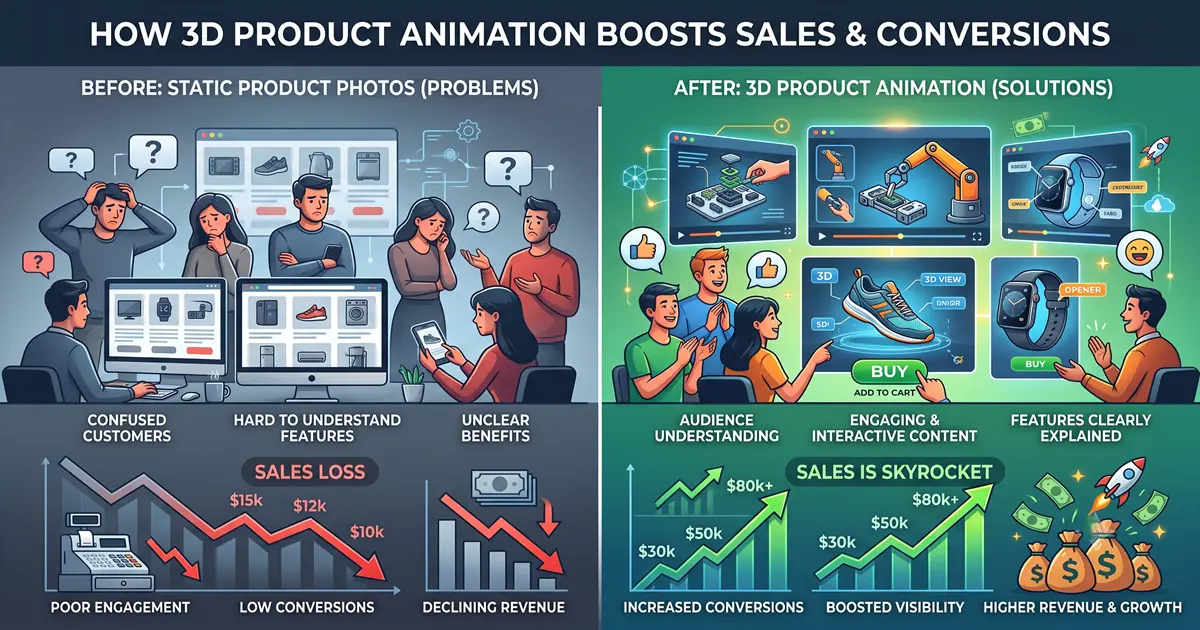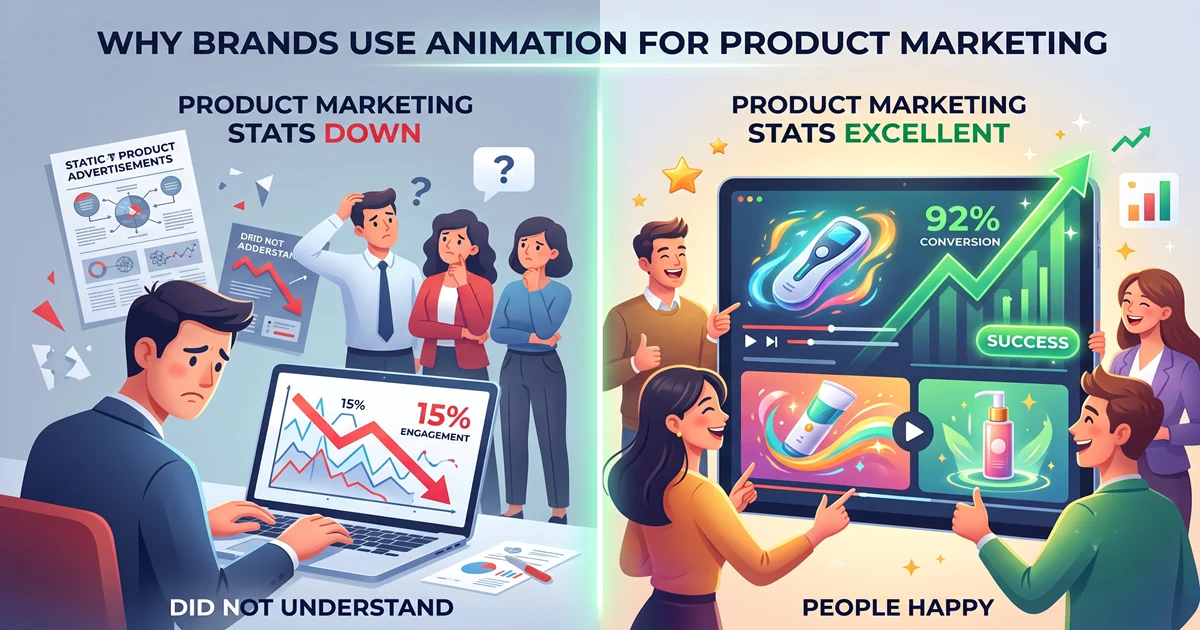
Brands use animation for product marketing because it can show what cameras physically cannot — internal mechanisms, invisible processes like airflow or heat, assembly sequences, and products that haven't finished manufacturing yet. Unlike photography or live video, animation gives marketers full control over what the customer sees and when, turning complex engineering into a clear, visual feature → function → benefit story.
Best for: manufacturers, medtech and industrial brands, automotive and electronics companies, and product-led startups marketing anything with internal complexity a camera can't reach.
Key takeaways
Animation isn't a substitute for photography or live video — it solves a different problem: explaining what can't be seen or filmed.
The core value is communication clarity, not visual polish. The right benchmark is: does the customer understand the product better after watching?
One master animation can be repurposed across the entire funnel — awareness ads, consideration-stage explainers, sales decks, trade shows, and dealer training.
Accuracy matters as much as creativity. Marketing animation should be validated against CAD data and engineering specs, and reviewed against FTC truth-in-advertising standards.
Animation, photography, live video, and static graphics each solve different jobs — the strongest strategies combine them rather than picking one.
Why Has Product Communication Become Harder to Do Well?
Modern products are more sophisticated than ever, but buyers haven't gained more time to understand them.
A typical product marketer today may need to explain an internal mechanical system, hidden electronic components, airflow or heat movement, an assembly sequence, multiple configurations, or software working alongside hardware — often within a few seconds of someone's attention.
Traditional marketing formats each hit a wall here:
Photography shows appearance well but can't reveal sealed internal mechanisms without dismantling the product.
Text and spec sheets describe function but force the buyer to mentally translate specs into understanding.
Static diagrams show structure but struggle to show movement, sequence, or transformation.
Conventional video shows a real product operating but is limited by physical access, scale, lighting, and what exists at the time of filming.
That gap creates a predictable outcome: complex product → difficult explanation → incomplete understanding → buyer hesitation.
Animation changes that chain to: complex product → visual explanation → clearer functionality → stronger buyer confidence.
What Can Animation Show That a Camera Cannot?
Animation's core advantage is moving past the exterior of a product. A camera records what physically exists in front of it; animation can visualize what cannot be photographed at all.
Take an industrial pump: a photo shows its housing and dimensions, and a video might show it running — but neither shows what's happening inside it. A 3D product animation can make the exterior transparent, move the camera through the housing, isolate individual components, and visualize the path of fluid through the system.
This same technique applies across categories:
Category | What animation typically reveals |
Engines & compressors | Internal combustion or compression sequences |
Medical devices | Sealed internal mechanisms, sterile components |
Consumer electronics | Circuitry, heat dissipation, moving parts |
Automotive systems | Powertrain, sensor, and safety-system interaction |
HVAC equipment | Airflow, pressure, and temperature change |
Batteries | Internal chemical/electrical processes |
Manufacturing machinery | Multi-stage mechanical operation |
Pumps and valves | Fluid path and pressure regulation |
Robotics | Coordinated multi-axis movement |
How Does Animation Make Internal Mechanisms Easier to Understand?
Internal mechanisms are often central to a product's value — and usually invisible to the buyer. Animation solves this through specific techniques:
Transparent cutaway views
Cross-sectional visualization
Exploded-view animation
Component isolation
Internal camera movement
Flow visualization
Product assembly animation
The distinction that matters: listing 30 interacting components in a brochure gives a buyer information. Showing those same 30 components separating, connecting, and operating in sequence gives them context — buyers don't just need to know a feature exists, they need to understand what it does and why it should affect their decision.
How Does Animation Turn a Technical Feature Into a Story a Buyer Understands?
A spec like "multi-stage pressure regulation with automatically controlled variable flow" makes sense to an engineer and means little to a buyer.
Animation can translate that same spec into a visual cause-and-effect sequence: pressure enters → system detects change → internal mechanism responds → flow adjusts → stable output is achieved. Now the buyer understands both what happens and why it matters.
The structure every effective product animation should follow:
Feature — What does the product contain?
Function — What does that feature actually do?
Benefit — Why does that matter to the customer?
Animation that stops at showing a component (feature only) is decorative. Animation that connects all three is a marketing asset.
Can Brands Market a Product Before It's Finished Manufacturing?
Yes — this is one of the more overlooked reasons brands use animation. Marketing teams frequently need promotional material while engineering, tooling, or manufacturing is still underway, and waiting for a finished physical unit can delay launch campaigns, distributor presentations, sales training, trade-show promotion, investor materials, and website development.
If accurate CAD files, engineering drawings, 3D models, or material specifications exist, a 3D product visualization can often be built before mass production begins — letting marketing run in parallel with product development instead of starting after it.
The caveat: pre-production visualization must accurately represent the intended product. The U.S. Federal Trade Commission holds that advertising claims must be truthful, non-deceptive, and supported by evidence — a standard that applies to the overall impression created by imagery, not just written claims. For photorealistic CGI, visual accuracy should be treated as a governance requirement, not an artistic choice.
What Is Exploded-View Animation and When Should Brands Use It?
Exploded-view animation separates an assembled product into its individual parts while preserving their spatial relationship — showing component hierarchy, materials, construction, and engineering design in a single sequence.
It's most effective when a product's real differentiation is inside it rather than on its exterior. For a B2B buyer evaluating industrial equipment, an exploded view typically communicates more than another exterior product shot, and it gives sales teams a consistent, repeatable visual explanation to use across every customer meeting.
How Does Animation Explain Product Assembly and Multi-Step Processes?
Some products only make sense once you see how they're assembled, installed, or used — not in their finished, static state.
Product assembly animation breaks that process into sequential steps without distraction: component enters → aligns → locks → seals → completed unit operates. The viewer follows the relationship between every stage without reconstructing it from separate diagrams — useful not only in marketing but in onboarding, dealer training, and sales enablement.
Explore 3D Product Animation Portfolio for Social Media Marketing
How Do Brands Visualize Things a Camera Can't Record — Like Airflow or Heat?
Many product benefits come from forces that simply can't be filmed: airflow, electromagnetic fields, electrical signals, data transfer, heat distribution, pressure, filtration, wireless connectivity, sensor triggers, and chemical interactions.
Animation represents these directly — air becomes flowing particles, heat becomes a temperature gradient, data becomes a visible signal moving between devices. This isn't decoration; it makes an otherwise invisible product benefit communicable to a buyer who could never see it any other way.
Can Animation Help Differentiate Products That Look the Same?
Yes. When competing products look visually similar, photography can show subtle design differences but can't explain why one engineering system performs differently from another.
Animation shifts the question from "what does our product look like?" to "what makes our product work differently?" — letting marketing teams emphasize proprietary engineering, materials, mechanisms, or durability features that a photo simply can't communicate.
Does Product Animation Help Sales Teams, Not Just Marketing?
Yes — this is one of its most practical uses. A common B2B sales problem is reps spending significant meeting time re-explaining basic product functionality before they can get to the conversations that actually close deals: application fit, commercial terms, implementation.
A well-built product explainer animation can handle that educational groundwork before the meeting, so a prospect arrives already understanding what the product is, how it works, and where it's used. That makes animation a sales enablement asset, not only a brand-awareness one — a distinction studios like Chasing Illusions Studio design
Where Does Animation Fit Across the Buyer Journey?
A single master animation rarely stays one video — sequences are typically repurposed across every funnel stage.
Funnel stage | What buyers need | Where animation fits |
Awareness | Fast attention and differentiation | Social videos, digital ads, teasers, launch announcements, exhibition screens |
Consideration | Deeper technical understanding | Feature demos, internal-technology breakdowns, comparisons, website videos |
Decision | Reduced uncertainty before purchase | Detailed operation demos, installation sequences, configuration options, technical comparisons |
At the consideration stage specifically, buyers are researching across search, video, social, and shopping surfaces before they compare and purchase — which is part of why richer visual content performs well at this stage.
This stage-specific value is especially pronounced for high-consideration B2B products, where several stakeholders are evaluating the same content independently.
Can One Product Animation Be Reused Across Multiple Marketing Channels?
Yes — a strong master animation functions as a reusable visual asset library rather than a single-use video. The same CGI can typically support:
Product websites — hero animations, feature sections, technical explainers
eCommerce — short demos showing functionality static images can't
Social media — reformatted into vertical clips, loops, and teasers
Sales presentations — selected sequences to explain technical concepts live
Trade shows — large-format visualization when showing the real product isn't practical
Digital advertising — short sequences focused on one benefit or differentiator
Product launches — a complete product story before buyers see the physical unit
Distributor/dealer education — standardized material for consistent partner explanations
This adaptability is one of the strongest budget arguments for animation: instead of treating every campaign as a separate production, brands build one visual asset ecosystem.
Animation vs. Photography vs. Video vs. Static Graphics: Which Should a Brand Use?
None of these formats replace the others — each solves a different communication problem.
Format | Best for | Falls short when |
Photography | Physical appearance, materials, scale, packaging, lifestyle context, real-world use | The product's value is internal, invisible, or in-motion |
Live-action video | Authenticity, real people/environments, manufacturing facilities, genuine demonstrations | Filming is physically restrictive — can't access, scale, or safely show internal function |
Static graphics | Specifications, quick-reference diagrams, simple comparisons | Viewers need to understand a multi-step sequence or interaction |
Animation | Internal mechanisms, motion, transformation, invisible processes, products not yet manufactured | Buyers need to see the literal, real, physical product interacting with a real environment |
The practical takeaway: the strongest product marketing strategies typically combine formats — photography for appearance, video for authenticity, and animation for whatever a camera physically cannot capture — rather than choosing one universally.
Why Does Visualization Accuracy Matter in Product Animation?
Powerful visual communication comes with a responsibility: an animation can make a product look extremely convincing — which means an inaccurate animation can create an equally convincing wrong impression.
Marketing teams should validate technical animation against CAD data, engineering documentation, product specifications, subject-matter experts, regulatory requirements, and approved product claims — particularly for medical devices, healthcare products, safety equipment, automotive systems, and other regulated categories.
The FTC holds advertisers responsible for both express and implied claims, evaluated by the overall impression conveyed to a reasonable consumer — a standard that applies fully to CGI. Impressive visuals should never substitute for accurate product communication.
The broader industrial shift toward digital product representation supports this. The U.S. National Institute of Standards and Technology (NIST) describes digital twins as virtual representations that help organizations analyze, simulate, and understand real-world equipment throughout its lifecycle. Marketing digital twins and engineering digital twins aren't the same thing, but the growing availability of CAD models, engineering datasets, and 3D assets gives marketing teams a stronger, more accurate foundation to visualize from.
What Makes a Product Marketing Animation Actually Effective?
Not every visually impressive animation is an effective one. Before production starts, marketers should be able to answer:
What does the customer struggle to understand? — mechanism, installation, workflow, technology, specification, or differentiation.
What should the customer understand after watching? — define one clear learning outcome.
Which features actually influence the purchase decision? — avoid animating every spec just because it exists.
What should be visualized rather than narrated? — use animation where movement or spatial understanding adds real value.
Where will it be used? — website, exhibition, sales deck, LinkedIn, YouTube ad, and eCommerce listing often need different edits of the same asset.
Is every claim accurate? — confirm the visualization reflects actual or approved intended functionality.
What's the Real Benchmark for a Good Product Animation?
Not whether it looks more impressive than static media. The real question is: does the customer understand the product better after seeing it?
A technically polished animation that fails to clarify the product contributes little. A focused visualization that clearly explains one difficult mechanism can contribute significantly more to marketing and sales outcomes — whether the audience is a consumer choosing an electronic device or an engineer evaluating industrial equipment.
Conclusion:
When Buyers Can See How a Product Works, They Can Better Understand Its Value?
Return to the buyer at the beginning of this article.
They have seen the photographs.
They have read the specifications.
But they still cannot visualize what happens inside the product.
That communication gap is exactly where animation for product marketing becomes valuable.
Animation can reveal internal mechanisms, demonstrate functionality, separate complex assemblies, visualize invisible technology, explain processes, present products before manufacturing, and convert technical specifications into understandable visual stories.
More importantly, the resulting content can move beyond a single campaign.
Product animation can support launches, websites, eCommerce, sales presentations, trade shows, advertising, social media, distributor communication, and customer education.
Brands therefore do not need to use animation simply because motion graphics or CGI look impressive.
They should use it when seeing the product differently helps the buyer understand the product better.
And when understanding improves, buyers are in a stronger position to evaluate features, recognize differentiation, discuss the product internally, and make informed purchase decisions.
Ready to Explain Your Product More Clearly?
If your product contains complex functionality, internal mechanisms, technical features, or benefits that traditional photography can't communicate, Chasing Illusions Studio can help translate that into clear 3D product animation for marketing, sales, launches, and product education.
FAQ: Animation for Product Marketing
Does animation replace product photography?
No. Photography still communicates physical appearance, materials, scale, and lifestyle context better than animation. The two are typically used together, not as substitutes for each other.
Can you make a product animation before manufacturing is finished?
Yes, if accurate CAD files, engineering drawings, 3D models, or specifications are available. The animation must still represent the intended product accurately to meet truth-in-advertising standards.
What industries benefit most from product animation?
Manufacturers, medical device companies, automotive and electronics brands, industrial equipment makers, and any product-led company whose value lives inside the product rather than on its surface.
Is product animation only useful for marketing, or does it help sales too?
Both. It's commonly used as a sales enablement asset — educating prospects on functionality before a sales conversation so reps can focus on application-specific questions instead of basics.
How is product animation different from a digital twin?
A digital twin is an engineering/operational virtual representation used to simulate and monitor real equipment. Marketing animation is built for customer communication. They can draw on the same underlying data (CAD models, engineering datasets) but serve different purposes.
Where can one master animation be reused?
Product websites, eCommerce listings, social media, sales presentations, trade shows, digital advertising, product launches, and distributor/dealer training — typically re-edited per channel rather than reshot.
Book a discovery 20-minutes strategy call.
📞 +91-9910911696 | +91-9910660851
📩 info [@] chasingillusions [.] in
Written by Deepak, eLearning Explainer Animation Production content strategist at Chasing Illusions Studio. 15+ years of experience in product animations. Our clients include Hindalco, Ernst & Young (EY), BinBase, Dozr, NMTronics, Equipment Wallet, Venwind, Healmate, Badacare, and 100+ brands across India, USA, Thailand, and the UK.
Chasing Illusions Studio
Premium animation & video production studio based in Delhi, India. Specialising in 3D animation, medical visualisation, architectural walkthroughs, and CGI.