What is 3D Product Rendering?
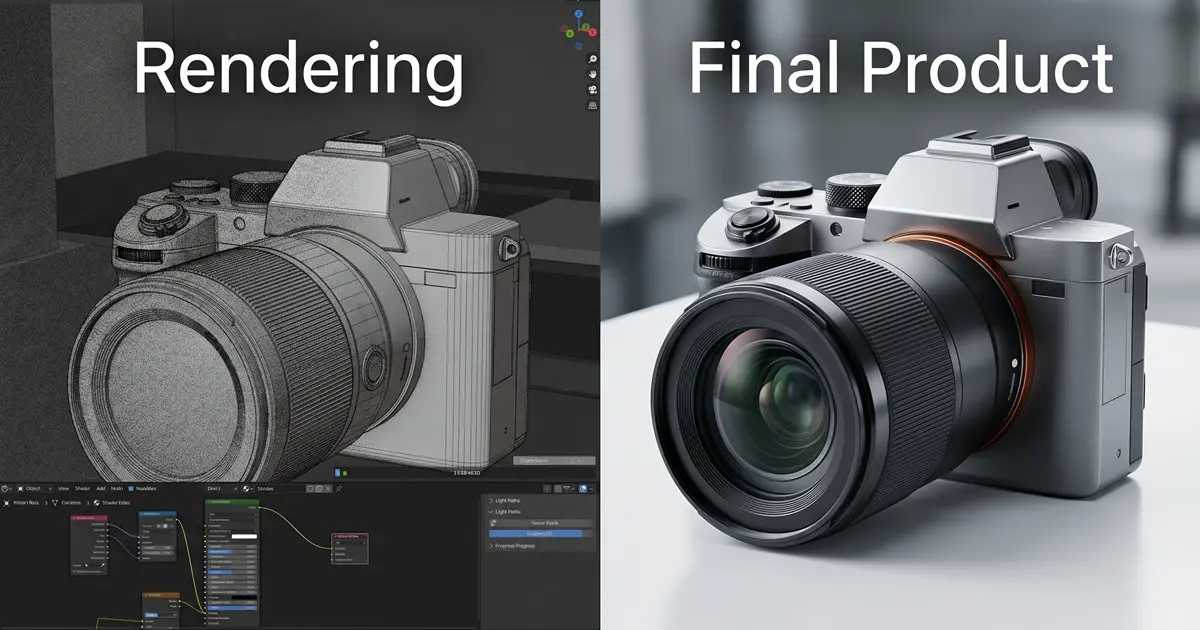
3D product rendering is the process of creating photorealistic or stylized digital images of physical products using specialised 3D modelling and rendering software — without requiring a physical prototype, photography studio, or lighting rig.
A 3D render is built from a digital mesh of the product's geometry, layered with accurate surface textures and materials, then illuminated using virtual lighting to simulate real-world conditions. The output can be a static image, a 360° spin, a lifestyle scene composite, or a full animation — all editable at any stage.
Brands across e-commerce, automotive, furniture, fashion, and medical industries rely on 3D product rendering to visualise products before they exist physically, showcase unlimited variants at scale, and produce consistent, high-quality imagery at a fraction of traditional photography costs.
3D Product Rendering vs. Traditional Photography
Factor | 3D Product Rendering | Traditional Photography |
Physical product required? | No | Yes |
Cost per variant | Near-zero after model creation | Full reshoot required |
Turnaround for changes | Hours | Days to weeks |
Colour / texture variants | Unlimited | One per shoot |
Environment control | Complete | Limited |
4K / 8K output | Yes | Depends on equipment |
AR / 360° capability | Yes (same model) | Separate shoot needed |
Sustainability | No physical waste | Props, travel, shipping |
For most product categories — furniture, electronics, apparel, automotive, consumer goods — 3D rendering is now the preferred choice for campaign-scale visual production.
How 3D Product Rendering Works: The 7-Step Process
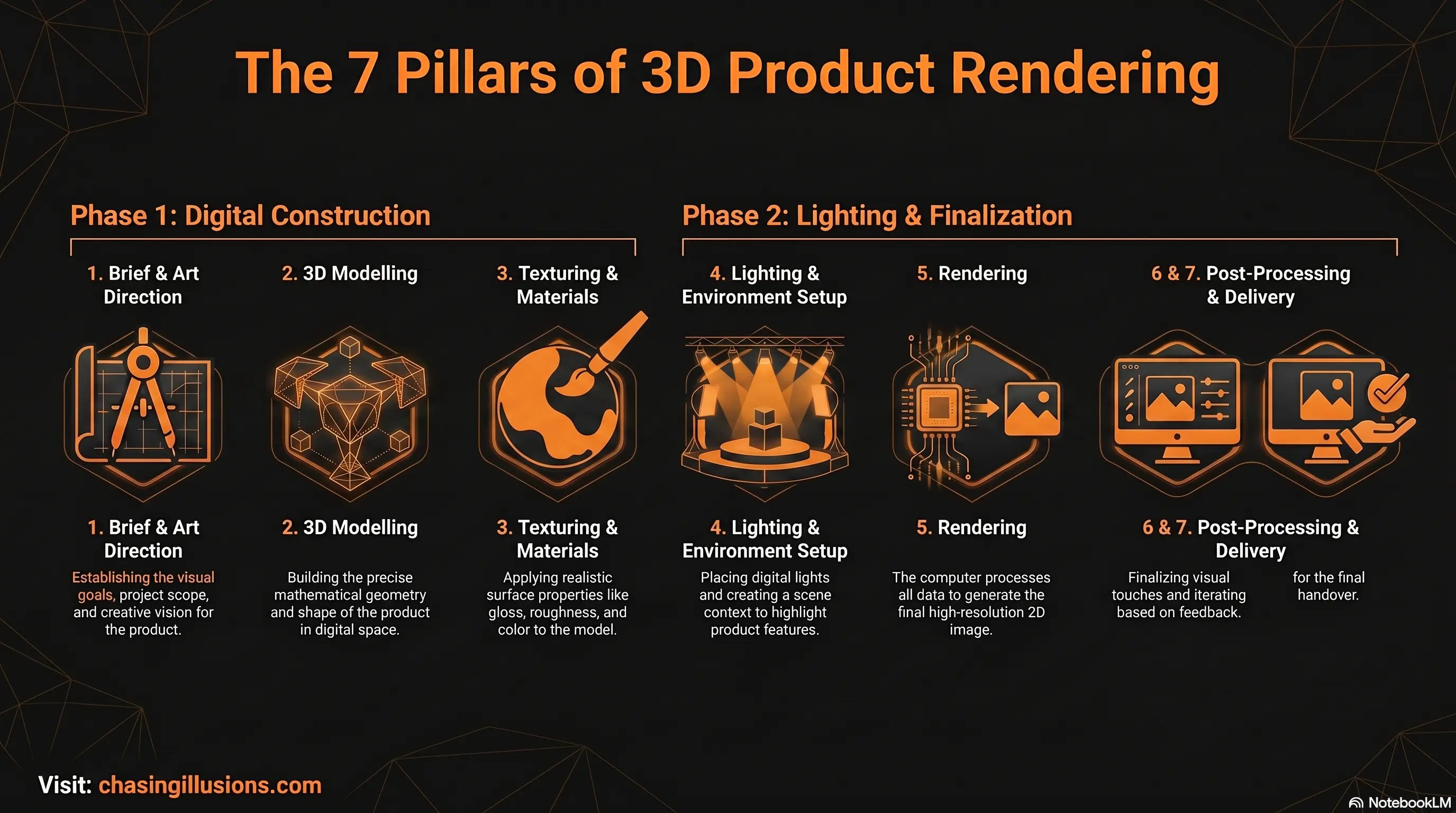
Step 1 — Brief & Art Direction
Every project begins with a clear creative brief: product specifications, target audience, desired aesthetic (photorealistic, lifestyle, minimalist, hero shot), and deliverable formats. Reference images, brand guidelines, and mood boards are established at this stage.
Step 2 — 3D Modelling
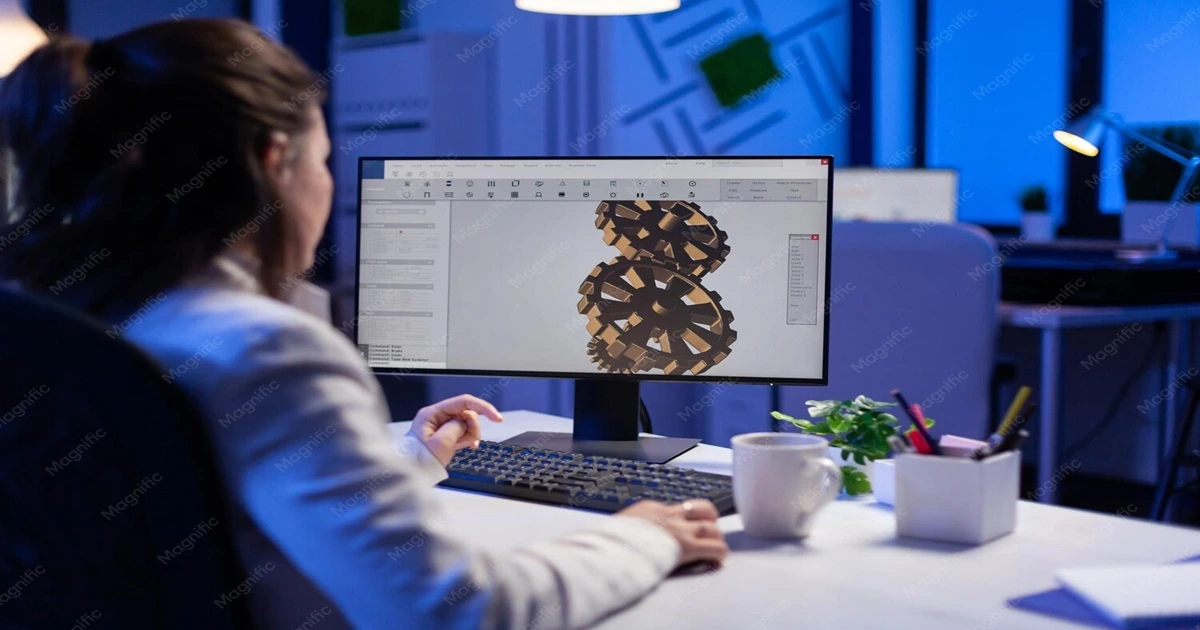
A 3D artist builds a digital model of the product using software such as Blender, Autodesk 3ds Max, or Autodesk Maya. This involves constructing the product's geometry (vertices, edges, and faces), maintaining clean topology for smooth surfaces, and detailing fine elements such as stitching, engravings, or component assemblies.
For industrial or engineering products, CAD files (STEP, IGES, OBJ) are often imported directly to ensure dimensional accuracy.
Step 3 — Texturing & Materials
Textures define how a product's surface looks and behaves under light. Using tools like Substance Painter, artists apply:
Diffuse/Albedo maps — base colour and pattern
Normal maps — microscopic surface detail (grain, scratches, embossing)
Roughness/Specular maps — how glossy, matte, or reflective the surface appears
Opacity maps — for transparent materials (glass, plastic)
Achieving accurate material representation — the difference between brushed aluminium and polished chrome, or matte fabric and velvet — is where professional rendering skill becomes critical.
Step 4 — Lighting & Environment Setup
Lighting is the single greatest factor in rendering realism. Artists configure virtual light sources (area lights, HDRIs, IES profiles) to simulate studio conditions, natural daylight, product display environments, or lifestyle settings. Shadows, reflections, and global illumination are calibrated to match the desired output.
Step 5 — Rendering
The rendering engine calculates every interaction between light, geometry, and materials to produce the final image. This is computationally intensive: a single 4K photorealistic frame can take anywhere from a few minutes (GPU render farm) to several hours (CPU rendering on a single machine). Render engines commonly used include V-Ray, Cycles (Blender), Arnold, and Corona.
Step 6 — Post-Processing
Rendered outputs are taken into Photoshop, DaVinci Resolve, or After Effects for final colour grading, contrast adjustments, background compositing, and any visual effects (lens flare, depth of field refinements, dust particles). This stage ensures the render meets brand standards and platform specifications.
Step 7 — Delivery & Iteration
Final renders are delivered in client-specified formats — PNG, JPEG, TIFF for stills; MP4, MOV for animations; GLTF/GLB for AR/3D web. Variant requests (colour swaps, background changes, alternative angles) are handled at a fraction of the cost of reshooting, since the core 3D model is retained.
3D Rendering Software: Tools by Use Case
Tool | Best For | Cost |
Blender | Full pipeline: modelling, texturing, rendering, animation | Free (open-source) |
Autodesk 3ds Max | Product design, architecture, high-end interiors | Subscription |
Autodesk Maya | Complex animation, fashion, accessories | Subscription |
V-Ray | Photorealistic lighting and materials; luxury goods | Subscription |
KeyShot | Quick product shots; beginner-friendly | One-time / subscription |
Substance Painter | Advanced texture and material authoring | Subscription |
Unreal Engine | Real-time rendering; AR/VR/metaverse applications | Free (non-commercial) |
Corona Renderer | Architectural visualisation; interiors | Free (non-commercial) |
For e-commerce and marketing clients, studios typically operate Blender or 3ds Max alongside V-Ray or Corona for photorealistic output, and Substance Painter for complex material work.
Benefits of 3D Product Rendering
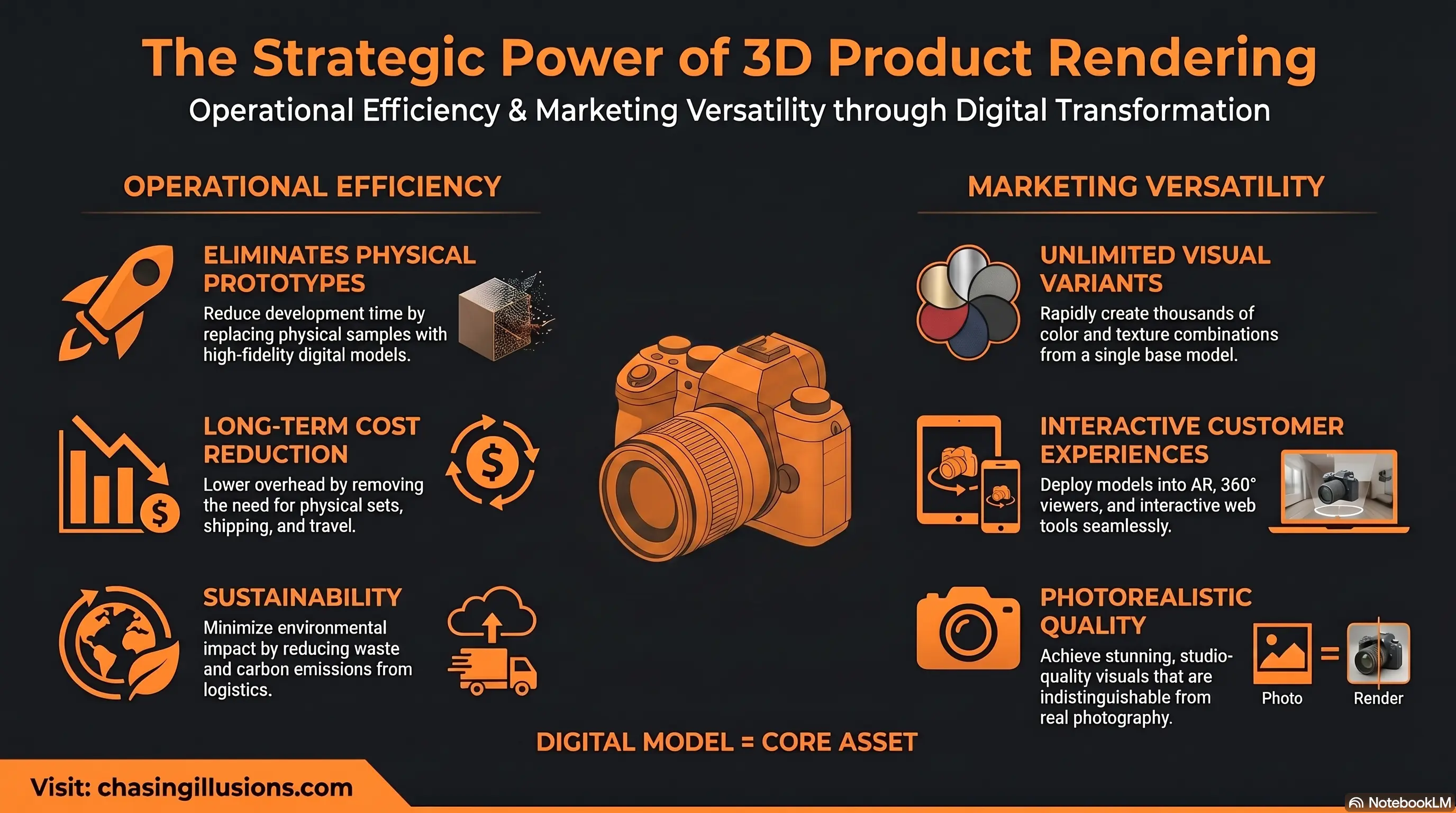
1. Eliminates the Need for Physical Prototypes
Products can be visualised, approved, and marketed before a single unit is manufactured. This is especially valuable for product launches, investor presentations, and pre-order campaigns where timelines are tight.
2. Unlimited Visual Variants at Scale
A single 3D model can generate hundreds of output variants — different colours, materials, environments, and angles — without any additional shooting. For a furniture brand launching a sofa in 15 fabric options, rendering replaces what would otherwise require 15 separate photography sessions.
3. Significant Long-Term Cost Reduction
The upfront investment in a high-quality 3D model pays dividends across its entire marketing lifecycle. Once a model exists, every new campaign, platform, or variant uses the same asset. Photography, by contrast, requires a full reshoot for each change.
4. Photorealistic Output Quality
Modern render engines — V-Ray, Arnold, Corona, Cycles — produce images that are visually indistinguishable from photography. Many major brands have migrated entire product catalogues to 3D renders without customers detecting any difference.
5. AR, 360°, and Interactive Experiences from One Model
The same 3D asset used to produce a static hero image can also power a 360° product spin, an augmented reality "try before you buy" experience, or an animated product explainer. This cross-platform asset utility is something photography cannot match.
6. Faster Turnaround for Marketing Campaigns
Digital files are instantly shareable across geographies. For studios like Chasing Illusions, this enables seamless collaboration with clients in India, the UK, USA, and Thailand — delivering final renders within agreed production windows without logistics delays.
7. Sustainability
Rendering eliminates studio rentals, physical props, inter-city shipping of products, and location shoots. For brands with ESG commitments, virtual product imagery is a measurable reduction in marketing-related carbon output.
Industry Applications
E-Commerce & D2C Brands
Online retailers use 3D rendering to display products in multiple configurations, contextual lifestyle scenes, and 360° views — directly improving conversion rates and reducing return rates driven by expectation mismatch.
Automotive
Car manufacturers and automotive accessory brands use rendering for product configurators, launch campaign imagery, and design validation. Entire campaigns for new models can run on rendered imagery before a production vehicle is available for shooting.
Furniture & Home Décor
High-volume furniture retailers use 3D rendering to showcase pieces in varied room settings, fabrics, and finishes. IKEA is widely cited as an industry benchmark — a majority of their catalogue imagery is rendered rather than photographed.
Fashion, Footwear & Accessories
Apparel and accessories brands use rendering for colourway previews, campaign imagery, and pre-production design review. This is particularly valuable for limited-edition drops, where speed-to-market is critical.
Architecture & Real Estate
Property developers use photorealistic architectural renders and interior visualisations to market properties before construction completes — supporting pre-sales, investor presentations, and planning applications. Chasing Illusions Studio's architectural walkthrough service specialises in this output for residential and commercial developers.
Consumer Electronics & Medical Devices
High-precision products with complex assemblies benefit from rendering that shows internal components, exploded views, and use-in-context scenarios — content that is difficult or impossible to capture with traditional photography. This crosses into product animation and industrial animation territory for more complex deliverables.
Gaming, AR & VR
Game studios and interactive experience designers use real-time rendering pipelines (Unreal Engine, Unity) to create product environments for virtual try-on, metaverse retail, and immersive brand experiences.
Challenges and Considerations
Skill and expertise requirements — Photorealistic rendering requires mastery of modelling, texturing, lighting, and post-processing. The quality gap between novice and professional output is significant and directly impacts brand perception. Businesses without in-house 3D capabilities typically partner with a specialist studio.
Initial model creation investment — Building a high-fidelity 3D model of a product requires time and expertise. This upfront cost is offset over the asset's lifetime, but represents a real consideration for single-use or short-run projects.
Complex or organic forms — Products with highly irregular, organic shapes (fresh food, multi-layered textiles) can be time-intensive to model and texture accurately. For these categories, photography may still be more efficient.
Hardware demands — High-resolution rendering requires capable GPU hardware or access to cloud rendering infrastructure. Studios operating professional pipelines invest accordingly; this is less of a concern when outsourcing to an established production partner.
How to Commission 3D Product Rendering?
Define your deliverables — Static stills, 360° spin, lifestyle scene, animation, or AR asset? Each has different production requirements.
Provide product references — Dimensions, material specifications, technical drawings, or CAD files give the rendering team what they need for accuracy.
Share brand and visual guidelines — Colour palette, preferred environments, tone, and campaign context.
Agree on resolution and file formats — Platform specifications (Amazon, Shopify, print, AR) determine output requirements.
Plan for iteration rounds — Professional studios typically include structured revision rounds. Feedback at the grey model or lighting proof stage is more efficient than requesting changes at final render.
For brands looking to commission 3D product renders or CGI and product visualisation from a full-service studio with India, US, and Thailand operations, Chasing Illusions Studio offers project-based engagements with defined turnaround and revision structures.
The Future of 3D Product Rendering
AI-assisted production is reducing time on repetitive tasks — automated UV unwrapping, AI texture generation, and lighting presets are all shortening production cycles without reducing output quality.
Real-time rendering via Unreal Engine 5 and similar platforms is narrowing the gap between pre-rendered and interactive content, enabling product configurators and immersive retail experiences that run in-browser or on mobile without dedicated hardware.
AR and spatial commerce is growing as a distribution format: a product render is increasingly not just a marketing image but a 3D asset deployed across web AR, retail apps, and spatial computing platforms.
Generative 3D tools — currently early in capability — are beginning to enter professional pipelines for concept-stage visualisation and background generation, though high-fidelity hero renders still require hand-crafted production.
Frequently Asked Questions
What is 3D product rendering?
3D product rendering is the process of generating photorealistic or stylized digital images of physical products using 3D modelling and rendering software such as Blender, V-Ray, or Autodesk 3ds Max — without requiring a physical prototype or photography studio.
How much does 3D product rendering cost in India?
Professional 3D product rendering in India typically ranges from ₹8,000 to ₹80,000 per image, depending on complexity, detail level, and number of variants required. Studios offering full-pipeline production — modelling, texturing, lighting, post-processing, and delivery — will quote per project based on scope.
Is 3D rendering better than product photography?
For most product categories, 3D rendering offers greater scalability, lower per-variant cost, and broader platform utility. Photography remains the more practical choice for organic, irregular products — particularly fresh food — where rendering complexity outweighs the cost of a physical shoot.
What software is used for 3D product rendering?
The most widely used tools are Blender (free), Autodesk 3ds Max, Autodesk Maya, V-Ray, KeyShot, Substance Painter, and Unreal Engine. The appropriate software depends on deliverable type, complexity, and whether the output is static imagery, animation, or real-time/AR.
Which industries use 3D product rendering most?
3D product rendering is most heavily used in e-commerce and retail, automotive, furniture and home décor, fashion and accessories, architecture and real estate, consumer electronics, medical devices, and gaming/AR/VR.
Can 3D renders be used for AR and interactive experiences?
Yes. A 3D model produced for static render output can be optimised and exported as a GLTF/GLB file for web AR, product configurators, or spatial commerce applications — making it a cross-platform asset that serves multiple use cases from a single production investment.
CONTACT NOW
Chasing Illusions Studio is a full-service animation and video production company with offices in Delhi, India, the USA, and Thailand. The studio's CGI and product visualisation team works with e-commerce brands, manufacturers, and marketing agencies across India, the UK, and North America. Get in touch to discuss your 3D rendering project.
Book a discovery 20-minutes strategy call.
📞 +91-9910911696 | +91-9910660851
📩 info [@] chasingillusions [.] in
Written by Deepak, content strategist at Chasing Illusions Studio. Our clients include Hindalco, Ernst & Young (EY), BinBase, Dozr, Equipment Wallet, Venwind, Healmate, Badacare, and 100+ brands across India, USA, Thailand, and the UK.
Last Updated: July 02 2026 | Chasing Illusions Studio
Chasing Illusions Studio
Premium animation & video production studio based in Delhi, India. Specialising in 3D animation, medical visualisation, architectural walkthroughs, and CGI.