TL;DR
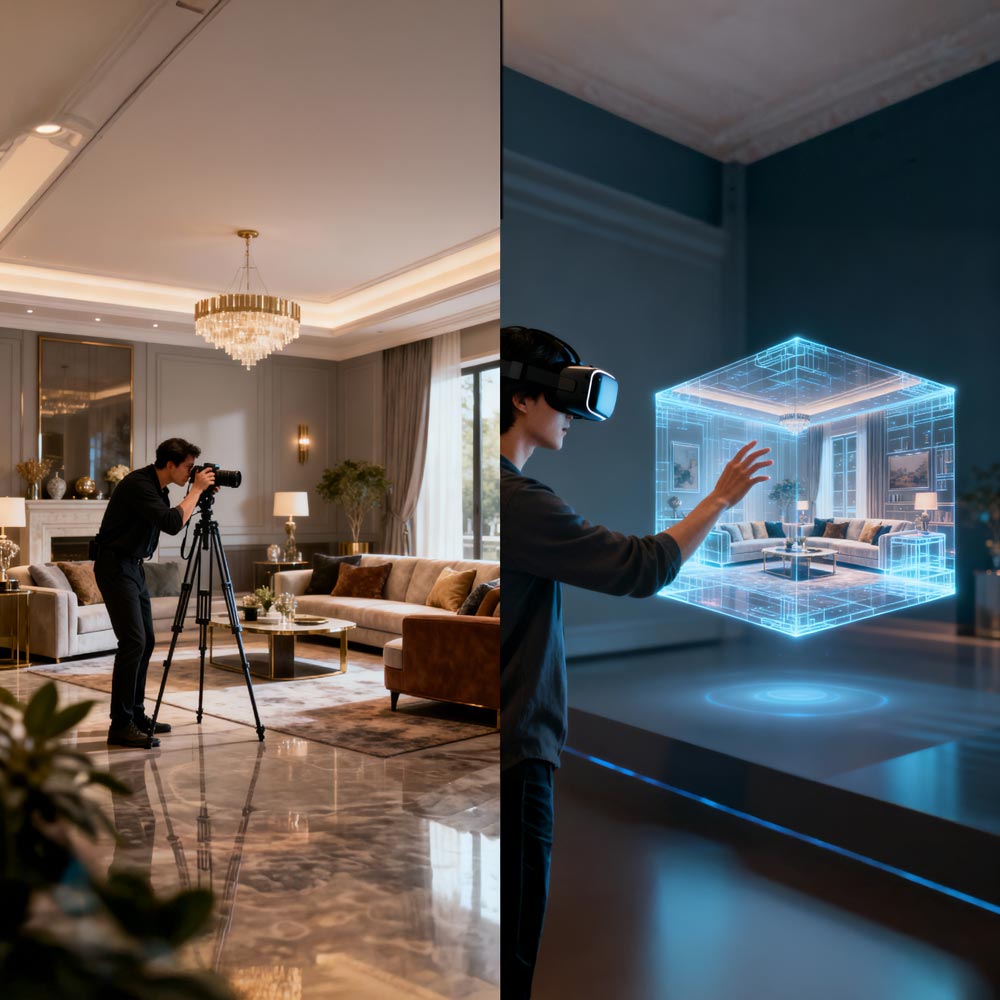
For pre-construction projects, 3D architectural walkthrough wins every time — lower cost, complete flexibility, zero dependency on construction completion. For finished properties, photography wins for lifestyle and texture shots but still loses on flexibility, scalability, and pre-launch viability. This guide breaks down every scenario with real numbers so you can make the right call for your next project.
The Problem Every Real Estate Marketer Faces
You have a property to sell. It might be a luxury residential tower in Gurugram, a commercial complex in Hyderabad, a resort in Thailand, or a villa development in Dubai. You need visuals — stunning, trustworthy, purchase-inspiring visuals — and you need them before your launch date.
The question your marketing team is asking right now is the same one every real estate developer, architect, and property consultant wrestles with:
Do we shoot it, or do we render it?
Traditional property photography has been the default for decades. You hire a photographer, fly them to the site, spend two or three days shooting, and deliver polished images to your sales team. Clean. Familiar. Safe.
But in 2026, that default is being challenged — and in many cases, replaced — by 3D architectural walkthroughs and CGI rendering. Not because photography is bad, but because for a growing majority of property projects, rendering is faster, cheaper, more flexible, and frankly more impressive.
This is not a theoretical debate. It is a decision with direct financial consequences for your marketing budget and your sales timeline. So let us look at it seriously, with real numbers and real scenarios.
What Is 3D Architectural Walkthrough?
A 3D architectural walkthrough is a computer-generated animation that takes the viewer through a building or space as if they were physically walking through it. It is created entirely from architectural drawings, CAD files, or 3D models — no physical building required.
The viewer sees the lobby, the corridor, the apartment interior, the view from the balcony, the landscaping, the car park, the rooftop terrace — all rendered in photorealistic detail with accurate lighting, materials, textures, and spatial proportion.
Modern 3D walkthroughs are produced at cinematic quality. The best ones are genuinely indistinguishable from filmed footage to the untrained eye. They can include animated elements — people walking, cars moving, trees swaying in the breeze, sunlight shifting through windows — that make the space feel alive rather than static.
The walkthrough is typically delivered as a 2–5 minute video, though interactive real-time versions are increasingly common for high-end residential and commercial projects.
What Is Architectural Photography?
Architectural photography is the professional photography of completed or near-completed built environments. A skilled architectural photographer understands how to use natural and artificial light, wide-angle lenses, perspective correction, and post-processing to show a building or interior at its absolute best.
Great architectural photography captures what renders sometimes cannot — the warmth of natural light at a specific time of day, the texture of real materials, the feeling of actually being in a space. The best architectural photographers in India and internationally produce images that are genuinely emotionally powerful.
The limitation is clear: you need something to photograph. The building must exist. The interiors must be furnished and styled. The landscaping must be planted. The street must be clean. The sky must cooperate.
For a project under construction — which describes the majority of pre-launch real estate marketing situations — photography simply cannot help you.
Head-to-Head Comparison: Every Factor That Matters
Cost
This is where the numbers get interesting.
Architectural photography cost in India:
A professional architectural photographer in India charges ₹30,000 – ₹1,50,000 per day. A typical residential project shoot takes 2–3 days. Add travel, accommodation, a stylist for interiors, props, and post-processing, and a realistic budget for a well-executed property photo shoot runs ₹1,50,000 – ₹5,00,000.
For international projects — a resort in Thailand, a development in Dubai — you are looking at flights, per diem, equipment freight, and often a local assistant. Total cost can reach ₹8,00,000 – ₹20,00,000 for a single shoot.
3D architectural walkthrough cost in India:
A high-quality 2–3 minute architectural walkthrough from an experienced Indian studio runs ₹80,000 – ₹3,00,000 depending on complexity, number of spaces, level of detail, and turnaround time. A full suite of still renders (10–20 images) from the same 3D model adds ₹40,000 – ₹1,20,000.
The critical point: the 3D model is reusable. Once built, you can generate unlimited still images, revised walkthroughs, day/night versions, seasonal variations, and virtual tours from the same source file. The photography shoot is a one-time event — if something changes, you reshoot.
Verdict on cost: For pre-construction, 3D wins comprehensively. For completed properties, cost is closer — but rendering still has long-term flexibility advantages.
Timeline
Photography timeline:
Coordinating a shoot involves booking the photographer weeks in advance, aligning with site readiness, arranging styling and staging, and hoping for suitable weather. Post-processing of 500+ raw images into 20–30 final delivered images takes another 1–2 weeks. Realistic total: 3–6 weeks from decision to delivery.
And that assumes the property is ready. If construction is delayed — which in the Indian real estate market is common — the entire shoot is pushed back. Your marketing launch waits for your contractor.
3D walkthrough timeline:
From receipt of CAD drawings or reference images, a typical 2–3 minute architectural walkthrough takes 3–6 weeks to produce. Still renders can be delivered in 1–2 weeks.
But here is the key difference: the 3D production timeline is entirely independent of construction progress. You can begin your walkthrough production on day one of a three-year construction project. Your marketing material will be ready before the foundation is poured.
Verdict on timeline: Photography is held hostage by construction. 3D is not.
Flexibility and Revisions
This is one of the most underappreciated advantages of 3D rendering — and one of the most painful limitations of photography.
Imagine you have shot a beautiful series of apartment interior photographs. The developer then decides to change the flooring from marble to engineered wood. The kitchen cabinet colour is updated. The lobby furniture is swapped for a different supplier's range.
With photography: reshoot. Rebook the photographer. Re-style the space. Re-process the images. Pay again.
With 3D rendering: update the materials in the 3D model. Re-render the affected frames. Done. No site visit required. No reshoot cost. Changes that would cost ₹2,00,000 and three weeks in photography cost ₹20,000 and three days in 3D.
This flexibility also applies to the sales process itself. Different buyers want different things. A young couple wants to see the apartment with warm, family-friendly styling. A corporate buyer wants a clean, minimal look. With 3D, you can produce both versions from the same model. With photography, you stage for one audience and hope it resonates with all of them.
Verdict on flexibility: 3D wins, and it is not close.
Realism and Emotional Impact
This is the one area where photography has historically had the edge — and where the gap is rapidly closing.
Photographic images carry an inherent authenticity. The viewer knows it is real. There is a psychological trust in a photograph — it shows what actually exists, not what is planned. For completed properties, this trust translates to confidence in the purchase decision.
High-quality 3D rendering has become extraordinarily photorealistic. The best architectural renders in 2026 are genuinely difficult to distinguish from photographs. Global real estate marketing agencies regularly use renders in print campaigns, digital advertising, and billboard hoardings without any disclosure — and buyers respond positively.
However, there are specific scenarios where photography still wins on emotional impact. Lifestyle photography — images of people enjoying the space, cooking in the kitchen, having breakfast on the terrace — has a warmth and spontaneity that rendered equivalents can struggle to match. Texture photography, where the specific feel of a material is the point — rough concrete, aged timber, handmade tile — is still better captured by a lens than a renderer.
Verdict on realism: For pre-construction, rendering is the only option. For completed properties, both are strong — photography has a slight edge in lifestyle and texture shots, but modern rendering has effectively closed the gap in architectural and spatial photography.
Pre-Launch Viability
This is the decisive factor for most Indian real estate projects.
Photography: not possible before construction completion. You cannot photograph a building that does not exist. You cannot photograph an interior that has not been furnished. The majority of Indian real estate is sold off-plan — buyers commit based on promise, not delivery. Photography offers nothing for this stage.
3D walkthrough: perfectly suited for pre-launch. The entire purpose of architectural 3D visualisation is to show what will be. It is the ideal pre-launch marketing tool. Buyers can tour the apartment, understand the layout, appreciate the views, and imagine their life in the space — two years before the keys are handed over.
Some of India's most successful real estate launches have been conducted entirely on the strength of 3D walkthroughs and renders, with pre-launch sales completing entire towers before construction reached the third floor.
Verdict on pre-launch viability: 3D wins absolutely. Photography cannot compete in this scenario.
International Marketing
For developers marketing Indian properties to NRI buyers, or for studios like ours working on international projects in Thailand, UAE, or Europe, the logistics of photography become a significant cost and coordination problem.
Flying a photographer to Phuket for a resort shoot. Arranging access to a development in Dubai. Getting a Gurugram-based photographer to a site in Tier 2 cities across India. Each scenario involves travel costs, visa coordination, time zone delays, and logistical complexity.
3D visualisation eliminates every single one of these problems. The 3D model exists in a file. It can be rendered with the Phuket coastline in the background, the Dubai skyline on the horizon, or any environment the developer specifies — without anyone leaving the studio.
We produced the complete visual marketing suite for the Anantara Phuket project entirely from our Delhi studio. Not a single frame involved a flight to Thailand. The client received cinematic-quality walkthrough footage and a full suite of lifestyle renders, delivered on time, within budget, and at a fraction of what an on-location production would have cost.
Verdict on international projects: 3D wins on cost, logistics, and speed.
A Real Project Comparison: What the Numbers Looked Like
For a luxury residential development project we worked on, the developer received two competing proposals — one from an architectural photography studio, one from us for 3D visualisation.
Photography proposal:
3-day shoot on location after fit-out completion. 25 final processed images. 1 drone video. Estimated total cost: ₹6,50,000. Timeline: available only after construction completion (18 months away). No pre-launch content possible.
3D visualisation proposal (Chasing Illusions):
Complete 3D modelling of 4 apartment types, common areas, and building exterior. 2.5-minute walkthrough animation. 28 still renders across all spaces. Day and night versions. Seasonal variation renders. Available 6 weeks after CAD file receipt. Total cost: ₹4,80,000. Reusable model for future marketing needs.
The developer chose 3D. The pre-launch marketing campaign launched 16 months before construction completion. The project sold 68% of available units in the first 45 days of the sales launch — a result that would have been impossible with photography alone.
When Should You Choose Photography?
3D architectural walkthrough is not the right answer in every situation. Here is when photography is genuinely the better choice.
When the property is fully completed and styled. If you have a beautiful finished building with real materials, real furnishings, and real natural light — photograph it. The authenticity of a real space, shot well, is genuinely powerful.
When lifestyle storytelling is the priority. If your campaign is built around people — a family living in the apartment, friends gathered on the terrace, a couple having breakfast with a view — live action photography and videography with real people in real spaces is more emotionally resonant than rendered equivalents.
When material texture is the selling point. Heritage properties, boutique hotels, and artisan-finished developments often have specific material quality — handmade tiles, reclaimed timber, aged brass hardware — that a camera captures better than a renderer.
When budget is extremely constrained and the property exists. For a single completed property with a tight marketing budget, a one-day photography shoot may deliver sufficient imagery more cost-effectively than commissioning a full 3D model.
When the buyer audience is skeptical of CGI. In some market segments — typically older, more traditional buyers — there can be a perception that CGI renders are being used to hide problems with the actual property. In these cases, photography (or a combination of photography and renders) can build more trust.
When Should You Choose 3D Architectural Walkthrough?
The answer is straightforward: almost always, and certainly in the following scenarios.
When the property is under construction or pre-construction. When you need pre-launch marketing content. When design changes are likely. When you are marketing to international or NRI buyers. When the project spans multiple unit types and you cannot style and shoot every variant. When you need content for digital advertising, social media, website, brochure, and exhibition — all from a single production budget. When you are targeting a younger buyer demographic that expects immersive, cinematic property marketing.
The Smartest Strategy: Use Both
For the highest-impact real estate marketing campaigns, the answer is not either/or — it is a sequenced strategy.
Phase 1 — Pre-launch (construction months 1–18):
Full 3D walkthrough and renders. Launch campaigns. Generate leads. Build waitlist. Close pre-launch sales.
Phase 2 — Near-completion (construction months 16–20):
Supplement the 3D renders with lifestyle photography of the actual show apartments. Use real photography for human-focused lifestyle content while keeping 3D for architectural and spatial imagery.
Phase 3 — Post-handover:
Full property photography for the resale market, rental listings, and ongoing brand asset library.
This sequenced approach gives you marketing material from day one, builds credibility as the property nears completion, and produces lasting assets for the full lifecycle of the development.
Frequently Asked Questions
Is 3D rendering cheaper than photography for real estate?
For pre-construction projects, yes — significantly. A full 3D walkthrough and render suite from an Indian studio costs ₹1,20,000 – ₹5,00,000 and can be produced before the building exists. Equivalent photography requires a completed property, a professional shoot, styling, and travel — typically ₹1,50,000 – ₹8,00,000 depending on location and scope. The 3D model is also reusable for future marketing needs, while a photo shoot must be repeated if anything changes.
Can a 3D walkthrough replace photography entirely for pre-launch real estate marketing?
Yes, and this is now standard practice for most Indian real estate launches. Buyers have become very comfortable making purchase decisions based on high-quality 3D walkthroughs and renders. The key is quality — a poorly produced render hurts more than it helps. A photorealistic, well-lit, architecturally accurate 3D walkthrough from an experienced studio is a completely legitimate substitute for photography at the pre-launch stage.
How long does a 3D architectural walkthrough take to produce?
From receipt of CAD drawings or detailed reference materials, a 2–3 minute walkthrough animation typically takes 4–7 weeks. Still renders of 10–20 images typically take 2–3 weeks. Timelines depend on the number of spaces, level of detail required, number of revision rounds, and client review turnaround times.
What files do I need to provide to start a 3D walkthrough project?
We typically work from AutoCAD drawings (.dwg), SketchUp models (.skp), Revit files (.rvt), or detailed PDF floor plans and reference images. For interiors, material specifications (flooring type, wall finishes, furniture references) help us match your intended design intent accurately. The more detailed the brief, the more accurate the output.
Can 3D renders be used for RERA registration and legal compliance?
3D renders and walkthroughs are widely used in RERA brochures and registration documents across India. However, RERA regulations require disclosure that images are "artist's impressions" and may vary from the final product. We include appropriate disclaimers in all our render deliverables. Consult your legal team for specific RERA compliance requirements in your state.
What is the difference between a 3D walkthrough and a virtual tour?
A 3D walkthrough is a pre-rendered video — cinematic, directed, with a fixed camera path through the space. A virtual tour is an interactive experience where the viewer controls the direction and speed of exploration, typically using 360-degree rendered imagery or a real-time 3D engine. Both are created from the same 3D model. Walkthroughs are typically used in marketing campaigns and presentations; virtual tours are embedded in websites and used for self-guided exploration.
Which delivers better results for NRI property buyers?
3D walkthroughs, without question. NRI buyers cannot visit the property in person to evaluate it. They need to experience the space remotely, across a WhatsApp share or a website embed, at any time of day from any location in the world. A 3-minute 3D walkthrough does this perfectly. Photography requires physical presence or at minimum a video call walkthrough of the actual space — neither of which is possible before construction is complete.
Let's Visualise Your Project
Whether your development is a luxury residential tower, a commercial complex, a hospitality project, or a master-planned community — we would love to show you what it could look like.
We have been producing architectural walkthroughs and CGI renders for developers, architects, and real estate marketers since 2009. Our clients include Emaar, Anantara, and property developers across India, UAE, and Southeast Asia.
Get in touch for a free project consultation:
info@chasingillusions.in
+91 99109 11696
www.chasingillusions.com
All project budgets, timelines, and consultations are handled with full confidentiality. NDA available on request
Chasing Illusions Studio
Premium animation & video production studio based in Delhi, India. Specialising in 3D animation, medical visualisation, architectural walkthroughs, and CGI.