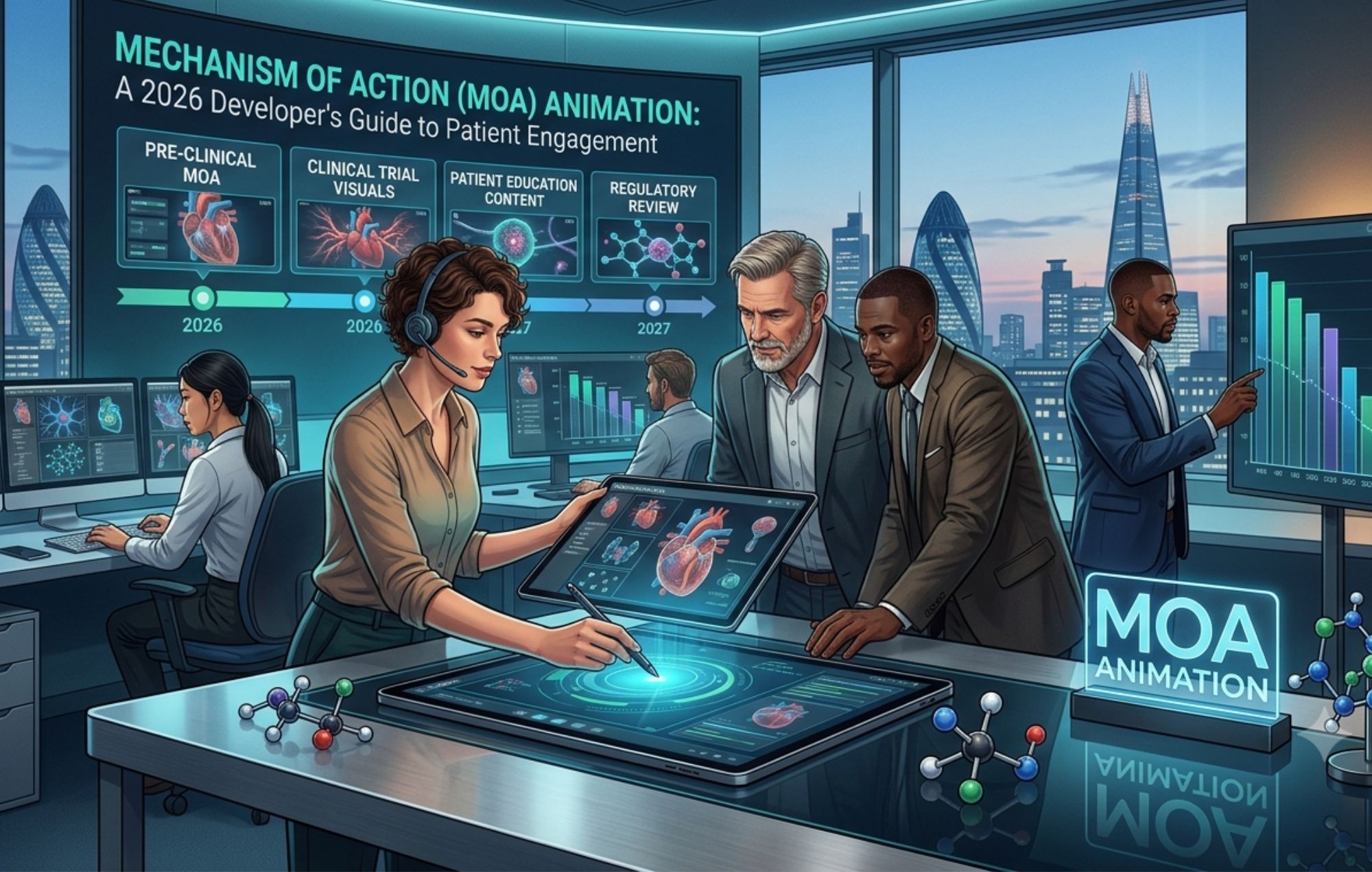
A mechanism of action animation is, in most pharma and biotech organisations, the single most commercially important piece of visual content the company will commission. It is what the sales rep plays when a physician has two minutes. It is what runs on the congress booth display when an HCP walks past. It is what goes into the investor deck when the science has to land in 90 seconds or not at all.
Given that weight, the pricing question — what does an MOA animation actually cost — is one of the most consistently misunderstood in the industry. Quotes range from $5,000 to $150,000 for what looks, on the surface, like the same deliverable. This guide explains why the range exists, which tier fits which use case, what determines timeline, and what a studio actually needs from you when you brief a project.
What MOA Animation Is — and the Three Things It Has to Do
A mechanism of action video is a short 2D or 3D animation that shows how a drug, biologic, or therapy works at the cellular or molecular level. The standard sequence: the molecule enters the body, travels to the target site, binds to its receptor, triggers downstream cellular events, and produces a therapeutic outcome. Standard runtime for an HCP-facing MOA is 90–120 seconds — long enough to carry the key scientific message, short enough for the attention span of a busy prescriber.
The animation has to accomplish three things simultaneously, and the tension between them is what makes it difficult and expensive to do well:
Scientific accuracy. Every frame represents a biological claim. An MOA sequence that misrepresents receptor binding, overstates downstream effects, or implies efficacy beyond the approved label is not just a quality problem — for promotional content in the UK, it is a potential ABPI Code of Practice breach. For content supporting an FDA or EMA submission, it is a regulatory filing issue. The studio's science review process is not overhead — it is the point.
Visual clarity. The mechanism being shown is, by definition, invisible to the naked eye. The animation must make it comprehensible to an audience that ranges from specialist HCPs to general investors to patients, depending on the use case. Molecular complexity that is visually accurate but unintelligible to its intended audience has failed at its commercial purpose.

Regulatory compliance. For promotional use in the UK, ABPI and MHRA advertising rules apply. For US use, FDA requirements govern what can be claimed in a sales aid. For congress presentations, platform-specific rules apply. The same animation may need different versions for different markets or audiences, and those differences affect both production scope and cost.
MOA Animation Cost in 2026 — The Real Ranges
The price spread in MOA animation is wider than in almost any other production category. Here is what the market actually looks like across tiers, based on published pricing from studios active in 2026:
Tier 1: Investor and Early-Stage Content (2D, $5,000–$15,000)
What it is: A 2D MOA animation using motion graphics and illustration to explain a mechanism or pathway. Typically 30–90 seconds. Scientifically accurate but not molecularly detailed — the level of visual depth appropriate for an investor audience that needs to understand the mechanism without needing to evaluate it at the level of a clinician.
Who it's for: Biotech startups and early-stage pharma companies using MOA animation in investor decks, pitch presentations, grant applications, and Series A/B fundraising. Also appropriate for internal team alignment on mechanism early in development.
What drives the cost: Script complexity, whether the studio builds the science from scratch or from your existing materials, number of revision rounds, and whether voiceover and music are included. A single-pathway 2D animation with a clear brief and existing reference materials lands at the lower end; a multi-pathway animation requiring original scientific illustration from published literature lands higher.
Timeline: 4–6 weeks from a complete brief.
Tier 2: HCP Education and Congress Content (3D, $15,000–$40,000)
What it is: A 3D MOA animation with true molecular and cellular detail, considered lighting, and a level of scientific specificity appropriate for a healthcare professional audience. Typically 60–120 seconds. Used for physician detailing, sales force enablement tools, congress booth display, KOL engagement, and medical affairs presentations.
Who it's for: Pharma companies in late-stage development or post-launch building the HCP-facing content suite. Biotech companies preparing for first HCP engagement at major congresses such as ESMO, ASH, or ASCO.
What drives the cost: The leap from Tier 1 to Tier 2 is primarily the science review investment. A 3D MOA built for HCP use requires access to protein structure databases, review against published pharmacology literature, on-screen citation capability, and a studio science team qualified to evaluate the biological accuracy of every rendered sequence. Studios without in-house science review cannot consistently produce HCP-grade work — and the cost difference between tiers reflects this infrastructure difference.
Timeline: 8–12 weeks from a complete brief. A key determinant is the client's internal review process — plan to start production at least 12 weeks before any hard congress or launch deadline.
Tier 3: Full Promotional Launch Package (3D, $40,000–$150,000+)
What it is: A comprehensive MOA production for a pharmaceutical product launch — the hero animation and its full derivative suite: HCP-facing main cut, patient-facing simplified version, sales rep tablet tool, congress loop, social media cuts, and often a VR or interactive version for advisory board use. In the UK, this tier requires full ABPI Code compliance, MLR review at each production stage, and certification before any promotional use.
Who it's for: Top-tier pharma companies commissioning the core visual asset for a brand launch. The animation produced at this tier is not a single video — it is the visual foundation that every other promotional channel will reference for the life of the product.
What drives the cost: Beyond the science review and production quality of Tier 2, launch-package MOA production involves multiple MLR review cycles (each substantive revision may restart the certification process under the 2024 ABPI Code), multiple regional versions for different regulatory markets, legal review of every on-screen claim, and often 15–20 weeks of structured production time. The cost is not inflated — it reflects what it actually takes to produce a compliant, globally distributable pharmaceutical promotional asset.
Timeline: 12–20 weeks. Plan to engage a studio 16 weeks minimum before your launch deadline if ABPI-compliant promotional content is required.
The Four Use Cases and What Each Actually Needs
Understanding which use case your MOA animation serves determines which tier is appropriate — and briefing the wrong tier is the most common source of both overspending and underdelivering.
Investor Pitch and Fundraising
The investor audience does not need molecular-level biological accuracy — it needs to understand the mechanism well enough to evaluate the scientific differentiation of the asset and the plausibility of the therapeutic claim. A 2D animation that communicates the mechanism clearly and the differentiation compellingly does this job. A full 3D launch-quality MOA at $60,000 does the same job at 4–12x the cost.
What matters here: script clarity, visual simplicity, and whether the animation makes the "why is this different" argument clearly in the first 30 seconds. Our guide to medical animation for clinical skills training covers the principles that apply across all medical animation briefs, including investor content.
Congress and Tradeshow Booth
Congress MOA content has a specific viewing context: a busy HCP walking past a booth display with 15–30 seconds of attention before deciding whether to stop. The animation must work without audio (captioned or on mute in a noisy environment), communicate the core mechanism in the opening 20 seconds, and sustain enough visual interest to keep the HCP at the display through to the key differentiation message.
This use case sits firmly in Tier 2 — 3D quality appropriate for clinical audiences, but not necessarily the full MLR compliance infrastructure required for a sales aid used by a rep in a one-on-one physician call. Congress content has its own regulatory considerations (ABPI Code Clause 23 for UK events) but a different certification pathway from promotional sales materials.
Sales Force and Rep Tablet Tools
This is where full Tier 3 compliance applies in the UK. An animation used by a pharmaceutical sales representative in a physician call is a promotional material under the ABPI Code — it must be MLR-approved, certified, and updated whenever the approved label changes. Every on-screen claim must be substantiated and referenced. This is the use case where the production process is as important as the production quality, because a rep tool that fails MLR review cannot be deployed regardless of how good it looks.
Medical Affairs and KOL Engagement
Medical affairs MOA content — for advisory boards, KOL scientific exchange, and medical education programmes — sits in a different regulatory category from promotional content. It is governed by non-promotional standards and does not require ABPI Code promotional certification, but it does require a higher scientific standard than investor content: KOLs will evaluate biological accuracy against their own clinical and research expertise. This use case typically sits between Tier 2 and Tier 3 in both scientific rigour and cost.
What Actually Determines the Cost of Your MOA
Across all tiers, five variables drive cost more than any other factor:
Mechanism complexity. A single-target, single-pathway mechanism — drug binds to receptor, receptor is blocked, downstream effect follows — is straightforward to animate. A multi-target biologic showing simultaneous engagement of multiple pathways, immune signalling cascades, and downstream effects across different cell types is materially more complex. Every additional element in the mechanism adds science review time, modelling time, and render time.
Audience specificity. The more technically sophisticated the audience, the more molecularly accurate the animation must be — which means more investment in science review and in the 3D modelling of protein structures, receptor conformations, and cellular environments. An investor audience tolerates a simplified schematic; a room of oncologists does not.
Review cycles. MLR review is the largest single variable in promotional content cost. Each substantive revision — a changed claim, a corrected biological sequence, a modified voiceover line — may require another full MLR cycle before the animation can be deployed. Studios that structure production to minimise MLR cycles (locking scientific accuracy at storyboard before animation begins) produce significantly lower total costs than those that produce first and review later.
Derivative versions. A single master animation repurposed into six channel-specific versions — HCP long cut, patient short cut, congress loop, social media vertical, rep tablet tool, investor deck clip — is significantly more cost-efficient than commissioning each version separately. But it requires the master to be produced with all derivative uses in mind from the outset, which affects the brief and the production plan.
Timeline pressure. Rush delivery on a complex MOA is expensive — not because studios charge arbitrary premiums, but because compressing the science review and revision process generates either higher cost (more parallel resources) or higher risk (less thorough review). A studio that agrees to produce a compliant promotional MOA in four weeks for a launch in six weeks is either cutting corners or quoting something that will require significant rework.
How to Brief an MOA Animation Studio — The Checklist
A precise brief produces a more accurate quote, a faster production process, and a final animation that matches the original intent. The two biggest sources of MOA project cost overruns are vague briefs and late-stage scientific corrections. Both are addressable at the brief stage.
Science and mechanism:
The drug name, mechanism, and indication (approved or in development)
The key mechanism steps you need visualised — in plain English, not just a summary of the SmPC
Any existing reference materials: published pharmacology papers, protein structure data (PDB files if available), existing slides or diagrams showing the mechanism
The claims that must be supported — and the references that support them
Any molecular elements that are proprietary or unpublished (affects what the studio can source from public databases)
Audience and use case:
Primary audience: investors, HCPs (specialist vs. general), patients, internal sales team
Intended deployment: investor deck, congress booth, rep tablet, patient portal, advisory board, regulatory submission
Whether the content is promotional or non-promotional (determines regulatory framework)
Markets where it will be used (UK ABPI, US FDA, EU EMA, or multi-market)
Format and technical:
Target runtime (90–120 seconds is industry standard for HCP content)
2D or 3D (if undecided, your studio should advise based on audience and budget)
Whether derivative versions are needed and for which channels
File format requirements (MP4, MOV, VR-ready, interactive platform)
Voiceover language and any accessibility requirements (captions, audio description)
Production:
Hard deadline — specifically, is there an MLR submission date, a congress date, or a launch date that cannot move
Your internal review process — who needs to approve at each stage and what that cycle looks like
Budget range — even a rough range allows a studio to scope appropriately rather than quoting blind
The Brief Quality Test
Before sending a brief to any studio, answer this question: if the studio produced exactly what the brief describes, would you be happy with it?
A brief that says "we need an MOA animation showing how our drug works, approximately 90 seconds, for use at ESMO" will produce a quote that is meaningless for comparison — because different studios will make completely different assumptions about scientific depth, visual style, MLR compliance, and derivative deliverables. The quote you receive back is not comparable across studios because they are not quoting the same thing.
A brief that specifies the mechanism steps, the HCP audience specialisation, the congress booth use case, the need for a simultaneous patient-facing simplified version, the ABPI compliance requirement, and the October submission deadline will produce quotes that are meaningfully comparable — and will produce a final animation that matches the intent without a 10-week rework cycle. For guidance on how to structure a studio brief effectively, our guide to briefing a 3D animation studio covers the principles that apply across all animation categories.
Where Chasing Illusions Studio Fits
We produce 3D medical animation including MOA content, mechanism of disease visualisation, surgical procedure animation, and medical device mechanism video. Our work sits primarily in the Tier 1–2 range: investor pitch content, internal medical education, congress-adjacent materials, and non-promotional MedTech explainers — at a price point typically 30–40% below equivalent US or UK studio rates for comparable output quality.
For full ABPI-compliant promotional MOA requiring UK MLR review and promotional certification, we recommend studios with that specific process infrastructure. For the broader category of medical animation where regulatory burden is lower — clinical education, patient pathways, device training, non-promotional biotech content — our science review process and 3D production capability are directly relevant. Our medical animation work covers the full range of what we produce.
Frequently Asked Questions
How much does MOA animation cost in 2026?
2D MOA animation for investor or early-stage use starts at $5,000–$15,000. 3D MOA for HCP and congress use runs $15,000–$40,000. Full ABPI-compliant promotional launch packages run $40,000–$150,000+ depending on complexity, number of derivative versions, and MLR revision cycles. The largest single cost driver is the science review and regulatory compliance process — not the animation production itself.
How long does an MOA animation take to produce?
4–6 weeks for a 2D investor-pitch animation from a complete brief. 8–12 weeks for a 3D HCP-facing MOA. 12–20 weeks for a full ABPI-compliant promotional launch package. Plan to engage a studio at least 16 weeks before any hard launch or congress deadline if MLR review is required.
What is the ideal length for an MOA animation?
90–120 seconds is the industry standard for an HCP-facing MOA — long enough to carry the key mechanistic message, short enough for a prescriber's attention span. Investor-pitch content can be shorter (30–60 seconds). Patient education content is typically 60–90 seconds with simpler language and visual style.
What does a studio need from me to quote a MOA project?
At minimum: the drug name and mechanism, the intended audience, whether the content is promotional or non-promotional, the markets where it will be used, the target runtime, whether derivative versions are needed, and your hard deadline. A budget range — even approximate — allows the studio to scope appropriately rather than quoting blind.
Can MOA animation be repurposed across multiple channels?
Yes — and it should be planned from the outset. A master 3D MOA animation can be adapted into an HCP long cut, patient short cut, congress loop, sales rep tablet tool, social media vertical, and investor deck clip. Repurposing a master produced with derivative versions in mind costs significantly less than commissioning each version separately.
What is the difference between 2D and 3D MOA animation? 2D MOA uses motion graphics and illustration — cleaner, faster to produce, appropriate for investor and patient audiences where molecular-level biological detail is less important than conceptual clarity. 3D MOA renders true molecular and cellular environments — appropriate for HCP audiences and regulatory submissions where biological accuracy is being evaluated. 2D starts at $5,000; 3D starts at $15,000. Both can achieve scientific accuracy — the choice is about visual depth and audience expectation, not about quality.
Book a discovery 20-minutes strategy call.
📞 +91-9910911696 | +91-9910660851
📩 info [@] chasingillusions [.] in
Written by Deepak, content strategist at Chasing Illusions Studio. Our clients include DLF, Emaar, Ganga Reality, Banner Boswell, Shapoorji Pallonji, EC World, Taj, Florida Hospital, etc., 100+ companies across India, USA, Thailand, and the UK.
Last Updated: Aug 06 2026 | Chasing Illusions Studio
Chasing Illusions Studio
Premium animation & video production studio based in Delhi, India. Specialising in 3D animation, medical visualisation, architectural walkthroughs, and CGI.