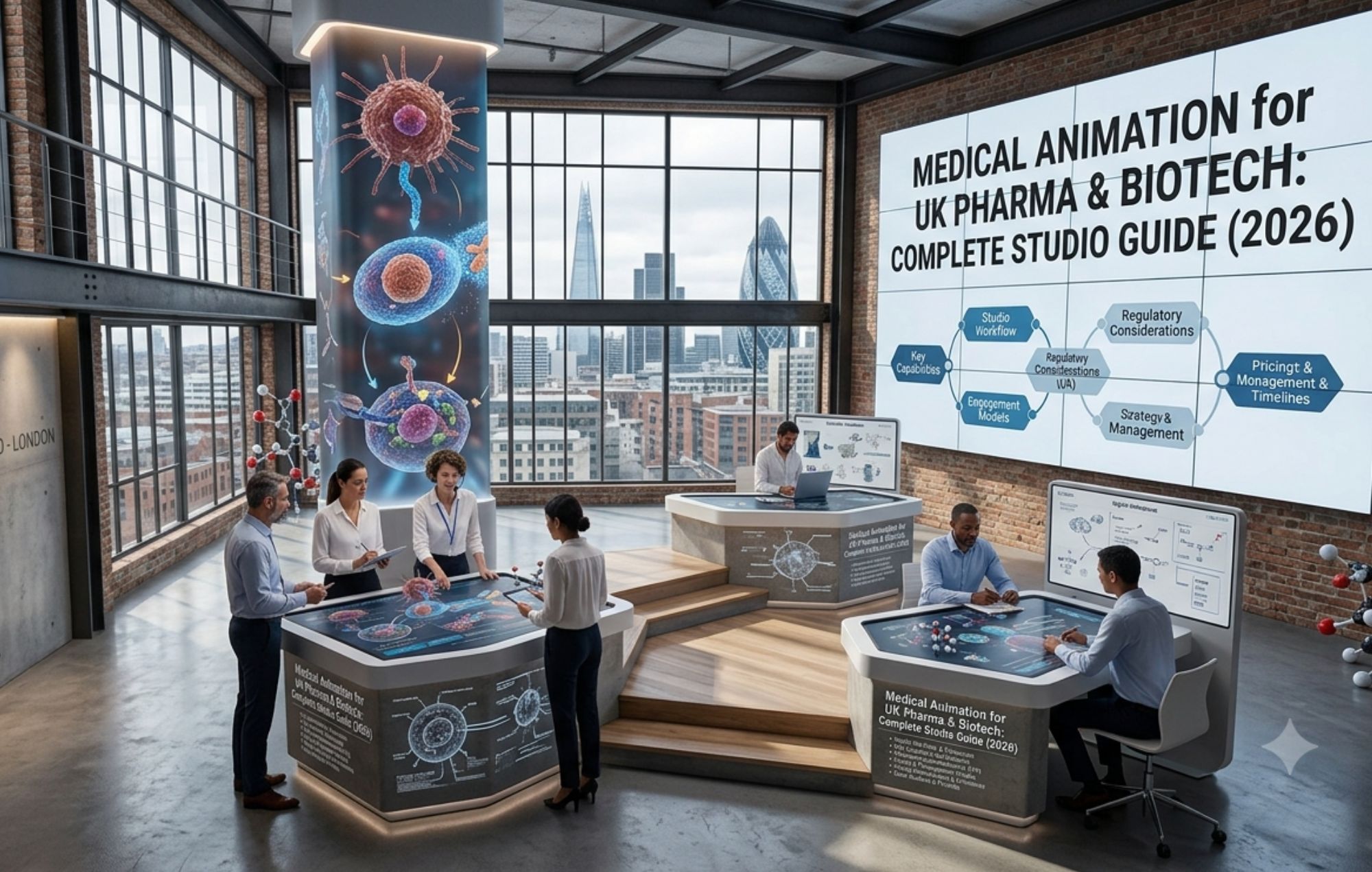
The global medical animation market is valued at approximately $863 million in 2026 and growing at a CAGR of 19.2% through 2033, driven by increasing complexity in pharmaceutical treatments, regulatory demand for visual evidence, and the shift toward digital health education. For UK organisations — pharma companies, medical device manufacturers, NHS trusts, and life science startups — this creates both an opportunity and a sourcing challenge: the demand for high-quality, scientifically accurate animation is growing faster than the pool of qualified studios capable of delivering it.
This page covers what medical animation in the UK actually involves, what it costs, what to look for when evaluating a studio, and why a growing number of UK clients are working with India-based studios without compromising on clinical accuracy or regulatory compliance.
What Medical Animation Is Used For in the UK
Medical animation serves different purposes depending on who commissions it. UK clients broadly fall into four categories:
Pharmaceutical companies commission mechanism of action (MOA) animations to explain how a drug interacts with biological targets, supports regulatory submissions, and trains sales representatives. According to the Association of the British Pharmaceutical Industry, global pharmaceutical R&D investment has maintained a CAGR of 6.6% in recent years — each new molecule in development represents a potential animation brief.
Medical device manufacturers use animation for MHRA submissions, CE Mark documentation, surgeon training, and patient consent materials. A device that cannot be clearly visualised is harder to approve, harder to sell, and harder to use correctly.
NHS trusts and healthcare providers commission patient education animations to improve understanding of procedures, treatments, and chronic disease management. A 2024 meta-analysis in BMC Medical Education across 39 trials and 2,959 participants found that 3D visualisation tools significantly improved test scores, engagement, and learner satisfaction.
Life science startups use medical animation for investor presentations and fundraising — a 90-second animation that clearly communicates a novel therapeutic mechanism is often the most effective single asset in a Series A pitch.
What Medical Animation Costs in the UK
Pricing in the UK medical animation market varies significantly by studio tier, clinical complexity, and production scope. Based on published UK market rates as of 2026:
Service | UK Studio Range | India-Based Studio Range |
|---|---|---|
MOA / drug mechanism animation (60 sec) | £8,000 – £18,000 | £4,500 – £10,000 |
Medical device demonstration (90 sec) | £10,000 – £22,000 | £5,500 – £12,000 |
Surgical procedure walkthrough (2 min) | £15,000 – £35,000 | £8,000 – £18,000 |
Patient education animation (60–90 sec) | £6,000 – £14,000 | £3,500 – £8,000 |
Regulatory-grade submission package | £20,000 – £45,000 | £11,000 – £25,000 |
The cost differential between UK-based and India-based studios at equivalent quality tiers is typically 40–50%. For UK clients managing tight development budgets — particularly startups and early-stage medtech companies — this is a meaningful difference.
The note on pricing from Educational Voice's March 2026 healthcare animation guide is worth bearing in mind: "Healthcare and regulated-sector projects carry a cost premium above general commercial rates, reflecting SME review, compliance sign-off, and accuracy verification." The premium is justified — accuracy in medical animation is not a stylistic preference, it is a regulatory requirement and a clinical responsibility.
What Separates Medical Animation from General Commercial Animation
The distinction matters more in this category than any other. A medical animation that is visually impressive but anatomically inaccurate is not just poor quality — it is a liability. Errors in a patient education animation can influence treatment decisions. Errors in a device training animation can affect clinical practice.
Three production requirements differentiate genuine medical animation studios from general studios attempting medical briefs:
Physician review process. Scientific accuracy must be validated by qualified medical professionals, not just checked by the production team. A studio without a formal physician review stage is not suited for regulated-sector work.
Regulatory literacy. For MHRA submissions, CE Mark documentation, or FDA materials (for UK companies with US market ambitions), the animation must align with the specific visual evidence requirements of each regulatory pathway. Studios unfamiliar with these frameworks produce animations that look right but fail submission review.
Anatomical library and reference standards. Medical animation requires access to verified anatomical models, cellular structures, and biological pathway data. Studios working from general reference images rather than peer-reviewed anatomical sources introduce error risk at the modelling stage.
At Chasing Illusions Studio, every medical animation goes through a physician review stage before final delivery. Our production team works from peer-reviewed anatomical references and verified biological data, and our work has supported regulatory submissions for medical device companies seeking both MHRA and FDA documentation. For UK clients looking for a full breakdown of our medical animation services and examples, the portfolio and process guide is available on the service page.
Why UK Clients Are Working with India-Based Studios
The practical case for offshore medical animation comes down to three factors.
Cost. A 40–50% reduction in production cost at equivalent quality tier means UK pharma startups can commission a full MOA animation that would otherwise be out of reach for their current development budget.
Production scale. An 80-plus artist team operating across Indian business hours provides production capacity that most UK boutique studios cannot match. For clients with tight launch timelines or multiple concurrent animation briefs, this is operationally significant.
Multilingual capability. For UK pharmaceutical companies operating across European or Asian markets, multilingual narration — French, German, Arabic, Hindi, Mandarin — from the same production pipeline is a practical advantage that UK-only studios rarely offer as standard.
The operational trade-off is real: India-based studios cannot provide in-person meetings at your London office. For clients who value face-to-face relationship management as a standard expectation, the cost saving may not outweigh the preference. For clients with structured review processes and clear briefs, the model works consistently.
How to Choose a Medical Animation Studio in the UK
Ask specifically about their physician review process. Not "do you ensure accuracy" — but "at which production stages does a qualified medical professional review the work, and what credentials do they hold?"
Request examples in your specific therapeutic area or device category. A studio with strong oncology MOA work may not have relevant experience in orthopaedic device visualisation. Portfolio relevance to your specific brief matters more than general impressiveness.
Confirm regulatory experience. If your animation needs to support an MHRA submission or a CE Mark application, ask whether the studio has previously produced animation for this regulatory purpose and whether they understand the specific format requirements.
Clarify revision rounds and what triggers additional charges. Medical animation typically involves more revision cycles than commercial animation, due to clinical feedback from physician reviewers and regulatory alignment checks. Get this in writing before production starts.
Frequently Asked Questions
How long does medical animation take to produce?
A standard 60–90 second MOA or device animation typically takes 6–10 weeks from confirmed brief to final delivery, including physician review cycles. Surgical procedure animations and regulatory-grade packages take 10–16 weeks. Rush delivery is possible at a premium but adds risk to clinical accuracy review timelines.
Can the same animation be used for multiple purposes?
Yes, and this is one of the strongest arguments for investing in quality production. A well-produced MOA animation can serve regulatory submissions, sales representative training, physician education, patient consent materials, and investor presentations — with minor adaptations for each context. Modular production (where individual scenes are built to be isolated and reused) maximises this value.
Do UK regulatory authorities require animation?
No. Neither the MHRA nor the EMA mandates animation. However, animation is increasingly accepted — and in some cases preferred — for complex device or biological mechanism evidence. Studios experienced in regulatory submissions understand what level of scientific specificity and labelling consistency each authority expects.
What is the difference between MOA animation and patient education animation?
Mechanism of action (MOA) animation is primarily for professional audiences — physicians, regulators, investors — and requires the highest level of scientific precision. Patient education animation prioritises clarity and emotional accessibility over technical depth, and is typically reviewed by patient advocacy groups or clinical communications specialists rather than specialist physicians.
Ready to discuss your medical animation project?
Contact Chasing Illusions Studio for a consultation and quote within 24 hours. We serve UK pharmaceutical companies, medtech manufacturers, NHS trusts, and life science startups from our production facility in Delhi, with UK-hours communication available.
Book a discovery 20-minutes strategy call.
📞 +91-9910911696 | +91-9910660851
📩 info [@] chasingillusions [.] in
Written by Deepak, content strategist at Chasing Illusions Studio. Our clients include DLF, Emaar, Ganga Reality, Banner Boswell, Shapoorji Pallonji, EC World, Taj, Florida Hospital, etc., 100+ companies across India, USA, Thailand, and the UK.
Also read:
Chasing Illusions Studio
Premium animation & video production studio based in Delhi, India. Specialising in 3D animation, medical visualisation, architectural walkthroughs, and CGI.