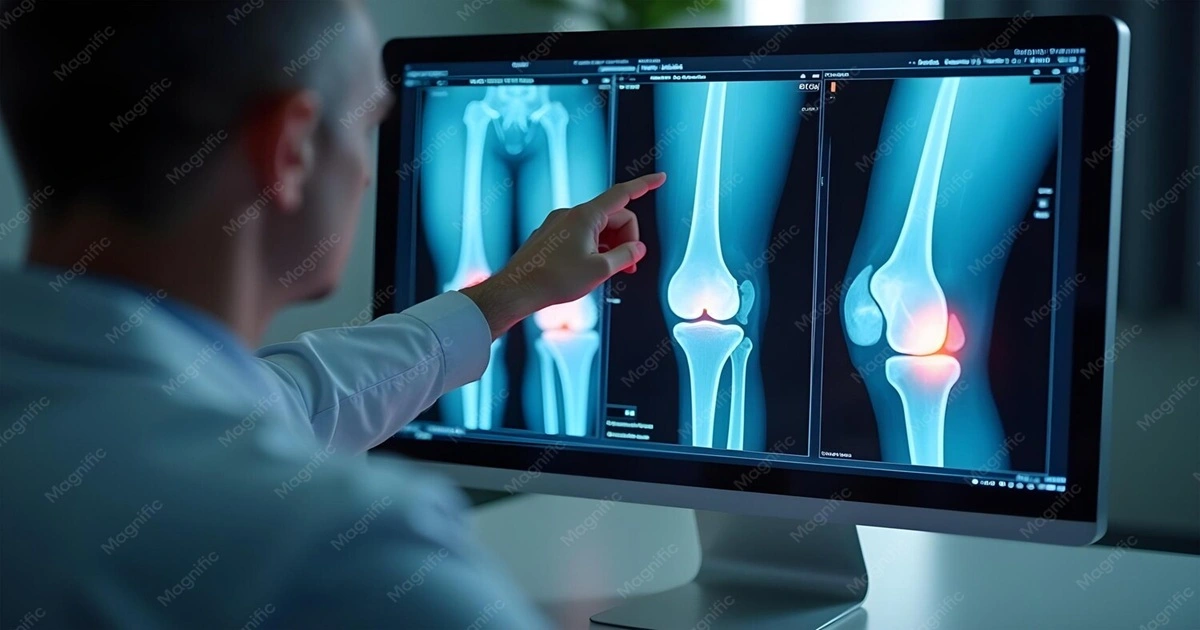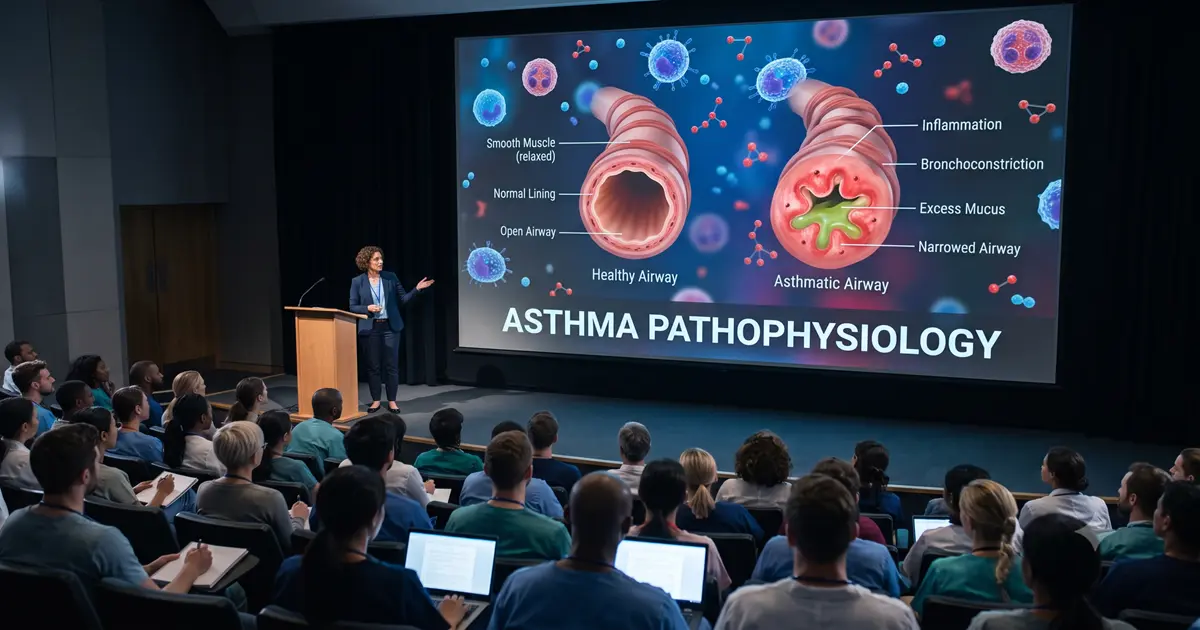
Imagine launching a breakthrough biotechnology product that took years of research to develop—only to lose your audience because the science is too complex to explain in a few slides. For many biotech and life sciences companies, the challenge is not the innovation itself; it is communicating what happens inside a cell, molecule, protein, or biological system clearly enough for people to understand.
3D Biotechnology Animation for Product Launch addresses this communication gap by turning complex biological mechanisms, research findings, technologies, and product concepts into structured visual stories. Instead of relying entirely on technical diagrams or dense presentations, biotechnology companies can use animation to show processes that cannot be directly seen.
From mechanism-of-action visualization and molecular processes to product demonstrations, investor presentations, trade shows, websites, and sales enablement, 3D scientific visualization can make sophisticated biotechnology concepts easier to follow without oversimplifying the underlying science.
What Is 3D Biotechnology Animation?
3D biotechnology animation is the use of three-dimensional modeling, scientific visualization, animation, and visual storytelling to represent biological systems, molecular interactions, laboratory processes, biotechnology products, and scientific concepts.
Unlike conventional product videos, a biotech animation may visualize things that are microscopic, invisible, abstract, or impossible to film directly.
For example, an animation can depict:
Molecular interactions between proteins and targets
Cellular signaling pathways
DNA and RNA processes
Gene-editing concepts
Protein folding or structural changes
Drug-target interactions
Delivery mechanisms
Cell-based processes
Laboratory workflows
Biopharmaceutical manufacturing concepts
Medical device functionality
Research and development processes
This makes 3D biotech animation particularly valuable when the audience needs to understand how something works, rather than simply seeing what the product looks like.
The FDA describes biological products as including diverse products such as vaccines, gene therapy products, cells, tissues, recombinant therapeutic proteins, and other products that may be produced using biotechnology methods.
That diversity also explains why biotechnology product visualization needs to be tailored to the specific scientific concept, audience, and communication objective.
Why Biotechnology Products Are Difficult to Market?
Biotechnology marketing has a communication problem that many conventional industries do not face.
A consumer product can often be demonstrated by showing it in use. A biotechnology product may depend on molecular interactions, cellular behavior, genetic modification, biochemical pathways, or other processes that cannot be captured with a conventional camera.
A typical biotech product presentation might include:
Scientific terminology
Research data
Molecular diagrams
Technical specifications
Microscopy images
Charts and graphs
Clinical or laboratory information
Product development stages
Complex biological pathways
These materials can be essential for scientific audiences but difficult for investors, business-development teams, prospective partners, customers, or non-specialist stakeholders to interpret quickly.
This is where scientific animation becomes useful.
Instead of asking an audience to mentally construct a three-dimensional process from a two-dimensional diagram, animation can establish the environment, introduce the biological components, demonstrate movement, and explain the sequence step by step.
Research on molecular visualization has highlighted its value for communicating molecular structures and processes, while more recent work emphasizes the importance of carefully designing molecular motion and interactions to avoid misleading viewers.
How 3D Biotechnology Animation for Product Launch Works?
A successful 3D Biotechnology Animation for Product Launch should not begin with animation software. It should begin with the scientific communication objective.
A typical workflow includes the following stages.
1. Define the Scientific Communication Goal
First, determine what the audience needs to understand.
For example:
What is the product?
What biological problem does it address?
How does the technology work?
What mechanism should be visualized?
Which product features need demonstration?
What differentiates the technology?
Which scientific information must be presented accurately?
This prevents the animation from becoming visually impressive but scientifically unfocused.
2. Identify the Target Audience
The same biotechnology product may need different explanations for different audiences.
A scientific communications team may require greater technical detail, while an investor presentation may focus more on the technology platform and development concept.
Possible audiences include:
Scientists and researchers
Physicians and healthcare professionals
Investors
Business-development teams
Potential partners
Product marketing teams
Sales representatives
Distributors
Students and trainees
General audiences
Audience knowledge should influence terminology, visual complexity, narration, pacing, and the amount of scientific detail.
3. Build a Scientifically Accurate Storyboard
The storyboard converts the scientific information into a visual sequence.
For example:
Problem → Biological context → Product introduction → Mechanism → Interaction → Result → Product value → Closing message
The storyboard should clearly distinguish between:
Established scientific facts
Hypotheses
Simplified representations
Simulated processes
Conceptual visualizations
This distinction is particularly important in healthcare and biotechnology marketing.
4. Develop 3D Scientific Assets
The next stage involves creating or adapting scientific models.
Depending on the project, these may include:
Cells
Proteins
DNA
RNA
Receptors
Antibodies
Enzymes
Molecules
Viruses
Tissues
Medical devices
Laboratory equipment
Manufacturing environments
Molecular visualization can represent both structure and dynamic interactions, but scientific animation requires deliberate visual choices because audiences may otherwise interpret artistic representations as literal biological behavior.
5. Animate the Biological Process
Animation brings the scientific concept to life.
For example, a mechanism-of-action sequence might show:
Product introduction
Movement toward a biological target
Recognition or binding
Molecular interaction
Cellular response
Downstream pathway
Intended biological concept
The animation can use camera movements, transitions, magnification, labels, cross-sections, transparency, and controlled pacing to guide attention.
6. Add Scientific Narration and Graphics
Voice-over, on-screen labels, diagrams, captions, and callouts can reinforce important information.
For international audiences, the same core animation can potentially be adapted with:
Different narration
Subtitles
Multiple languages
Audience-specific terminology
Shorter marketing cuts
Technical versions
Presentation-specific edits
7. Scientific and Regulatory Review
Before publication, the animation should be reviewed by appropriate scientific and regulatory stakeholders.
This is especially important when the content discusses:
Therapeutic products
Disease mechanisms
Clinical outcomes
Safety
Efficacy
Product claims
Mechanisms of action
Comparative claims
The FDA notes that promotional communications for regulated products must not be false or misleading, making scientific and regulatory review an important part of responsible biotech communication.
Key Applications of Biotechnology Animation
Mechanism of Action Visualization
One of the most valuable applications is mechanism of action animation.
A mechanism of action can involve multiple biological stages that are difficult to communicate through static graphics.
3D animation can show:
Target recognition
Molecular binding
Receptor interactions
Cellular signaling
Enzyme activity
Protein interactions
Transport mechanisms
Immune responses
Genetic processes
The goal is not to claim that animation proves efficacy. Rather, it provides a visual model of the scientific mechanism or proposed process being communicated.
Molecular Animation and Visualization
Molecules are often too small and complex to understand intuitively.
Molecular animation can represent:
Molecular structures
Protein interactions
Binding events
Conformational changes
Molecular transport
Protein complexes
DNA/RNA interactions
Drug-target relationships
Recent scientific literature describes molecular visualization as an increasingly important medium for interpreting and communicating complex molecular systems, with newer approaches incorporating dynamic and data-integrated representations.
Cell Biology Animation
Cell biology animation can visualize processes occurring inside or between cells.
Possible sequences include:
Cell signaling
Cellular uptake
Protein synthesis
Intracellular transport
Immune-cell interactions
Cell division
Gene expression
Cellular communication
Earlier educational research found that animations can help learners visualize molecular and cellular processes that are difficult to represent with conventional two-dimensional materials.
Biotechnology Product Demonstration
Some biotech products involve sophisticated technologies that cannot be effectively demonstrated through conventional video.
A biotechnology product animation can show:
Product architecture
Components
Workflow
Usage concept
Interaction with biological systems
Laboratory processes
Manufacturing concepts
Technical functionality
This is particularly useful for B2B marketing where prospective customers may need to understand the technology before engaging with a sales team.
Genetic Engineering Visualization
Genetic engineering involves laboratory technologies used to alter an organism's DNA, including adding, deleting, or changing DNA sequences.
Animation can visually explain concepts such as:
DNA modification
Gene insertion
Gene editing
Vector-based delivery concepts
Genetic sequencing workflows
Expression of engineered genes
Synthetic biology concepts
Because these processes occur at scales that cannot be directly observed by most audiences, animation can provide a conceptual bridge between technical research and visual communication.
Drug Discovery Visualization
Drug discovery involves multiple stages and scientific disciplines.
A visualization may explain:
Target identification → Screening → Candidate selection → Molecular interaction → Optimization → Preclinical development
3D scientific visualization can also illustrate molecular structures, target interactions, computational concepts, or laboratory workflows.
The objective should be to communicate the research process accurately rather than imply that visualization itself establishes a product's safety or effectiveness.
Laboratory Process Animation
Laboratory workflows can be difficult to explain using photographs alone.
Animation can demonstrate:
Sample preparation
Testing workflows
Cell culture concepts
Molecular assays
Instrument processes
Research pipelines
Laboratory automation
Sample movement
Analytical workflows
This can be valuable for product education, research presentations, sales enablement, and scientific communications.
How 3D Biotechnology Animation Supports Product Launches?
A biotechnology product launch usually involves multiple communication channels.
The same core animation can be strategically adapted for different touchpoints.
1. Product Launch Videos
A long-form product launch video can introduce the technology, explain the science, and establish the product narrative.
It can combine:
Brand storytelling
Scientific visualization
Product demonstration
Technical animation
Narration
Data visualization
The result is a structured presentation that can move an audience from the problem to the technology and its intended application.
2. Website Product Pages
Scientific concepts can be difficult to explain using website copy alone.
Short animation segments can help demonstrate:
How the technology works
Product architecture
Biological mechanisms
Key processes
Technical workflows
Short clips can also be separated from a larger animation and used across different website sections.
3. Investor Presentations
Biotech investors frequently encounter complex scientific and technical information.
An investor presentation can use animation to visually explain:
Technology platforms
Scientific differentiation
Research pipelines
Mechanisms
Product development concepts
Manufacturing workflows
Market applications
However, animation should support the evidence rather than replace it. Scientific visualization can improve communication, but it should not be used to make unsupported financial, clinical, or scientific claims.
4. Trade Shows and Conferences
Trade-show environments are highly competitive.
A looping 3D animation can communicate a technology visually even when a representative is speaking with another visitor.
For conference presentations, animation can also replace a sequence of static diagrams with a controlled scientific narrative.
Molecular animation has historically been used for conference presentations, research communication, publication-related materials, and teaching.
5. Sales Enablement
Sales teams often need different levels of explanation depending on who they are speaking to.
A modular animation can provide:
A short introductory version
A technical version
Product-specific modules
Mechanism sequences
Workflow demonstrations
FAQ-oriented clips
This allows sales representatives to choose visuals according to the audience's level of scientific knowledge.
Why Visual Storytelling Matters in Biotech Marketing?
The fundamental challenge in biotech marketing is often translation.
Scientists may understand the research because they already know the terminology and biological context. A potential partner or investor may not have the same mental model.
Visual storytelling creates an intermediate layer.
Instead of presenting:
Technical description → Technical diagram → Technical conclusion
the story can become:
Biological problem → Visual context → Technology → Mechanism → Process → Product application
This approach does not eliminate scientific detail. It organizes that detail so the audience can follow it.
Research on molecular visualization has also emphasized that visualization is valuable for scientific communication but requires thoughtful design and appropriate training.
3D Biotechnology Animation vs. Traditional Scientific Graphics
Static graphics remain extremely useful. They are particularly effective for papers, presentations, technical documents, and reference materials.
However, animation adds another dimension: time.
Communication Method | Best Used For |
|---|---|
Scientific illustration | Structures, diagrams, reference information |
Infographics | Data, statistics, comparisons |
Photography | Physical products and laboratories |
Video footage | Real-world processes |
3D animation | Invisible, microscopic, technical, or conceptual processes |
Interactive visualization | Exploration and deeper engagement |
The choice should depend on the communication objective rather than the assumption that animation is always superior.
For example, a simple molecular structure may require only a high-quality illustration. A multi-stage cellular interaction may benefit substantially from animation.
What Makes a High-Quality 3D Biotech Animation?
A professional 3D Biotechnology Animation for Product Launch should balance three elements:
Scientific Accuracy
The visual representation should be based on credible scientific information and reviewed by appropriate subject-matter experts.
Visual Clarity
The audience should immediately understand:
What they are looking at
What is happening
Why it matters
What happens next
Marketing Relevance
The animation should support a defined business objective.
That could be:
Product awareness
Product education
Lead generation
Investor communication
Partner engagement
Sales enablement
Scientific communication
Conference presentation
A beautiful animation without a communication objective can become expensive decoration.
Common Mistakes in Biotechnology Product Animation
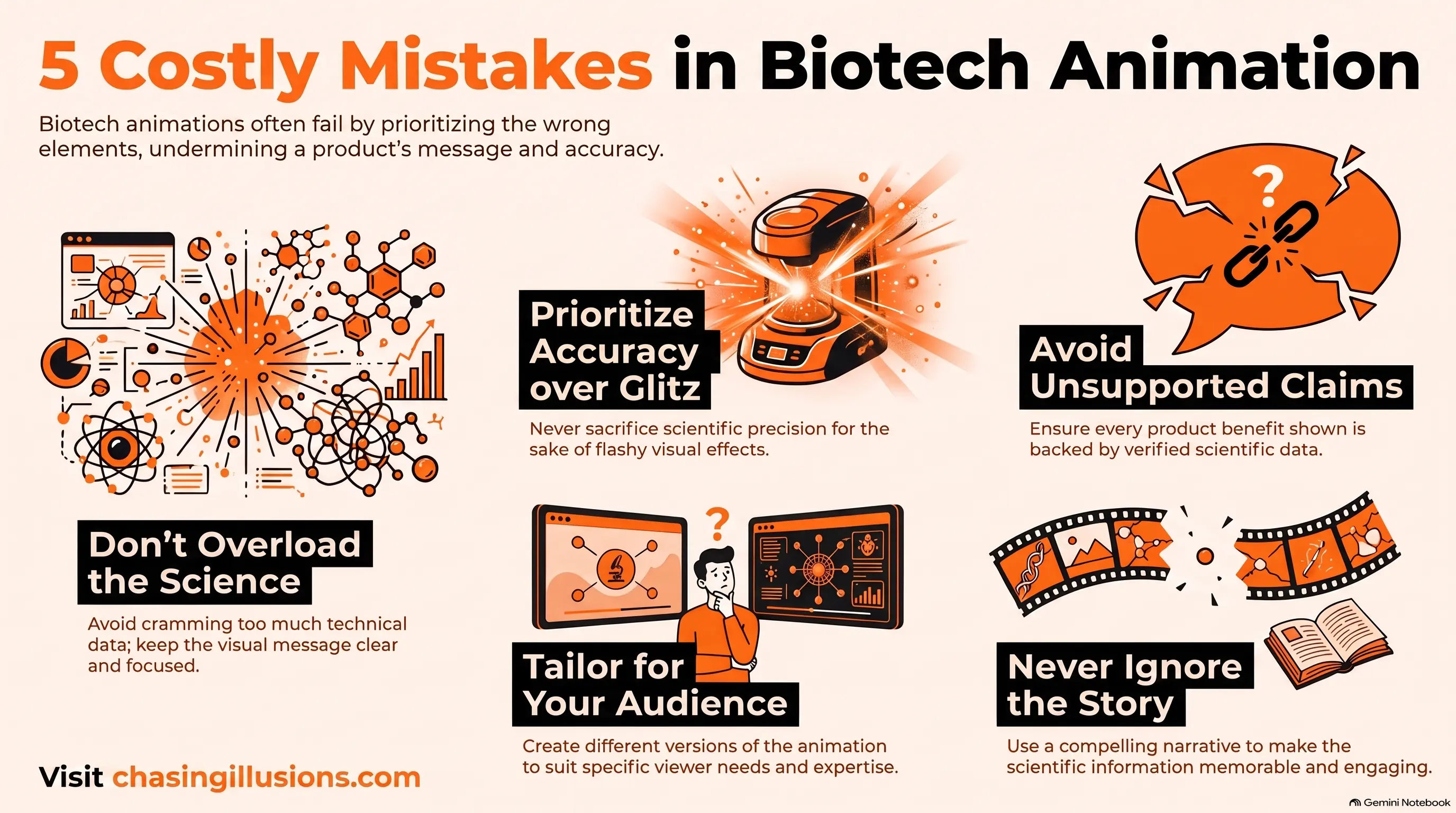
Overloading the Animation With Science
More scientific information does not necessarily mean better communication.
Trying to explain every pathway, molecule, data point, and process in one video can overwhelm the audience.
Sacrificing Accuracy for Visual Effects
Stylized molecular animations can be visually attractive, but artistic choices should not accidentally imply biological behavior that is unsupported by the underlying science.
Making Unsupported Product Claims
Animation should never create the impression that a product is clinically proven, safe, effective, or superior unless the relevant claims are supported and permitted for the intended communication.
The FDA specifically emphasizes the importance of truthful, non-misleading promotional communications for regulated products.
Using the Same Version for Every Audience
A researcher, investor, salesperson, physician, and general website visitor may require very different levels of technical detail.
Ignoring the Story
Scientific animation should not become a sequence of disconnected molecular shots.
There should be a clear beginning, progression, and conclusion.
How to Plan a 3D Biotechnology Animation Project?
Before production begins, answer these questions:
Scientific Questions
What biological process needs to be visualized?
What scientific evidence supports the representation?
Which mechanisms are established?
Which elements are conceptual or simplified?
What needs subject-matter review?
Marketing Questions
What is the primary communication objective?
Who will watch the animation?
What should the audience understand after watching?
Where will the animation be used?
Is it part of a product launch campaign?
Production Questions
What animation duration is required?
Is voice-over needed?
Are subtitles required?
Will multiple versions be created?
Are short social-media cuts required?
What aspect ratios are needed?
What scientific assets or data are available?
Answering these questions early reduces revisions and helps align scientific, creative, and marketing teams.
Where Can Biotechnology Animation Be Used?
A single 3D Biotechnology Animation for Product Launch can potentially become a reusable content asset across multiple channels.
Common applications include:
Company websites
Product landing pages
Product launch campaigns
Investor presentations
Scientific conferences
Trade shows
Sales presentations
Sales enablement platforms
Internal training
Research presentations
Educational content
Social media
Email campaigns
Webinars
Digital advertising
Partner presentations
This makes animation particularly useful for companies that need consistent scientific communication across different audiences and stages of the marketing funnel.
The Role of Scientific Review in Biotechnology Animation
Scientific animation sits between communication and technical interpretation.
That means the production team should work from reliable source material.
Useful inputs can include:
Peer-reviewed research
Published scientific literature
Product documentation
Regulatory documents
Approved labeling
Scientific figures
Molecular structures
Research data
Expert interviews
Internal scientific presentations
The FDA explains that biological products can be complex and that manufacturing, characterization, safety, purity, and potency considerations are important parts of biological product regulation.
For European audiences, the European Medicines Agency similarly describes biological medicines as products whose active substances originate from biological sources and notes their structural diversity, including proteins ranging from relatively simple molecules to complex monoclonal antibodies.
These realities reinforce an important principle: biotechnology visualization should communicate scientific complexity clearly without pretending that complexity does not exist.
3D Biotechnology Animation for Different Business Objectives
For Biotechnology Companies
Use animation to communicate technology platforms, research concepts, product mechanisms, and innovation.
For Biopharmaceutical Companies
Visualize biological products, molecular mechanisms, delivery concepts, manufacturing workflows, and product education.
For Pharmaceutical Companies
Use pharmaceutical product animation to explain mechanisms, molecular interactions, disease biology, and product concepts where appropriate.
For Medical Device Companies
Demonstrate device architecture, workflows, biological interactions, and technical functionality.
For Healthcare Startups
Use concise biotech explainer videos to introduce innovative technologies to potential customers, partners, and investors.
For R&D Teams
Use scientific visualization to communicate research concepts during internal meetings, conferences, presentations, and collaborations.
For Scientific Communications Teams
Create scientifically structured visual assets for education, presentations, publications, conferences, and digital communications.
For Investors and Business Stakeholders
Use biotechnology storytelling to explain complicated technologies without reducing them to unsupported marketing claims.
Frequently Asked Questions About 3D Biotechnology Animation
What is 3D biotechnology animation?
3D biotechnology animation uses three-dimensional modeling and animation to visualize biological systems, molecular processes, biotechnology products, laboratory workflows, and scientific concepts that may be difficult or impossible to film directly.
How can 3D biotechnology animation help a product launch?
It can help explain complex technologies, mechanisms, biological processes, and product concepts through visual storytelling. The resulting content can be adapted for product launch videos, websites, investor presentations, conferences, sales enablement, and educational materials.
What can a biotech animation show?
A biotech animation can show molecules, proteins, cells, DNA, RNA, receptors, biological pathways, laboratory processes, product workflows, medical devices, manufacturing concepts, and other scientific processes.
Can biotechnology animation show a mechanism of action?
Yes. A mechanism-of-action animation can visually represent a proposed or established sequence of biological interactions, such as target recognition, molecular binding, signaling, transport, or downstream cellular processes. The visualization should be based on appropriate scientific evidence and clearly distinguish established facts from conceptual representations.
Is 3D biotech animation useful for investor presentations?
Yes. It can help explain complex technology platforms, research concepts, product mechanisms, and development workflows. However, animation should complement—not replace—scientific evidence, financial analysis, clinical data, or appropriate disclosures.
Can one animation be used across multiple marketing channels?
Yes. A well-planned master animation can often be adapted into shorter clips, presentation sequences, website modules, trade-show loops, sales assets, and educational content.
How long should a biotech product animation be?
There is no universal ideal duration. The appropriate length depends on the scientific complexity, audience, platform, and communication objective. A short marketing video may focus on one concept, while a detailed scientific presentation may require a longer narrative.
Is scientific review necessary?
For scientific and healthcare-related communication, subject-matter review is strongly advisable. Scientific review helps identify inaccuracies, misleading visual assumptions, terminology problems, and unsupported interpretations before publication.
Does animation prove that a biotechnology product works?
No. Animation is a communication medium. It can illustrate a mechanism, process, technology, or scientific concept, but it does not independently establish clinical efficacy, safety, or regulatory approval.
Best Practices for 3D Biotechnology Animation
For the strongest results, follow these principles:
Start with the science, not the visual effects.
Define one primary communication objective.
Identify the audience before developing the storyboard.
Use scientifically defensible visual references.
Separate established evidence from conceptual visualization.
Use animation to explain movement, interaction, and sequence.
Keep scientific terminology appropriate to the audience.
Use narration and labels strategically.
Review scientific and regulatory claims before publication.
Design the master animation for future content reuse.
The design of molecular animation deserves particular care because visual metaphors can influence how viewers interpret molecular agency, movement, and interaction. Recent design research recommends deliberate visual choices to reduce potential misconceptions.
Why 3D Biotechnology Animation Is Becoming More Valuable?
Biotechnology research is becoming increasingly complex, while organizations must communicate that research to increasingly diverse audiences.
Modern molecular visualization is evolving beyond static molecular structures toward dynamic, data-integrated representations that can communicate molecular form, function, motion, and interaction.
At the same time, scientific communication increasingly requires researchers and companies to translate complex data into understandable visual narratives.
This creates an opportunity for biotech companies to treat animation not simply as promotional video production, but as a scientific communication asset.
The most effective approach is not to make the science look simpler than it is. It is to make the science easier to see.
Conclusion: Turn Invisible Biotechnology Into Understandable Stories
A biotechnology product can represent years of research, complex molecular science, sophisticated engineering, and significant investment. Yet none of that matters if the intended audience cannot understand the concept being presented.
3D Biotechnology Animation for Product Launch provides a practical way to bridge that communication gap.
By visualizing molecular interactions, cellular processes, mechanisms of action, laboratory workflows, product technologies, and scientific concepts, animation can transform abstract information into structured visual stories.
The key is to combine scientific accuracy, visual clarity, audience understanding, and responsible marketing communication.
For biotechnology and life sciences companies, the goal should not simply be to create an impressive animation. It should be to create a scientifically grounded visual asset that helps the right audience understand the right idea at the right moment.
That is where professional scientific storytelling can make a meaningful difference. Chasing Illusions Studio can help biotechnology, pharmaceutical, healthcare, and life sciences teams turn complex scientific concepts into engaging 3D visual communication for product launches, presentations, websites, and marketing campaigns.
Looking to visualize your biotechnology product or scientific concept? Explore professional 3D biotechnology animation solutions with Chasing Illusions Studio and discuss your project requirements.
Authoritative Sources & Further Reading
U.S. Food and Drug Administration (FDA): Biological Products & Biologics — FDA explains the scope, complexity, manufacturing considerations, and regulatory framework surrounding biological products.
FDA: Advertising & Promotional Labeling — Useful reference for understanding the importance of truthful and non-misleading promotional communication for regulated products.
National Human Genome Research Institute (NHGRI): Genetic Engineering — Government reference explaining genetic engineering and laboratory-based DNA modification technologies.
European Medicines Agency (EMA): Biosimilar Medicines Overview — Reference covering biological medicines and their structural and biological complexity.
NIH/NCBI: Design Principles for Molecular Animation — Peer-reviewed discussion of molecular visualization, motion, interactions, and design considerations.
NIH/NCBI: A Survey of Educational Uses of Molecular Visualization — Research examining the use of molecular visualization for communicating structural and biological information.
NIH/NCBI: Molecular and Cellular Biology Animations — Research discussing the use of animations to visualize molecular and cellular processes.
PubMed: The Evolving Landscape of Molecular Visualization (2026) — Recent review discussing dynamic, data-integrated molecular visualization and its role in research and communication.
PubMed: Visualization as a Tool for Scientific Research and Communication — Discussion of the growing need for visualization as biological data becomes increasingly complex.
Book a discovery 20-minutes strategy call.
📞 +91-9910911696 | +91 9910660851
📩 info [@] chasingillusions [.] in
Written by Deepak, Healthcare Content Strategist at Chasing Illusions Studio. Our clients include Ambler Surgical, Practo, Bayer, SMT, Novartis, and 100+ healthcare brands across India, USA, Thailand, and the UK.
Last Updated: Aug 12 2026 | Chasing Illusions Studio.
Chasing Illusions Studio
Premium animation & video production studio based in Delhi, India. Specialising in 3D animation, medical visualisation, architectural walkthroughs, and CGI.