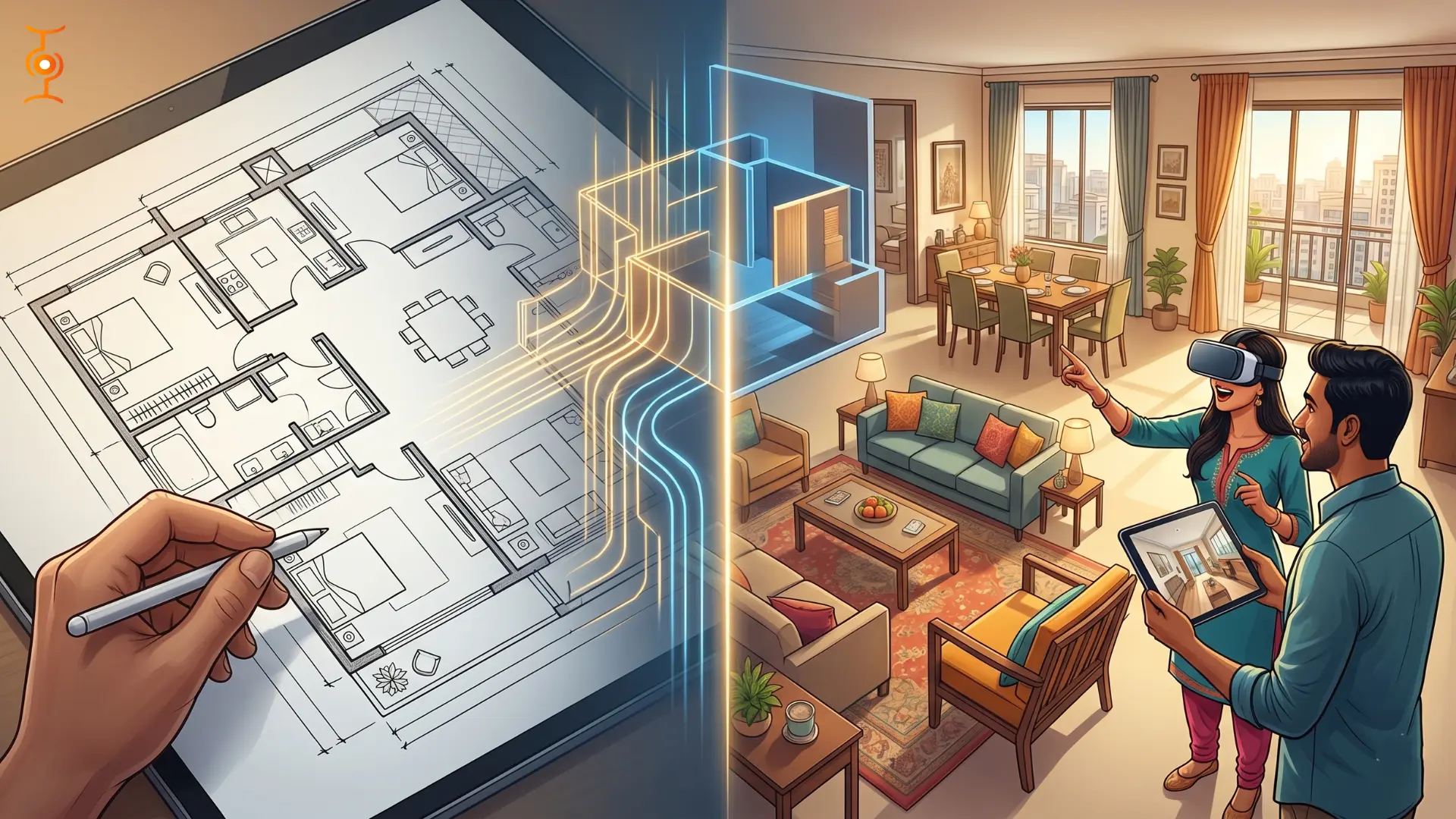
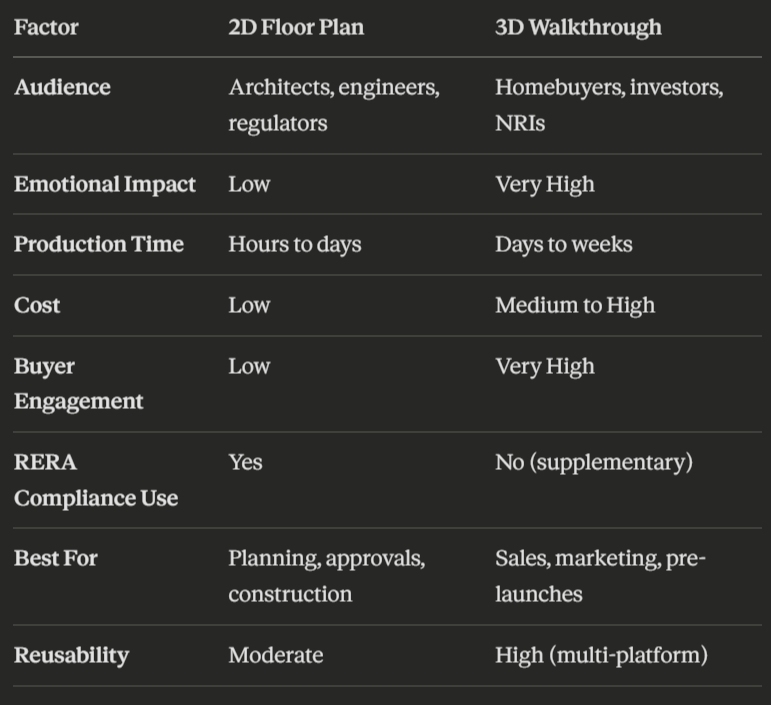
Use 2D floor plans for RERA filing, construction, and technical accuracy. Use 3D walkthroughs for marketing, sales, and remote buyers. Most developers in India use both: 2D for compliance, 3D for conversion.
Imagine a potential homebuyer sitting in Bengaluru, browsing your residential project online at 10 PM. They see a flat 2D floor plan — a grid of lines and room labels. Then they visit a competitor's listing and find themselves virtually walking through the exact same apartment, experiencing sunlight through the living room window and the kitchen layout in real scale. Which project do they call first thing in the morning?
That single scenario explains why the 3D walkthrough vs 2D floor plan debate is no longer just a design preference — it is a core real estate marketing decision in India today.
What Is a 2D Floor Plan?
A 2D floor plan is a scaled, top-down architectural drawing that shows the spatial layout of a property. It illustrates room dimensions, wall placements, door and window positions, and overall square footage.
Strengths of 2D Floor Plans
✅ Cost-effective and fast to produce — ideal for early design stages and building approvals
✅ Technically precise — architects, civil engineers, and construction managers rely on them for accurate measurements
✅ Easy to print and share — works seamlessly across brochures, permit filings, and technical documents
✅ Standard compliance — required by RERA (Real Estate Regulatory Authority) for project registration in India
Limitations of 2D Floor Plans in Marketing
Despite their utility in construction and compliance, 2D floor plans have a fundamental shortcoming in sales: they require spatial imagination. Most homebuyers — even educated ones — struggle to mentally convert a grid of lines into a livable home. For non-technical audiences, a 2D layout can feel cold, abstract, and difficult to connect with emotionally.
What Is a 3D Walkthrough?
A 3D walkthrough (also called a 3D virtual tour or architectural walkthrough animation) is a photorealistic, animated rendering of a property that allows viewers to experience the space as if they were physically present. It incorporates lighting, textures, furniture, landscaping, and even ambient sound to simulate a real-world property visit.
Strengths of 3D Walkthroughs in Real Estate Marketing
✅ Immersive buyer experience — buyers emotionally connect with a space before it is even built
✅ Reduces site visit dependency — particularly valuable for NRI buyers, outstation investors, and busy urban professionals
✅ Reduces buyer hesitation — seeing a realistic, furnished space builds confidence faster than any brochure
✅ Competitive differentiation — luxury and mid-segment developers use walkthroughs to stand out in saturated markets like Mumbai, Pune, Hyderabad, and Delhi NCR
✅ Reusable marketing asset — a single high-quality animation can power your website, social media campaigns, YouTube channel, and sales centre screens
Where 3D Walkthroughs Outperform Traditional Visuals?
In India's under-construction property market, most buyers are investing in a space they cannot physically see. A 3D architectural walkthrough bridges that trust gap by translating plans into experience. Interior designers also use them to pre-visualise material choices and design concepts for clients before committing to expensive finishes.
3D Walkthrough vs 2D Floor Plan: Head-to-Head Comparison
2D Floor Plan vs 3D Walkthrough: Cost Comparison

Estimated Pricing Guide
2D Floor Plan Cost
Basic 2D Floor Plan
Simple layout
Black & white design
Minimal furniture
Estimated Cost: ₹1,000 – ₹5,000 per layout
Colored 2D Floor Plan
Furniture placement
Color-coded rooms
Enhanced presentation
Estimated Cost: ₹5,000 – ₹15,000
Premium Marketing Floor Plan
Branded design
High-detail textures
Real estate brochure ready
Estimated Cost: ₹15,000 – ₹40,000
3D Walkthrough Cost
Basic 3D Walkthrough
Exterior-only animation
Limited detailing
Short duration
Estimated Cost: ₹50,000 – ₹1.5 Lakhs
Mid-Level 3D Walkthrough
Exterior + interior
Realistic lighting
Landscaping
Camera movements
Estimated Cost: ₹1.5 Lakhs – ₹5 Lakhs
Premium Cinematic 3D Walkthrough
Ultra-realistic rendering
Advanced animations
Drone-style cinematic shots
Human characters & vehicles
Day/night transitions
Luxury presentation
Estimated Cost: ₹5 Lakhs – ₹25 Lakhs+
Note: Get FREE architectural walkthrough cost + customized quotation within 12 hours, contact us.
Which One Should You Choose for Real Estate Marketing in India?
The honest answer: you need both — but for different purposes.
Choose 2D Floor Plans If:
✅ You need technical layouts
✅ Your budget is limited
✅ Project is in planning stage
✅ You need quick turnaround
✅ You only need brochure support
A 2D floor plan is a regulatory and technical necessity. No project in India can move forward without it. But when it comes to converting a prospect into a buyer, a 3D walkthrough delivers results that flat drawings simply cannot match.
Choose 3D Walkthroughs If:
✅ You want higher property sales
✅ You are targeting premium buyers
✅ You need strong marketing visuals
✅ You are running digital ads
✅ You want investors to visualize the project
✅ Your project includes luxury amenities
Here is a practical decision framework based on project stage:
Pre-Launch and Marketing Phase
Use a 3D walkthrough animation as your primary sales tool. It creates buzz, drives social media engagement, and makes your pre-launch campaign visually compelling. Developers targeting premium segments in cities like Gurugram, Noida, Bengaluru, and Mumbai consistently see higher booking rates when walkthroughs are part of the campaign.
Construction Documentation and RERA Filing
Use 2D floor plans for all regulatory submissions, site execution, and internal coordination between the architecture and construction teams.
Interior Design Consultation
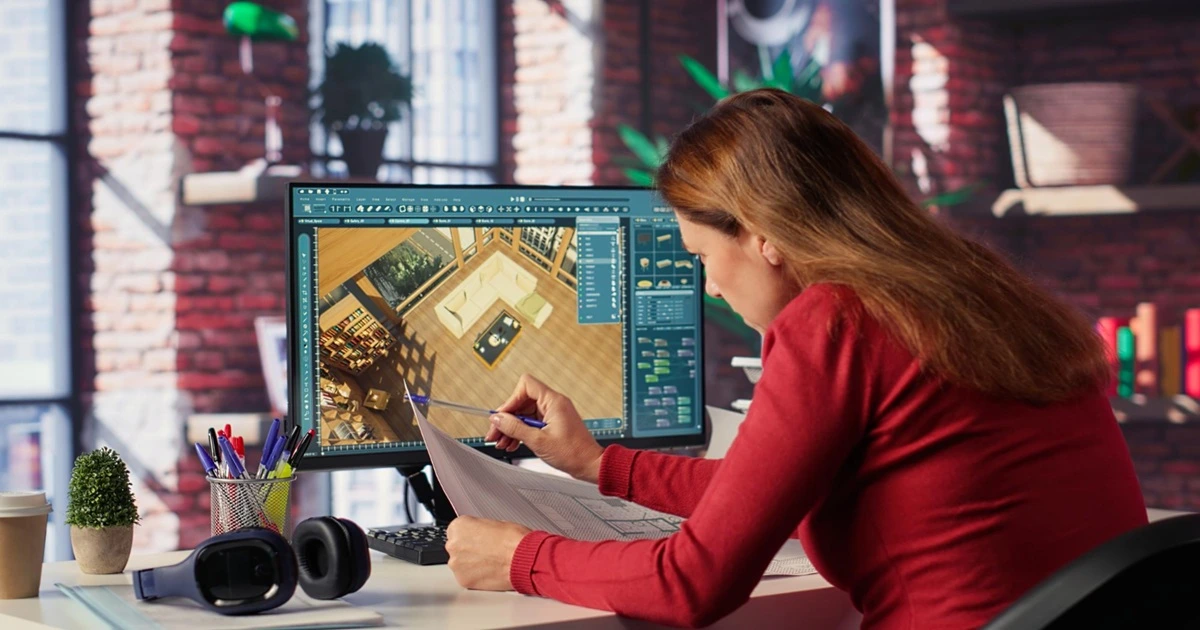
Interior designers and architects increasingly combine both formats — using 2D plans for spatial accuracy and 3D renders or walkthrough animations for client presentations and design approvals.
Targeting NRI and Remote Buyers
A 3D virtual tour is virtually non-negotiable. Remote buyers from the UAE, USA, UK, and Canada rely heavily on walkthroughs to make high-value investment decisions without travelling to India.
The ROI Argument: Why 3D Walkthroughs Justify the Investment
In real estate marketing, the cost of poor communication is a lost sale. A ₹50,000–₹2,00,000 investment in a high-quality 3D architectural walkthrough can directly influence a ₹50 lakh to ₹5 crore purchase decision. The ROI logic is straightforward.
Moreover, a well-produced walkthrough video works across every touchpoint — your project website, Instagram reels, YouTube pre-roll ads, WhatsApp campaigns, and on-screen displays at your sales office. No other single marketing asset delivers that kind of multi-channel utility.
Need Professional 3D Walkthrough or Floor Plan Services?
Chasing Illusions Studio specializes in:
Architectural Walkthroughs
Real Estate Animation
3D Floor Plans
Interior Visualization
CGI Property Marketing
Immersive Property Presentations
Transform your property concept into visuals that attract buyers faster.
Explore our 3D Architectural Walkthroughs Animation Portfolio.
Frequently Asked Questions (FAQs):
Q1. Is a 3D walkthrough mandatory for RERA?
No. RERA requires approved 2D floor plans and layout drawings for project registration. A 3D walkthrough is a marketing tool, not a regulatory requirement — but it is increasingly becoming a competitive necessity.
Q2. How much does a 3D walkthrough cost in India in 2026?
Costs vary based on project size, level of detail, and studio expertise. A basic residential walkthrough animation can range from ₹30,000 to ₹1,50,000, while high-end photorealistic walkthroughs for luxury projects can go higher. Quality directly impacts buyer perception, so it is worth investing appropriately.
Q3. Can I use a 2D floor plan for marketing instead of 3D?
Not entirely, but it significantly reduces the number of visits needed. For buyers in other cities or countries, a well-executed 3D virtual tour can be the deciding factor before they commit to a site visit or even book directly.
Q4. Which is better for interior design presentations — 2D or 3D?
3D renders and walkthrough animations are far more effective for interior design client presentations. They allow clients to visualise material choices, lighting, and spatial flow before any physical work begins, reducing costly change requests later.
Q5. How long does it take to produce a 3D walkthrough?
Production time depends on project complexity. A standard 2–3 minute residential walkthrough typically takes 7 to 21 working days, from initial drawings to the final rendered output.
Conclusion:
The 3D walkthrough vs 2D floor plan question does not have a winner — it has a purpose. A 2D floor plan is the backbone of technical execution and regulatory compliance. A 3D architectural walkthrough is the engine of modern real estate marketing.
In a market as competitive and buyer-driven as India's real estate sector, the developers, architects, and construction managers who embrace both tools strategically will consistently outperform those who rely on static drawings alone. Buyers today do not just want to know the square footage — they want to feel the home before they buy it.
CONTACT NOW
If you are ready to elevate your project's marketing with cinematic-quality 3D walkthroughs and visualisations, Chasing Illusions Studio specialises in turning architectural blueprints into immersive visual experiences that move buyers from interest to decision.
Book a discovery 20-minutes strategy call.
📞 +91-9910911696 | +91-9910660851
📩 info [@] chasingillusions [.] in
Written by Deepak, Architectural Walkthrough content strategist at Chasing Illusions Studio. Our clients include DLF, Emaar, Ganga Reality, Banner Boswell, Shapoorji Pallonji, EC World, Taj, Florida Hospital, etc., 100+ architectural companies across India, USA, Thailand, and the UK.
Last Updated: July 09 2026 | Chasing Illusions Studio
Chasing Illusions Studio
Premium animation & video production studio based in Delhi, India. Specialising in 3D animation, medical visualisation, architectural walkthroughs, and CGI.