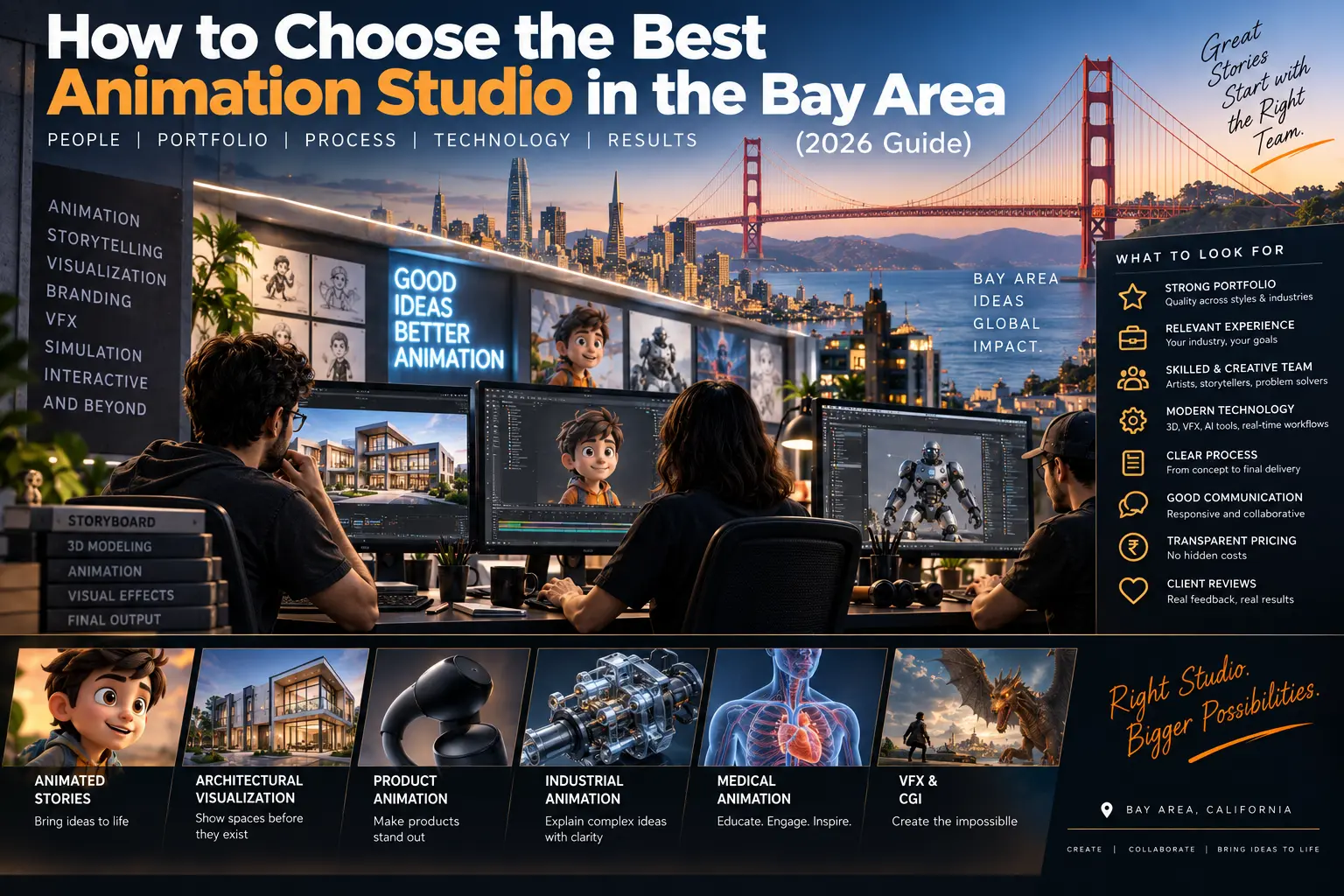
The Bay Area — including San Francisco, Silicon Valley, and Oakland — has a strong ecosystem for animation, driven by technology, startups, gaming, healthcare, and entertainment. If you're commissioning a 3D product demo, a corporate training video, a game asset, or a brand film, choosing the right studio makes a real difference to the result — and to whether the project actually pays for itself.
This guide is a practical, honest roadmap for evaluating Bay Area animation studios: why the choice matters, the criteria that genuinely predict a good outcome, the types of animation you might need, what it costs, how to brief and work with a studio, and the pitfalls to avoid. No inflated statistics, no invented rankings — just what to actually look for.
Why choosing the right studio matters
Animation isn't just visuals — it's storytelling that has to do a specific job, whether that's explaining a product, training staff, closing a sale, or winning attention on a crowded feed. A weak animation wastes real budget and can quietly undercut how a brand is perceived. A strong one communicates clearly, holds attention, and can contribute meaningfully to the project's business goals.
In a competitive market like the Bay Area, the quality of a brand's visuals contributes to how prospective customers perceive the product or company. A polished, accurate animation tends to signal a serious operation; a clumsy or generic one can suggest the opposite, fairly or not. That's why the choice of studio is worth real diligence rather than picking whoever quotes lowest or has the flashiest reel.
It also matters because animation is rarely a one-off. The right studio becomes a repeat partner — the one that already understands your product, your brand, and your review process — which compounds in value across future projects. Getting the first choice right saves you re-briefing a new studio from scratch every time.
The Bay Area's animation ecosystem
The Bay Area blends tech, film, and startup cultures, creating a diverse animation talent pool. It's home to major studios like Pixar and Industrial Light & Magic, alongside the tech companies, universities, and healthcare and biotech firms that commission a steady stream of animation work. That density means two things for you as a buyer: there's genuine expertise available, but there's also a wide quality range — from world-class production houses to small shops and freelancers — so filtering carefully matters.
Studios in this market tend to work with current tools (Unreal Engine, Maya, Blender, real-time rendering pipelines) and to understand the industries they serve, from Silicon Valley product launches to medical device visualization and real estate. A studio fluent in your specific industry will brief faster, ask better questions, and need fewer corrective rounds — which is worth more than it sounds when you're on a deadline.
Types of animation you might need
Before evaluating studios, it helps to be clear about what you're actually commissioning, because different work needs different specialists:
3D product animation — photorealistic demos of a product, its features, and how it works. Common for tech hardware, consumer electronics, and pre-launch products that can't be filmed yet.
2D explainer and motion graphics — clean, fast-to-produce animation for SaaS, apps, and concept explanation, where clarity matters more than photorealism.
Corporate training and safety videos — instructional animation that has to be accurate as well as clear, often with a review step for technical or compliance correctness.
Architectural and real estate visualization — walkthroughs and renders of spaces before they're built.
Medical and scientific animation — a specialized niche requiring accuracy alongside artistry; not something a general studio should attempt without domain expertise.
Game assets and interactive/VR — real-time content for games, virtual try-on, and immersive experiences.
A studio strong in one of these isn't automatically good at the others. Matching the studio's real strengths to your specific need is the single most important part of choosing well.
Criteria for choosing an animation studio
Portfolio and relevant expertise. A studio's portfolio is the best evidence of what it can actually do. Look for work in your category, not just a general showreel — a studio that excels at gaming may struggle with medical animation, which demands different technical skills. Ask for recent, category-matched examples, and pay attention to consistency across a full piece, not just a highlight clip.
Technology and tools. Leading studios use tools like Unreal Engine, V-Ray, or Blender, and increasingly real-time rendering for interactivity and faster iteration. Make sure the studio's tech stack fits your project — whether that's 4K photorealistic rendering, AR compatibility, or a real-time interactive build. The tool isn't the point on its own, but a mismatch is a warning sign.
Turnaround and scalability. Confirm the studio can meet your deadline without cutting quality, and can scale up for a larger campaign if needed. Ask for a specific timeline tied to your project's complexity, and — importantly — confirm their actual current pipeline, not just a quoted best case. A great studio that's fully booked can't help your launch.
Client reviews and reputation. Check independent feedback on platforms like Clutch or GoodFirms. Consistent, verifiable reviews are a good sign; no public feedback, or reviews that don't match the claims, is a reason for caution. Where possible, ask to speak to a past client in a similar industry.
Cost vs value. Animation pricing varies widely by style, complexity, and length. The cheapest option is rarely the best value — a low quote often means less detail, fewer revision rounds, junior artists, or a weaker result that doesn't achieve its purpose. Compare the actual scope behind each quote (number of scenes, revision rounds, output formats, who does the work), not just the headline number.
Communication and process. A defined process — brief, storyboard approval, draft review, final delivery — and a clear point of contact are strong signals. Vague process is where projects drift, budgets overrun, and timelines slip.
What animation costs in the Bay Area / US market
Animation pricing on the US market varies significantly with style, complexity, and length, so treat any figure as a starting point rather than a quote. A few honest general principles:
2D and 3D are priced differently — 3D often costs more when the project requires custom modeling, texturing, lighting, and rendering.
Custom work costs more than templated work — building characters, environments, and assets from scratch is skilled design time before any animation begins.
Per-minute cost rises with detail and effects — a simple explainer is a fraction of a photorealistic, multi-scene, VFX-heavy piece.
Length multiplies cost — every finished minute is significant production, and animation renders across many frames.
Rather than rely on a single number, get a scoped quote for your specific project — a good studio will give you a firm figure once it understands your runtime, style, number of scenes, and deliverables. For a detailed breakdown of what different budgets actually buy on the US market, see our guide on architectural walkthrough pricing in the US: what $5k vs $25k actually buys.
How to work with an animation studio
Getting a good result depends as much on how you brief and manage the project as on the studio you pick.
Start with a clear brief. Detail your goals, audience, budget, deadline, and where the animation will run. For a product demo, include product specs, dimensions, or CAD files. The clearer the brief, the more accurate both the result and the quote.
Approve the storyboard early. A good studio maps the animation's flow in a storyboard before production begins. Approving the direction here is far cheaper and faster than changing it once animation has started.
Review at the draft stage. Expect a draft or work-in-progress version for feedback partway through, before the final high-resolution render. Major changes are much easier at this point.
Give consolidated feedback. Batch your notes and give clear, prioritized feedback rather than piecemeal changes — this alone prevents most unnecessary revision cycles and keeps the timeline on track.
Agree the revision terms up front. Know how many rounds are included and what counts as a chargeable scope change before you start. For a fuller framework, see how to brief a 3D animation studio.
Trends shaping Bay Area animation in 2026
A few genuine shifts are worth knowing as you plan:
Real-time rendering (Unreal Engine, Unity) is increasingly used for interactive walkthroughs, configurators, and much faster feedback loops than traditional offline rendering — though final quality still depends on scene and hardware.
AI-assisted production is speeding up specific, repetitive tasks — denoising, texture variation, concept iteration — while skilled human work still drives accurate, high-fidelity output. It's an assist, not a replacement.
VR and AR continue to grow for training, product demos, and immersive marketing, particularly where letting a viewer explore beats watching a fixed video.
As with any trend, the honest measure is whether it fits your specific project, not whether it's fashionable. A simple explainer doesn't need real-time VR; a complex sales-gallery experience might.
Avoiding common pitfalls
A few things that reliably lead to disappointing outcomes:
Generic, non-category-matched portfolios — impressive general work means little if none of it resembles your project
Quotes that seem low but hide reduced scope — always compare what's actually included
Unclear or overpromised timelines — especially a studio promising complex photorealistic work implausibly fast
No defined revision process — "unlimited revisions" usually signals undefined scope, not generosity
Unverifiable claims — and this is worth flagging specifically: be cautious of studios advertising precise performance metrics, big-name clients, or exact ROI figures with no verifiable case study behind them. Ask for evidence of any specific claim. Real work stands up to that scrutiny; inflated marketing doesn't.
Working with Chasing Illusions Studio
Chasing Illusions Studio produces 3D and 2D animation for tech, healthcare, real estate, and industrial clients, working with current tools including Unreal Engine and real-time rendering, and to defined turnaround windows and revision structures agreed up front. We'd rather show relevant, category-matched samples on request than lead with headline claims — and we're happy to tell you honestly when a different approach, or even photography, would serve a particular project better.
To discuss a Bay Area or US animation project, see our services, view our portfolio on Behance, or get in touch for a scoped quote.
Frequently Asked Questions
How much does animation cost in the Bay Area?
It varies widely by style, complexity, and length — 2D and 3D are priced differently, and per-minute cost rises with detail, custom modeling, and effects. Get a scoped quote based on your runtime, style, and deliverables rather than relying on a single market figure.
How long does an animation project take?
Typically a few weeks for a straightforward piece, longer for complex, multi-scene, or photorealistic work — plus revision time. Confirm a specific timeline tied to your project, and check the studio's actual current availability.
What should I provide to get an accurate quote?
Your goals, audience, budget, deadline, where the video will run, and any product specs, CAD files, or references. The more complete the brief, the more accurate the quote.
How do I verify a studio's quality and reputation?
Review their category-matched portfolio, check verified ratings on Clutch or Google Reviews, ask for recent (not just greatest-hits) examples, and where possible speak to a past client in a similar industry.
Is a bigger or more expensive studio always better?
No. The best fit is the studio whose demonstrated strengths match your specific project, with a clear process and scope — not the one with the biggest name or the highest (or lowest) price.
Chasing Illusions Studio
Premium animation & video production studio based in Delhi, India. Specialising in 3D animation, medical visualisation, architectural walkthroughs, and CGI.