The Billboard That Broke the Internet
In March 2022, Nike unveiled a campaign on a curved LED screen at Tokyo's Shinjuku crossing — one of the busiest intersections on the planet. A giant Air Max sneaker appeared to burst out of the display, hover above the crowd, rotate in mid-air, and then snap back into the screen.
No special glasses. No AR app. No tricks.
Within 48 hours, footage of the illusion had amassed tens of millions of views across TikTok, Instagram, and Twitter. A single billboard in Tokyo became a global brand moment — and sparked a creative obsession that shows no signs of slowing down.
What Nike used was anamorphic video. And what happened next is why every forward-thinking brand is paying attention.
So — What Exactly Is Anamorphic Video?
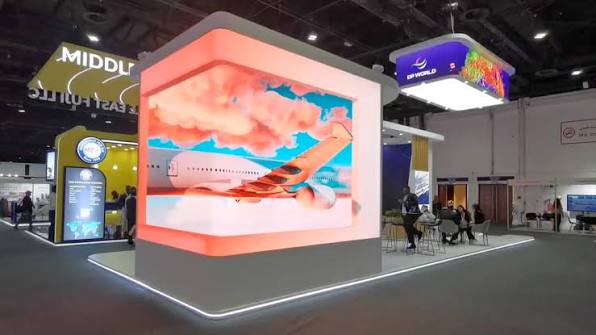
Anamorphic video is a technique that creates the convincing illusion of a three-dimensional object breaking out of a flat, two-dimensional screen. The object appears to have real depth, volume, and motion — as if it physically exists in the space in front of you.
Here's the clever part: the screen is still completely flat. There is no actual 3D technology involved.
The illusion is engineered through anamorphosis — a method where content is carefully distorted during production so that, when viewed from a specific angle (usually straight on, from the street), the distortion resolves into a convincing three-dimensional form. Combine this with high-resolution LED displays, precise lighting physics, realistic shadows, and motion choreography built for the screen's geometry, and you get something that makes people stop mid-stride, pull out their phone, and stare.
It is sometimes called naked-eye 3D — because no viewing aid is required. The illusion works on the human visual system alone.
How Does Anamorphic Video Actually Work?
The production process is more complex than it looks, which is precisely why the results are so striking.
Step 1 — 3D Environment Modelling
The physical location of the screen — its dimensions, viewing angle, surrounding architecture, and distance from the viewer — is recreated in a 3D software environment. The content is built inside that virtual replica.
Step 2 — Forced Perspective Mapping
The 3D asset (a sneaker, a car, a mascara wand, a creature) is animated and rendered with distortion applied to its geometry. This distortion is calculated specifically for the screen's real-world position and the viewer's expected eyeline.
Step 3 — Lighting and Physics Simulation
Shadows, reflections, and lighting are rendered to match the real-world environment at the screen's location. This grounds the object in its surroundings and is the difference between a convincing illusion and a cheap effect.
Step 4 — Corner or Curve Optimisation
Many anamorphic screens are L-shaped or curved. Content is split across both faces of the screen and stitched together so the illusion of depth appears to emerge from the seam — making the object look like it is truly breaking out of the display.
Step 5 — Final Output and Calibration
The finished video is tested and calibrated against the actual screen specifications before going live.
The result is a piece of content that works in two ways: as a live experience for people on the street, and as a shareable video moment that travels on social media far beyond the physical location.
Why Brands Are So Drawn to It
It Cuts Through Ad Blindness
Consumers have become extraordinarily good at ignoring advertising. Digital billboards rotate every few seconds. Static displays blend into the urban furniture. The human eye, having seen thousands of ads, learns to filter them out without conscious effort.
Anamorphic video interrupts that pattern entirely. When a visual cue suggests that an object is physically emerging from a flat surface, the brain registers it as a spatial anomaly — something that should not be possible. That moment of visual confusion demands attention. People pause. They look again. They film it.
That pause is the advertiser's window. And anamorphic video opens it wider than almost any other format available.
It Turns Passersby Into Distributors
One of the most powerful qualities of anamorphic advertising is what happens after the initial reaction. People film it and post it. Research suggests that 55% of viewers who encounter a 3D anamorphic ad say they would be likely to film and share it on social media. For a medium that has historically been measured by footfall and impression counts, that organic amplification changes the economics entirely.
A campaign that runs on a screen in Mumbai or Bengaluru does not stay in Mumbai or Bengaluru. It travels — on Instagram Reels, on X, on YouTube Shorts — reaching audiences who will never walk past the physical screen. OOH advertising is already known to boost branded search volume by 10 to 50 percent on average. Add viral social distribution and that number climbs considerably.
The Brand Associations It Creates
Beyond the immediate spectacle, anamorphic advertising makes a statement about the brand using it. Choosing this format signals technical ambition, creative confidence, and the willingness to invest in an experience rather than an impression. For luxury, fashion, automotive, and entertainment brands — categories where perception is the product — those associations are enormously valuable.
This is why the format has been adopted by brands including Nike, BMW, Balenciaga, Netflix, Maybelline, Louis Vuitton, Rolex, Samsung, and Amazon Prime. Each of them understands that the medium sends a message before the content does.
Five Campaigns That Defined the Format
Nike — Tokyo, Shinjuku (2022)
The campaign that started the current wave. A giant Air Max box appeared to open, releasing an oversized sneaker that floated above the crowd before pulling back into the screen. Nike used a 90-degree curved screen specifically designed for anamorphic content. The campaign generated over 50 million combined social media views globally in its first week and won multiple international creative awards.
Maybelline — London Underground (2023)
Maybelline used CGI and anamorphic video to create the appearance of a real London Underground train being swept through a giant mascara brush as it emerged from a tunnel. The campaign ran across multiple locations and became one of the most talked-about outdoor activations of that year — not just in beauty, but in advertising broadly.
Netflix — New York City
Promoting a flagship sci-fi series, Netflix created an anamorphic execution where a creature appeared to claw through a tear in the screen itself, interacting with the physical architecture around the display. The campaign reached millions of viewers online and reset expectations for what entertainment marketing could do in an OOH environment.
BMW — iX Launch
BMW used an anamorphic screen to show the iX model appearing to rotate inside a confined frame — the vehicle turning, banking, and accelerating as if suspended behind glass. The precision of the CGI lighting made the car look physically present. No traditional photography could have created that same feeling of presence at scale.
Balenciaga x Fortnite — Times Square
The gaming and fashion crossover brought Fortnite's character Doggo to Times Square dressed in Balenciaga. Built in Unreal Engine with real-time ray tracing, the execution made the character look physically located on the street. The campaign generated conversation across both gaming and fashion press — a crossover audience that very few formats could have reached simultaneously.
Where Anamorphic Video Works Best
Anamorphic advertising works across a range of physical environments, though the execution varies by context.
Corner LED Screens — The format works best here. L-shaped or curved screens at busy intersections allow content to appear to break through the seam of the display, creating the most convincing illusions. Locations like Times Square, Piccadilly Circus, Shibuya Crossing, and major Indian metro intersections are natural homes for this format.
Flat Large-Format Digital Screens — A single flat screen can carry anamorphic content effectively if the content is calibrated for the viewer's fixed eyeline. The effect is slightly less dramatic than a corner screen, but still compelling.
Mall and Retail Interiors — Indoor LED screens in high-footfall locations like shopping malls, airports, and stadiums bring the format to a captive audience that is already in a browsing mindset. Product reveals — watches, shoes, gadgets — perform particularly well here.
Events and Launches — Anamorphic screens have become a premium choice for product launch events, where the format makes a physical statement about the significance of what is being unveiled.
Is Anamorphic Video Only for Big Brands?
This is the most common misconception — and it is becoming increasingly outdated.
The technology that enables anamorphic content production has become significantly more accessible. AI and VFX toolsets have accelerated production pipelines. Studios that specialise in the format — including those in India — can now deliver anamorphic content at budgets that were unthinkable three years ago. A 3–5 minute anamorphic animation that once required six weeks of production can now be delivered in 20 to 30 days.
Programmatic DOOH (Digital Out-of-Home) advertising is projected to reach $1.22 billion in 2026. As more anamorphic-capable screens come online in metro cities — including Mumbai, Delhi, Bengaluru, and Hyderabad — and as production costs continue to come down, the format is moving within reach of mid-sized brands, not just global giants.
The question for brand managers today is not whether they can afford anamorphic. It is whether they can afford to let competitors claim the format first.
What Makes a Good Anamorphic Campaign?
The campaigns that work share a clear set of creative principles.
One hero object. The strongest anamorphic executions centre on a single, clearly defined subject — a sneaker, a car, a mascara brush, a creature. Cluttered compositions dilute the illusion.
Screen-specific design. Content cannot be adapted from standard formats. It must be built for the exact dimensions, viewing angle, and geometry of the screen it will run on. Generic assets will not create a convincing illusion.
Realistic physics. Shadows, reflections, and motion must behave as they would in real life. The moment the physics feel wrong, the illusion breaks. The highest-quality anamorphic work looks less like an animation and more like a documentation of something genuinely strange.
A social-first mindset. The live experience and the filmed version are two different content products. Great anamorphic campaigns are designed to look spectacular when viewed through a phone camera at street level — because that is how most people will experience them.
The Format for This Moment
Attention is the scarcest resource in modern marketing. Most brands are competing for fractions of a second — hoping a scroll-stopper or a retargeted display ad will land at the right moment.
Anamorphic video operates on a different logic entirely. It does not chase attention. It commands it. People walk toward it. They film it. They send it to people they know. They search for the brand afterward.
In a media environment where most advertising is designed to follow the consumer, anamorphic video asks the consumer to stop, look up, and come to it.
That is rare. And that is why the brands that understand how attention works are increasingly obsessed with it.
Ready to Take Your Brand Off the Screen and Into Space?
At Chasing Illusions Studio, we produce anamorphic video content for brands that want to be remembered — not just seen. From concept and 3D modelling to screen calibration and final delivery, we handle the full production pipeline.
Whether you are planning a product launch, an OOH campaign, or a brand activation that needs to travel on social, we can build the illusion.
CONTACT NOW
Book a discovery 20-minutes strategy call.
📞 +91-9910911696 | +91 9910660851
📩 info [@] chasingillusions [.] in
Written by Deepak, Content Strategist at Chasing Illusions Studio. Our clients include Tata Steel, Hindalco, Mase Atlantique, Epiroc, and 100+ industrial safety brands across India, USA, Thailand, and the UK.
Last Updated: June 23 2026 | Chasing Illusions Studio.
Chasing Illusions Studio
Premium animation & video production studio based in Delhi, India. Specialising in 3D animation, medical visualisation, architectural walkthroughs, and CGI.