title: "Medical Animation for UK Pharma & Biotech: Complete Studio Guide (2026)" meta_description: "How UK pharmaceutical and biotech companies commission medical animation — types, ABPI compliance, MHRA guidelines, NHS standards, costs in GBP, and what to look for in a studio." focus_keyword: "medical animation uk" secondary_keywords: "medical animation companies uk, healthcare animation studio uk, pharma animation uk, medical animation london" slug: "/blog/top-pharma-animation-agencies-uk" published: "August 2026"
Medical Animation for UK Pharma & Biotech: Complete Studio Guide (2026)
Quick Answer
A 3D medical animation for the UK pharmaceutical and biotech market covers mechanism of action videos, patient education animations, HCP training modules, and regulatory submission visuals. UK pharma companies commissioning medical animation need content that complies with the ABPI Code of Practice for promotional material, MHRA guidance for patient-facing content, and NHS England accessibility standards where relevant. This guide covers everything UK pharma and biotech teams need to know before commissioning a medical animation studio.
Why UK Pharma and Biotech Companies Use Medical Animation
The United Kingdom is one of Europe's largest pharmaceutical markets. The UK life sciences sector employs over 280,000 people and contributes more than £21 billion to the economy annually, according to the Office for National Statistics. Within this landscape, communicating complex science effectively is not just a marketing challenge — it is a regulatory, clinical, and commercial one.
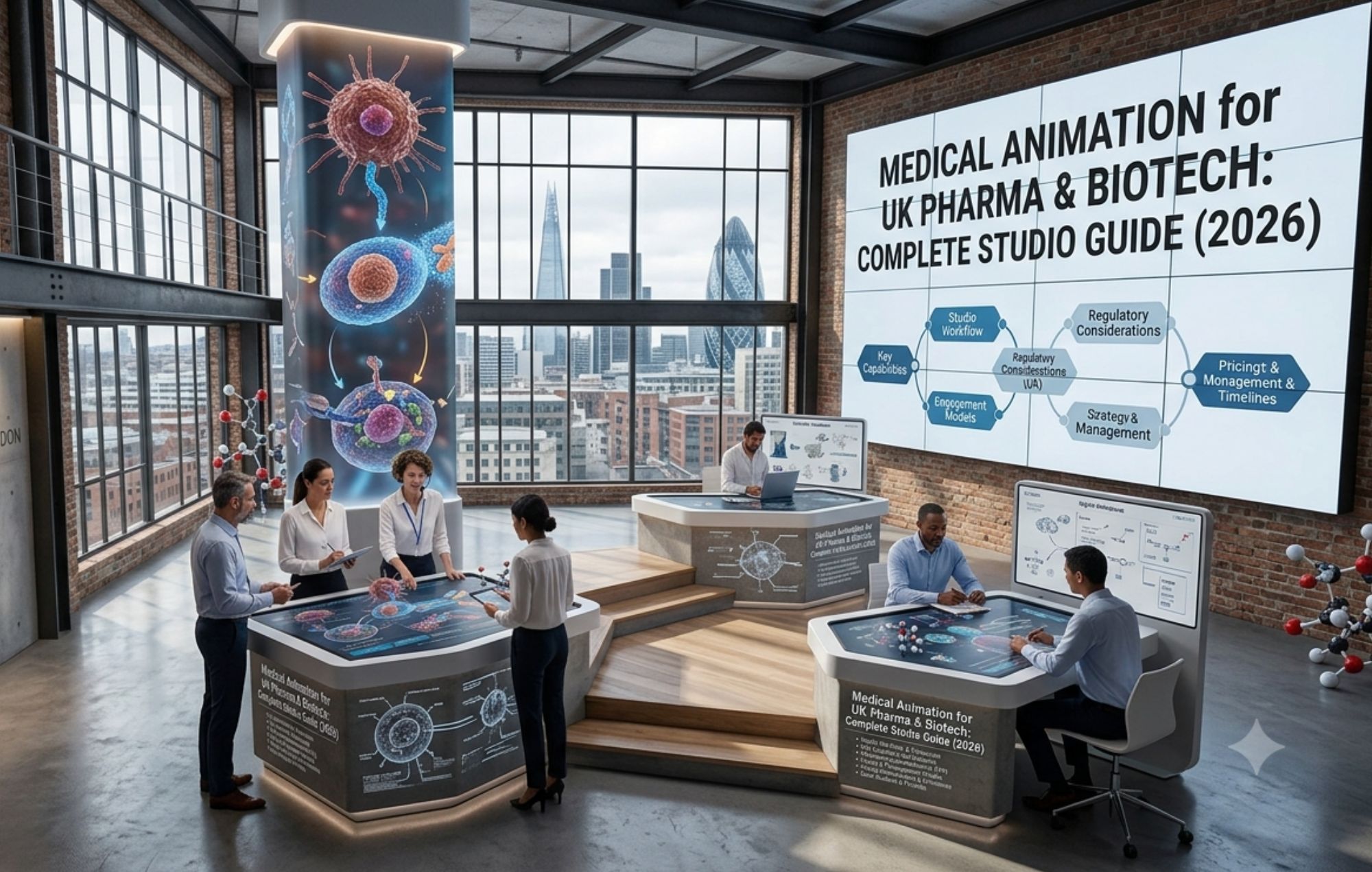
Medical animation addresses all three dimensions simultaneously.
For medical affairs teams, animation provides a format for communicating mechanism of action, pharmacokinetics, and clinical pharmacology data to specialist physicians in a way that is memorable, accurate, and visually compelling — without requiring a journal article or a dense slide deck.
For patient support programmes, animation translates clinical information into plain-language visual content that supports informed consent, improves treatment understanding, and enhances medication adherence. The NHS Long Term Plan specifically identifies health literacy as a priority area, and video-based patient education is increasingly used within NHS commissioned services to address it.
For commercial teams, medical animation supports product launches, conference presentations, digital campaigns, and medical representative training — providing consistent, brand-compliant content that can be deployed across all channels from a single production.
For regulatory affairs, static renders and animated sequences extracted from medical animations are increasingly included in regulatory dossiers submitted to the Medicines and Healthcare products Regulatory Agency (MHRA) and the European Medicines Agency (EMA) to support the visualisation of mechanism and clinical pharmacology.
The UK Regulatory Framework for Medical Animation
This is the most important section for any UK pharma or biotech company commissioning medical animation content. The regulatory environment in the United Kingdom is specific, well-defined, and carries real consequences for non-compliance. A medical animation studio working for UK clients needs to understand these frameworks — not just produce visually appealing content.
ABPI Code of Practice
Promotional content directed at healthcare professionals for prescription-only medicines in the United Kingdom is regulated under the ABPI Code of Practice for the Pharmaceutical Industry. The Code is administered by the Prescription Medicines Code of Practice Authority (PMCPA) and applies to all promotional activities by ABPI member companies and companies that have adopted the Code.
The Code requires that promotional communications, including animated videos, are accurate, balanced, and capable of substantiation. Every claim made in a medical animation intended for HCP audiences must be referenced to peer-reviewed literature, prescribing information, or regulatory documentation. Comparative claims require robust evidence. Superlative statements require specific substantiation.
Before commissioning any promotional medical animation for UK HCP audiences, your medical affairs or regulatory team should review the content against the current version of the ABPI Code. The PMCPA publishes its rulings and guidance documents publicly, providing detailed precedent on what constitutes compliant and non-compliant promotional content.
At Chasing Illusions Studio we work within the ABPI framework as standard for UK pharma clients, producing scripts that are referenced and structured for medical and regulatory review before any animation begins.
MHRA Guidelines for Patient Information
Patient-facing medical animation content in the UK must comply with guidance issued by the Medicines and Healthcare products Regulatory Agency. The MHRA's framework for written patient information — covering the requirements for plain language, balance, and accurate benefit-risk communication — provides the relevant standard for patient-facing video content as well.
Key principles that apply to patient-facing medical animations include: using plain language accessible to a lay audience, presenting benefit and risk information in a balanced way, not making therapeutic claims that go beyond the licensed indication, and not promoting prescription medicines directly to patients, which is prohibited under UK law under the Human Medicines Regulations 2012.
NHS England Standards
For animations intended to support disease awareness or patient education within NHS services, additional standards apply. NHS England publishes accessibility and health literacy guidance that covers language complexity, reading age, and the use of visual communication in NHS patient-facing content. Content produced for use within NHS commissioned services should be reviewed against these standards before deployment.
Medicines (Marketing Authorisation Etc.) Regulations
The promotion of unlicensed medicines or medicines outside their licensed indications is prohibited under the Human Medicines Regulations 2012. Medical animations commissioned for UK distribution must not make claims that extend beyond the product's UK Summary of Product Characteristics (SmPC) as approved by the MHRA or, for centrally authorised products, the EMA.
Every visual depiction of a drug's mechanism, every on-screen claim, and every narrated statement must be consistent with the approved SmPC and verifiable against referenced literature.
Types of Medical Animation for UK Pharma and Biotech
Mechanism of Action Animation
The most widely commissioned type of medical animation in the pharmaceutical sector. MOA animations visualise how a drug interacts with biological targets at the molecular, cellular, or systemic level — showing receptor binding, enzyme inhibition, intracellular signalling, or physiological effect in a continuous, narrated visual sequence.
For UK clients, MOA animations are used in medical representative training, HCP symposia and congress presentations, digital medical education platforms, and regulatory submissions. Our full guide to 3D mechanism of action animation covers the production process, biological scale options, and cost structure in detail.
Patient Education Animation
Simplified visual explanations of medical conditions, treatment mechanisms, drug administration, and side effect profiles — produced for patient audiences within the constraints of MHRA guidance and NHS accessibility standards.
Patient education animations are used in NHS patient pathways, hospital waiting areas, pharmacy dispensing consultations, and digital patient support programmes. Content must be approved by the relevant medical affairs team and, for content used within NHS services, is typically reviewed against NHS England's framework for patient information materials.
Medical Representative Training
Video-based learning modules for pharmaceutical sales forces covering product knowledge, clinical data, and objection handling. These fall under the ABPI Code requirements for training materials and must be accurate, balanced, and consistent with approved promotional claims.
Our e-learning and explainer video service covers the production of modular training content that can be integrated into learning management systems used by UK pharma field forces.
Clinical Trial and Research Communication
Animations explaining trial design, patient eligibility, consent procedures, and study endpoints — used in investigator meetings, patient recruitment campaigns, and research communications. These are not promotional content and fall outside the scope of the ABPI Code, though they must still be scientifically accurate and consistent with approved protocol documentation.
Surgical and Procedural Animation
For medical device companies and surgical product manufacturers operating in the UK, procedural animations showing device implantation, surgical technique, and anatomical context are used in HCP training, theatre team education, and commercial presentations. Our medical animation service covers device animation alongside pharmaceutical content.
Safety and Compliance Training
For pharmaceutical manufacturing, cleanroom protocol, GMP compliance, and lab safety — animated training content that reduces the risk of human error in regulated environments. See our safety and training animation service for this category.
Regulatory Submission Visuals
Static renders and animated sequences supporting MHRA licence applications, EMA Marketing Authorisation Applications, and NICE technology appraisal submissions. Our team produces materials in formats compatible with Common Technical Document requirements and works directly with regulatory affairs teams on content of this type.
What to Look for When Commissioning a Medical Animation Studio
UK pharma and biotech companies commissioning medical animation should assess studios against the following criteria. These reflect the specific requirements of the UK market rather than generic animation quality metrics.
ABPI Code Familiarity
The studio's scriptwriters and project managers should understand the ABPI Code and be able to apply it during content development — not just flag it as your team's responsibility. A studio that asks for your medical affairs sign-off process before starting the script is operating correctly. A studio that delivers a finished animation and then asks whether it needs regulatory review is not.
Scientific Accuracy Process
Ask how the studio handles scientific accuracy. Specifically: do they use publicly available molecular structure data such as the RCSB Protein Data Bank for molecular animations, do they require peer-reviewed references for all depicted mechanisms, and do they flag interpretive assumptions in their storyboard review process?
UK Client Experience
Producing compliant content for UK pharma is different from producing animation for general healthcare markets. Ask whether the studio has worked directly with UK pharmaceutical companies, whether their scripts have been through ABPI-aligned medical review, and whether they are familiar with NHS patient information standards.
Reference and Sign-Off Process
Every factual claim in a UK pharma animation should be traceable to a reference. The studio should deliver a reference list alongside the script, and the storyboard sign-off process should include a medical accuracy checkpoint before animation begins.
Delivery Formats
UK pharma companies deploy animations across a wide range of platforms — Veeva Vault for medical affairs content, internal LMS platforms for training, NHS-approved patient portals for patient education, and conference AV for congress use. The studio should deliver in formats compatible with all of these without treating each as a custom request.
Medical Animation Costs for UK Clients
Pricing reflects the biological complexity of the content, the visual quality tier, the duration of the finished video, and the number of language versions required. The following ranges are our 2026 pricing for UK clients quoted in GBP, all-inclusive of script, storyboard, 3D modelling, animation, rendering, post-production, and two rounds of revision.
Animation Type | Cost per Finished Minute (GBP) | Typical Use |
|---|---|---|
Standard 3D medical animation | £2,500 – £5,000 | MOA, HCP education, single mechanism |
High-complexity animation | £5,000 – £8,000 | Multi-pathway, multiple biological scales |
Premium 4K animation | £6,500 – £12,000 | Congress, broadcast, regulatory submission |
Patient education animation | £2,000 – £4,000 | NHS patient pathways, plain-language content |
Additional languages | £500 – £1,200 per language | Welsh, Urdu, Polish, Bengali, others |
Most UK pharma animation projects for a single mechanism or education module run two to four minutes of finished content, placing the typical project budget at £6,000 – £30,000 all-inclusive. Projects combining a clinical HCP version and a patient education cut are quoted as a package, with shared 3D asset costs reducing the combined price.
Production timelines run four to eight weeks from confirmed brief to final delivery, with expedited options available for congress or launch deadlines.
How We Work With UK Pharma and Biotech Clients Remotely
Chasing Illusions Studio is headquartered in Delhi with offices in the United States and Thailand. The majority of our UK pharma and biotech clients work with us entirely remotely — from brief through delivery — using structured review checkpoints at each production stage.
Working across time zones with UK clients is straightforward in practice. Delhi is four and a half hours ahead of UK time (GMT+5:30), which means UK morning feedback reaches us before our working day ends, and revised deliverables are ready for UK clients to review the following morning. In practice, UK clients find that turnaround on review rounds is faster than with domestic studios operating on the same business day.
All file transfers use encrypted delivery. NDAs are standard on all medical and pharmaceutical projects. Source files are retained and delivered to clients on project completion.
Our existing UK pharma and biotech client relationships cover oncology, immunology, rare disease, cardiovascular, and medical device categories. References are available on request for companies evaluating us as a studio partner.
Medical Animation in the NHS Context
A growing proportion of medical animation commissions from UK clients are intended for use within NHS services — in patient pathways, outpatient departments, hospital waiting areas, pharmacy consultations, and digital health platforms.
Content produced for use within NHS England services should be reviewed against the NHS England framework for health information, which covers language complexity, health literacy, accessibility for patients with low literacy or English as a second language, and the presentation of clinical information in a way that supports shared decision-making.
NHS Scotland, NHS Wales (Cymru), and Health and Social Care Northern Ireland each publish their own patient information standards that apply to content used within their respective health services. UK-wide distribution of patient-facing animation content requires familiarity with all four frameworks.
We produce patient education animation that can be reviewed and approved for NHS use. Content of this type always goes through your medical affairs and patient safety teams before delivery, and we structure our review process to accommodate NHS approval workflows where required.
Frequently Asked Questions
What regulations apply to medical animation content in the UK?
Promotional medical animation directed at UK healthcare professionals is regulated under the ABPI Code of Practice, administered by the PMCPA. Patient-facing animation must comply with MHRA guidance on patient information, including requirements for plain language, balance, and accurate benefit-risk communication. Content used within NHS services should additionally meet NHS England accessibility standards. The promotion of prescription medicines directly to patients is prohibited under the Human Medicines Regulations 2012. Content must not extend beyond the product's MHRA-approved Summary of Product Characteristics.
Can an India-based studio produce ABPI-compliant medical animation for UK clients?
Yes. ABPI Code compliance is a function of content quality and review process, not studio location. What matters is that the studio understands the Code, structures scripts to be referenced and balanced, builds in medical accuracy review checkpoints before animation begins, and delivers content that can be submitted for PMCPA-standard medical sign-off. At Chasing Illusions Studio we apply the ABPI framework as standard for UK pharmaceutical clients and structure our production process to accommodate your medical affairs and regulatory review requirements.
How long does medical animation production take for UK pharma projects?
Standard production runs four to eight weeks from confirmed brief to final delivery. Expedited timelines of two to three weeks are possible for straightforward content with rapid client review. Projects requiring multiple medical review rounds, ABPI sign-off, or multiple language versions take longer. We provide a production schedule broken down by stage before work begins and structure review checkpoints to align with your internal approval timelines.
What is the difference between promotional and non-promotional medical animation?
Promotional animation is content intended to influence prescribing behaviour, product choice, or commercial uptake — it is subject to the ABPI Code and must be certified by a medical signatory before use. Non-promotional animation covers disease awareness content not referencing specific products, patient education not promoting prescription medicines, clinical trial recruitment materials, and internal training content. The distinction matters for compliance purposes and affects the review and approval process. We ask clients to specify intended use at briefing stage so that the appropriate framework is applied from the outset.
Do you produce medical animation in languages other than English for UK distribution?
Yes. For UK pharma clients distributing content across multilingual patient populations, we produce voiceover and subtitle localisation in a range of languages including Welsh — required for NHS Wales patient-facing content under the Welsh Language (Wales) Measure 2011 — as well as Urdu, Punjabi, Bengali, Polish, and other languages reflecting UK patient population demographics. All voiceover recordings use professional, native-language artists.
Can medical animation be used in MHRA or NICE submissions?
Yes. Static renders and animated sequences are accepted as supporting visual materials in MHRA licence applications and NICE technology appraisal submissions, provided they are scientifically accurate, appropriately referenced, and consistent with claims made elsewhere in the dossier. For content intended for regulatory submission, we apply additional scientific review rigour and deliver source references for all depicted mechanisms and biological claims. We work directly with your regulatory affairs team on this type of content.
What does medical animation cost for UK pharma clients?
Standard 3D medical animation — molecular to cellular mechanism, single version, English voiceover — runs £2,500 – £5,000 per finished minute. High-complexity multi-pathway animations run £5,000 – £8,000 per finished minute. Premium 4K animations for congress or regulatory use run £6,500 – £12,000 per finished minute. Patient education animations run £2,000 – £4,000 per finished minute. Most complete projects sit in the £6,000 – £30,000 range all-inclusive. Contact us directly for a project-specific quote.
Work With Us on Your UK Medical Animation Project
We work with pharmaceutical companies, biotech startups, medical device manufacturers, and healthcare communications
Book a discovery 20-minutes strategy call.
📞 +91-9910911696 | +91-9910660851
📩 info [@] chasingillusions [.] in
Written by Deepak, Content Strategist at Chasing Illusions Studio, who leads content for clients including Ambler Surgical, Practo, Bayer, SMT, Novartis, and 100+ brands across India, USA, Thailand, and the UK.
We offer a free thirty-minute consultation to discuss your content requirements, regulatory context, and timeline before any commitment. NDAs are available on request at this stage.
© 2026 Chasing Illusions Studio Pvt. Ltd. — Medical Animation Studio India | Delhi | USA | Thailand
Chasing Illusions Studio
Premium animation & video production studio based in Delhi, India. Specialising in 3D animation, medical visualisation, architectural walkthroughs, and CGI.