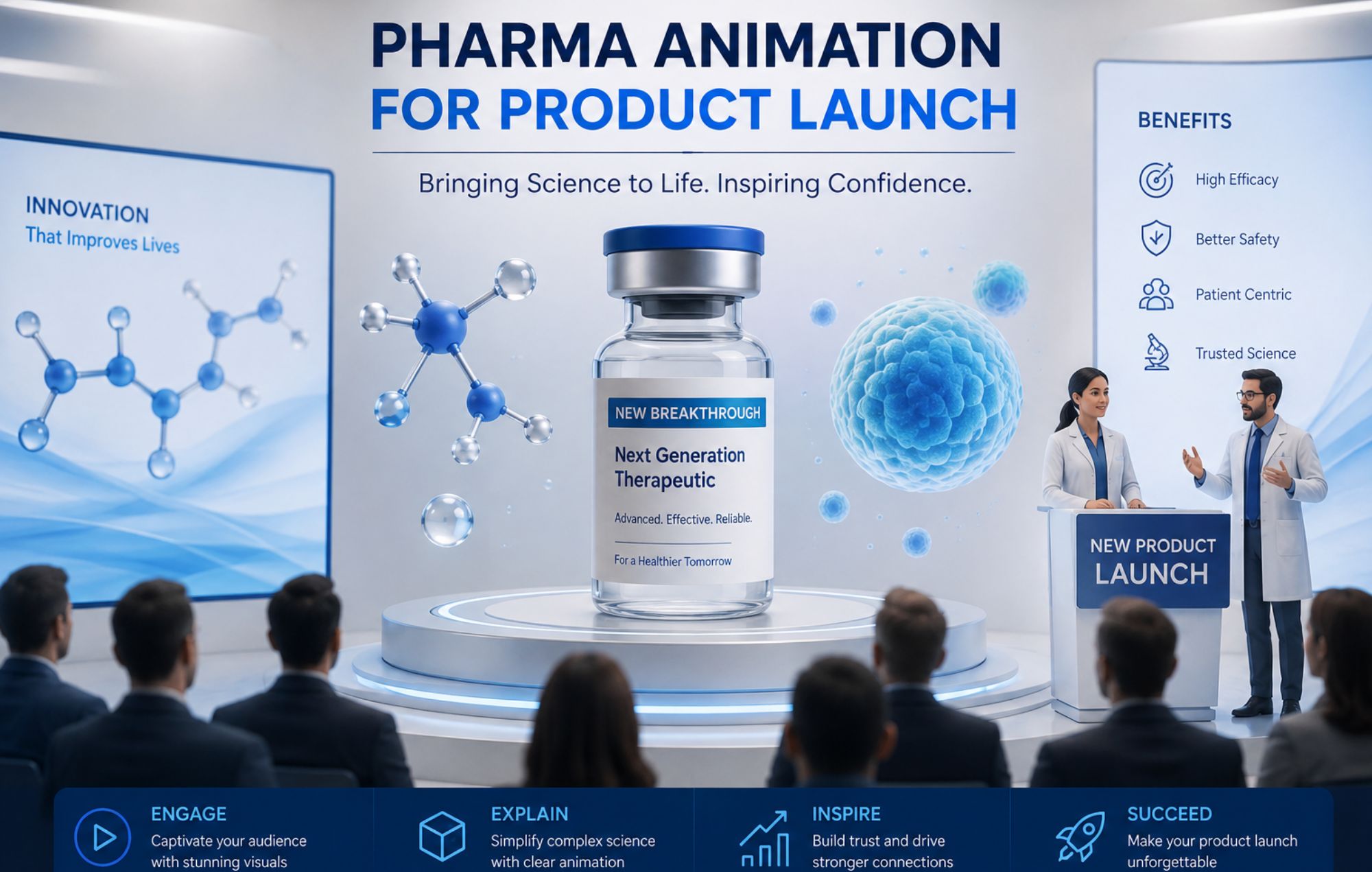
A pharmaceutical product launch is not a single event. It is a multi-year, multi-audience, multi-channel communication effort that touches medical affairs, commercial, market access, sales, patient support, and regulatory functions — often simultaneously. Animation sits at the centre of that communication stack because it is the one format that can carry the same scientific story across every audience and every channel without changing its core message.
The problem is that most pharma teams commission animation too late, brief it too narrowly, and then try to repurpose assets that were never designed for the channels they end up being used in. This guide covers how to plan animation as a strategic launch asset from the beginning — what to commission at each stage, how to brief it, what it costs, and how to build a single production into the shared visual language of the entire launch.
Why Animation Is Central to Pharma Launch Communication in 2026
HCP engagement in 2026 involves greater complexity, scale, and compliance demands than older manual workflows were built for. Pharma content now has to work across field teams, digital channels, congress settings, patient support ecosystems, and internal training environments without creating confusion or slowing everything down.
Animation addresses this directly. A well-produced MOA animation gives every function — marketing, medical affairs, market access, field force, patient support — a shared visual reference for the mechanism that does not vary by presenter, by geography, or by channel. When marketing, medical, market access, and leadership are all describing the same therapy differently, confusion starts inside the company before it ever reaches the market. Animation fixes that internal alignment problem before it becomes an external credibility problem.
The other driver is regulatory scrutiny. Animated content that misrepresents a mechanism or implies efficacy beyond the approved label is subject to the same standards as any other promotional material under the ABPI Code in the UK and FDA promotional rules in the US. Studios without science review infrastructure produce animation that fails MLR — which is not a production problem. It is a compliance liability.
The Launch Timeline — When Animation Needs to Start
Many launch activities start 18 to 36 months before the expected approval date. Animation production needs to be embedded in that timeline from the beginning — not added downstream once the strategy is finalised and the regulatory submission is in.
The most common and most expensive mistake: treating animation as a deliverable to be commissioned after the brand platform is locked. By that point, the first congress is eight weeks away, the sales force training is already scheduled, and the animation brief goes out with a four-week deadline for content that realistically needs 12–16 weeks to produce correctly.
Animation should be in the launch calendar from day one — with production milestones mapped against MLR review windows, congress submission deadlines, and Day 1 deployment targets. Here is what a realistic animation production timeline looks like against the launch calendar.
18–24 months before launch (pre-submission): Disease area shaping content. Unbranded animations explaining the disease burden, unmet need, and underlying biology without naming the product. This content supports KOL engagement, congress symposia in the relevant therapeutic area, and medical education programmes. No promotional certification is required at this stage — but scientific accuracy standards apply in full.
12–18 months before launch: The hero MOA animation enters production. At this stage the product name may not yet be used in promotional materials, but the mechanism can be shown in a way that builds scientific credibility with the HCP community ahead of approval.
6–12 months before launch: All promotional materials — including animation — require MLR clearance before use. A comprehensive launch readiness checklist should cover MLR clearance for all promotional materials, HCP segmentation and targeting, field force training completion, and digital infrastructure activation. The animation produced at the earlier stage enters its full promotional MLR review cycle here. Any substantive change to a claim or mechanism sequence restarts that cycle — which is why the scientific brief needs to be locked before production begins.
3–6 months before launch: Sales force training animation, internal alignment content, and congress loop versions are produced from the approved master. Patient education animation enters production and its own review pathway.
Day 1 (approval): All promotional materials, HCP tools, patient support resources, and sales force briefings are activated simultaneously. Staggered activation is one of the most avoidable and costly launch errors. Every animation asset — rep tablet tool, congress loop, website embed, patient portal video — must be approved and ready before Day 1, not on Day 1.
The Five Animation Types Every Launch Needs
A pharma product launch requires five distinct animation categories, each serving a different audience with different regulatory requirements and different production specifications. Understanding these before briefing a studio determines whether you get five coherent assets from one production or five disconnected videos that cannot be repurposed across channels.
1. MOA and MOD Animation — The Core Scientific Asset
The mechanism-of-action animation is the foundation of every other launch asset. It shows how the drug works at the cellular or molecular level — the molecule entering the body, reaching its target, binding to its receptor, triggering downstream effects, and producing the therapeutic outcome.
The mechanism-of-disease animation is its companion: showing how the disease develops, progresses, and affects the body — establishing the clinical context into which the MOA then fits. Together, MOA and MOD form the complete scientific story.
These are the most expensive and longest to produce — and the ones that must be started earliest. Everything else in the launch animation stack is derived from or references this foundation. Our medical animation services overview covers the full production process and what clinical accuracy review involves at each stage.
Typical investment: $15,000 – $80,000+ depending on mechanism complexity, molecular specificity, and regulatory tier
Timeline: 12–20 weeks for a full MLR-compliant promotional version
Primary audiences: HCPs, KOLs, investors, medical congress delegates
2. Congress and Booth Animation — Designed for a Noisy Environment
Congress animation operates under a specific constraint: the viewer is standing, moving, and often not wearing headphones. A single high-quality video can be repurposed for trade show booths, social media, investor pitches, and dedicated medical training apps — but repurposing only works if the original was produced with the congress environment in mind. That means it must work silently, communicate the core mechanism in the first 15–20 seconds, and loop seamlessly.
Congress animation is typically a shortened, captioned version of the hero MOA — 30–60 seconds, designed for a large display screen in ambient lighting with background noise. The scientific content is the same; the pacing, caption density, and visual emphasis are different.
Typical investment: $3,000 – $8,000 as a derivative of the master MOA
Timeline: 2–4 weeks from an approved master animation
Regulatory: ABPI Code Clause 23 for UK congresses; congress-platform specific rules apply
3. Sales Force Training and Rep Tablet Tools
Sales animation for rep tablet use is a full promotional material under the ABPI Code of Practice. Every claim must be substantiated and referenced. Every version must be MLR-approved and certified before deployment. Updates to the approved label require the animation to be reviewed and recertified.
Before launch, sales teams are often learning the disease area, treatment rationale, MOA, differentiators, safety language, and the approved way to discuss the product simultaneously. A long deck can cover all of that, but it may not help people retain the story in a real physician conversation. Video helps when it breaks the science into pieces that follow the natural flow of a two-minute prescriber interaction.
The practical brief for sales training animation differs from the HCP-facing asset: it prioritises rep comprehension and retention over scientific depth, uses a narrative flow designed for a structured detailing conversation, and often includes a simplified safety summary at the close that a sales rep can walk through with the prescriber.
Typical investment: $10,000 – $30,000 for a rep-facing promotional tool
Timeline: 8–12 weeks including MLR certification
Regulatory: Full ABPI Code promotional compliance required in UK; FDA promotional rules in US
4. Patient Education Animation
Patient-facing content has completely different production requirements from HCP content. The science must be simplified to a plain English standard accessible to a lay audience; clinical terminology must be replaced with plain language equivalents; and the emotional register shifts from scientific credibility to reassurance and empowerment.
Animations for HCPs focus on high-level terminology and data-rich visuals to support clinical decision-making. Patient animations use relatable metaphors and simplified visual representations to reduce anxiety and improve treatment adherence. These are not lesser versions of the HCP asset — they are a distinct production with different goals and a different review process.
For UK patient-facing content, MHRA advertising rules prohibit direct-to-consumer promotion of prescription medicines. Patient education animation for a prescription product must be genuinely educational — explaining a condition, a treatment pathway, or what to expect from treatment — without functioning as branded promotional communication directed at patients.
Typical investment: $5,000 – $15,000
Timeline: 4–8 weeks
Regulatory: Non-promotional standard in UK for Rx products; NHS trust patient pathways have separate governance
5. Investor and Pipeline Animation
For biotech companies and pharma companies with programmes in development, pipeline animation serves a different commercial purpose than promotional launch content. The audience is investors, partners, and analysts — not prescribers or patients. The regulatory framework is different (financial communications rather than pharmaceutical advertising), but the scientific accuracy requirement is identical.
Mechanism of action animations enhance presentations to investors and B2B collaborators, particularly when time is limited and the stakes are high. For a Series A or B biotech raising capital on the strength of a novel mechanism, a 90-second 3D MOA animation that makes the science visually credible is often the most commercially valuable single asset the company commissions in its early stages.
Typical investment: $8,000 – $25,000 for 2D–3D investor pitch MOA
Timeline: 4–8 weeks
Regulatory: Non-promotional; financial promotion rules apply in UK (FCA guidelines)
The Modular Content Framework — How One Animation Becomes Forty Assets
The biggest efficiency opportunity in pharma launch animation is the modular content framework — producing the hero MOA animation as a structured master from which all derivative assets are made, rather than commissioning each channel version separately.
In practice: a single MOA animation can become a full scientific explainer for medical education, an embedded version for the brand website, a 15-second congress screen loop, short silent loops for social channels, and a simplified patient-facing version — all sharing the same scientific core, the same visual language, and the same approved mechanism representation.
This only works when the master is produced with modular use in mind from the outset. The brief must specify every intended downstream use — congress loop, rep tablet, patient portal, social media vertical, website embed, investor deck — before production begins. A master produced without downstream uses specified cannot be efficiently adapted later because the scenes, pacing, and caption structure were not built for adaptation.
Before production begins, launch teams should identify all potential deployment channels and design the animation with future adaptations in mind. This approach significantly increases content lifespan while reducing the need to create new assets for every campaign or audience.
The practical consequence: the difference in cost between briefing a modular master and briefing each channel version separately is often 40–60%. The modular master is more expensive to produce initially because it is designed for adaptation. But the total spend across all channel versions is significantly lower than commissioning each version as an independent production.
The Biggest Mistakes Pharma Teams Make When Planning Launch Animation
Starting too late. A launch animation brief that goes out six weeks before the first congress, or four weeks before Day 1, has already missed the timeline for MLR-compliant production. The content that gets produced under that time pressure is either cut short in quality or cut short in review — neither is an acceptable outcome for a promotional material subject to ABPI or FDA scrutiny.
Briefing animation after the message is already locked. Too many pharma teams wait until the deck is packed, the brand story is set, and the launch timeline is already tight — then ask for a video to "make it simple." Animation cannot fix a confused message. It is most valuable when it is part of building the scientific platform, not illustrating a message written in a different format. The visual logic of an animation — what happens first, what the camera shows, what is emphasised — shapes how the audience understands the mechanism. Bringing the studio in after the deck is written produces an illustrated slide show, not a strategic communication asset.
Treating the master MOA as a final deliverable. The best launch animation strategy does not depend on one big video doing everything. It builds a clear core story, then turns that story into the right versions for the right audiences. A master MOA that sits on a server and gets attached to email decks is wasted. The value is in the derivative suite — congress loops, rep tools, social cuts, patient versions — that multiply the commercial impact of a single production investment.
Underestimating the MLR cycle. Every substantive change to a claim, a mechanism sequence, or a visual element in a promotional animation may require another full MLR review cycle. Teams that do not account for this in their brief consistently end up with animation that is delivered on time but cannot be deployed because it is still in review. Build MLR cycles into the production timeline from day one — as scheduled milestones, not contingency buffers.
Choosing on visual quality alone. A studio that produces beautiful animation but does not have a structured science review process is producing content that cannot safely carry a promotional claim. An inaccurate animation made by animators without scientific training will undermine credibility with an HCP audience that will immediately recognise the error. The brief evaluation process must establish who reviews scientific content, how the studio handles MLR comments mid-production, and whether they have examples of content that has passed regulatory review.
How to Brief a Studio for Launch Animation
A complete brief covers six areas. Missing any of them produces a quote that is either inaccurate or incomparable across studios.
The science: Drug name, mechanism, indication (approved or in development), key mechanism steps in plain English rather than SmPC language, reference materials including published pharmacology papers and protein structure data, and claims that must appear with their supporting references.
The audiences: Who will see each version (HCPs by specialty, patients, investors, internal teams, congress delegates), whether each version is promotional or non-promotional, and the relevant markets (UK under ABPI Code, US under FDA promotional rules, EU, or global).
The channels and formats: Every intended deployment channel — congress booth, rep tablet, website, patient portal, social media, investor deck, internal training — with format requirements per channel including runtime, aspect ratio, captioning, and audio-off compatibility.
The production scope: Master animation specification (full MOA, full MOD, or combined), list of all derivative versions required, whether modular or separate productions, and language and voiceover requirements.
The regulatory pathway: Which MLR platform will be used (Veeva Vault PromoMats is common), how many MLR review cycles to plan for, and whether the studio needs to prepare annotation documents alongside the animation.
The timeline: Hard deadlines including first congress date, Day 1, and sales force training kickoff; internal review milestones that cannot move; and any flexibility in the production schedule.
Where Chasing Illusions Studio Fits in a Pharma Launch
Our pharmaceutical and medical animation work sits primarily in the pre-approval and non-promotional tier: disease area animation, investor pitch MOA, internal training content, patient education, and congress-adjacent materials for biotech and pharma companies where scientific accuracy and visual quality are the primary requirements.
Our production team combines physician-reviewed scientific content with 3D cinematic rendering — covering MOA and MOD animations, surgical procedure content, medical device mechanism videos, and clinical skills training. We serve UK, US, and Indian pharma clients, with multilingual narration capability for global launch programmes.
For full ABPI-compliant promotional launch materials requiring UK MLR review and certification infrastructure, we recommend studios with that specific compliance setup. For companies that need specialist scientific quality at a price point appropriate for early-stage biotech, Series A/B fundraising, non-promotional educational programmes, or pre-approval disease shaping content, our capability and structure are directly relevant.
For UK-specific regulatory context around medical animation and the ABPI compliance framework, our guide to medical animation companies in the UK covers the MHRA rules, ABPI Code requirements, and which production tiers apply to different launch scenarios.
Frequently Asked Questions
When should pharma teams start planning animation for a product launch?
Many launch activities begin 18 to 36 months before the expected approval date. Animation production should be embedded in that timeline from the beginning. The hero MOA animation — the foundation of every other launch asset — needs 12–20 weeks to produce with full MLR compliance. That means the brief needs to go out 14–24 weeks before the first planned use, which could be a congress 12 months before approval.
What animation does a pharma product launch actually need?
Five categories: MOA and MOD animation (the scientific core), congress and booth animation (optimised for ambient viewing environments), sales force training and rep tablet tools (full promotional compliance), patient education animation (non-promotional, plain language), and investor and pipeline animation (financial communications standard). Each has different regulatory requirements and different production specifications.
How much does launch animation cost?
Disease area and investor content: $8,000–$25,000. MOA for HCP use: $15,000–$80,000+. Full promotional launch package including derivative suite: $80,000–$300,000+. The modular content approach — producing one master designed for adaptation rather than commissioning each channel version separately — typically reduces total spend across all channel versions by 40–60%.
Can one animation really be used across all launch channels?
Yes — but only if it was produced with that intent from the outset. Specifying every intended downstream use in the brief before production begins is the requirement. A master produced without downstream uses specified cannot be efficiently adapted because the structure, pacing, and scene design were not built for it.
What is the MLR cycle and how does it affect animation timelines?
Medical, Legal, and Regulatory review is the internal approval chain pharmaceutical companies use before any promotional content is deployed. Every substantive change — a modified claim, a corrected mechanism sequence, a revised voiceover line — may require another full MLR cycle. For a complex MOA with three to four MLR rounds, this adds 6–10 weeks to the production schedule. Build MLR cycles as scheduled milestones, not buffers.
What should I look for in a studio briefed on pharma launch animation?
Science review infrastructure — specifically who reviews scientific content and what their credentials are. MLR process experience — how the studio structures production to minimise review cycles. Derivative production capability — whether they can produce the full channel suite from one master or only individual commissions. And regulatory market experience — whether they have produced content for the specific framework (ABPI, FDA, or EMA) that applies to your launch.
Discuss your pharma animation requirements with our team.
Contact Chasing Illusions Studio for a consultation and quote within 24 hours. We serve pharmaceutical companies, biotech organisations, and medical device manufacturers across India, the UK, the UAE, and the US.
📞 +91 99109 11696
📧 info@chasingillusions.com
💬 WhatsApp available during Indian business hours
Also read:
Chasing Illusions Studio
Premium animation & video production studio based in Delhi, India. Specialising in 3D animation, medical visualisation, architectural walkthroughs, and CGI.