
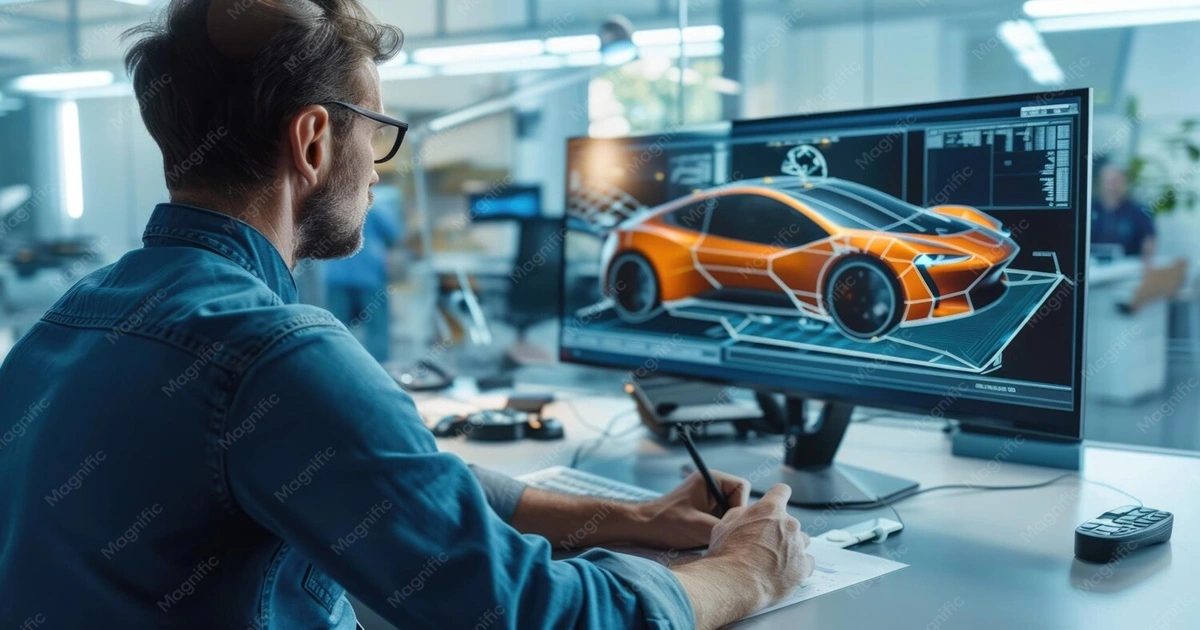
Imagine trying to explain what happens inside an electric powertrain, how a suspension system moves, or how hundreds of components come together on an assembly line—using only photographs and technical drawings. The information may be accurate, but understanding it can still be difficult.
Automotive 3D animation solves this communication problem by turning vehicles, components, mechanical systems, and manufacturing processes into interactive-looking three-dimensional visual sequences. It can show not only what a vehicle looks like, but also how its components move, interact, operate, or are assembled.
This makes automotive 3D animation useful across vehicle design, engineering, manufacturing, EV technology communication, technical training, product development, and marketing—not simply advertising.
What Is Automotive 3D Animation?
Automotive 3D animation is a computer generated animation of three-dimensional graphics is use for moving visualizations of vehicles, components, environments, and mechanical processes. It follows a complete process from 3D modeling to post-production to represent how an automotive product looks, moves, operates, or is assembled.
As compare to static photographs, a 3D animation shows internal structures, invisible mechanisms, future vehicle concepts, assembly processes, and component relationships that may be impossible to capture physically.
How Does Automotive 3D Animation Work?
The production workflow generally follows:
3D Modelling → Texturing → Rigging → Animation → Lighting → Rendering → Post-Production
It is not mandatory to follow the same production process for every automotive project. A car launch project may prioritize the detailed work on photorealism, cinematic camera movement, lighting, and visual storytelling, while an engineering animation can put attention toward geometric accuracy and mechanical relationships.
Let's take a look below step by step for production process:
1. 3D Modelling for Automotive Animation
The first stage is creating the digital three-dimensional model.
Automotive models can be developed from:
CAD data
Engineering drawings
Product specifications
Existing 3D assets
Photographic references
Design concepts
Depending on the project, artists may model:
Vehicle body
Interior
Wheels
Engine components
EV battery systems
Powertrain
Mechanical components
Interior systems
For engineering, manufacturing, and technical communication, geometric accuracy is particularly important. A visually impressive model is not necessarily suitable for explaining a mechanical system if its components or proportions are incorrect.
CAD data can therefore provide an important starting point for technically focused automotive visualization.
2. Texturing and Materials
A basic 3D model does not automatically look like a real vehicle. Materials and textures give surfaces their visual characteristics.
Automotive 3D visualization may reproduce materials such as:
Automotive paint
Glass
Chrome
Carbon fiber
Plastic
Rubber
Leather
Metal
Brushed aluminum
Artists control properties such as reflection, roughness, transparency, color, and surface detail to reproduce the appearance of real-world materials.
For photorealistic vehicle rendering, these details can significantly influence how the final vehicle appears under different lighting conditions.
3. Rigging Automotive Models
Rigging prepares a 3D model so that its components can move in a controlled way.
For an automotive project, rigging can enable:
Wheels to rotate
Doors to open
Steering components to move
Suspension systems to articulate
Mechanical components to operate
Vehicle parts to separate in an exploded view
For technical animation, movement should represent the intended mechanical relationship rather than simply being visually attractive.
For example, an animation demonstrating suspension movement should communicate the relationship between the relevant components rather than moving parts arbitrarily for visual effect.
4. Automotive Animation
Once the model and controls are prepared, animators create movement and camera sequences.
Automotive animation can include:
Vehicle driving sequences
Camera movements
Product demonstrations
Mechanical animations
Exploded-view animations
Assembly sequences
Feature demonstrations
Interior transformations
Safety demonstrations
Manufacturing processes
The animation style depends heavily on the communication objective.
A marketing film might use dynamic camera movements and cinematic transitions, whereas a technical animation may use controlled camera angles and slower movements to make a mechanical process easier to understand.
5. Lighting and Rendering
Lighting determines how the vehicle, materials, environment, and components appear on screen.
Common approaches include:
Studio lighting
Outdoor lighting
Day and night environments
HDRI lighting
Product lighting
Technical lighting
Lighting influences reflections, shadows, visibility, material appearance, and overall realism.
Rendering then converts the 3D scene into final visual frames. Rendering settings vary according to the required quality, resolution, realism, delivery format, and production schedule.
6. Post-Production
The rendered frames are assembled and refined during post-production.
This stage can include:
Compositing
Color correction
Editing
Motion graphics
Titles and annotations
Sound design
Voiceover
Background music
Visual effects
The amount of post-production depends on the intended use. An engineering visualization may require relatively simple editing and annotations, while an automotive advertising film may involve extensive compositing, sound design, visual effects, and motion graphics.
What are the Automotive Applications of 3D Animation?
Automotive 3D animation can support multiple stages of the vehicle lifecycle, from concept and engineering through manufacturing, training, and marketing.
Engineering Applications
Engineers and product development teams can use automotive 3D visualization to communicate complex vehicle systems more clearly.
Applications include:
Mechanical system visualization
Component demonstrations
Design communication
Engineering presentations
Digital prototyping
Assembly visualization
Exploded views
Technical documentation
Design review
An exploded-view animation, for example, can separate components sequentially to reveal how a system is constructed and how individual parts relate to one another.
This can make complex assemblies easier to communicate than a static technical illustration alone.
Visualization Is Not the Same as Simulation
An important distinction is that animation, visualization, and simulation are not interchangeable.
A 3D animation can visually represent how a mechanical system is intended to operate. That does not automatically make it an engineering simulation capable of predicting physical behavior.
Simulation requires appropriate engineering models, parameters, computational methods, and validation. A visualization may communicate the results or concepts associated with engineering work, but it should not be presented as a predictive simulation unless it actually is one.
What are EV Applications of Automotive 3D Animation?
Electric vehicles introduce systems that can be difficult to explain through conventional exterior photography.
Automotive 3D animation can visualize:
Electric powertrain
Battery pack
Battery cells
Charging systems
Electric motor operation
Thermal-management systems
EV components
Electric vehicle features
The U.S. Department of Energy identifies the electric motor, inverter, boost converter, and onboard charger as important components of electric-drive propulsion systems.
A 3D animation can therefore show relationships between components that are normally hidden inside the vehicle.
For example, a battery-pack visualization could use cutaways or exploded views to communicate the relationship between cells, modules, cooling systems, electrical connections, and the larger vehicle architecture.
The DOE also describes how modelling and simulation software can be used to create virtual vehicles based on vehicle and laboratory data, demonstrating the broader role of digital modelling in electric-vehicle development.
However, technical animations should be based on appropriate engineering references rather than assuming that every vehicle uses the same architecture.
Manufacturing Applications
Automotive manufacturing involves complex equipment, components, workflows, and assembly operations.
3D animation can communicate:
Assembly-line processes
Manufacturing processes
Equipment operation
Component assembly
Production workflows
Maintenance procedures
Factory training
Quality-control processes
A manufacturing animation can, for example, visually walk employees through the sequence in which components are assembled or demonstrate how equipment should be operated.
Digital representations can also support manufacturing planning. Siemens describes automotive digital twins as virtual representations of products, production systems, and manufacturing operations that can be used to plan, simulate, and validate manufacturing before production begins.
This is different from simply creating a marketing animation: the digital model can become part of a broader digital engineering and manufacturing workflow.
Training Applications
Automotive companies often need to explain complicated procedures to technicians, employees, dealers, and other stakeholders.
Automotive training animation can support:
Technician training
Vehicle maintenance education
Equipment training
Safety training
Employee onboarding
Automotive eLearning
Service procedure demonstrations
For example, a maintenance animation can show the sequence of removing a component, inspecting it, servicing it, and reinstalling it.
Safety-related animations can also visually demonstrate vehicle technologies and procedures. NHTSA provides detailed explanations of technologies such as forward collision warning, automatic emergency braking, lane departure warning, adaptive cruise control, and lane-centering assistance.
For training content involving safety systems, technical claims should be checked against the relevant manufacturer's documentation, applicable standards, and authoritative sources.
Marketing Applications
Automotive 3D animation is also widely suited to product communication and marketing.
Applications include:
Vehicle launch films
Product demonstrations
Feature visualization
Automotive advertising
Social media content
Dealer presentations
Product websites
Digital campaigns
A manufacturer can use a 3D vehicle model to demonstrate exterior design, interior features, technology, or mechanical systems without requiring every scene to be photographed physically.
The same underlying 3D asset can sometimes be adapted for different content formats, although reuse depends on licensing, technical requirements, asset quality, and the scope of the new production.
Automotive CGI vs Automotive 3D Animation
Automotive CGI and automotive 3D animation are related, but they are not identical.
Automotive CGI = the category. Any computer-generated imagery of vehicles, still or moving.
Automotive 3D Animation = a subset. Specifically CGI where things move over time.
All 3D animation is CGI. Not all CGI is animation.
Factor | Automotive CGI | Automotive 3D Animation |
Scope | Umbrella term | A type within the umbrella |
Motion | Still or moving | Motion is the point |
Output | Stills, sequences, real-time, AR/VR | Video, film, ads, sims |
Typical use | Print ads, configurators, packshots, billboards | TV spots, films, games, explainers |
Time element | Optional | Essential |
A Useful Analogy:
CGI is like "photography" — covers stills and video
3D Animation is like "videography" — a motion-specific subset
Or in film terms: CGI is the medium; 3D animation is one of its formats.
Therefore:
Automotive CGI can be static or animated, while automotive 3D animation is a form of CGI involving movement.
For example, a photorealistic image of a new vehicle is automotive CGI. A sequence showing that vehicle driving, opening its doors, or demonstrating its powertrain is automotive 3D animation.
Automotive 3D Animation vs Traditional Automotive Photography
The Real Difference:
Traditional automotive photography captures a real car with a real camera in a real or LIVE location.
Automotive 3D animation builds the car and environment digitally, then renders motion.
One is a record of something that exists. The other is a construction of something that may or may not exist yet.
Factor | Traditional Photography | Automotive 3D Animation |
Subject | Must physically exist | Can be pre-production, concept, or non-existent |
Cost (EV vehicle) | Shipping, insuring, prepping a real vehicle | One-time model cost, reusable forever |
Time | Days to weeks on set | Weeks to months in production |
Revisions | Reshoot = new shoot | Re-render = adjust a file |
Variants | One car, one color per shoot | Infinite colors/trims from one model |
Consistency | Varies shoot to shoot | Pixel-perfect across all assets |
For example, photographing the exterior of an EV can show its physical design, but it cannot directly reveal the internal relationship between its battery pack, electric motor, power electronics, and thermal-management components.
A 3D animation can create a cutaway or exploded view to communicate those relationships.
What Makes Automotive 3D Animation Effective?
The quality of an automotive animation is not determined only by how realistic the vehicle looks.
Effective automotive visualization generally depends on:
Accurate 3D Models
The digital model should be appropriate for the intended purpose. Engineering and technical projects require greater attention to geometric accuracy than purely conceptual visualizations.
Correct Mechanical Relationships
Components should move and interact according to the intended mechanical relationships.
Realistic Materials
Paint, glass, metal, rubber, plastic, carbon fiber, and other materials should behave visually in a believable manner.
Appropriate Lighting
Lighting should support visibility, realism, and the communication objective.
Controlled Camera Movement
Camera movements should help the audience understand the subject rather than distract from it.
Clear Storytelling
Even technically complex information needs a logical visual sequence.
Technical Accuracy
Engineering references should be verified before technical claims or mechanical behavior are presented as fact.
Appropriate Level of Detail
Not every project needs the same degree of modelling or photorealism. The appropriate detail level depends on the audience, purpose, platform, and budget.
Audience-Specific Explanation
An animation for mechanical engineers may require significantly more technical detail than an animation designed for consumers.
Why Is Automotive 3D Animation Useful for Complex Vehicle Systems?
Many automotive systems are hidden, compact, or difficult to observe while operating.
A traditional photograph can show only static and flat designs or diagrams. It can't show how machine works inside the vehicles as well as can't capture hidden components and their relationship between invisible forces. But on the other hand, a 3D animation is useful for complex vehicle systems because it can capture invisible moments in motion; how hidden components' funtion together; overall it can show what you can't see in photography.
The Core Problem 3D animation Solves:
Complex vehicle systems are:
Hidden — inside the body, under the floor, behind panels
Invisible in motion — fluids, electricity, air, heat, torque
Multi-layered — dozens of parts interacting simultaneously
Time-dependent — things happen in milliseconds or over seconds
Abstract — you can't "see" voltage, pressure, or thermal flow
Photography and video can't show any of this. 3D animation can.
1. Cutaways and X-Ray Views
Slice a car in half to reveal the drivetrain
Fade body panels to see the battery pack underneath
2. Exploded Views
Parts separate and float apart, then reassemble.
Shows every component in a system and how they fit
Reveals relationships that a parts diagram flattens
3. Invisible Forces Made Visible
This is where animation becomes genuinely irreplaceable.
Fluids
Coolant flowing through a battery pack
Oil circulating through an engine
Fuel/air mixture entering cylinders
Electricity
Current flowing from battery to motor
Regenerative braking sending energy back
4. Motion That's Too Fast, Too Slow, or Too Small
Animation controls time and scale freely.
Too fast: slow to 1/1000 speed
Too slow: compress to seconds
Too small: scale up to visible
Too big: shrink to fit a screen
You can show 10 milliseconds or 10 years in the same 30-second clip.
5. Simultaneous Multi-System Interaction
Complex vehicles are systems of systems. Animation shows them together.
Example — a hybrid accelerating:
Engine combustion (mechanical)
Electric motor assist (electrical)
Battery discharge (electrochemical)
Coolant flow (thermal)
ECU decisions (data)
Power split through the transmission (mechanical)
A single animated sequence can show all six layers synchronized, with each highlighted in turn. No other medium does this.
This allows the viewer to move from the complete vehicle to individual components and then to the relationship between those components.
For advanced vehicle technologies, visualization can be particularly useful because modern vehicles incorporate increasingly sophisticated electronic and driver-assistance systems. NHTSA documents a range of current driver-assistance technologies and continues to research advanced vehicle technologies.
What are the Common Automotive 3D Animation Formats?
Depending on the objective, automotive animation can take several forms.
Vehicle Product Animation
Focuses on the exterior design, interior, features, and product experience.
Automotive Engineering Animation
Explains mechanical systems, components, processes, or engineering concepts.
Exploded View Animation
Separates components to demonstrate construction and relationships.
Automotive Mechanism Animation
Shows how mechanical components move and interact.
Manufacturing Animation
Explains production, assembly, machinery, or factory processes.
EV Animation
Visualizes batteries, electric motors, power electronics, charging, and related systems.
Automotive Training Animation
Uses visual demonstrations to support technical, maintenance, safety, or onboarding instruction.
Automotive CGI Commercial
Uses photorealistic 3D environments, vehicles, lighting, camera movement, and visual effects for advertising and promotional communication.
Explore our automotive animation work
How to Choose the Right Automotive 3D Animation Approach?
Before production begins, define what the animation must communicate.
Ask:
Who is the audience?
What system or vehicle needs to be explained?
Is the purpose engineering, manufacturing, training, or marketing?
How technically accurate must the model be?
Is CAD data available?
Does the animation need cutaways or exploded views?
Is photorealistic rendering necessary?
Where will the final animation be used?
Are voiceover, labels, annotations, or motion graphics required?
Which technical claims need authoritative verification?
These questions help determine the required modelling detail, animation style, rendering quality, post-production, and production workflow.
The Main Approaches:
1. Offline Pre-Rendered Animation
Best for: TV ads, brand films, hero launch videos, anything where visual quality is paramount
Strengths: Photoreal materials, accurate ray-traced reflections, cinematic lighting
Choose when: The final output is a fixed video and quality sells the product
2. Real-Time Engine Animation
Best for: Configurators, VR showrooms, live presentations, interactive training
Strengths: Instant feedback, interactive, fast iteration, ray tracing now near-offline quality
Choose when: Interactivity matters or you need many variants fast
3. Technical/Engineering Animation
Best for: Exploded views, assembly sequences, service procedures, system explanations
Strengths: Accurate to real geometry, can drive from CAD directly
Choose when: Accuracy and clarity beat cinematic polish
4. Simulation-Driven Animation
Best for: Airflow, thermal, crash, structural, fluid systems
Strengths: Physically accurate, driven by real data
Choose when: The physics is the message
5. Procedural / Data-Driven Animation
Best for: Large fleets, many variants, recurring content, data visualization
Strengths: Scales automatically, one setup generates hundreds of outputs
Choose when: You need volume and consistency
6. Hybrid (CG + Live Action)
Best for: Premium ads blending real footage with CG cars or environments
Strengths: Authenticity of real footage + flexibility of CG
Choose when: You want realism with impossible elements
Also Read: CGI for Automotive & Luxury Brands: Choosing the Right Studio
Frequently Asked Questions
What is automotive 3D animation?
Automotive 3D animation is the creation and animation of three-dimensional digital vehicles, components, systems, environments, and mechanical processes to explain how automotive products look, move, operate, or are assembled.
What is automotive CGI?
Automotive CGI is computer-generated visual content created for vehicles and automotive products. It can include both static images and animated sequences.
Is automotive CGI the same as 3D animation?
No. CGI is the broader category. Automotive 3D animation is a type of CGI that contains movement over time.
Can automotive 3D animation use CAD data?
Yes. CAD data can serve as an important source for creating technically focused automotive 3D models, although the data may need preparation or optimization for animation and rendering.
Can 3D animation show an engine or EV battery?
Yes. Automotive 3D animation can visualize internal components such as engines, batteries, motors, powertrains, transmissions, suspension systems, and other mechanical or electrical systems.
Can automotive 3D animation be used for training?
Yes. It can support technician training, maintenance education, safety training, equipment instruction, onboarding, eLearning, and service-procedure demonstrations.
Is automotive 3D animation the same as engineering simulation?
No. An animation can visually represent a system or process without mathematically simulating its physical behavior. Engineering simulation requires appropriate models, inputs, computational methods, and validation.
Can one 3D vehicle model be used for different types of content?
Potentially. A suitable underlying 3D asset can sometimes be adapted for marketing, training, product visualization, and other formats, depending on licensing, asset quality, technical requirements, and project scope.
Conclusion:
Automotive 3D animation transforms complex vehicles and automotive systems into understandable visual experiences. Instead of showing only what a vehicle looks like, it can communicate how its components are designed, how systems interact, how products are assembled, and how technologies work.
From engineering visualization and digital prototyping to EV communication, manufacturing, technical training, and vehicle marketing, its applications extend across the automotive product lifecycle.
The most effective approach is not simply to create the most visually impressive animation. The objective should be to combine accurate modelling, appropriate mechanical relationships, realistic materials, purposeful animation, effective lighting, and clear storytelling according to the audience and communication goal.
As automotive products become increasingly complex, clear visual communication can help engineering, manufacturing, training, and marketing teams explain that complexity more effectively.
CONTACT NOW
For organizations looking to communicate vehicles, components, manufacturing processes, or automotive technologies through technically grounded 3D visualization, Chasing Illusions Studio can help develop automotive 3D animation and visualization content tailored to the intended audience and application.
Chasing Illusions Studio
Premium animation & video production studio based in Delhi, India. Specialising in 3D animation, medical visualisation, architectural walkthroughs, and CGI.