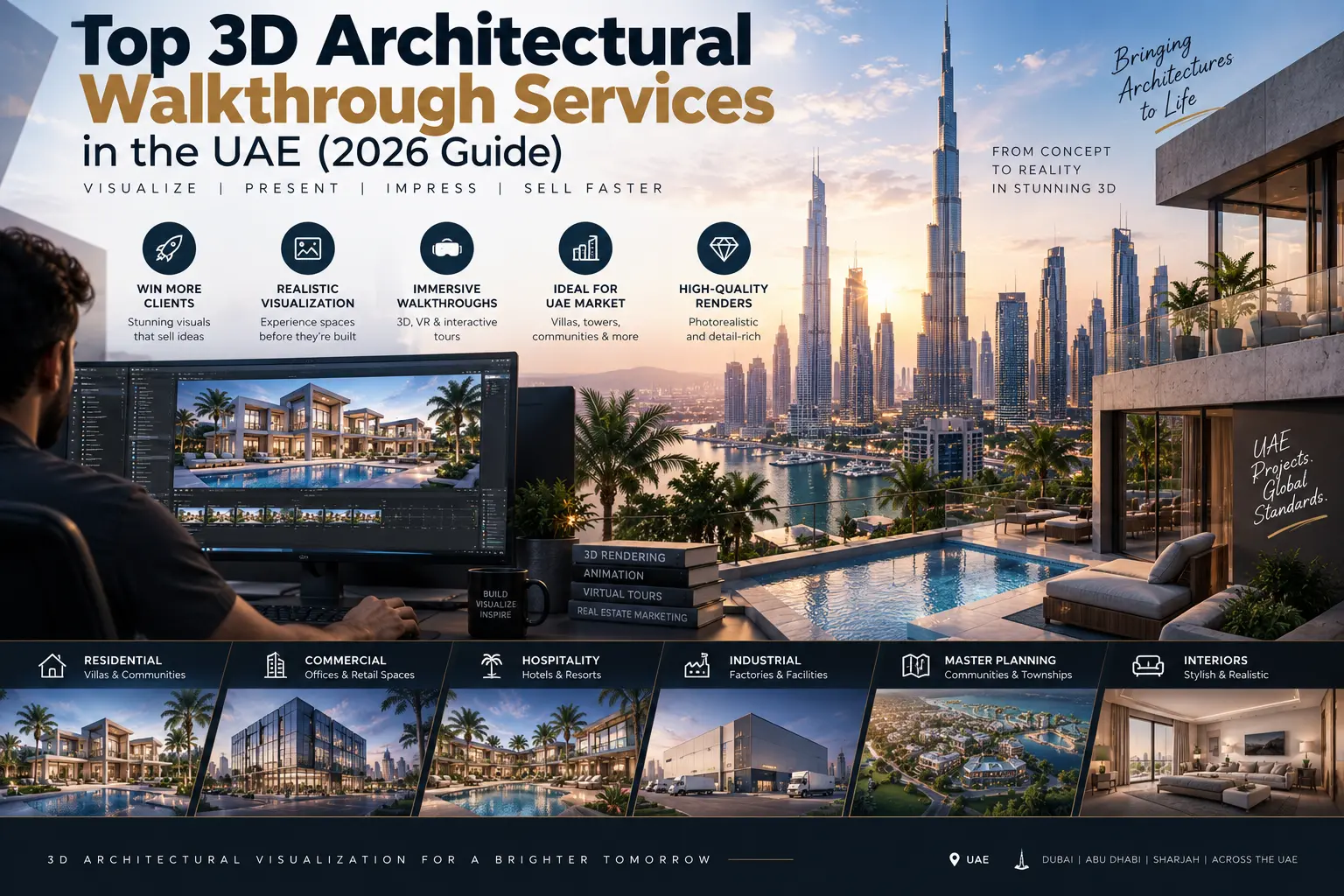
AI and VR are genuinely changing how architectural walkthroughs get made and experienced — but there's a lot of hype around it, and a lot of inflated numbers. This guide takes an honest look at what these technologies actually do in architectural visualization, which tools are real and useful, where they help on UAE projects specifically, and where the claims outrun reality.
No invented statistics, no fabricated case studies — just what the tools do and how they fit real production.
How AI and VR are changing architectural walkthroughs
Two shifts are real and worth understanding:
AI is speeding up parts of the production pipeline. It's genuinely useful for repetitive or computational tasks — denoising renders, generating texture variations, assisting with layout options, and speeding up iteration. It is not (yet) replacing the skilled work of building an accurate, convincing walkthrough; it's shortening specific stages within it.
VR and real-time engines are changing how walkthroughs are experienced. Instead of watching a fixed video, a client can navigate a space themselves in real time — on a headset or on screen. For off-plan property, especially, letting a buyer explore rather than watch is a meaningful step up.
Both matter in the UAE, where off-plan sales are a large part of the market and developments increasingly target remote and international buyers who decide before visiting.
The real tools — what they do
These are the tools genuinely used in AI- and VR-assisted architectural visualization. (Specs and pricing change often — confirm current details before relying on them.)
Real-time and VR engines:
Unreal Engine 5 — real-time rendering with dynamic lighting (Lumen) and high-detail geometry (Nanite); widely used for interactive and VR walkthroughs
Unity — real-time engine strong for AR/VR and mobile-compatible experiences
D5 Render / Twinmotion — real-time archviz tools with fast, PBR-based previews
AI-assisted rendering and generation:
V-Ray AI Denoiser — machine-learning denoising that can meaningfully cut render times
Generative AI tools (e.g. Runway) — used for concept-stage imagery and texture/pattern generation, useful early in a project rather than for final hero output
Cloud rendering services — GPU render farms that speed up heavy scenes without local hardware
AR and mixed reality:
Unity Reflect, Adobe Aero — overlay 3D models onto physical spaces via phone or tablet for on-site visualization
Apple Vision Pro, HoloLens 2 — mixed-reality devices that blend the model with the real environment
BIM, collaboration and real-time visualization:
Revit — BIM authoring and model coordination
Autodesk Construction Cloud / Docs — document and model collaboration across teams
NVIDIA Omniverse — a collaborative 3D and real-time visualization ecosystem
Where AI and VR genuinely help
Faster iteration. AI denoising and real-time engines can shorten the feedback loop, allowing many changes to be previewed significantly faster than a traditional final-render workflow. In practice that can mean more revision cycles within the same timeline, though the effect varies by scene, hardware, and resolution.
Interactive client experiences. Real-time and VR walkthroughs let clients and buyers explore a space at their own pace, which is more engaging than a fixed video — particularly valuable for off-plan and remote buyers.
Concept-stage speed. Generative AI can help explore layout and aesthetic directions quickly at the concept stage, before committing to full production.
On-site AR. AR tools let stakeholders see a proposed design overlaid on the actual site, useful for decision-making and reducing misunderstandings before construction.
An honest note on the hype
A lot of content on this topic quotes precise figures — "cuts costs by 40%," "increases engagement by 70%," "saves 25 hours per project." Treat those with caution. The real effect of AI and VR on any given project depends heavily on the project's complexity, the studio's workflow, and what's being measured — there's no universal percentage, and most of the widely-quoted numbers aren't traceable to a solid source.
What's honestly true: these tools can speed up specific stages and enable more interactive experiences. Whether that translates into a specific cost or time saving on your project is something a studio can only estimate after seeing the scope. Anyone quoting an exact percentage without knowing your project is guessing.
It's also worth being clear about what AI doesn't do yet: high-fidelity, accurate hero walkthroughs still require skilled human production — modelling, materials, lighting, and art direction. AI assists that work; it doesn't replace it.
Relevance for UAE projects
The UAE's active off-plan market and its focus on innovation make AI- and VR-assisted visualization particularly relevant here. Real-time and VR walkthroughs suit the international, remote-buyer audience many UAE developments target, and BIM-compliant workflows matter for coordination with local authorities. Culturally specific design detail — mashrabiya, Islamic geometric patterns, region-appropriate materials — can be built into walkthroughs, though the accuracy of that detail comes from skilled work and good reference, not from a tool alone.
For UAE developers, the practical use case is often less about using "AI" as a selling point and more about shortening the distance between design approval and buyer experience. A real-time or VR environment can let sales teams demonstrate apartments, amenities, views, and circulation before the physical project exists, while AI-assisted tools help the production team iterate on materials, lighting, and visual options more efficiently. It tends to matter most for off-plan residential towers, luxury villas, masterplans, hospitality developments, and sales-centre experiences aimed at remote or international buyers.
For the broader question of choosing a UAE walkthrough studio, see our guide to architectural walkthrough services in the UAE. For the fundamentals of the medium itself, see our guide to 3D visualization.
Frequently Asked Questions
Is AI replacing 3D architectural visualization artists? Not for high-fidelity architectural walkthroughs. AI can assist with tasks such as denoising, texture generation, and concept exploration, while accurate modelling, materials, lighting, animation, and art direction still require skilled production.
Can AI create a complete architectural walkthrough? AI can help generate concepts, references, and certain visual elements, but a production-ready walkthrough generally requires an accurate 3D environment, controlled materials, lighting, camera movement, and technical review.
Is VR better than a traditional architectural walkthrough video? They serve different purposes. A video is a controlled presentation; VR or real-time lets users explore the environment themselves. The right format depends on the project and audience.
Can VR walkthroughs be used for off-plan property sales in the UAE? Yes. VR and interactive walkthroughs let prospective buyers explore unbuilt properties remotely, which is useful when buyers can't visit the development before deciding.
Can an existing 3D architectural model be used for VR? Often yes, though the model may need optimization, material adjustments, lighting changes, and real-time performance preparation before it works interactively.
Does AI make architectural walkthroughs cheaper? It can reduce effort in specific parts of the workflow, but there's no universal percentage saving. The effect depends on project complexity, existing assets, workflow, and which tasks are automated.
The takeaway
AI and VR are real, useful shifts in architectural visualization — faster iteration, interactive experiences, quicker concept exploration, and on-site AR. But the technology is a set of tools that assist skilled production, not a shortcut that replaces it, and the dramatic percentage claims that circulate around this topic mostly don't hold up. The honest version is more modest and more useful: these tools let a good studio work faster and offer richer client experiences, and on the right project — especially off-plan work for remote buyers — that's genuinely valuable.
If you're planning a UAE project and want to understand which of these approaches actually fits it, see our architectural walkthroughs service, view our portfolio on Behance, or get in touch to talk through scope.
Chasing Illusions Studio
Premium animation & video production studio based in Delhi, India. Specialising in 3D animation, medical visualisation, architectural walkthroughs, and CGI.