CGI product animation is computer-generated visual content that shows a product with full creative control over angle, environment, and detail — without physical photography. It's used across e-commerce, advertising, and product marketing to demonstrate features that are hard or impossible to capture with a camera. This guide covers what it is, how it's made, what it costs, how it compares to traditional video, and how to choose a studio.
What Is CGI Product Animation?
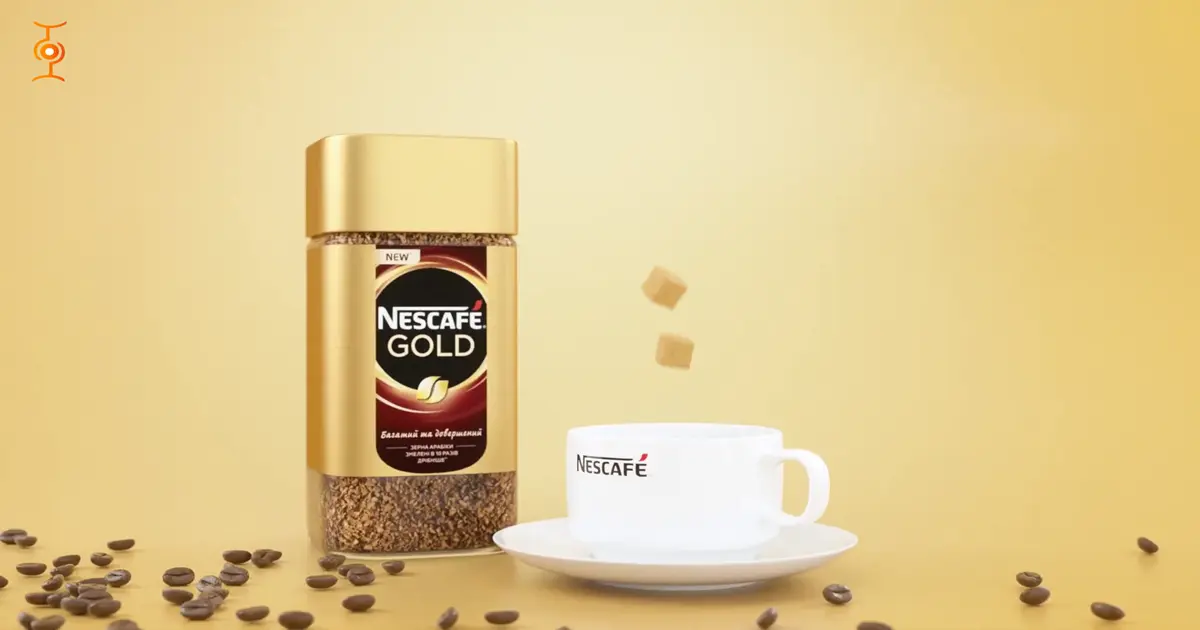
CGI product animation is the process of building a photorealistic, computer-generated version of a product so it can be "filmed," lit, and staged without a physical camera shoot.
Unlike traditional photography or video, CGI gives full creative control: any angle, any environment, any lighting condition, and features that are physically difficult to show — like internal airflow or moving mechanical parts — can all be rendered digitally. It's widely used in e-commerce, advertising, and product-launch marketing.
Key takeaway: CGI replaces the physical shoot with a 3D model — the product never has to be photographed at all.
CGI vs Product Photography vs Live-Action Video
Factor | CGI Animation | Product Photography | Live-Action Video |
|---|---|---|---|
Physical product needed | No (can start pre-launch) | Yes | Yes |
Cost to change colour/material | Low — edit the 3D file | High — reshoot | High — reshoot |
Shows internal mechanisms/airflow | Yes, easily | No | Difficult, often not possible |
Best for | New/pre-launch products, complex features, impossible angles | Simple hero shots, fast turnaround, budget campaigns | Human interaction, lifestyle, testimonials |
Typical turnaround | 2–6 weeks | 1–3 days | 1–2 weeks |
Key takeaway: CGI is the better choice when the product doesn't exist yet, needs frequent visual updates, or has features a camera can't capture. Photography is faster and cheaper for simple, finished products.
When CGI Isn't the Right Choice
CGI isn't always the answer. It's usually not worth it for:
Simple products with no complex features — a modest photography package may outperform CGI on cost.
Campaigns needing real human interaction — CGI can't replace authentic testimonials or lifestyle footage.
Very short timelines (under a week) — high-quality rendering takes time; rushing it sacrifices realism.
Key takeaway: choose CGI for complexity and flexibility, not as a default replacement for every product video.
How a CGI Animated Product Video Is Made
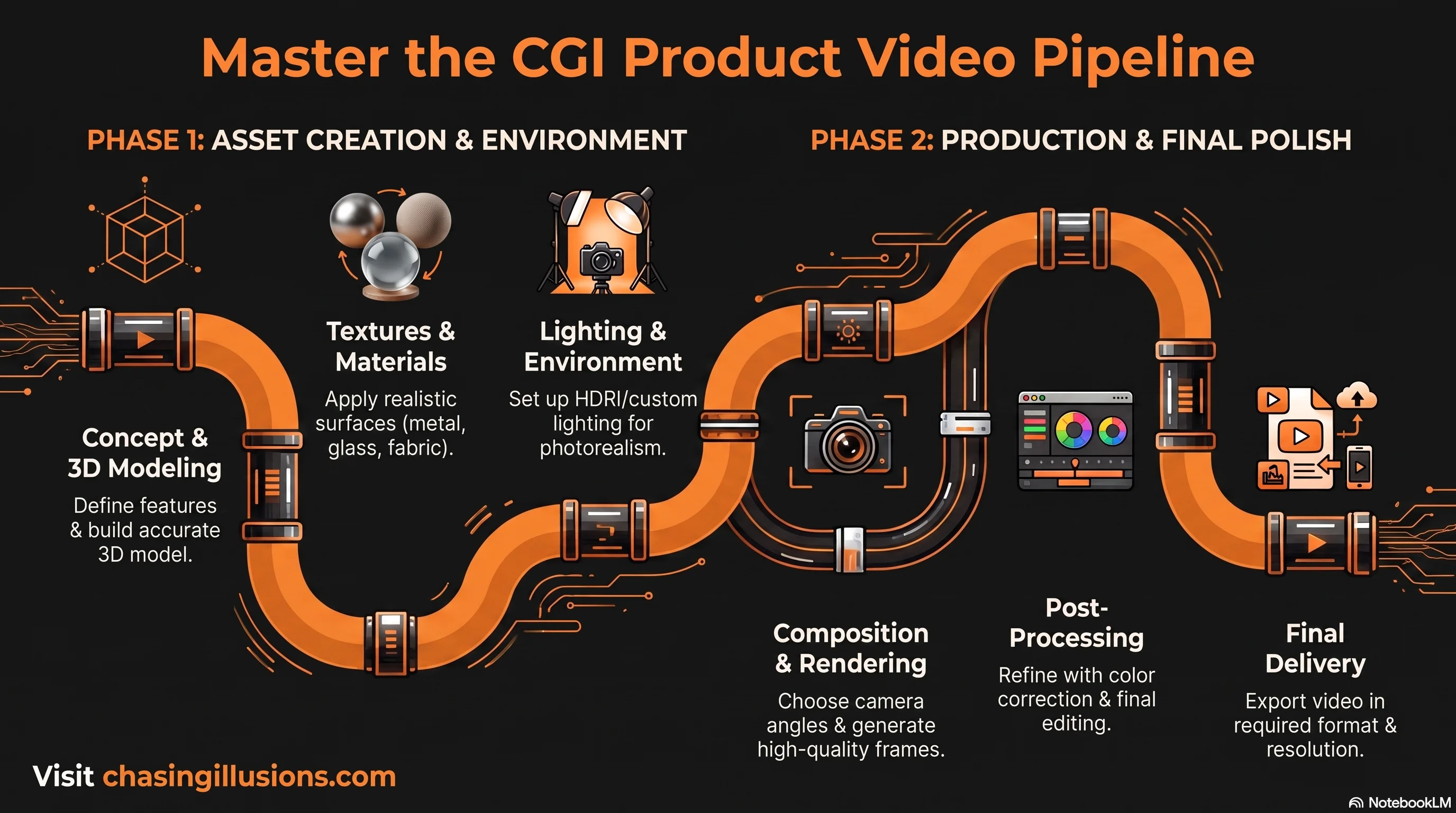
A CGI product demo is built in eight stages:
Concept & planning — define the product's key features, audience, and visual style; gather references.
3D modeling — build an accurate model in software like Blender, 3ds Max, or Maya.
Texturing & materials — apply realistic materials (metal, glass, plastic, fabric).
Lighting & environment — set up lighting with HDRI maps or custom setups for realism.
Camera angles & composition — choose the viewpoints that present the product most clearly.
Rendering — generate photorealistic frames using engines like V-Ray, Arnold, or Cycles.
Post-processing — colour-correct and refine in Photoshop or After Effects.
Final delivery — export in the resolution and format the target platform requires.
Key takeaway: most of the creative decisions — angle, lighting, material — happen digitally in steps 3–5, which is what makes CGI easier to revise than a physical shoot.
How Long Does CGI Product Animation Take?
Timelines depend on quality, duration, and complexity. As a rough guide:
Simple product spin/rotation (~15 sec, single product, basic lighting): 10–12 working days
Standard product demo with feature call-outs (~30 sec): 18–22 working days
High-end, multi-scene marketing animation (~30 sec): 25–30 working days
Revision rounds typically add 3–7 days each.
What CGI Product Animation Costs
The tiers below are our typical ranges — indicative starting points, not fixed quotes. Actual cost depends on duration, complexity, level of detail, features, and revisions, so confirm a scoped quote for your project.
Tier | What's included | Typical range |
|---|---|---|
Basic | Simple animation, 1–2 modeled assets, clean motion, minimal FX (~15 sec) | ₹1,50,000 – ₹1,80,000 |
Standard | Custom product modeling, mid-level detail, cinematic camera motion, moderate FX/particles (~15 sec) | ₹2,50,000 – ₹3,00,000 |
Premium | High-detail modeling, cinematic storytelling, advanced FX (cloth/fluids/particles), multi-scene (~30 sec) | ₹4,50,000 – ₹5,50,000 |
Typically included: creative concept & storyboard (1 option), 3D modeling/texturing/shading per tier, animation/lighting/rendering/compositing, final video in your required resolution and format, and up to 2 revision rounds.
Usually excluded (available as add-ons): LED screen rental or playback hardware, on-site testing/QC, live-action shoot, voiceover, and music licensing, plus revisions beyond the agreed rounds.
What Services a CGI Product Animation Company Offers
CGI product visualizations — photorealistic renders for marketing, e-commerce, and presentations
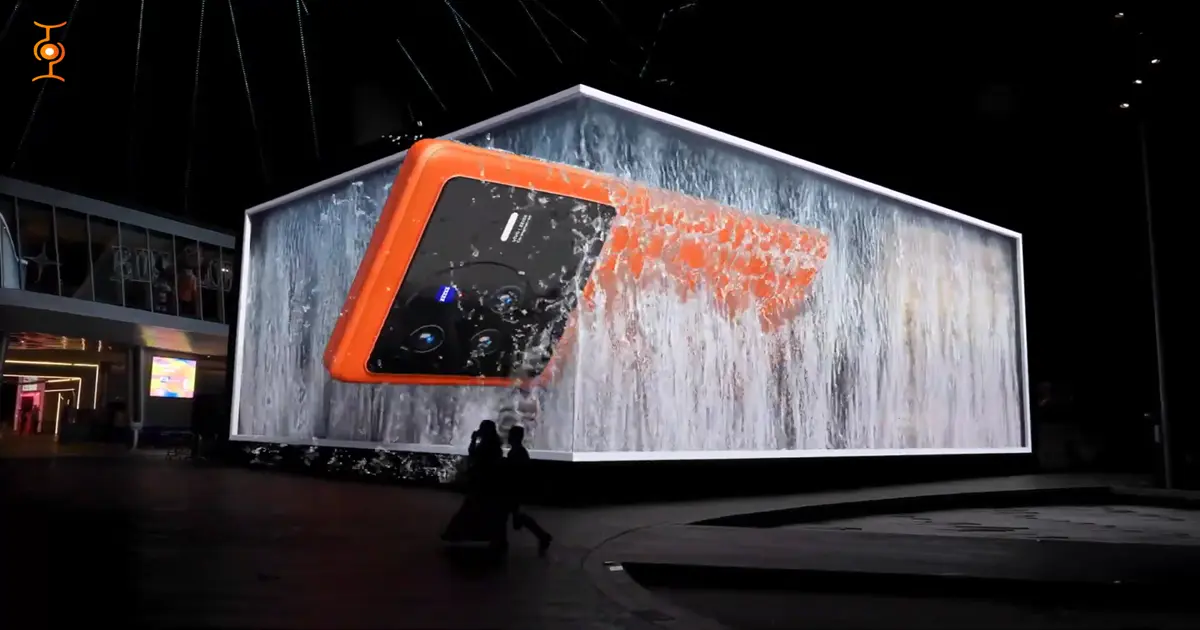
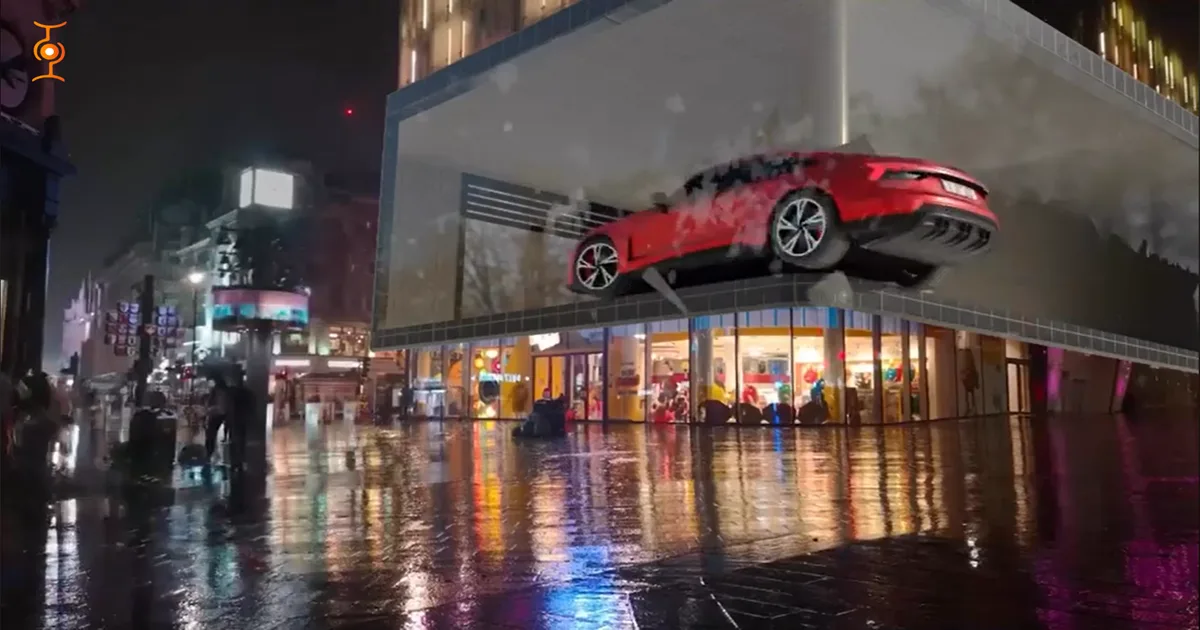
Anamorphic event displays — large-format displays that create 3D illusions from a specific viewing angle
Interactive CGI experiences — AR/VR applications and interactive product demos
Anamorphic illusion creation — projection-mapped 3D illusions on physical surfaces
CGI brand films & commercials — from product hero shots to cinematic brand stories
CGI reels & social content — short-form content for Instagram, YouTube, and other platforms
Key takeaway: "CGI product animation" and "anamorphic display" are related but distinct — the first is video/marketing content, the second is physical/event installations. See our CGI and anamorphic video work on Behance.
Benefits of CGI Animation for Product Marketing
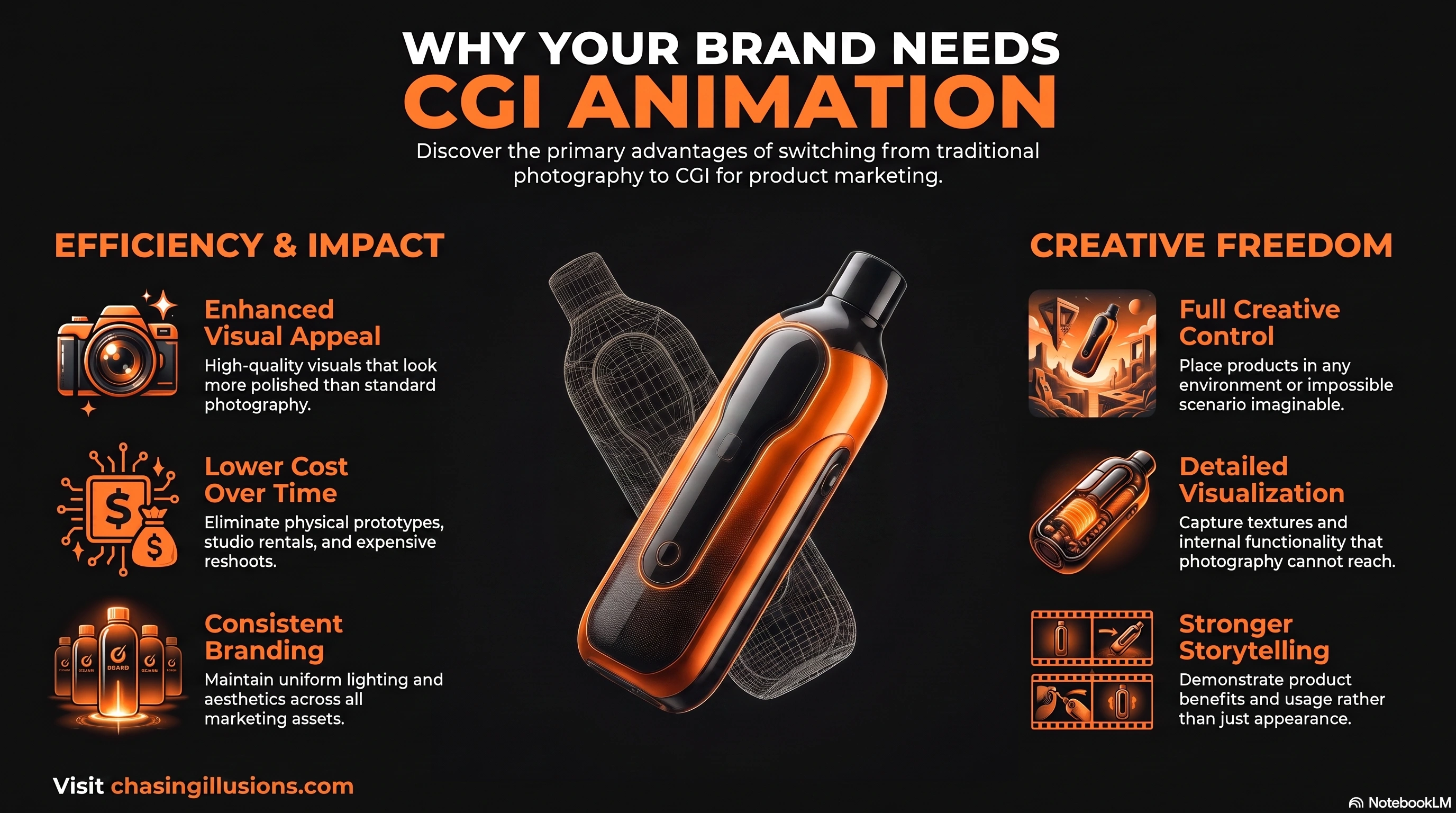
Enhanced visual appeal — polished visuals, often beyond what standard photography achieves
Lower cost over time — no physical prototypes, studio rental, or reshoots
Full creative control — any environment, any scenario, including impossible ones
Detailed visualization — shows textures and internal function a camera can't capture
Easy variation — swap colours and materials without reshooting
Consistent branding — uniform lighting and aesthetics across all assets
Fast updates — revise visuals without waiting on physical samples
Stronger storytelling — demonstrate use and benefits, not just appearance
Multi-platform use — website, social, TV, AR/VR, and e-commerce from one asset
How to Choose a CGI Animation Company
Look for five things when evaluating a studio:
Portfolio in your product category — cosmetics, food & beverage, industrial, and medical CGI each need different technical skills (fluid dynamics, material realism, mechanical accuracy).
Rendering-quality samples — ask for full-resolution, unretouched render examples, not just showreels.
Revision policy — confirm how many rounds are included before extra charges apply.
Turnaround transparency — a studio should give a specific timeline tied to your project's complexity, not just a general range.
Delivery-format flexibility — confirm they can export for your specific platforms (web, social, broadcast, AR/VR).
A note worth adding, given how common it is in this industry: be cautious of studios advertising named blue-chip clients or precise campaign metrics with no verifiable case study behind them. Ask for evidence of any specific claim — real work stands up to that; inflated marketing doesn't.
Why Work With Chasing Illusions Studio
Chasing Illusions Studio is a CGI and anamorphic animation production company based in Delhi, India, working with brands across banking, cosmetics, food & beverage, personal care, and industrial products. Our CGI work covers photorealistic product visualization, explainer and brand animation, and interactive/AR-VR product demos. We work to defined turnaround windows and revision structures agreed up front, and we're happy to show relevant, category-matched samples on request rather than headline claims.
Glossary
CGI (Computer-Generated Imagery): visual content created with 3D software rather than a camera.
Anamorphic: an effect that looks distorted from most angles but reveals a 3D illusion from one specific viewpoint.
HDRI: a lighting technique using panoramic images to create realistic reflections and lighting.
Photorealistic rendering: CGI output detailed enough to be hard to distinguish from a photograph.
Render engine: software (e.g. V-Ray, Arnold, Cycles) that converts a 3D scene into final image or video frames.
Frequently Asked Questions
How does CGI animation improve product marketing? It lets brands show products from any angle, in any environment, and highlight features a camera can't easily capture — internal mechanisms, material texture — which typically improves clarity and engagement compared with static photography alone.
What does CGI animation for product videos cost? Our typical ranges: basic (~15 sec) ₹1,50,000–₹1,80,000; standard (~15 sec) ₹2,50,000–₹3,00,000; premium (~30 sec) ₹4,50,000–₹5,50,000. Final cost depends on type, duration, complexity, and revisions — contact us for a scoped quote.
Why do companies switch from traditional video to CGI? Lower long-term cost, faster revisions, and the ability to show details that are difficult or impossible to film — especially for pre-launch or frequently updated products.
Is CGI animation better than product photography? Neither is universally better. CGI suits complex, pre-launch, or frequently updated products; photography is faster and cheaper for simple, finished ones.
How long does a CGI product animation take? Simple animations: 10–12 working days; standard demos: 18–22; high-end multi-scene: 25–30, plus revision time.
Talk to Us About Your Project
To discuss a CGI product animation for your launch or campaign, see our product animation service, view our portfolio on Behance, or get in touch for a scoped quote.
Chasing Illusions Studio
Premium animation & video production studio based in Delhi, India. Specialising in 3D animation, medical visualisation, architectural walkthroughs, and CGI.