If you're commissioning 3D rendering in Canada — whether for real estate, product marketing, architecture, or industrial visualization — one of the first questions is also the hardest to get a straight answer to: what will it actually cost? Pricing varies widely, and studios rarely publish rates because so much depends on the specifics of the job.
This guide gives you honest, usable ranges and, more importantly, explains what drives the number up or down so you can budget realistically and read a quote critically. A note on the figures below: these are general market ranges to set expectations, not fixed quotes. Rendering rates shift with demand, software costs, and studio location, and Canadian pricing spans a wide band depending on whether you're working with a large Toronto or Vancouver studio, a smaller regional one, or an overseas team. Always confirm current rates directly for your specific project.
The short answer
For a rough sense of scale in the Canadian market:
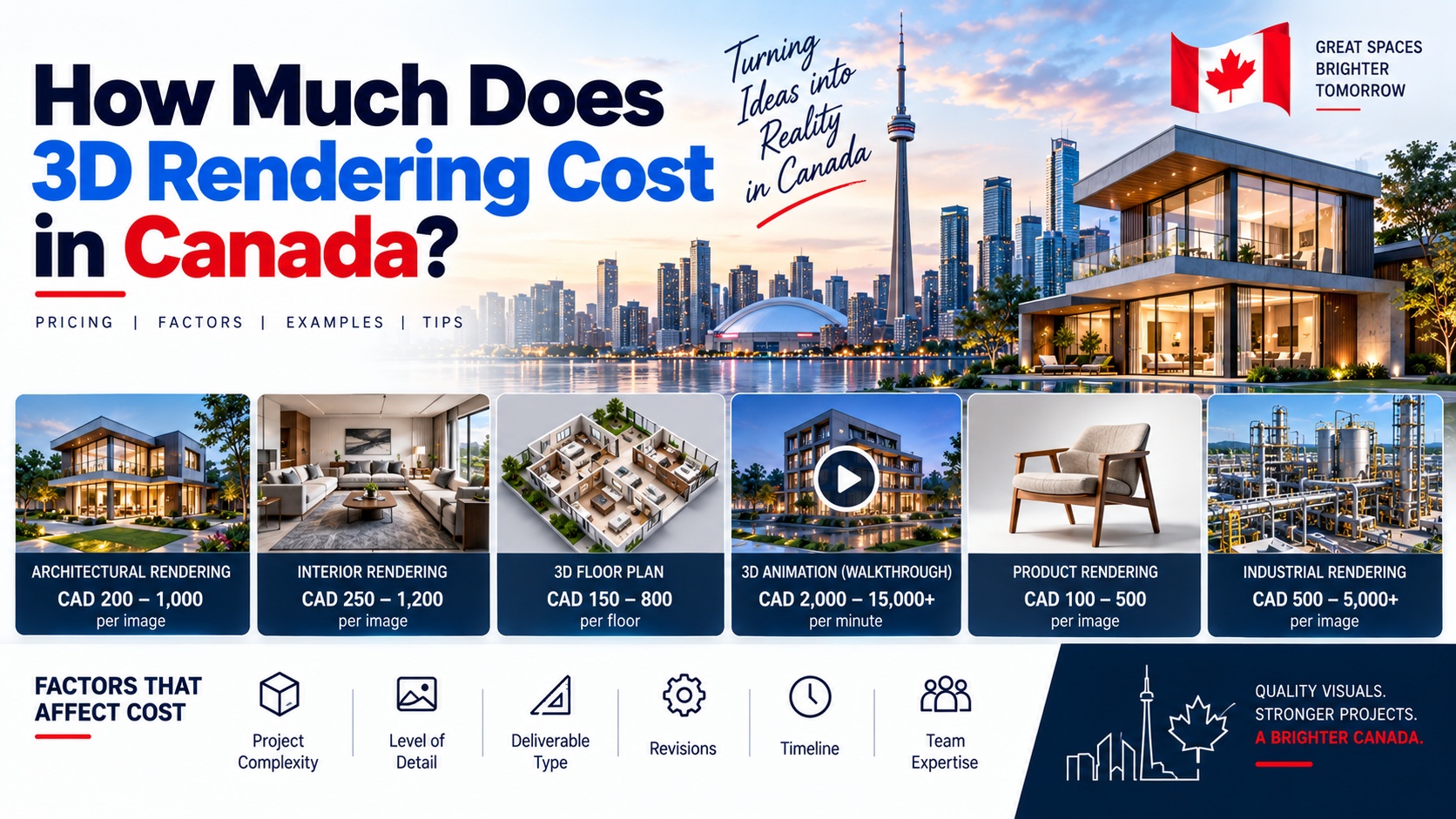
Simple product or single still render: roughly CAD $200 – $1,000 per image
Detailed architectural exterior/interior still: roughly CAD $500 – $3,000+ per image
Product or architectural animation / walkthrough: roughly CAD $2,000 – $15,000+ depending on length and complexity
Complex or interactive 3D visualization: CAD $15,000+
These are broad bands, and the same project can land at very different points within them depending on the factors below. Treat them as a starting point for a conversation, not a price list.
What actually drives the cost
Rather than fixating on a single number, it's more useful to understand the variables — because these are exactly what a studio will ask about when scoping your quote.
Complexity of the subject. A single product on a white background is far cheaper to render than a detailed building interior with furniture, textures, and landscaping, or an industrial facility full of equipment and piping. The more geometry and detail, the more hours involved.
Stills vs. animation. A still image is one rendered frame. Animation is hundreds or thousands of frames — a few seconds of finished walkthrough is a large number of individually rendered images, which is why animation costs multiples of what stills do. For a fuller breakdown, see how much 3D renderings cost and the complete cost guide: 3D walkthrough vs 2D floor plan.
Level of realism. A clean, presentable render is quicker than a photorealistic one with accurate lighting, reflections, and material detail. Photorealism takes more setup time and more render compute, both of which cost.
Whether a model already exists. If you already have an accurate 3D model, you're paying only for rendering. If the model has to be built from scratch, that's a separate stage of work added to the bill — see 3D rendering vs 3D modeling for why these are distinct costs.
Number of views or variants. Pricing is often per image or per view. Ten angles of a product, or the same room in five colour schemes, multiplies the render count — though variants of an existing model are cheaper than starting fresh each time.
Revisions. Most studios include a set number of revision rounds and charge for extra. Clear, consolidated feedback keeps this cost down; piecemeal changes drive it up.
Studio location and model. This is the big one for Canadian buyers. A large domestic studio in a major city carries higher overhead and rates than a smaller regional one or an overseas team. Many Canadian businesses work with international studios for exactly this reason — but weigh that against communication, timezone, and revision-cycle considerations, not just the headline rate.
Pricing by project type
Product rendering. Simple products on plain backgrounds sit at the lower end; complex products with intricate materials (jewelry, electronics, machinery) cost more. Product rendering is often the most cost-effective 3D work because the models are smaller in scope than a building. If you're weighing it against photography, 3D product rendering vs traditional photography covers the trade-offs.
Architectural rendering. Exterior and interior stills of buildings cost more than product work because of the scene complexity — landscaping, furniture, lighting, and context. A single polished interior still is a meaningful piece of work. Pricing scales with the number of views and the level of detail.
Architectural walkthroughs / animation. A moving tour through a building is the higher-cost tier because of the frame count. For a detailed look at what different budgets buy, what $5k vs $25k actually buys you in architectural walkthrough pricing is a useful reference (US-focused, but the tiering logic applies).
Industrial and plant visualization. Rendering a factory or plant is among the more complex work because of the density of equipment and the accuracy required — see 3D industrial plant rendering: a buyer's guide for how this is scoped.
Interactive / real-time. A navigable model the viewer controls is the most involved deliverable and sits at the top of the range.
How Canadian pricing compares
Canadian rates generally sit in a similar band to other developed Western markets like the US, UK, and Australia — higher than markets like India, where studios offer considerably lower rendering rates. This is why many Canadian companies weigh domestic studios (easier collaboration, same timezone, local accountability) against overseas ones (lower rates, but more coordination). Neither is automatically "better value" — it depends on how much hand-holding, revision, and communication your project needs. A complex, evolving project often benefits from closer collaboration; a well-specified, self-contained one can travel further afield without friction.
How to get an accurate quote
The single best way to control cost is to give a studio enough to scope accurately. Bring:
A clear description of the deliverable — stills or animation, how many views, what resolution, and where it'll be used
Any existing assets — CAD files, 3D models, product specs, floor plans. Existing accurate models cut cost significantly
Reference images showing the style and quality level you want
Your actual purpose — marketing, a sales tool, planning, a competition entry — since that shapes what level of finish you genuinely need
A realistic revision expectation — and a habit of giving consolidated rather than piecemeal feedback
For a broader framework on briefing, how to brief a 3D animation studio applies directly to rendering work too.
Is it worth the cost?
3D rendering earns its cost when it replaces something more expensive or unlocks something you couldn't do otherwise — marketing a product before it's manufactured, selling a property before it's built, or testing a design before committing to construction. For product businesses especially, rendering can be cheaper over time than repeated photography, because once the model exists, new angles and variants are inexpensive to produce. Whether it's worth it for you comes down to what the render enables and how many times you'll reuse the asset — not the sticker price alone.
The bottom line
3D rendering in Canada spans a wide range — from a few hundred dollars for a simple still to five figures for complex animation or interactive work — and the number depends far more on your project's specifics than on any published rate. Understanding what drives the cost lets you budget realistically, scope your brief well, and read a quote with a critical eye.
If you'd like a scoped estimate for your specific project, see our product animation and architectural walkthroughs service pages, or get in touch — sharing your assets and goal is the fastest way to a real number rather than a range.
Chasing Illusions Studio
Premium animation & video production studio based in Delhi, India. Specialising in 3D animation, medical visualisation, architectural walkthroughs, and CGI.