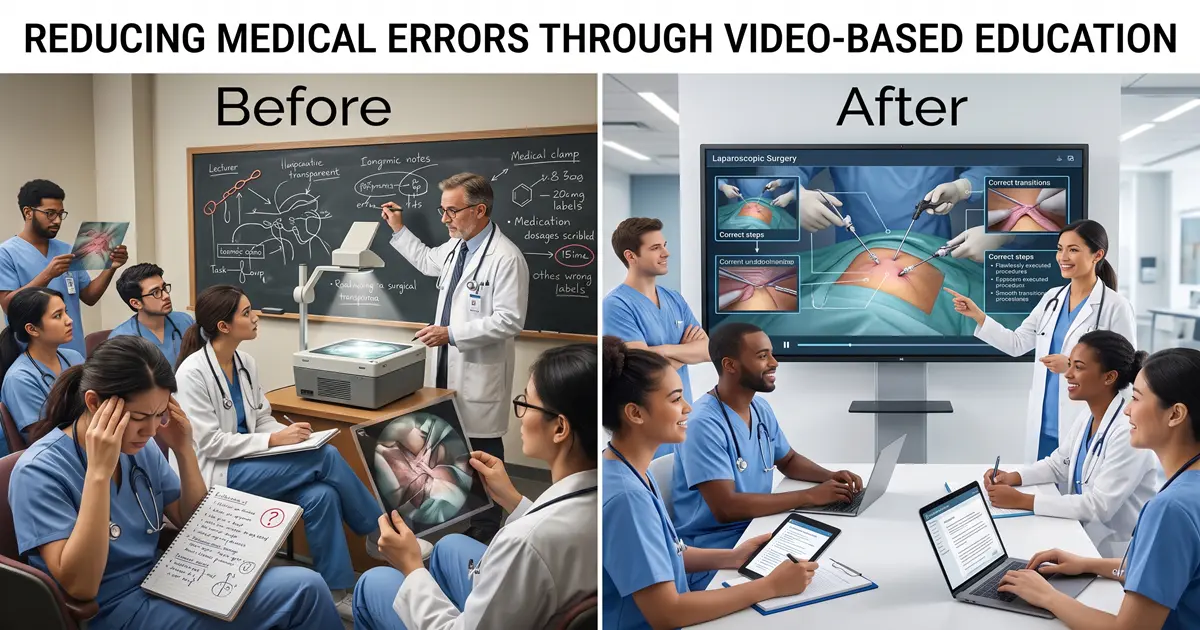
Video-based training reduces medical errors by closing the gap between what clinicians read once and what they must do at the bedside. Clinical studies show video instruction improves protocol adherence (up to a two-thirds reduction in missed safety-critical steps), builds procedural confidence faster than text-based training, and enables just-in-time correction that static documents can't. Medical animation extends this further by visualizing anatomy, drug mechanisms, and device function that live footage can't capture.
A nurse pauses mid-shift, unsure whether the new IV pump protocol calls for a manual prime or an auto-prime. She skims a laminated one-pager taped to the wall, guesses, and moves on. Multiply that split-second uncertainty across a hospital of thousands of procedures a day, and you start to see where preventable harm comes from. It isn't usually recklessness — it's a gap between what a clinician read once in a manual and what they actually need to do at the bedside. Closing that gap is exactly what video-based healthcare education is built to do, and a growing body of clinical research shows it works.
For hospital leaders, patient safety officers, and clinical education directors, the question isn't whether training matters — it's which training format actually changes behavior at the point of care.
This guide breaks down the evidence, the mechanisms, and the practical path to building a video-based training program that reduces errors instead of just checking a compliance box.
What Is Video-Based Healthcare Education, and Why Does It Reduce Errors?
Video-based healthcare education is clinical training delivered through demonstrative video or animation rather than static text or live lecture — designed to show a procedure's sequence, decision points, and visual cues rather than describe them.
Why Do Medical Errors Still Happen Despite Existing Training?
Most healthcare organizations already have training programs. The problem is that traditional formats — static slide decks, printed protocols, annual in-person lectures — don't match how clinical knowledge actually needs to be retrieved: quickly, visually, and under pressure.
Key numbers:
~251,000 U.S. deaths/year linked to medical error
~$20B in annual costs
59% of reported errors are diagnostic
Medical errors are estimated to be the third leading cause of death in the U.S., costing roughly $20 billion annually.
Peer-reviewed studies show video-based training cuts safety-critical task failures by roughly two-thirds and improves diagnostic pattern recognition.
Video works because it closes the gap between reading a procedure and doing it — something static text and annual lectures can't replicate.
The highest-ROI use cases: diagnostic reasoning, safety-critical protocols, procedural skills, and onboarding at scale.
The deeper issue is retention. Text-based and lecture-based instruction asks learners to translate abstract information into physical or cognitive action later, often weeks or months after the training happened. That translation step is where knowledge quietly evaporates — and where reducing medical errors has to start if it's going to work.
How Does Video-Based Healthcare Education Actually Reduce Errors?
It Closes the Gap Between Knowledge and Action
Video shows the how, not just the what. Instead of describing a procedure in text, a well-made training video demonstrates the sequence of actions, the visual cues to watch for, and the exact moment a decision needs to be made.
Research on clinical reasoning bears this out. A mixed-methods study comparing video-based and paper-based diagnostic error education for medical students found that video instruction helped learners form a clearer mental image of the patient and clinical setting, improving their awareness of high-risk diseases and red-flag situations. The researchers concluded that video-based instruction promotes more immersive learning and better recognition of red-flag situations than paper-based methods, in part because video more closely resembles real clinical practice.
It Improves Adherence to Safety-Critical Protocols
Perhaps the most compelling evidence for patient safety training comes from anesthesia.
A 425-procedure anesthesia study found video training cut safety-task failures by roughly two-thirds.
The reduction was statistically significant for eight of the fourteen safety-critical tasks studied.
That's not a marginal improvement. It's the kind of measurable outcome that hospital administrators and quality improvement managers can point to when justifying a shift in training budget.
It Builds Procedural Confidence, Not Just Awareness
Confidence gaps are a quieter but equally dangerous driver of error — a clinician who isn't sure of a step hesitates, improvises, or defers unnecessarily. A study of pathology trainees found that supplementing education with in-house procedural videos significantly improved sampling confidence at both six and twelve months, with trainees who used the videos showing higher confidence ratings than those who didn't, from the start of training onward.
Similarly, in surgical training, a randomized study found that video-based learning of coping strategies for common errors — showing trainees both mistakes and how to recover from them — improved laparoscopy training outcomes as a pragmatic, cost-effective teaching approach.
It Enables Immediate, Repeatable Correction
Unlike a one-time lecture, video content can be paused, reviewed, and revisited exactly when a learner needs it. Research on video-based error correction in CPR training found that interrupting learners who miss a step and immediately replaying the relevant video prompt promotes more efficient skill acquisition, better learning retention, and more reflective practice. That kind of just-in-time correction is nearly impossible to replicate with static documentation.
Explore our 3D Medical Animation Videos Portfolio for Healthcare Professionals
Video vs. Text vs. Live Instruction vs. Simulation — Which Actually Works?
Format | Consistency | Retention Under Pressure | Scalability | Best Use |
|---|---|---|---|---|
Live lecture | Low (varies by instructor) | Low | Poor | One-time orientation |
Static text/manuals | High | Low | High | Reference lookup only |
Video/animation | High | High | High | Procedure, protocol, diagnostic training |
Hands-on simulation | High | High | Low (resource-heavy) | Skill practice, complementary to video |
What Makes Video-Based Learning More Effective Than Traditional Formats?
Consistency Across a Large Workforce
A live instructor delivers a slightly different lesson every time. A video delivers the same standard of instruction to every nurse, resident, and technician, regardless of shift, site, or seniority — which matters enormously for healthcare compliance training across multi-site systems.
Lower Cognitive Load Under Real-World Conditions
Clinical settings are noisy, fast-moving, and emotionally charged. Visual-sequential learning reduces the cognitive translation work required compared with parsing dense text, which is part of why video interventions have been shown to meaningfully improve protocol adherence even in high-stress environments like anesthesia induction.
Scalability Without Sacrificing Quality
Once produced, a training video can be redeployed across departments, hospital networks, and onboarding cohorts indefinitely — a scalability advantage that live, instructor-led sessions simply can't match at enterprise scale.
Where Does Video-Based Training Deliver the Highest Return?
Training Area | Why Video Outperforms Static Formats |
|---|---|
Diagnostic reasoning | Builds pattern recognition for red-flag situations |
Safety-critical protocols | Reinforces exact sequencing under pressure |
Procedural/technical skills | Demonstrates hand movement, positioning, and technique |
Onboarding & compliance | Delivers consistent instruction at scale |
Error recovery training | Shows not just correct technique but recovery from mistakes |
For clinical decision-making training, the highest-value use cases are the ones involving sequence, timing, or visual recognition — exactly the areas where text-based instruction tends to fail clinicians in the moment.
How Long Does It Take to Build a Video-Based Training Program?
A standard 3d medical animation project of 60 - 90 seconds typically takes 20–25 working days after final video script is approved. From scoping to deployment; a premium 3d medical animation video of 90-150 seconds takes around 45-60 working days to rollout. Cost scales with animation complexity — 2D explainer-style modules are the fastest and most economical entry point; 3D medical animation for anatomy or device mechanics takes longer and costs more but is often non-negotiable where footage isn't possible.
How Should Healthcare Organizations Build a Video-Based Training Program?
1. Start with the Highest-Risk Failure Points
Don't try to convert every training module to video at once. Use incident reports, near-miss data, and Joint Commission findings to identify where errors actually cluster, then prioritize those topics first.
2. Design for the Moment of Use, Not Just the Classroom
The best clinical training videos are built to be revisited at the point of care — short, procedure-specific, and searchable — rather than sitting inside a single long orientation module that's watched once and forgotten.
3. Use Medical Animation Where Live Footage Falls Short
Some of the most important moments in clinical training — internal anatomy, drug mechanisms, disease progression, device function — can't be filmed. This is where medical animation for healthcare becomes essential: it visualizes what a camera physically cannot capture, making complex physiological or procedural concepts intuitive rather than abstract.
Chasing Illusions Studio has produced this kind of clinically validated animation for organizations including Bayer, Novartis, and SMT, translating device mechanisms and internal anatomy into training content reviewed for clinical accuracy before deployment.
4. Measure Behavior Change, Not Just Completion Rates
A training program that tracks "videos watched" is measuring the wrong thing. Track downstream metrics: protocol adherence, near-miss reports, time-to-competency, and — where possible — actual error rates before and after rollout.
5. Keep Content Current
Clinical guidelines shift. A library of outdated training videos is arguably worse than no video library at all, because it creates false confidence. Build a review cycle into the program from day one.
What Should Hospital Leaders Look for in a Training Video Partner?
Not all healthcare training videos are created equal, and the difference matters more in this sector than almost any other.
Criteria | What to ask for | Red flag |
|---|---|---|
Clinical accuracy | Sign-off process by a subject-matter expert or medical advisor | No SME review step in their workflow |
Sector-specific experience | Portfolio of medical/healthcare work, not just generic corporate video | Only generalist explainer/corporate reel |
Instructional design | Evidence they design for point-of-care use (short, searchable, procedure-specific) | Only produces long single-module videos |
Regulatory fluency | Experience with compliance-heavy clients (pharma, medtech, hospital systems) | No regulated-industry clients in portfolio |
Update/maintenance model | A defined review cycle for keeping content current with changing guidelines | One-time delivery with no revision plan |
Key Terms
Video-based healthcare education — training delivered through video rather than static text or live lecture, designed to be paused, replayed, and revisited at the point of care.
Medical animation — 3D or 2D visual content used to depict anatomy, physiology, or device mechanisms that can't be captured on camera.
Protocol adherence — the degree to which clinical staff follow a defined, evidence-based sequence of steps during a procedure.
Frequently Asked Questions
Does video-based training actually reduce clinical errors, or just improve satisfaction scores?
The evidence points to real behavioral change, not just higher satisfaction. In the anesthesia protocol study, adherence to safety-critical tasks improved measurably after video training was introduced, with the odds of failure cut by roughly two-thirds.
Is video-based education effective for experienced staff, or only for new hires?
Both. Confidence gains from video-based training have been observed across multiple experience levels in procedural fields, not just first-year trainees.
How does video-based education compare to hands-on simulation?
They're complementary. Video builds visual and cognitive familiarity beforehand, making simulation time more productive rather than replacing it.
What is the biggest mistake healthcare organizations make when adopting video training?
Treating it as a one-time production project instead of an evolving library tied to real incident data and updated as guidelines change.
How much does a healthcare training video or medical animation project cost?
Costs vary by several factors like format, timeline, duration, no. of revisions, and complexity, generally the most healthcare clients begin with a pilot module before scaling to a full library.
Let's take a look below to the healthcare training video cost in Delhi NCR 2026:
Level | Suitable For | Duration | Scope Highlights | Cost (INR) |
|---|---|---|---|---|
Basic | Educational purpose, training, academic explainers | 30–60 sec | Simple models; limited effects; Indian VO; 2 reviews | ₹1.2L – ₹1.5L |
Standard | Device manufacturers, pharma equipment firms | 60–90 sec | Detailed modeling; device interaction; pro VO; compositing | ₹2L – ₹3L |
Premium | MOD-level, micro-detail, high-end accuracy | 90–150 sec | Cinematic detailing; surgical accuracy; VR-ready | ₹4L – ₹6L+ |
NOTE: Get FREE 3d medical aniamtion quotation + cost sheet within 12 hours, contact us.
What are the medical animation models and how much does a medical animation per model project cost?
Let's explore the medical animation per model cost in Delhi NCR 2026. The medical animation project consist of various complex models like:
organ models: heart, brain, kidney, lungs
Micro elements (DNA strands, blood cells, tissues, molecules)
Medical devices/instruments (stents, catheters, OT tools)
Animation, lighting, compositing, rendering & typography
Costs vary by several factors for per models, let's see the cost table given below:
Item | Unit | Rate (INR) |
|---|---|---|
Complex organ models (heart, brain, kidney, lungs) | Per model | ₹20,000 – ₹25,000 |
Micro elements (DNA strands, blood cells, tissues, molecules) | Per model | ₹10,000 – ₹15,000 |
Medical devices/instruments (stents, catheters, OT tools) | Per model | ₹10,000 – ₹20,000 |
Animation, lighting, compositing, rendering & typography | Per second | ₹1,500 – ₹2,000 |
Voice Over (Indian artist) | Per 60 sec | ₹10,000 |
The above 3d medical animation video per model cost is based on market research of 2026.
Bringing It Back to the Bedside
That nurse hesitating over the IV pump protocol isn't a training failure of intelligence or effort — it's a format failure. Video-based healthcare education works because it teaches the way clinicians actually need to learn: visually, sequentially, and in a form they can revisit exactly when the stakes are highest. The research is consistent across specialties, from anesthesia to laparoscopy to diagnostic reasoning: when training moves from static text to structured video, adherence improves, confidence improves, and — most importantly — error rates go down.
For healthcare organizations ready to move from theory to execution, the next step is finding a professional medical animation production partner who understands both the clinical stakes and the visual storytelling required to make complex medicine intuitive. Chasing Illusions Studio specializes in exactly that intersection — building medical animation and training video content designed not just to inform clinicians, but to change what happens the next time they're standing at the bedside.
Book a discovery 20-minutes strategy call.
📞 +91-9910911696 | +91-9910660851
📩 info [@] chasingillusions [.] in
Written by Deepak, Healthcare Content Strategist at Chasing Illusions Studio, who leads content for clients including Ambler Surgical, Practo, Bayer, SMT, Novartis, and 100+ healthcare brands across India, USA, Thailand, and the UK.
Last Updated: July 27 2026 | Chasing Illusions Studio
Chasing Illusions Studio
Premium animation & video production studio based in Delhi, India. Specialising in 3D animation, medical visualisation, architectural walkthroughs, and CGI.